
 100% FREE ACCESS
10th Standard Syllabus & Materials
10th Standard
TN 10th English Prose - 4 - The Attic Important Questions And Answers Study Material - QB365 Set A
NEW10th Standard
TN 10th English Supplementary - 3 - The Story of Mulan Important Questions And Answers Study Material - QB365 Set A
NEW10th Standard
TN 10th English Poem - 3 - I am Every Woman Important Questions And Answers Study Material - QB365 Set A
NEW10th Standard
TN 10th English Prose - 3 - Empowered Women Navigating The World Important Questions And Answers Study Material - QB365 Set A
NEW10th Standard
TN 10th English Supplementary - 2 - Zigzag Important Questions And Answers Study Material - QB365 Set A
NEW10th Standard
TN 10th English Poem - 2 - The Grumble Family Important Questions And Answers Study Material - QB365 Set A

Published on: 29/10/2022
QB365 provides a detailed and simple solution for every Possible Creative Questions in Class 12 Maths Subject -Numbers and Sequences , English Medium. It will help Students to get more practice questions, Students can Practice these question papers in addition to score best marks.
Download Tamil Nadu 10th Standard Maths question papers, model tests, one-mark questions, important questions, and public exam papers in PDF format. Free study materials and answer keys for TN State Board students.
Questions + Answers key
Take MCQ Maths Test1.
If sn the sum of first n terms of an A.P. is given by sn = 5n2 + 3n.Then find the nth term.
2.
Which term of the A.P. -1, 3 ,7, 11 .... is.95?
3.
Find four terms of an A.P. whose sum is 20 and the sum of whose squares is 120
4.
\(\text {If } 2 \mathrm{x}, \mathrm{x}+10,3 \mathrm{x}+2 \text { are in A.P. Find } \mathrm{x} \text {. }\)
5.
Find the first three terms of \(a_{n}=\frac{2 n-3}{6}\)
6.
Find the nth term of the sequence 5, 8, 11,...
7.
Write the general term of the sequence \(\frac{-1}{2}, 0, \frac{3}{2}, \frac{8}{2}, \ldots\)
8.
What is the 15th term of the sequence defined by \(a_{n}=\frac{n(n-3)}{n+4} ?\)
9.
write the first three terms of the sequence defined by \(a_{n}=(-1)^{n-1}, 2^{n}\)
10.
What is the remainder when 3209 + 59 is divided by 8?
11.
\(\text { Does } 7 \text { divides }\left(2^{29}+3\right) ?\)
12.
The traffic lights at three different road crossings change after every 48 sec, 72 sec and 108 sec respectively. If they all change simultaneously at 8.20 am, then at what time will they again change simultaneously?
13.
Write the H.C.F. of smallest composite number and the smallest Prime number
14.
Find the H.C.F. and L.C.M of 100 and 190 by fundamental theorem of arithmetic
15.
lf 6n is a number such that n is a natural number. Check whether is any value of n \(\in\) N for which 6n is divisible by 7.
1.
\(S_{n} =5 n^{2}+3 n \)
\(S_{n-1} =5(n-1)^{2}+3(n-1) \)
\(=5\left(n^{2}-2 n+1\right)+3(n-1) \)
\(=5 n^{2}-10 n+5+3 n-3 \)
\(=5 n^{2}-7 n+2 \)
\(\text { Now } n^{\text {th }} \text { term }=S_{n}-S_{n-1}\)
\(\therefore \text { The required } n^{\text {th }} \text { term }=\left[5 n^{2}+3 n\right]-\left[5 n^{2}-7 n+2\right]\)
\(=5 n^{2}+3 n-5 n^{2}+7 n-2\)
\(t_{n}=10 n-2\)
2.
\(a=-1, d=t_{2}-t_{1}=3-(-1)=4\)
\(\text { Let } 95 \text { be the } n^{\text {th }} \text { term of the A.P. }\)
\(\text {then } t_{n}=95\)
\(a+(n-1) d =95 \)
\(-1+(n-1) 4 =95 \)
\((n-1) 4 =95+1=96 \)
\(n-1 =\frac{96}{4}=24\)
\(n=24+1=25\)
\(\therefore 95 \text { is the } 25^{\text {th }} \text { term of the A.P. }\)
3.
Let the four terms be (a - 3d),(a - d) (a + d), (a + 3d)
Sum = 20 (a - 3d) + (a - d) + (a + d) + (a + 3d) = 20
a - 3d + a - d + a + d + a + 3d = 20
4a = 20
\(a=\frac{20}{4}=5\)
Given sum of squares = 120
\((a-3 d)^{2}+(a-d)^{2}+(a+d)^{2}+ (a+3 d)^{2}=120 \)
\(a^{2}+9 d^{2}-6 a d+a^{2}+d^{2}-2 a d+a^{2}+d^{2}+2 a d+a^{2}+9 d^{2}+6 a d=120\)
\(4 a^{2}+20 d^{2} =120 \)
\(a^{2}+5 d^{2} =30 \)
\(25+5 d^{2} =30 \)
\(5 d^{2} =5 \)
\(d =\pm 1 \)
If d= 1 then the number are 2,4,6,8
If d= -1 then the number are 8,6,4,2
therefore the four numbers are 2,4,6,8
4.
\(\text { Given } 2 \mathrm{x}, \mathrm{x}+10,3 \mathrm{x}+2 \text { are in A.P }\)
\(x+10-2 x =3 x+2-[x+10] \)
\(-x+10 =3 x+2-x-10=2 x-8 \)
\(10+8 =2 x+x \)
\(3 x =18 \)
\(x =\frac{18}{3}=6\)
5.
Given \(a_{n} =\frac{2 n-3}{6} \)
\(\therefore a_{1} =\frac{2(1)-3}{6}=\frac{2-3}{6}=\frac{-1}{6} \)
\(a_{2} =\frac{2(2)-3}{6}=\frac{4-3}{6}=\frac{1}{6} \)
\(a_{3} =\frac{2(3)-3}{6}=\frac{6-3}{6}=\frac{3}{6}
\)
\(\therefore \text { First three terms are } \frac{-1}{6}, \frac{1}{6}, \frac{3}{6} \text {. }\)
6.
Given the sequence 5, 8, 11,... Every term is 3 more than the previous term but the first term is 5.
The general term may be an = 3n + 2
7.
In each term the numerator increases by n (n - 2) and denominator is 2.
The general term is \(a_{n}=\frac{n(n-2)}{2}\)
8.
Given \(a_{n} =\frac{n(n-3)}{n+4} \)
\(a_{15} =\frac{15(15-3)}{15+4}=\frac{15 \times 12}{19} \)
\(a_{15} =\frac{180}{19}
\)
9.
Given \(a_{n}=(-1)^{n-1} 2^{n}\)
\(\mathrm{a}_{1} =(-1)^{1-1} 2^{1} \)
\(=(-1)^{0} 2^{1}=1 \times 2=2 \)
\(\mathrm{a}_{2} =(-1)^{2-1} \times 2^{2} \)
\(=(-1)^{1} \times 4=-4 \)
\(\mathrm{a}_{3} =(-1)^{3-1} \times 2^{3} \)
\(=(-1)^{2} \times 8=8\)
\(\therefore \text { First three terms are } 2,-4,8\)
10.
\(3^{2} =1(\bmod 8) \)
\(\left(3^{2}\right)^{101} \equiv 1^{101}(\bmod 8) \)
\(3^{202} \equiv 1(\bmod 8) \)
\(5^{2} \equiv 1(\bmod 8) \)
\(5 \equiv 5(\bmod 8) \)
\(\left(5^{2}\right)^{4} \equiv 1^{4}(\bmod 8) \)
\(5^{8} .5^{1} \equiv 5(\bmod 8) \)
\(3^{202}+5^{9} =6(\bmod 8)
\)
Remainder is 6 when divided by 8
11.
We have
\(2^{3} \equiv 1(\bmod 7) \)
\(\left(2^{3}\right)^{8} \equiv 1^{8}(\bmod 7) \)
\(2^{3} 2^{24} \equiv 1 \times 1^{8}(\bmod 7) \)
\(2^{27} \equiv 1(\bmod 7) \)
\(2^{2} 2^{27} \equiv 4 \times 1(1 \bmod 7) \)
\(2^{29} \equiv 4(\bmod 7) \)
\(2^{29}+3 =(4+3)(\bmod 7) \)
\(2^{29}+3 \equiv 0(\bmod 7)
\)
\(2^{29}+3 \text { is divisible by } 7\)
12.
\(\text { Interval of change }=\text { L.C.M. of }(48,72,108) \text { sec }\)
\(\begin{aligned}
&\begin{array}{l|l}
2 & 48,72,108 \\
\hline 3 & 4,6, 9 \\
\hline 2 & 4,2, 3 \\
\hline & 2,1, 3
\end{array}
\end{aligned}\)
LCM = 12 x 3 x 2 x 2 x 3 = 432
So the lights will again change simultaneously after every 432 sec
= 432/60 = 7 min 12 sec
Hence next change will be at 8 : 27 : 12 am.
13.
Smallest composite number = 4 = 22
Smallest prime number = 2 = 21
Therefore H.C.F of 4 and 2 = 2
14.
By fundamental theorem we have every composite number can be expressed as a product of primes
Factorizing 100 and 190
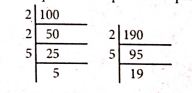
\(100=2^{2} \times 5^{2} \)
\(190=2^{1} \times 5^{1} \times 19^{1} \)
\(\therefore H C F \text { of } 100 \text { and } 190=2^{1} \times 5^{1}= 10\)
\(\text { H.C.F. } \times \text { L.C.M. }=\text { Product of two numbers }\)
\(10 \times \text { L.C.M. }=100 \times 190\)
\(\text { L.C.M. }=\frac{100 \times 190}{10}=1900\)
15.
We have 6n = (2 x 3 )n
= 2n x 3n
prime factorization of 6n does not contain the prime number 7. Therefore 6n is not divisible by 7

10th Standard Syllabus & Materials
10th Standard
TN 10th English Prose - 2 - The Night the Ghost Got in Important Questions And Answers Study Material - QB365 Set A
NEW10th Standard
TN 10th English Supplementary - 1 - The Tempest Important Questions And Answers Study Material - QB365 Set A
NEW10th Standard
TN 10th English Poem - 1 - Life Important Questions And Answers Study Material - QB365 Set A
NEW10th Standard
TN 10th English Prose - 1 - His First Flight Important Questions And Answers Study Material - QB365 Set A



Tamilnadu Stateboard 10th Standard Subjects
Tamilnadu Stateboard Standards





