
 100% FREE ACCESS
10th Standard Syllabus & Materials
10th Standard
TN 10th English Prose - 4 - The Attic Important Questions And Answers Study Material - QB365 Set A
NEW10th Standard
TN 10th English Supplementary - 3 - The Story of Mulan Important Questions And Answers Study Material - QB365 Set A
NEW10th Standard
TN 10th English Poem - 3 - I am Every Woman Important Questions And Answers Study Material - QB365 Set A
NEW10th Standard
TN 10th English Prose - 3 - Empowered Women Navigating The World Important Questions And Answers Study Material - QB365 Set A
NEW10th Standard
TN 10th English Supplementary - 2 - Zigzag Important Questions And Answers Study Material - QB365 Set A
NEW10th Standard
TN 10th English Poem - 2 - The Grumble Family Important Questions And Answers Study Material - QB365 Set A

Published on: 29/10/2022
QB365 provides a detailed and simple solution for every Possible Creative Questions in Class 12 Maths Subject -Numbers and Sequences , English Medium. It will help Students to get more practice questions, Students can Practice these question papers in addition to score best marks.
Download Tamil Nadu 10th Standard Maths question papers, model tests, one-mark questions, important questions, and public exam papers in PDF format. Free study materials and answer keys for TN State Board students.
Questions + Answers key
Take MCQ Maths Test1.
Find the 6th term of the A.P. \(\frac{2 m+1}{m}, \frac{2 m-1}{m}, \frac{2 m-3}{m}, \ldots\)
2.
If \(\frac{1}{b+c}, \frac{1}{c+a}, \frac{1}{a+b} \text { are in A.P. then prove that }\mathrm{a}^{2}, \mathrm{~b}^{2}, \mathrm{c}^{2} \text { are in A.P }\)
3.
The sum of 5th and 9th terms of an A.P. is 72 and the sum of 7th and 12th term is 97. Find the A.P.
4.
The 10th term an A.P. is 52 and 16th term is 82. Find the 32nd term and the general term.
5.
A sequence is defined by \(a_{n}=n^{3}-6 n^{2}+11 n-6\) show that the First three terms of the sequence are zero and all other terms are positive
6.
Find the next five terms of the sequence given by \(a_{1}=4 ; a_{n}=4 a_{n-1}+3, n>1\)
7.
\(\text { Solve } 9 x \equiv 5(\bmod 13)\)
8.
Six bells commence tolling together and toll at intervals of 2, 4, 6, 8, 10 and 12 seconds respectively In 30 minutes, how many times do they toll together?
9.
Find the smallest number of five digits exactly divisible by 16,24,36 and 54.
10.
Find the greatest number which can divide 1356, 1868 and, 2764 leaving the same remainder 12 in each case
11.
In an Interview, the number of participants in Mathematics, Physics and Chemistry are 60, 84 and 108 respectively. Find the minimum number of rooms required if in each room the same number of participants to be seated and alt of them being in the same subject
12.
lf d is the H.C.F. of 56 and 72, find x and y satisfying d = 56x + 72y
13.
If the H.C.F. of 210 and 55 is expressible in the form 210 x 5 + 55y. Find y.
14.
Show that if x and y are both odd positive integers, then x2 + y2 is even but not divisible by 4.
15.
Show that the square of an odd positive integer is of the form 8q + 1, for some integer q.
1.
Here \(\mathbf{t}_{1} =\frac{2 m+1}{m} \mathrm{t}_{2}=\frac{2 m-1}{m} \)
\(\mathrm{~d} =\mathrm{t}_{2}-\mathrm{t}_{1} \)
\(=\frac{2 m-1}{m}-\frac{2 m+1}{m} \)
\(=\frac{2 m-1-2 m-1}{m} \)
\(=\frac{-2}{m} \)
\(\text {Now } t_{n} =a+(n-1) d \)
\(t_{n} =\left[\frac{2 m+1}{m}\right]+(n-1)\left[\frac{-2}{m}\right] \)
\(=\left[\frac{2 m+1}{m}\right]+\left[\frac{-2 n}{m}\right]-1\left[\frac{-2}{m}\right] \)
\(=\frac{2 m+1}{m}-\frac{2 n}{m}+\frac{2}{m} \)
\(=\frac{2 m+1-2 n+2}{m} \)
\(\text {Thus } \mathrm{n}^{\text {th }} \text { term }=\frac{2 m-2 n+3}{m}\)
\(\therefore 6^{\text {th }} \text { term } t_{6}=\frac{2 m-2(6)+3}{m}\)
\(6^{\text {th }} \text { term }=\frac{2 m-9}{m}\)
2.
\(\text { Given } \frac{1}{b+c}, \frac{1}{c+a}, \frac{1}{a+b} \text { are in A.P. }\)
\(\therefore \mathrm{t}_{2}-\mathrm{t}_{1}=\mathrm{t}_{3}-\mathrm{t}_{2}\)
\(\frac{1}{c+a}-\frac{1}{b+c}=\frac{1}{a+b}-\frac{1}{c+a}\)
\(\frac{(b+c)-(c+a)}{(c+a)(b+c)}=\frac{(c+a)-(a+b)}{(a+b)(c+a)}\)
\(\frac{b+c-c-a}{c b+a b+c^{2}+a c}=\frac{c+a-a-b}{c a+b c+a^{2}+a b} \)
\(\frac{b-a}{a b+c b+a c+c^{2}}=\frac{c-b}{a b+b c+c a+a^{2}}
\)
\((b-a)\left(a b+b c+c a+a^{2}\right) \)
\(=(c-b)\left(a b+c b+a c+c^{2}\right) \)
\(a b^{2}+b^{2} c+c a b+a^{2} b-a^{2} b-a b c-a^{2} c-a^{3} \)
\(=a b c+c^{2} b+a c^{2}+c^{3}-a b^{2}- \)
\(c b^{2}-a b c-b c^{2} \)
\(a b^{2}+b^{2} c-a^{2} c-a^{3}=a c^{2}+c^{3}-a b^{2}-c b^{2} \)
\(b^{2} c-a^{2} c+a b^{2}-a^{3}=c^{3}-c b^{2}+a c^{2}-a b^{2} \)
\(c\left(b^{2}-a^{2}\right)+a\left(b^{2}-a^{2}\right)
\)
\(=c\left(c^{2}-b^{2}\right)+a\left(c^{2}-b^{2}\right) \)
\(\left(b^{2}-a^{2}\right)(c+a) =\left(c^{2}-b^{2}\right)(c+a) \)
\(b^{2}-a^{2} =c^{2}-b^{2}
\)
\(\mathrm{t}_{2}-\mathrm{t}_{1}=\mathrm{t}_{3}-\mathrm{t}_{2} \text { of the sequence } \mathrm{a}^{2}, \mathrm{~b}^{2}, \mathrm{c}^{2}\therefore \mathrm{a}^{2}, \mathrm{~b}^{2}, \mathrm{c}^{2} \text { are in A.P. }\)
3.
Given a5 + a9 = 72 and a7 + a12 = 97
a + 4d + a + 8d = 72 and a + 6d + a + 11d = 97
2a + 12d = 72..(1) and 2a + 17 d, = 97
Solving (1) and (2)
2a + 12 d = 72
2a + 17d = 97
\((2)-(1) \Rightarrow 5 d=25\)
\(\mathrm{d} =5 \)
\(2 \mathrm{a}+12 \mathrm{~d} =72 \)
\(2 \mathrm{a}+12(5) =72 \)
\(2 \mathrm{a}+60 =72 \)
\(2 \mathrm{a} =72-60=12 \)
\(\mathrm{a} =\frac{12}{2}=6
\)
The A.P. is a, a + d, a + 2d.a + 3d...
6, 6 + 5, 6 + 2(5),6 + 3(5) ...
6, 11, 16,21,...
4.
\(t_{n}=a+(n-1) d\)
10th term of an A.P. is 52.
\(t_{10}=a+(10-1) d=52\)
\(a+9 d=52\)
16th term is 82
a + 15d = 82
a + 9d = 52
Solving (1) and (2)
(2) - (1), 6d = 30
d = 5
a + 9d = 52 from (l)
a +9(5) = 52
a + 45 = 52
a - 52 - 45 = 7
t32 = a + 31d
= 7 + 31(5) = 7 + 155
t32 = 162
The general term an = 5n + 2
5.
Given \(a_{n}=n^{3}-6 n^{2}+11 n-6\)
\(\text { Put } \mathrm{n}=1, \mathrm{a}_{1} =1^{3}-6(1)^{2}+11(1)-6 \)
\(=1-6+11-6=12-12 \)
\(\mathrm{a}_{1} =0 \)
\(\text { Put } \mathrm{n}=2, \mathrm{a}_{2} =2^{3}-6(2)^{2}+11(2)-6 \)
\(=8-(6 \times 4)+22-6 \)
\(=8-24+22-6=30-30 \)
\(\mathrm{a}_{2} =0 \)
\(\text { Put } \mathrm{n}=3, \mathrm{a}_{3} =3^{3}-6(3)^{2}+11(3)-6 \)
\(=27-54+33-6=60-60 \)
\(\mathrm{a}_{3} =0 \)
So we have a1 = a2 = a3 = 0
That is the value of the cubic polynomial \(a_{n}=n^{3}-6 n^{2}+11 n-6\)
becomes zero for n = 1, 2, 3
\(\therefore(n-1),(n-2) \text { and }(n-3) \text { are factors of } a_{n}\)
\(\therefore a=(n-1)(n-2)(n-3) \text { for which } a_{n}>0 \text { for }\text { all } n>3\)
Other terms are Positive
6.
Given \(a_{1}=4\)
\(a_{n}=4 a_{n-1}+3 \text { for } n>1\)
\(\text { Put } n=2 ; a_{2}=4 a_{2-1}+3=4 a_{1}+3\)
\(=4(4)+3=16+3\)
\(a_{2}=19\)
\(\text { Put } n=3 ; \quad a_{3}=4 a_{3-1}+3=4 a_{2}+3\)
\(=4(19)+3=76+3\)
\(a_{3}=79\)
\(\text { Put } n=4 ; a_{4}=4 a_{4-1}+3=4 a_{3}+3\)
\(=4(79)+3=316+3\)
\(a_{4}=319\)
\(\text { Put } n=5 ; a_{5}=4 a_{5-1}+3=4 a_{4}+3\)
\(=4(319)+3=1276+3\)
\(a_{5}=1279\)
\(\text { Put } n=6 ; a_{6}=4 a_{6-1}+3=4 a_{5}+3\)
\(=4(1279)+3=5116+3\)
\(a_{6}=5119
\)
\(\therefore \text { The next five terms are } a_{n}=19, a_{3}=79,a_{4}=319, a_{5}=1279, a_{6}=5119\)
7.
9x \(\equiv\) 5 (mod13)
9x - 5 = 13 k for some integer k
\(x=\frac{13 k+5}{9} \text { for some integer } k\)
When we put 1, 10, 19,.... the 13k + 5 is divisible by 13.
\(x=\frac{13(1)+5}{9}=2 \)
\(x=\frac{13(10)+5}{9}=15 \)
\(x=\frac{13(19)+5}{9}=28 \)
\(x=\frac{13(28)+5}{9}=41
\)
The solutions are 2, 15, 28, 41,....
8.
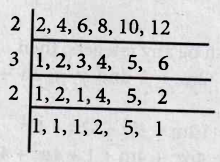
L.C.M. = 12 x 10 = 120
L.C.M. of 2,4,6,8,10, 12 is 120
\(\therefore\) The bells will toll together after every 120 sec. i.e., 2 min.
In 30 minutes they will toll together \(\left(\frac{30}{2}+1\right)=16\) times
9.
Smallest number of five digits is 10000.
Required number must be divisible by 16,24,35 and 54
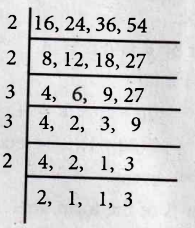
\(\text { L.C.M. }=2^{4} \times 3^{3}\)
= 16 x 27 = 432
L.C.M. of 16, 24,36,54 = 432
\(\therefore\) Required number is divisible by 432.
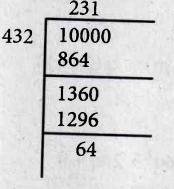
On dividing 10000 by 432,we get remainder = 64
Required number = 10000 + (432 - 64)
= 10358
10.
Required number = H.C.F. of(1356 - 12),(1868 - 12), (2764 - 12)
= H.C.F. of 1344,1856, 2752
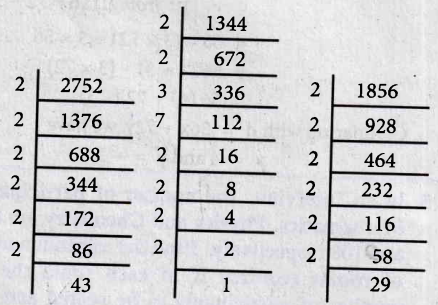
\(2752=2^{6} \times 43^{1}\)
\(1344=2^{6} \times 3^{1} \times 7^{1} \)
\(1856=2^{6} \times 29^{1} \)
\(\text { H.C.F. is } 2^{6}=64\)
\(\therefore \text { The required number }=64\)
11.
The number of participants in each room is the H.C.F. of 60, 84 and 108.
First we find the H.C.E of 60 and 84, by applying
Euclid's Division Algorithm.
84 = 60 x 1 +24
60 = 24 x 2+ 12
24 = 12 x 2 + 0
The remainder = 0
\(\therefore\) H.C.F. of 60 and 84 is 12.
Now applying Euclid's Division Algorithm to 12 and 108
108 = 12 x 9 + 0
Remainder = 0
\(\therefore\) H.C.F. of 12 and 108 = 12
\(\therefore\) H.C.F. (60,84, 108) = 12.
\(\therefore\) In each room, the minimum 12 number of participants can be seated.
Total number of participants = 60 + 84 + 108
= 252
Number of rooms required \(=\frac{252}{12}=21\)
12.
Applying Euclid's division Algorithm to find the H.C.E of 56 and 72, we have
72 = 56 x 1 + 16 ...(1)
56 = 15 x 3 + 8...(2)
16 = 8 x 2 + 0
Remainder = 0
H.C.F. of 56 and 72 = 8
From (2) we have
8 = 56 - 16 x 3
8 = 56 - (72 -56 x 1) x 3
[\(\because\) from(1) 16 = 72 - 56 x 1]
= 56 - (3 x 72) + 3 x 56
= 56(1 +3)-(3 x 72)
= 56(4) + 72(-3)
Comparing with d = 55x + 72y,we have
x = 4 and y = -3
13.
Let us find the H.C.F. of 210 and 55, Applying
Euclid's Division Algorithm
210 - 55 x 3 + 45
55 = 45 x 1 + 10
45 = 10 x 4 + 5
10 = 5 x 2 + 0
Remainder = 0
H.C.F. of 210 and 55 is 5
Given 5 - 210 x 5 + 55y
5 - 210 x 5 = 55y
55y = 5 - 1050 = -1045
\(y=\frac{-1045}{55}\)
\(y = -19\)
14.
Let m and n be any integers, then
x = 2m + 1 and Y = 2n + 1 since x and y are odd
\(x^{2}+y^{2} =(2 m+1)^{2}+(2 n+1)^{2} \)
\(=4 m^{2}+4 m+1+4 n^{2}+4 n+1 \)
\(=4\left(m^{2}+n^{2}\right)+4(m+n)+(1+1) \)
\(=4\left(m^{2}+n^{2}\right)+4(m+n)+2 \)
\(=4 q+2, \text { where } q=\left(m^{2}+n^{2}\right)+(m+n) \)
\(=4 q+2 \)
\(x^{2}+y^{2}=2[2 a+1] \text { which is an even number. }\)
Thus 4q + 2 is an even number, which is not divisible by 4.
i.e., It leaves the remainder 2.
Hence x2 + y2 is even but not divisible by 4.
15.
First we will Prove "any odd positive integer n is of the form 4q + 1 or 4q + 3, where q is some integer"'
By Euclid's division Lemma,
If 'a' and 'b' are two positive integers then
a = bq + r where \(0 \leq \mathrm{r}<|\mathrm{b}|\)
Suppose the positive integer be 'a' and b = 4
then a = 4q + r where \(0 \leq \mathrm{r}<|\mathrm{4}|\)
\(a=40 . a=4 q+1 ; a=4 q+2 ; \quad a=4 q+3\)
\(=2(2 q) ; a=4 q+1=2(2 q+1) ; =\text { odd }\)
\(=\text { even; } =\text { odd } ; =\text { even }\)
Any positive odd integer is of the form 4q + 1 or 4q + 3
Case (I)
\(\text { If } a =4 q+1 \)
\(a^{2} =(4 q+1)^{2} \)
\(=16 q^{2}+8 q+1 \)
\(=8 q(2 q+1)+1 \)
\(=8 m+1 \text { where } m=q(2 q+1) \)
Case (II)
\(\text { If } a=4 q+3\)
then \(a^{2} =(4 q+3)^{2}=16 q^{2}+24 q+9 \)
\(=8\left[2 q^{2}+3 q\right]+8+1 \)
\(=8\left[2 q^{2}+3 q+1\right]+1 \)
\(=8 m+1 \text { where } m=2 q^{2}+3 q+1 \)
We conclude that the square of an odd positive integer is of the form 8q + 1, for same integer q.

10th Standard Syllabus & Materials
10th Standard
TN 10th English Prose - 2 - The Night the Ghost Got in Important Questions And Answers Study Material - QB365 Set A
NEW10th Standard
TN 10th English Supplementary - 1 - The Tempest Important Questions And Answers Study Material - QB365 Set A
NEW10th Standard
TN 10th English Poem - 1 - Life Important Questions And Answers Study Material - QB365 Set A
NEW10th Standard
TN 10th English Prose - 1 - His First Flight Important Questions And Answers Study Material - QB365 Set A



Tamilnadu Stateboard 10th Standard Subjects
Tamilnadu Stateboard Standards





