
 100% FREE ACCESS
10th Standard Syllabus & Materials
10th Standard
TN 10th English Prose - 4 - The Attic Important Questions And Answers Study Material - QB365 Set A
NEW10th Standard
TN 10th English Supplementary - 3 - The Story of Mulan Important Questions And Answers Study Material - QB365 Set A
NEW10th Standard
TN 10th English Poem - 3 - I am Every Woman Important Questions And Answers Study Material - QB365 Set A
NEW10th Standard
TN 10th English Prose - 3 - Empowered Women Navigating The World Important Questions And Answers Study Material - QB365 Set A
NEW10th Standard
TN 10th English Supplementary - 2 - Zigzag Important Questions And Answers Study Material - QB365 Set A
NEW10th Standard
TN 10th English Poem - 2 - The Grumble Family Important Questions And Answers Study Material - QB365 Set A

Published on: 09/05/2020
10th Standard Maths English Medium Public Exam Model Question Paper June 2020
Download Tamil Nadu 10th Standard Maths question papers, model tests, one-mark questions, important questions, and public exam papers in PDF format. Free study materials and answer keys for TN State Board students.
Questions + Answers key
Take MCQ Maths Test1.
Let A = {0, 1, 2, 3} and B = {1, 3, 5, 7, 9} be two sets. Let f: A \(\rightarrow\)B be a function given by f(x) = 2x + 1. Represent this function as a table.
2.
Let A = {0, 1, 2, 3} and B = {1, 3, 5, 7, 9} be two sets. Let f: A \(\rightarrow\)B be a function given by f(x) = 2x + 1. Represent this function as a set of ordered pairs.
3.
Let A = {1,2, 3, 4} and B = {-1, 2, 3, 4, 5, 6, 7, 8, 9, 10, 11, 12} Let R = {(1, 3), (2, 6), (3, 10), (4, 9)} \(\subseteq \) A x B be a relation. Show that R is a function and find its domain, co-domain and the range of R.
4.
prove the following identity tan4\(\theta \) + tan2\(\theta \) = sec4\(\theta \) - sec2\(\theta \) .
5.
Determine the nature of roots for the following quadratic equations
2x2 - 2x + 9 = 0
6.
Which of the following sequences are in G.P.?
4, 44, 444, 4444,...
7.
Find the square root of the following polynomials by division method 16x4 + 8x2 + 1
8.
Find the equation of a line through the given pair of points (2, 3) and (-7, -1)
9.
What is the inclination of a line whose slope is 1
10.
Check whether the following sequences are in A.P. or not?
\(3\sqrt { 2 } ,5\sqrt { 2 } ,7\sqrt { 2 } ,9\sqrt { 2 } \),.....
11.
A and B are two events such that, P(A) = 0.42, P(B) = 0.48, P(A ∩ B) = 0.16. Find (i) P(not A) (ii) P(not B) (iii) P(A or B)
12.
The standard deviation and mean of a data are 6.5 and 12.5 respectively. Find the coefficient of variation.
13.
The horizontal distance between two buildings is 70 m. The angle of depression of the top of the first building when seen from the top of the second building is 45°. If the height of the second building is 120 m, find the height of the first building.
14.
15.
Find the diameter of a sphere whose surface area is 154 m2.
16.
D and E are respectively the points on the sides AB and AC of a \(\triangle\)ABC such that AB = 5.6 cm, AD = 1.4 cm, AC = 7.2 cm and AE = 1.8 cm, show that DE || BC
17.
A relation ‘f’ \(X \rightarrow Y\) is defined by f(x) = x2 - 2 where x \(\in \) {-2, -1, 0, 3} and Y = R
(i) List the elements of f
(ii) Is f a function?
18.
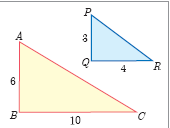
Is \(\triangle\)ABC ~ \(\triangle\)PQR?
19.
20.
If the smallest value and co-efficient of range a data are 25 and 0.5 respectively. Then the largest value is ___________
25
75
100
12.5
21.
If a letter is chosen at random from the English alphabets {a, b....,z}, then the probability that the letter chosen precedes x ____________
\(\frac { 12 }{ 13 } \)
\(\frac { 1 }{ 13 } \)
\(\frac { 23 }{ 26 } \)
\(\frac { 3 }{ 26 } \)
22.
A spherical steel ball is melted to make 8 new identical balls. Then the radius each new ball is how much times the radius of the original ball?
\(\frac { 1 }{ 3 } \)
\(\frac { 1 }{ 4 } \)
\(\frac { 1 }{ 2 } \)
\(\frac { 1 }{ 8 } \)
23.
The material of a cone is converted into the shape of a cylinder of equal radius. If the height of the cylinder is 5 cm, then height of the cone is ___________
10 cm
15 cm
18 cm
24 cm
24.
The y-intercept of the line 3x - 4y + 8 = 0 is ___________
\(-\frac { 8 }{ 3 } \)
\(\frac { 8 }{ 3 } \)
2
\(\frac { 1 }{ 2 } \)
25.
Find the equation of the line passing the point which is parallel to the y axis (5, 3) is ____________
y = 5
y = 3
x = 5
x = 3
26.
Two concentric circles if radii a and b where a>b are given. The length of the chord of the circle which touches the smaller circle is ____________
\(\sqrt { { a }^{ 2 }-{ b }^{ 2 } } \)
\(\sqrt { { a }^{ 2 }-{ b }^{ 2 } } \)
\(\sqrt { { a }^{ 2 }+{ b }^{ 2 } } \)
\(2\sqrt { { a }^{ 2 }+{ b }^{ 2 } } \)
27.
A line which intersects a circle at two distinct points is called ____________
Point of contact
secant
diameter
tangent
28.
The ratio of the areas of two similar triangles is equal to ____________
The ratio of their corresponding sides
The cube of the ratio of their corresponding sides
The ratio of their corresponding attitudes
The square of the ratio of their corresponding sides
29.
Axis of symmetry in the term of vertical line separates parabola into ___________
3 equal halves
5 equal halves
2 equal halves
4 equal halves
30.
The real roots of the quadratic equation x2-x-1 are ___________
1, 1
-1, 1
\(\frac { 1+\sqrt { 5 } }{ 2 } ,\frac { 1-\sqrt { 5 } }{ 2 } \)
None
31.
Consider the following statements:
(i) The HCF of x+y and x8-y8 is x+y
(ii) The HCF of x+y and x8+y8 is x+y
(iii) The HCF of x-y nd x8+y8 is x-y
(iv) The HCF of x-y and x8-y8 is x-y
(i) and (ii)
(ii) and (iii)
(i) and (iv)
(ii) and (iv)
32.
Sum of infinite terms of G.P is 12 and the first term is 8. What is the fourth term of the G.P?
\(\frac { 8 }{ 27 } \)
\(\frac { 4 }{ 27 } \)
\(\frac { 8 }{ 20 } \)
\(\frac { 1 }{ 3 } \)
33.
What is the HCF of the least prime and the least composite number?
1
2
3
4
34.
If f(x) + f(1 - x) = 2 then \(f\left( \frac { 1 }{ 2 } \right) \) is ___________
5
-1
-9
1
35.
If f(x) = 2 - 3x, then f o f(1 - x) = ?
5x+9
9x-5
5-9x
5x-9
36.
If f(x) = ax - 2, g(x) = 2x - 1 and fog = gof, the value of a is ___________
3
-3
\(\frac { 1 }{ 3 } \)
13
37.
If the order pairs (a, -1) and (5, b) belongs to {(x, y) | y = 2x + 3}, then a and b are __________
-13, 2
2, 13
2, -13
-2,13
38.
39.
How many balls, each of radius 1 cm, can be made from a solid sphere of lead of radius cm?
64
216
512
16
40.
41.
If A is an assets angle of Δ ABC, right angle at 3, then the value of sin A T cos A is ___________
=1
>1
<1
=2
42.
43.
If (sin α + cosec α)2 + (cos α + sec α)2 = k + tan2α + cot2α, then the value of k is equal to
9
7
5
3
44.
45.
The range of the data 8, 8, 8, 8, 8. . . 8 is
0
1
8
3
46.
The angle of depression of the top and bottom of 20 m tall building from the top of a multistoried building are 30° and 60° respectively. The height of the multistoried building and the distance between two buildings (in metres) is
20, 10\(\sqrt { 3 } \)
30, 5\(\sqrt { 3 } \)
20, 10
30, 10\(\sqrt { 3 } \)
47.
The first term of an arithmetic progression is unity and the common difference is 4. Which of the following will be a term of this A.P.
4551
10091
7881
13531
48.
74k \(\equiv \) ________ (mod 100)
1
2
3
4
49.
The straight line given by the equation x = 11 is
parallel to X axis
parallel to Y axis
passing through the origin
passing through the point (0,11)
50.
The area of triangle formed by the points (−5, 0), (0, −5) and (5, 0) is
0 sq. units
25 sq. units
5 sq. units
none of these
51.
In the adjacent figure \(\angle BAC\) = 90o and AD\(\bot \)BC then
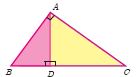
BD.CD = BC2
AB.AC = BC2
BD.CD = AD2
AB.AC = AD2
52.
If in \(\triangle\)ABC, DE || BC, AB = 3.6 cm, AC = 2.4 cm and AD = 2.1 cm then the length of AE is
1.4 cm
1.8 cm
1.2 cm
1.05 cm
53.
A shuttle cock used for playing badminton has the shape of the combination of
a cylinder and a sphere
a hemisphere and a cone
a sphere and a cone
frustum of a cone and a hemisphere
54.
The height of a right circular cone whose radius is 5 cm and slant height is 13 cm will be
12 cm
10 cm
13 cm
5 cm
55.
If g = {(1,1), (2,3), (3,5), (4,7)} is a function given by g(x) = αx + β then the values of α and β are
(-1,2)
(2,-1)
(-1,-2)
(1,2)
56.
Let A = {1, 2, 3, 4} and B = {4, 8, 9, 10}. A function f: A ⟶ B given by f = {(1, 4), (2, 8), (3, 9), (4,10)} is a
Many-one function
Identity function
One-to-one function
Into function
57.
For the given matrix A = \(\left( \begin{matrix} 1 \\ 2 \\ 9 \end{matrix}\begin{matrix} 3 \\ 4 \\ 11 \end{matrix}\begin{matrix} 5 \\ 6 \\ 13 \end{matrix}\begin{matrix} 7 \\ 8 \\ 15 \end{matrix} \right) \) the order of the matrix AT is
2 x 3
3 x 2
3 x 4
4 x 3
58.
Graph of a linear equation is a ____________
straight line
circle
parabola
hyperbola
59.
If ATB=90o then prove that
\(\sqrt { \frac { tanA\quad tanB+tanA\quad cotB }{ sinA\quad secB } } -\frac { { Sin }^{ 2 }A }{ { Cos }^{ 2 }A } =tanA\)
60.
Find two consecutive natural numbers whose product is 20.
61.
Which of the following list of numbers form an AP? If they form an AP, write the next two terms:
-2, 2, -2, 2, -2
62.
If R = {(a, -2), (-5, b), (8, c), (d, -1)} represents the identity function, find the values of a, b, c and
63.
A function f: [-7,6) \(\rightarrow\) R is defined as follows.
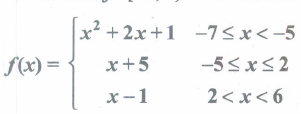
\(\cfrac { 4f(-3)+2f(4) }{ f(-6)-3f(1) } \)
64.
A bird is flying from A towards B at an angle of 35°, a point 30 km away from A. At B it changes its course of flight and heads towards C on a bearing of 48° and distance 32 km away.
How far is B to the West of A? (sin 55° = 0.8192, cos 55° = 0.5736, sin 42° = 0.6691.cos 42° = 0.7431)
65.
Prices of peanut packets in various places of two cities are given below. In which city, prices were more stable?
| Prices in city A | 20 | 22 | 19 | 23 | 16 |
| Prices in city B | 10 | 20 | 18 | 12 | 15 |
66.
The mean of the following frequency distribution is 62.8 and the sum of all frequencies is 50. Compute the missing frequencies f1 and f2.
| Class Interval | 0.20 | 20-40 | 40-60 | 60-80 | 80-100 | 100-120 |
| Frequency | 5 | f1 | 10 | f2 | 7 | 8 |
67.
If A = \(\left[ \begin{matrix} 1 & 8 & 3 \\ 3 & 5 & 0 \\ 8 & 7 & 6 \end{matrix} \right] \), B = \(\left[ \begin{matrix} 8 & -6 & -4 \\ 2 & 11 & -3 \\ 0 & 1 & 5 \end{matrix} \right] \), C = \(\left[ \begin{matrix} 5 & 3 & 0 \\ -1 & -7 & 2 \\ 1 & 4 & 3 \end{matrix} \right] \) compute the following
3A + 2B - C
68.
If x sin3\(\theta \) + ycos3\(\theta \) = sin\(\theta \) cos\(\theta \) and x sin\(\theta \) = ycos\(\theta \), then prove that x2 + y2 = 1.
69.
Find the equation of a straight line through the point of intersection of the lines 8x + 3y = 18, 4x + 5y = 9 and bisecting the line segment joining the points (5, –4) and (–7, 6).
70.
Find the number of coins, 1.5 cm in diameter and 2 mm thick, to be melted to form a right circular cylinder of height 10 cm and diameter 4.5 cm.
71.
The marks scored by 10 students in a class test are 25, 29, 30, 33, 35, 37, 38, 40, 44, 48. Find the standard deviation.
72.
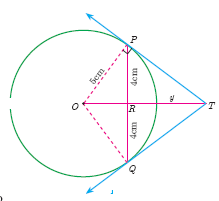
PQ is a chord of length 8 cm to a circle of radius 5 cm. The tangents at P and Q intersect at a point T. Find the length of the tangent TP.
73.
A cylindrical glass with diameter 20 cm has water to a height of 9 cm. A small cylindrical metal of radius 5 cm and height 4 cm is immersed it completely. Calculate the raise of the water in the glass?
74.
Calculate the mass of a hollow brass sphere if the inner diameter is 14 cm and thickness is 1mm, and whose density is 17.3 g/ cm3.
75.
The radius and height of a cylinder are in the ratio 5 : 7 and its curved surface area is 5500 sq.cm. Find its radius and height.
76.
ABCD is a quadrilateral in which AB=AD, the bisector of \(\angle\)BAC and \(\angle\)CAD intersect the sides BC and CD at the points E and F respectively. Prove that EF||BD
77.
In each of the following cases state whether the function is bijective or not. Justify your answer.
i. f : R ⟶ R defined by f(x) = 2x + 1
ii. f : R ⟶ R defined by f(x) = 3 - 4x2
78.
Prove that (cosec\(\theta \) - sin\(\theta \)) (sec\(\theta \) - cos\(\theta \)) (tan\(\theta \) + cot\(\theta \)) = 1
79.
A = \(\left( \begin{matrix} 3 & 0 \\ 4 & 5 \end{matrix} \right) \), B = \(\left( \begin{matrix} 6 & 3 \\ 8 & 5 \end{matrix} \right) \), C = \(\left( \begin{matrix} 3 & 6 \\ 1 & 1 \end{matrix} \right) \) find the matrix D, such that CD – AB = 0
80.
At t minutes past 2 pm, the time needed to 3 pm is 3 minutes less than \(\frac {t^{2}}{4}\). Find t.
81.
Draw the two tangents from a point which is 5 cm away from the centre of a circle of diameter 6 cm. Also, measure the lengths of the tangents
82.
Construct a \(\triangle\)PQR such that QR = 6.5 cm,\(\angle\)P = 60oand the altitude from P to QR is of length 4.5 cm.
1.
A table
| x | 0 | 1 | 2 | 3 |
|---|---|---|---|---|
| f(x) | 1 | 3 | 5 | 7 |
2.
A = {1,2,3},B = {1,3,5, 7,9}
f(x) = 2x + 1
f(0)) = 2(0) + 1 = 1
f(1) = 2(1) + 1=3
f(2) = 2(2) + 1 = 5
f(3) = 2(3) + 1 = 7
(i) A set of ordered pairs.
f = {(0, 1), (1, 3), (2, 5), (3, 7)}
(ii) A table
| x | 0 | 1 | 2 | 3 |
| f(x) | 1 | 3 | 5 | 7 |
(ii) An arrow diagram
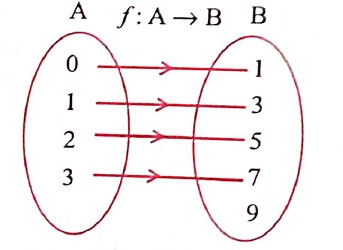
(iv) A Graph f = \(\{(x, f(x) / x \in A\}\)
= {(0, 1), (1, 3), (2, 5), (3, 7)}
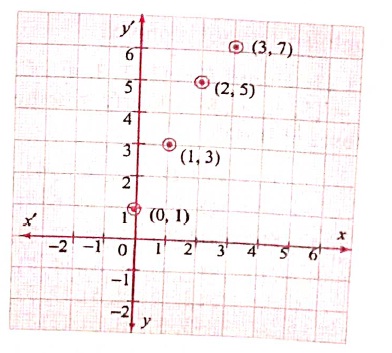
3.
Domain of R = {1,2,3,4}
Co-domain of R = B = {-1, 2, 3,4,5,6, 7, 9, 10, 11,12}
Range of R = {3, 6,10, 9}
4.
tan4\(\theta \) + tan2\(\theta \) = sec4\(\theta \) - sec2\(\theta \)
L.H.S = tan2θ (tan2θ + 1)
= tan2θ.sec2θ
= sec4θ - sec2θ
= R.H.S
5.
2x2 - 2x + 9 = 0
Here, a = 2, b = -2, c = 9
Now, Δ = b2 - 4ac = (-2)2 - 4(2)(9) = -68
Here, Δ = -68 < 0. So, the equation will have no real roots.
6.
\(\frac{t_{2}}{t_{1}}=\frac{44}{4}=11
\)
\(\frac{t_{3}}{t_{2}}=\frac{444}{44}=\frac{111}{11}
\)
\(\frac{t_{4}}{t_{3}}=\frac{4444}{444}=\frac{1111}{111}
\)
The ratios between the successive terms are not equal. Therefore the sequence 4, 44, 444,... are not in G.P.
7.
\(\sqrt { { 16x }^{ 4 }+{ 8x }^{ 2 }+1 } \)
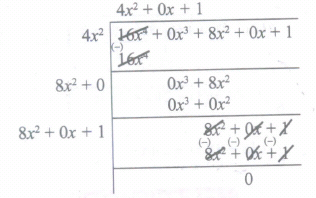
\(\therefore \sqrt { { 16x }^{ 4 }+{ 8x }^{ 2 }+1 } \)|4x2 + 1|
8.
Given points (2, 3) and (- 7, - 1)
Equation of the line passing through (x1 , y1) and (x2, y2) is
\( \frac{y-y_{1}}{y_{2}-y_{1}}=\frac{x-x_{1}}{x_{2}-x_{1}} \)
\(\frac{y-3}{-1-3}=\frac{x-2}{-7-2} \)
9 (y - 3) - 4 (x - 2)
9y - 27 = 4 x - 8
4 x - 9y +19 = 0
9.
Slope 'm' = 1
tanθ = 1 = tan 450
θ = 450
10.
t2 - t1 = 5\(\sqrt { 2 } \) - 3\(\sqrt { 2 } \) = 2\(\sqrt { 2 } \)
t3 - t1 = 7\(\sqrt { 2 } \) - 5\(\sqrt { 2 } \) = 2\(\sqrt { 2 } \)
t4 - t3 =9\(\sqrt { 2 } \) - 7\(\sqrt { 2 } \) = 2\(\sqrt { 2 } \)
Thus, the differences between consecutive terms are equal. Hence the terms of the sequence 3\(\sqrt { 2 } \), 5\(\sqrt { 2 } \), 7\(\sqrt { 2 } \), 9\(\sqrt { 2 } \) ..... are in A.P
11.
(i) Given P(A) = 0.42
P(not A) = 1 - P(A)
\(\mathrm{P}(\bar{A})=1-0.42=0.58\)
(ii) Given P(B) = 0.48
P(not B) = 1 - P(B)
\(\mathrm{P}(\bar{B})=1-0.48=0.52\)
(iii) P(A or B) = \(P(A \cup B)\)
\(=\mathrm{P}(\mathrm{A})+\mathrm{P}(\mathrm{B})-\mathrm{P}(A \cap B)\)
= 0.42 + 0.48 - 015
= 0.90 - 0.16
P(A or B) = 0.74
12.
Standard deviation \(\sigma=6.5\)
Mean \(\bar{x}=12.5\)
Coefficient of variation C.V \(=\frac{\sigma}{x} \times 100 \%
\)
\(=\frac{6.5}{12.5} \times 100 \%
\)
\(=\frac{65}{125} \times 100 \%
\)
\(=\frac{13}{25} \times 100 \%
\)
= 52 %
Co-efficient of variation is 52%
13.
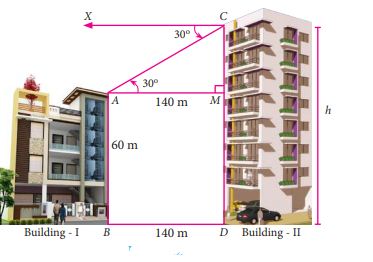
Let AD is the first building.
BC is the second building.
AD = BE = BC - CE
From the right triangle CED
\(\tan 45^{\circ} =\frac{C E}{D E} \)
\(1 =\frac{C E}{A B}=\frac{C E}{70 m} \)
CE = 70 m
BE = BC - EC
= 120 m - 70 m = 50 m
AD = 50 m
Height of the first building is 50 m.
14.
15.
Let r be the radius of the sphere. Given that, surface area of sphere = 154 m2
4\(\pi\)r2 = 154
\(4\times \frac { 22 }{ 7 } \times { r }^{ 2 }=154\)
gives \({ r }^{ 2 }=154\times \frac { 1 }{ 4 } \times \frac { 7 }{ 22 } \)
hence, \({ r }^{ 2 }=\frac { 49 }{ 4 } \)We get r = \(\frac{7}{2}\)
Therefore, diameter is 7 m
16.
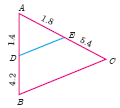
We have AB = 56.cm, AD = 14. cm, AC = 72. cm and AE = 18.cm.
BD = AB - AD = 5.6 –1.4 = 4.2 cm
and EC = AC – AE = 7.2–1.8 = 5.4 cm
\(\frac { AD }{ DB } =\frac { 1.4 }{ 4.2 } =\frac { 1 }{ 3 } \) and \(\frac { AE }{ EC } =\frac { 1.8 }{ 5.4 } =\frac { 1 }{ 3 } \)
\(\frac { AD }{ DB } =\frac { AE }{ EC } \)
Therefore, by converse of Basic Proportionality Theorem, we have DE is parallel to BC. Hence proved.
17.
f(x) = x2 - 2 where x \(\in \){ -2, -1, 0, 3}
(i) f( -2) = ( -2)2 - 2 = 2; f( -1) = ( -1)2 - 2 = -1
f(0) = (0)2 - 2 = - 2 ; f(3) = (3)2 - 2 = 7
Therefore, f = {(-2, 2), (-1, -1), (0, -2), (3, 7)}
(ii) We note that each element in the domain of f has a unique image. Therefore f is a function.
18.
In Is \(\triangle\)ABC ~ \(\triangle\)PQR
\(\frac { PQ }{ AB } =\frac { 3 }{ 6 } =\frac { 1 }{ 2 } ;\frac { QR }{ BC } =\frac { 4 }{ 10 } =\frac { 2 }{ 5 } \)
Since \(\frac { 1 }{ 2 } \neq \frac { 2 }{ 5 } ,\frac { PQ }{ AB } \neq \frac { QR }{ BC } \)
The corresponding sides are not proportional.
Therefore \(\triangle\)ABC is not similar to \(\triangle\)PQR.
19.
(a)
20.
(b)
75
21.
(c)
\(\frac { 23 }{ 26 } \)
22.
(c)
\(\frac { 1 }{ 2 } \)
23.
(b)
15 cm
24.
(c)
2
25.
(c)
x = 5
26.
(b)
\(\sqrt { { a }^{ 2 }-{ b }^{ 2 } } \)
27.
(b)
secant
28.
(d)
The square of the ratio of their corresponding sides
29.
(c)
2 equal halves
30.
(c)
\(\frac { 1+\sqrt { 5 } }{ 2 } ,\frac { 1-\sqrt { 5 } }{ 2 } \)
31.
(a) Capital employed - Goodwill + current liabilities
32.
(a)
\(\frac { 8 }{ 27 } \)
33.
(b)
2
34.
(d)
1
35.
(c)
5-9x
36.
(a)
3
37.
(d)
-2,13
38.
(c)
39.
(a)
64
40.
(b)
41.
(a)
=1
42.
(d)
43.
(b)
7
44.
(a)
45.
(a)
0
46.
(d)
30, 10\(\sqrt { 3 } \)
47.
(c)
7881
48.
(a)
1
49.
(b)
parallel to Y axis
50.
(b)
25 sq. units
51.
(c)
BD.CD = AD2
52.
(a)
1.4 cm
53.
(d)
frustum of a cone and a hemisphere
54.
(a)
12 cm
55.
(b)
(2,-1)
56.
(c)
One-to-one function
57.
(d)
4 x 3
58.
(a)
straight line
59.
60.
Let a natural number be x.
The next number = x + 1
x (x + 1) = 20
X2+x-20 = 0
(x + 5)(x - 4) = 0
x=-5,4
∴ x=4
(∵ x≠-5, x is a natural number
The next number = 4 + 1= 5
Two consecutive numbers are 4,5.
61.
-2, 2, -2, 2, -2
t2 - t1 = 2-(-2) = 4
t3 - t2 = -2 -2 = -4
t4 - t3 = 2 - (-2) = 4
It is not an A.P.
62.
R = {(a, -2), (-5, b), (8, c), (d, -1)} represents the identity function.
a = -2, b = -5, c = 8, d = -1.
63.
\(\cfrac { 4f(-3)+2f(4) }{ f(-6)-3f(1) } \)
For f(1) & f(3)
Since 1 & 3 lies between -5 ≤ x ≤2, We take, f(x) = x +5
f(1) = 1 + 5 = 6
f(-3) = -3 +5 = 2
For f(4): Since 4 lies between 2 < x < 6 We take, f(x) = x -1
f(4) = 4 -1 = 3
For f(-6): Since -6 lies between -7≤ x < -5 ,We take, f(x) = x² + 2x +1
f(-6) = (-6)² + 2(-6) + 1 = 36 -12 + 1 = 24 +1 = 25
Now ,\(\cfrac { 4f(-3)+2f(4) }{ f(-6)-3f(1) } \) =\(\frac{ 4(2) +2(3) }{ 25 - 3(6)}\)
= \(\frac{ 8 + 6 }{ 25 -18}\)
= \(\frac{14 }{ 7}\) = 2
Hence, the value of \(\cfrac { 4f(-3)+2f(4) }{ f(-6)-3f(1) } \) = 2
64.
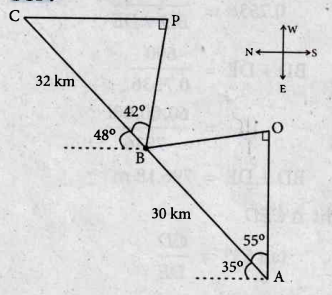
Let A be the initial position of the bird.
B be the position after travelling 30 km at an angle of 35o from A.
Let C be the position after travelling 32 km at an angle of 48o from B.
[complementary angle]
From the right triangle AOB
\(\cos 55^{\circ}=\frac{O A}{A B} \)
\(0.5736=\frac{O A}{30} \)
OA = 30 x 0.5736 = 17.21 km
B is 17 .21 km to the West of A
65.
| City A | City B | ||||
|---|---|---|---|---|---|
| x1 | d1 = x - \({ \overline { x } }_{ 1 }\) | d12 | x2 | d2 = x - \({ \overline { x } }_{ 2 }\) | d22 |
| 20 | 0 | 0 | 10 | -5 | 25 |
| 22 | 2 | 4 | 20 | 5 | 25 |
| 19 | -1 | 1 | 18 | 3 | 9 |
| 23 | -3 | 9 | 12 | -3 | 9 |
| 16 | -4 | 16 | 15 | 0 | 0 |
| 100 | 6 | 30 | 75 | 0 | 68 |
\(\bar { { x }_{ 1 } } =\frac { 100 }{ 5 } =20\)
\(\sigma =\sqrt { \frac { \sum { { d }^{ 2 } } }{ n } } \)
\(=\sqrt { \frac { 30 }{ 5 } } \)
\(=\sqrt { 6 } \)
= 2.44
\(CV=\frac { \sigma }{ \bar { x } } \times 100\)
\(=\frac { 2.44 }{ 20 } \times 100\)
= 12.2
\(\bar { { x }_{ 2 } } =\frac { \sum { x } }{ n } =\frac { 75 }{ 5 } =15\)
\(\sigma =\sqrt { \frac { \sum { { d }^{ 2 } } }{ n } } \)
\(=\sqrt { \frac { 68 }{ 5 } } \)
\(=\sqrt { 13.6 } \)
= 3.68
\(CV=\frac { \sigma }{ \bar { x } } \times 100\)
\(=\frac { 3.86 }{ 15 } \times 100\)
\(=\frac { 368 }{ 15 } \)
C.V. of city A < C.V of city B.
∴ City A is more consistents.
66.
Mean \(\overline { x } \) = 62.8
Σx = 50
| Class interval | Mid value of x1 | Frequency f1 | Σf1x1 |
|---|---|---|---|
| 0-20 | 10 | 5 | 50 |
| 20-40 | 30 | f1 | 30f1 |
| 40-60 | 50 | 10 | 500 |
| 60-80 | 70 | f2 | 70f2 |
| 80-100 | 90 | 7 | 630 |
| 100-120 | 110 | 8 | 880 |
| 30+f1+f2 | 2060+30f1+70f2 |
\(\overline { x } =\frac { \sum { { f }_{ i }{ x }_{ i } } }{ \sum { { f }_{ i } } } =\frac { 2060+30{ f }_{ 1 }+70{ f }_{ 2 } }{ 30+{ f }_{ 1 }+{ f }_{ 2 } } \)
\(\frac { 2060+30{ f }_{ 1 }+70{ f }_{ 2 } }{ 30+{ f }_{ 1 }+{ f }_{ 2 } } \) = 62.8 ....(1)
30 + f1 + f2 = 50 (given)
f1 +f2 = 20 ...(2)
2060 + 30f1 + 70f2 = 3140
30f1 + 70f2 = 3140 - 2060
30f1 + 70f2 = 1080 ....(3)
Solving (2) & (3) we get,
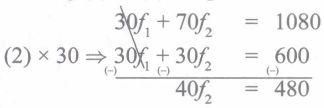
Sub.f2 = 12 in (2), we get
f2 +12 = 20 ⇒ f1 = 8
f1 = 8, f2 = 12
67.
3A + 2B - C = \(3\left[ \begin{matrix} 1 & 8 & 3 \\ 3 & 5 & 0 \\ 8 & 7 & 6 \end{matrix} \right] +2\left[ \begin{matrix} 8 & -6 & -4 \\ 2 & 11 & -3 \\ 0 & 1 & 5 \end{matrix} \right] -\left[ \begin{matrix} 5 & 3 & 0 \\ -1 & -7 & 2 \\ 1 & 4 & 3 \end{matrix} \right] \)
= \(\left[ \begin{matrix} 3 & 24 & 9 \\ 9 & 15 & 0 \\ 24 & 21 & 18 \end{matrix} \right] +\left[ \begin{matrix} 16 & -12 & -8 \\ 4 & 22 & -6 \\ 0 & 2 & 10 \end{matrix} \right] +\left[ \begin{matrix} -5 & -3 & 0 \\ 1 & 7 & -2 \\ -1 & -4 & -3 \end{matrix} \right] \)
= \(\left[ \begin{matrix} 14 & 9 & 1 \\ 14 & 44 & -8 \\ 23 & 19 & 25 \end{matrix} \right] \)
68.
We have x sin3\(\theta \) + ycos3\(\theta \) = sin\(\theta \) cos\(\theta \)
\(
\Rightarrow \ (x \sin \theta)\left(\sin ^{2} \theta\right)+(y \cos \theta) \cos ^{2} \theta
\)
\(= \sin \theta \cos \theta
\)
\(\Rightarrow \ x \sin \theta\left(\sin ^{2} \theta\right)+(x \sin \theta) \cos ^{2} \theta
\)
\(= \sin \theta \cos \theta \quad[\because x \sin \theta=y \cos \theta] \mathrm{S}
\)
\(\Rightarrow \ x \sin \theta\left(\sin ^{2} \theta+\cos ^{2} \theta\right)=\sin \theta \cos \theta
\)
\(\Rightarrow x \sin \theta=\sin \theta \cos \theta
\)
\( \mathrm{x}=\cos \theta\) ...(1)
\(\text { Now, } x \sin \theta=y \cos \theta
\)
\(
\Rightarrow \cos \theta \sin \theta=y \cos \theta
\)
\(\Rightarrow [\because x=\cos \theta \text { from (1) }]
\)
y = sin\(\theta \) ...(2)
From (1) and (2)
\( x^{2}+y^{2}=\cos ^{2} \theta+\sin ^{2} \theta
\)
= 1
x2 + y2 = 1.
69.
Let us solve 8x + 3y = 18 and 4x + 5y = 9
8x + 3y = 18 ....(1)
4x + 5y = 9 ....(2)
.JPG)
Substitute in (1)
8x + 3(0) = 18
.JPG)
The point of intersection of (1) and (2) is \(\left( \frac { 9 }{ 4 } ,0 \right) \)
Mid point of the line segment joining (5, -4) and (-7,6) is
\(\left(\frac{x_{1}+x_{2}}{2}, \frac{y_{1}+y_{2}}{2}\right)=\left(\frac{5-7}{2}, \frac{-4+6}{2}\right)=(-1,1)\)
Equation of the straight line joining \(\left( \frac { 9 }{ 4 } ,0 \right) \) and (-1, 1) is
\(\frac{y-y_{1}}{y_{2}-y_{1}} =\frac{x-x_{1}}{x_{2}-x_{1}}
\)
\(\frac{y-0}{1-0} =\frac{x-\frac{9}{4}}{-1-\frac{9}{4}}
\)
\(\frac{y}{1} =\frac{4 x-9}{-13}
\)
-13y = 4x - 9
4x + 13y - 9 = 0
70.
Coin is in the form of a cylinder
Diameter of the coin = 1.5 cm
Radius of the coin = \(\frac{1.5}{2}\)
Thickness = height = 2 mm = \(\frac{2}{10}=0.2 \mathrm{~cm}\)
Volume of coin (cylinder) = \(\pi r^{2} h\)
\(=\pi\left(\frac{1.5}{2}\right)^{2}(0.2)
\)
\(=0.1125 \pi \mathrm{cm}^{3}
\)
Diameter of cylinder = 4.5 cm
radius = \(\frac{4.5}{2}=2.25 \mathrm{~cm}\)
height = 10 cm
volume = \(\pi r^{2} h\ sq. units
\)
= \(\pi(2.25)^{2}(10)
\)
= \(50.625 \pi
\)
No.of coins \(=\frac{\text { Volume of cylinder }}{\text { Volume of Coin }}
\)
\(=\frac{50.625 \pi}{0.1125 \pi}=450 \text { coins. }
\)
71.
The mean of marks is 35.9 which is not an integer. Hence we take assumed mean, A=35,n=10.
| xi | di = xi - A di = x - 35 |
di2 |
| 25 | -10 | 100 |
| 29 | -6 | 36 |
| 30 | -5 | 25 |
| 33 | -2 | 4 |
| 35 | 0 | 0 |
| 37 | 2 | 4 |
| 38 | 3 | 9 |
| 40 | 5 | 25 |
| 44 | 9 | 81 |
| 48 | 13 | 169 |
| \({ \Sigma d }_{ i }\) = 9 | \(\frac { { \Sigma d }_{ i }^{ 2 } }{ n } \) = 453 |
Standard deviation
σ =\(\sqrt { \frac { { \Sigma d }_{ i }^{ 2 } }{ n } -\left( \frac { { \Sigma d }_{ i } }{ n } \right) ^{ 2 } } \)
= \(\sqrt { \frac { 453 }{ 10 } -\left( \frac { 9 }{ 10 } \right) ^{ 2 } } \)
= \(\sqrt { 45.3-0.81 } \)
= \(\sqrt { 44.49 } \)
σ ≃ 6.67
(ii) Step deviation method
Let x1, x2, xn,... be the given data. Let A be the assumed mean.
Let c be the common divisor of xi-A
Let di = \(\frac { x_{ i }-A }{ c } \)
Then xi = dic + A ....(1)
Σxi = Σ(dic + A) = cΣdi + A x n
\(\frac { \Sigma { x }_{ i } }{ n } =c\frac { \Sigma d_{ i } }{ n } +A\)
\(\bar { x } \) = c \(\bar { d } \)+A ..(2)
\({ x }_{ i }-\bar { x } =c{ d }_{ i }+A-c\bar { d } -A=c(\bar { d_{ i } } -\bar { d } )\)(using (1) and (2))
σ = \(\sqrt { \frac { \Sigma ({ x }_{ i }-\bar { x } )^{ 2 } }{ n } } =\sqrt { \frac { \Sigma (c({ d }_{ i }-\bar { d } )^{ 2 } }{ n } } =\sqrt { \frac { { c }^{ 2 }\Sigma ({ d }_{ i }-\bar { d } )^{ 2 } }{ n } } \)
σ = \(c\times \sqrt { \frac { { \Sigma d }_{ i }^{ 2 } }{ n } -\left( \frac { { \Sigma d }_{ i } }{ n } \right) ^{ 2 } } \\ \)
72.
Let TR = y. Since, OT is perpendicular bisector of PQ
PR = QR = 4 cm
In\(\triangle\)ORP, OP2 = OR2 + PR2
OR2 = OP2 - PR2
OR2 = 52 - 42 = 25 - 16 = 9 \(\Rightarrow\) OR = 3cm
OT = OR + RT = 3 + y ..(1)
In \(\triangle\)PRT, TP2 + TR2 + PR2 ..(2)
and \(\triangle\)OPT we have, OT2 = TP2 + OP2
OT2 = (TR2 + PR2) + OP2 (substitute for TP2 from (2))
(3 + y)2 = y2 + 42 + 52 (substitute for OT from (1))
9 + 6y2 + 16 + 25 therefore \(y=TR=\frac { 16 }{ 3 } \)
6y = 41 - 9 we get \(y=\frac { 16 }{ 3 } \)
From (2), TP2 = TR2 + PR2
\(TP2=\left( \frac { 16 }{ 3 } \right) +4^{ 2 }=\frac { 256 }{ 9 } +16=\frac { 400 }{ 9 } \)so, \(TP=\frac { 20 }{ 3 } \)
73.
Diameter of Glass = 20 cm
radius = 10 cm
water upto height = 9 cm
radius of cylindrical metal = 5 cm
height of cylindrical metal = 4 cm
Volume of water displaced = Volume of cylindrical metal
\(\pi r_{1}^{2} h_{1}=\pi r_{2}^{2} h_{2}
\)
\((10)^{2} h_{1}=(5)^{2}(4)
\)
\(h_{1}=\frac{100}{100}=1 \mathrm{~cm}
\)
Hence, the increase in water level is 1 cm.
74.
Let r and R be the inner and outer radii of the hollow sphere.
Given that, inner diameter d = 14 cm; inner radius r = 7 cm; thickness = 1 mm = \(\frac{1}{10}\)cm
Outer radius R = 7 + \(\frac { 1 }{ 10 } =\frac { 71 }{ 10 } =7.1cm\)
Volume of hollow sphere \(=\frac { 4 }{ 3 } \pi \left( { R }^{ 3 }-{ r }^{ 3 } \right) cu.cm\)
\(=\frac { 4 }{ 3 } \times \frac { 22 }{ 7 } (357.91-343)=62.48cm^{ 3 }\)
But, weight of brass in 1 cm3 = 17.3 gm
Total weight = 17362 x 62.48 = 1080.90 gm
Therefore, total weight is 1080.90 grams.
75.
Given that radius and height of a cylinder are in the ratio 5 : 7
\(\text { i.e., } \frac{r}{h}=\frac{5}{7} \Rightarrow \mathrm{h}=\frac{7 r}{5}\)
Curved surface area = 5500 sq. cm
\(2 \pi r h =5500 \)
\(2 \times \frac{22}{7} \times r \times \frac{7 r}{5} =5500 \)
\(r^{2} =\frac{5500 \times 5}{2 \times 22} \)
\(r^{2} =625 \Rightarrow r=25 \)
\(=\frac{7(25)}{5}=35 \)
radius = 25 cm, height = 35 cm
76.
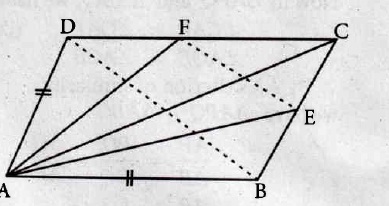
Given: A quadrilateral ABCD in which AB = AD and the bisectors of \(\angle\)BAC and \(\angle\)CAD meet the sides BC and CD at E and F respectively.
To prove: EF || BD
Construction: Join AC, BD and EF.
Proof: In \(\triangle\)CAB, AE is the bisector of \(\angle\)BAC
\(\therefore \frac{A C}{A B}=\frac{C E}{B E}\) ......(1)
In \(\triangle\)ACD , AF is the bisector of \(\angle\)CAD
\( \frac{A C}{A D} =\frac{C F}{D F} \)
\(\Rightarrow \ \frac{A C}{A B} =\frac{C F}{D F}\) ......(2)
From (1) and (2) we get
\( \frac{C E}{B E}=\frac{C F}{D F} \)
\(\frac{C E}{E B}=\frac{C F}{F D}\)
Thus in \(\triangle\)CBD, E and F divide the sides CB and CD respectively in the same ratio.
By the converse of Thales theorem, we have EF || BD.
77.
i) f: R ⟶ R and f(x) = 2x + 1
when x = -1,f(- 1) = 2(- 1) + 1 =- 1 \( \in\) R
when x = 0, f(0) = 2 (0) + 1 = 1 \( \in\) R
when x = 1,f (1) = 2(1) + 1 = 3 \( \in\) R and soon
For every value of x \( \in\) R, f (x) also \( \in\) R.
The function is well defined and it is one-to-one function (Injective)
For f (x) : R ⟶ R , the domain and range are also well defined. So it is an onto function (Surjective)
Thus, the function is one - to one onto i.e. Bijective function.
(ii) f : R ⟶ R , f(x) = 3 - 4x2
when x = 0, f (0) = 3 - 4(0) = 3 \( \in\) R
when x = 1, f (1) = 3 - 4(1)2 = -1 \( \in\) R
when x = 2, f (2) = 3 - 4(2)2 = 13 \( \in\) R
when x = -1, f (-1) = 3 - 4(-1)2 = -1 \( \in\) R
when x = -2, f (-2) = 3 - 4(-2)2 = -13 \( \in\) R
From this, it is clear that two or more elements having same image in the co-domain So, it is not one-to-one and it is many-to-one function. Hence it is not Bijective.
78.
(cosec\(\theta \) - sin\(\theta \)) (sec\(\theta \) - cos\(\theta \)) (tan\(\theta \) + cot\(\theta \))
\(\left( \frac { 1 }{ sin\theta } -sin\theta \right) \quad \left( \frac { 1 }{ cos\theta } -cos\theta \right) \left( \frac { sin\theta }{ cos\theta } +\frac { cos\theta }{ sin\theta } \right) \)
\(=\frac { 1-si{ n }^{ 2 } }{ sin\theta } \times \frac { 1-co{ s }^{ 2 } }{ cos\theta } \times \frac { si{ n }^{ 2 }\theta +co{ s }^{ 2 }\theta }{ sin\theta cos\theta } \)
\(=\frac { co{ s }^{ 2 }\theta si{ n }^{ 2 }\theta \times 1 }{ si{ n }^{ 2 }\theta co{ s }^{ 2 }\theta } =1\)
79.
\(A=\left[ \begin{matrix} 3 & 0 \\ 4 & 5 \end{matrix} \right] ,B=\left[ \begin{matrix} 6 & 3 \\ 8 & 5 \end{matrix} \right] ,C=\left[ \begin{matrix} 3 & 6 \\ 1 & 1 \end{matrix} \right] \)
CD - AB = 0 ⇒ CD = AB
\(AB=\left[ \begin{matrix} 3 & 0 \\ 4 & 5 \end{matrix} \right] \left[ \begin{matrix} 6 & 3 \\ 8 & 5 \end{matrix} \right] =\left[ \begin{matrix} (18+0) & (9+0) \\ (24+40) & (12+25) \end{matrix} \right] \)
\(CD=\left[ \begin{matrix} 18 & 9 \\ 64 & 37 \end{matrix} \right] \)
\(Let\quad D=\left[ \begin{matrix} x & y \\ z & w \end{matrix} \right] \)
\(\left[ \begin{matrix} 3 & 6 \\ 1 & 1 \end{matrix} \right] \left[ \begin{matrix} x & y \\ z & w \end{matrix} \right] =\left[ \begin{matrix} 18 & 9 \\ 64 & 37 \end{matrix} \right] \)
\(\left[ \begin{matrix} 3x+6z & 3y+6w \\ x+z & y+w \end{matrix} \right] =\left[ \begin{matrix} 18 & 9 \\ 64 & 37 \end{matrix} \right] \)
3x + 6z = 18 ...(1)
x + z = 64 ...(2)
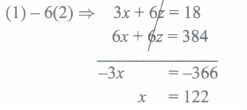
Sub. x=122 in(2)
122+z=64
z=64-122=-58
3y+6w=9 ....(3)
y+w=37 ....(4)
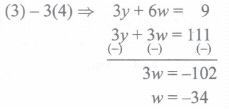
Sub. w = -34 in (4)
y-34 = 37
y = 37 + 34 = 71
∴ Solutions: x = 122
y = 71
z = -58
w = -34
\(\therefore D=\left[ \begin{matrix} 122 & 71 \\ -58 & -34 \end{matrix} \right] \)
80.
\(60-t=\frac { { t }^{ 2 } }{ 4 } -3\)
⇒ t2-12 = 240-4t
⇒ t2+4t-252 = 0
⇒ t2+18t-14t-252 = 0
⇒ t(t +18)-14(t +18) = 0
⇒ (t +18)(t-14) = 0
∴ t = 14 or t = -18 is not possible
81.
Diameter = 6 cm
Radius =\(\frac { 6 }{ 2 } =3cm\)
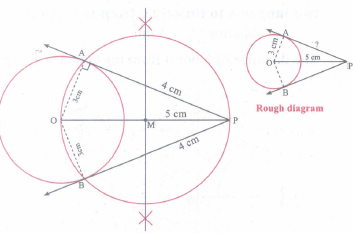
Length of the tangents PA = PB = 4 cm
Construction:
Steps:
(1) With centre O, draw a circle of radius 3cm.
(2) Draw a line OP = 5 cm
(3) Draw a bisector of OP, which cuts OP and M
(4) With M as centre and MO as radius draw a circle which cuts previous circle at A and B
(5) Join AP and BP. AP and BP are the required tangents. Thus length of the tangents are PA = PB = 4 cm.
82.
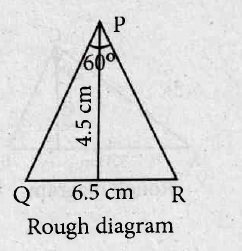
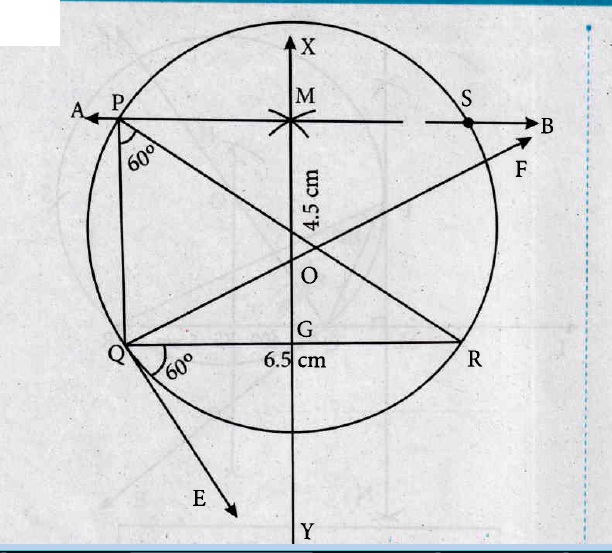
Construction:
Steps (1) Draw QR = 6.5 cm.
Steps (2) Draw \(\angle RQE={ 60 }^{ 0 }\)
Steps (3) Draw \(\angle FQE={ 90 }^{ 0 }\)
Steps (4) Drawn the perpendicular bisector XY to ER which intersects QF at O and ER at G.
Steps (5) With O as center and OQ as radius drawn a circle
Steps (6) XY intersects QR at G. On XY, from G marked an arc at M, such that GM = 4.5 cm
Steps (7) Drawn AB through M which is parallel to QR
Steps (8) AB meets the circle at P and S
Steps (9) Joined QP and RP Then \(\triangle\)PQR is the required triangle.
Steps (10) Here \(\triangle\)SQR is also another required triangle.

10th Standard Syllabus & Materials
10th Standard
TN 10th English Prose - 2 - The Night the Ghost Got in Important Questions And Answers Study Material - QB365 Set A
NEW10th Standard
TN 10th English Supplementary - 1 - The Tempest Important Questions And Answers Study Material - QB365 Set A
NEW10th Standard
TN 10th English Poem - 1 - Life Important Questions And Answers Study Material - QB365 Set A
NEW10th Standard
TN 10th English Prose - 1 - His First Flight Important Questions And Answers Study Material - QB365 Set A



Tamilnadu Stateboard 10th Standard Subjects
Tamilnadu Stateboard Standards





