
 100% FREE ACCESS
10th Standard Syllabus & Materials
10th Standard
TN 10th English Prose - 4 - The Attic Important Questions And Answers Study Material - QB365 Set A
NEW10th Standard
TN 10th English Supplementary - 3 - The Story of Mulan Important Questions And Answers Study Material - QB365 Set A
NEW10th Standard
TN 10th English Poem - 3 - I am Every Woman Important Questions And Answers Study Material - QB365 Set A
NEW10th Standard
TN 10th English Prose - 3 - Empowered Women Navigating The World Important Questions And Answers Study Material - QB365 Set A
NEW10th Standard
TN 10th English Supplementary - 2 - Zigzag Important Questions And Answers Study Material - QB365 Set A
NEW10th Standard
TN 10th English Poem - 2 - The Grumble Family Important Questions And Answers Study Material - QB365 Set A

Published on: 09/05/2020
10th Standard Maths English Medium Public Exam Model Question Paper - II July 2020
Download Tamil Nadu 10th Standard Maths question papers, model tests, one-mark questions, important questions, and public exam papers in PDF format. Free study materials and answer keys for TN State Board students.
Questions + Answers key
Take MCQ Maths Test1.
If 15tan2 θ+4 sec2 θ=23 then find the value of (secθ+cosecθ)2 -sin2 θ
2.
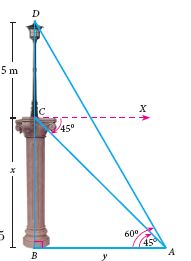
A pole 5 m high is fixed on the top of a tower. The angle of elevation of the top of the pole observed from a point ‘A’ on the ground is 60° and the angle of depression to the point ‘A’ from the top of the tower is 45°. Find the height of the tower.(\(\sqrt3\)=1.732)
3.
In \(\angle ACD={ 90 }^{ 0 }\) and \(CD\bot AB\) Prove that \(\cfrac { { BC }^{ 2 } }{ { AC }^{ 2 } } =\cfrac { BD }{ AD } \)
4.
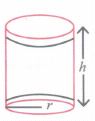
A wooden article was made by scooping out a hemisphere from each end of a cylinder as shown in figure. If the height of the cylinder is 10 cm and its base is of radius 3.5 cm find the total surface area of the article.
5.
C.V. of a data is 69%, S.D. is 15.6, then find its mean.
6.
Which of the following list of numbers form an AP ? If they form an AP, write the next two terms:
1, 1, 1, 2, 2, 2, 3, 3, 3
7.
A function f: (1,6) \(\rightarrow\)R is defined as follows:
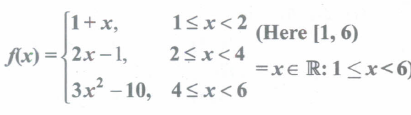
Find the value of f(3),
8.
If the points A(6, 1), B(8, 2), C(9, 4) and D(P, 3) are the vertices of a parallelogram, taken in order. Find the value of P.
9.
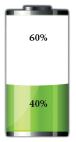
A mobile phone is put to use when the battery power is 100%. The percent of battery power ‘y’ (in decimal) remaining after using the mobile phone for x hours is assumed as y = − 0.25 x + 1
How much time does it take so that the battery has no power?
10.
In a game, the entry fee is Rs.150. Th e game consists of tossing a coin 3 times. Dhana bought a ticket for entry . If one or two heads show, she gets her entry fee back. If she throws 3 heads, she receives double the entry fees. Otherwise she will lose. Find the probability that she (i) gets double entry fee (ii) just gets her entry fee (iii) loses the entry fee.
11.
Simplify
\(\frac { 4{ x }^{ 2 }y }{ 2{ x }^{ 2 } } \times \frac { 6x{ z }^{ 3 } }{ 20{ y }^{ 4 } } \)
12.
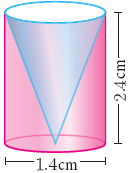
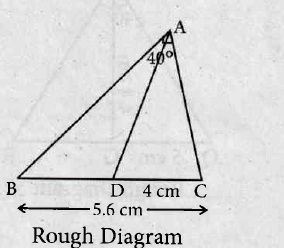
From a solid cylinder whose height is 2.4 cm and diameter 1.4 cm, a conical cavity of the same height and base is hollowed out. Find the total surface area of the remaining solid.
13.
14.
Find the depth of a cylindrical tank of radius 28 m, if its capacity is equal to that of a rectangular tank of size 28 m x 16 m x 11 m.
15.
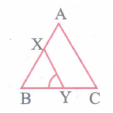
In figure the line segment XY is parallel to side AC of \(\Delta ABC\) and it divides the triangle into two parts of equal areas. Find the ratio \(\cfrac { AX }{ AB } \)
16.
The marks scored by 5 students in a test for 50 marks are 20, 25, 30, 35, 40. Find the S.D for the marks. If the marks are converted for 100 marks, find the S.D. for newly obtained marks.
17.
Prove that the equation x2(a2+b2)+2x(ac+bd)+(c2+ d2) = 0 has no real root if ad≠bc.
18.
Show that any positive odd integer is of the form 4q + 1 or 4q + 3, where q is some integer.
19.
Show that the points (1, 7), (4, 2), (-1,-1) and (-4,4) are the vertices of a square.
20.
If α and β are the roots of x2 + 7x + 10 = 0 find the values of
\(\frac { \alpha }{ \beta } +\frac { \beta }{ \alpha } \)
21.
Find the sum of the following
6 + 13 + 20 + ...+ 97
22.
If n = 5 , \(\bar { x } \) = 6, Σx2 = 765 then calculate the coefficient of variation.
23.
If 1 + 2 + 3 +...+ k = 325, then find 13 + 23 + 33 +...K3.
24.
Water is flowing at the rate of 15 km per hour through a pipe of diameter 14 cm into a rectangular tank which is 50 m long and 44 m wide. Find the time in which the level of water in the tanks will rise by 21 cm.
25.
prove the following identities.\(\frac { 1-ta{ n }^{ 2 }\theta }{ co{ t }^{ 2 }\theta -1 } =ta{ n }^{ 2 }\theta \)
26.
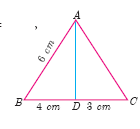
In the figure, AD is the bisector of \(\angle\)A. If BD = 4 cm, DC = 3 cm and AB = 6 cm, find AC.
27.
Find the slope of a line joining the given points (- 6, 1) and (-3, 2)
28.
Let A = {3,4,7,8} and B = {1,7,10}. Which of the following sets are relations from A to B?
R1 = {(3,7), (4,7), (7,10), (8,1)}
29.
The difference between the remainders when 6002 and 601 are divided by 6 is ____________
2
1
0
3
30.
A girl calculates the probability of her winning in a match is 0.08 what is the probability of her losing the game ___________
91%
8%
92%
80%
31.
32.
A page is selected at random from a book. The probability that the digit at units place of the page number chosen is less than 7 is
\(\frac{3}{10}\)
\(\frac{7}{10}\)
\(\frac{3}{9}\)
\(\frac{7}{9}\)
33.
If 5x = sec\(\theta \) and \(\frac { 5 }{ x } \) = tan\(\theta \), then x2 - \(\frac { 1 }{ { x }^{ 2 } } \) is equal to
25
\(\frac { 1 }{ 25 } \)
5
1
34.
If sin \(\theta \) + cos\(\theta \) = a and sec \(\theta \) + cosec \(\theta \) = b, then the value of b(a2 - 1) is equal to
2a
3a
0
2ab
35.
74k \(\equiv \) ________ (mod 100)
1
2
3
4
36.
37.
In a \(\triangle\)ABC, AD is the bisector \(\angle\)BAC. If AB = 8 cm, BD = 6 cm and DC = 3 cm. The length of the side AC is
6 cm
4 cm
3 cm
8 cm
38.
In ∆LMN, \(\angle\)L = 60o, \(\angle\)M = 50o. If ∆LMN ~ ∆PQR then the value of \(\angle\)R is
40o
70°
30°
110°
39.
A spherical ball of radius r1 units is melted to make 8 new identical balls each of radius r2 units. Then r1:r2 is
2:1
1:2
4:1
1:4
40.
If the ordered pairs (a + 2, 4) and (5, 2a + b) are equal then (a, b) is
(2,-2)
(5,1)
(2,3)
(3,-2)
41.
If there are 1024 relations from a set A = {1, 2, 3, 4, 5} to a set B, then the number of elements in B is
3
2
4
8
42.
If number of columns and rows are not equal in a matrix then it is said to be a
diagonal matrix
rectangular matrix
square matrix
identity matrix
43.
Draw the graph of y = x2 + 3x + 2 and use it to solve x2 + 2x + 1 = 0
44.
Draw the graph of y = x2 - 4 and hence solve x2 + 1 = 0
45.
Draw a triangle ABC of base BC = 5.6 cm, \(\angle\)A = 40o and the bisector of \(\angle\)A meets BC at D such that CD = 4 cm.
46.
Construct a \(\triangle\)ABC such that AB = 5.5 cm, \(\angle\)C = 25o and the altitude from C to AB is 4 cm.
1.
2.
Let BC be the height of the tower and CD be the height of the pole
Let ‘A’ be the point of observation.
Let BC = x and AB = y.
From the diagram,
ㄥBAD = 60° and ㄥXCA = 45° = ㄥBAC
In right triangle ABC, tan 45o = \(\frac{BC}{AB}\)
gives 1 = \(\frac{x}{y}\) so, x = y ...(1)
In right triangle ABD, tan60° = \(\frac{BC}{AB}\) = \(\frac{BC+CD}{AB}\)
gives \(\sqrt3\) = \(\frac{x+5}{y}\) so, \(\sqrt3\)y = x + 5
we get \(\sqrt3\) x = x + 5 [From (1)]
so, \(\frac { 5 }{ \sqrt { 3 } -1 } =\frac { 5 }{ \sqrt { 3 } -1 } \times \frac { \sqrt { 3 } +1 }{ \sqrt { 3 } +1 } =\frac { 5(1.732+1) }{ 2 } \) = 6.83
Hence, height of the tower is 6.83 m.
3.
\(\Delta ACD\sim \Delta ABC\)
So,
\(\cfrac { AC }{ AB } =\cfrac { AD }{ AC } \)
AC2 = AB ·AD
Similarly \(\Delta BCD\sim \Delta BAC\)
So,
\(\cfrac { BC }{ BA } =\cfrac { BD }{ BC } \)
BC2 = BA·BD
From (1) and (2)
\(\cfrac { { BC }^{ 2 } }{ AC^{ 2 } } =\cfrac { BA.BD }{ AB.AD } =\cfrac { BD }{ AD } \)
4.
Radius of the cylinder be r
Height of the cylinder be h
Total surface area of the article
= CSA of cylinder + CSA of 2 hemispheres
= 2ㅠrh + 2πr2 = 2πr(h + 2r)
\(=2\times \frac { 22 }{ 7 } \times 3.5\times (10+2\times 3.5)\)
= 22 x 17 = 374 cm2
5.
CV =\(\frac { \sigma }{ \bar { x } } \) x 100 ⇒ \(\bar { x } =\frac { \sigma }{ CV } \) x 100
\(\bar { x } =\frac { 15.6 }{ 6.9 } \) x 100 = 22.6
6.
1,1,1,2,2,2,3,3,3
t2 - t1 = 1-1 = 0
t3 - t2 = 1-1 = 0
t4 - t3 = 2-1 = 1
Here t2 - t1 ≠ t3 - t2
ஃ It is not an A.P.
7.
f(3) =. 2x - 1
= 2(3) - 1 = 6 - 1 = 5
8.
We know that diagonals at a parallelogram bisect each other.
So, the coordinates of the mid-point at AC = coordinates of the mid-point at BD.
i.e., \(\left[ \frac { 6+9 }{ 2 } ,\frac { 1+4 }{ 2 } \right] =\left[ \frac { 8+P }{ 2 } ,\frac { 2+3 }{ 2 } \right] \)
\(\left[ \frac { 15 }{ 2 } ,\frac { 5 }{ 2 } \right] =\left[ \frac { 8+P }{ 2 } ,\frac { 5 }{ 2 } \right] \)
\(\frac { 15 }{ 2 } =\frac { 8+P }{ 2 } \)
P = 7
9.
If the battery power is 0 then y = 0
Therefore, 0 = − 0.25x + 1 gives - 0.25 x = 1 hence x = 4 hours.
Thus, after 4 hours, the battery of the mobile phone will have no power.
10.
ln tossing a coin 3 times, the sample space
S = {HHH, HHT, HTH, HTT, THH, THT, TTH, TTT}
n(S) = 3
(i) Let 'A' be the event of getting double entry fee. She received double entry fee when she throws 3 heads.
A = {HHH}
n(A) = 1
\(\mathrm{P}(\mathrm{A})=\frac{n(A)}{n(S)}=\frac{1}{8}\)
(ii) Let 'B' be the event of getting the entry fee back. She receives her entry fee back when she throws one or two heads
B = {HHT HTH, HTT, THH, THT, TTH}
n(B) = 6
\(\mathrm{P}(\mathrm{B})=\frac{n(B)}{n(S)}=\frac{6}{8}=\frac{3}{4}\)
Probability of getting back entry fee = \(\frac{3}{4}\)
(iii) Let 'C' be the event of losing the entry fee
c = {TTT}
n(C) = 1
\(\mathrm{P}(C)=\frac{n(C)}{n(S)}=\frac{1}{8}\)
Probabilify of losing the entry fee = \(\frac{1}{8}\)
11.
\(\frac { 4{ x }^{ 2 }y }{ 2{ x }^{ 2 } } \times \frac { 6x{ z }^{ 3 } }{ 20{ y }^{ 4 } } =\frac { { 3x }^{ 3 }z }{ 5{ y }^{ 3 } } \)
12.
Let h and r be the height and radius of the cone and cylinder.
Let l be the slant height of the cone.
Given that, h = 2.4 cm and d = 1.4 cm ; r = 0.7 cm
Here, total surface area of the remaining solid} C.S.A. of the cylinder + C.S.A. of the cone + area of the bottom
= 2\(\pi\)rh + \(\pi\)rl + \(\pi\)r2 sq.units
Now, \(\\ \\ l=\sqrt { { r }^{ 2 }+{ h }^{ 2 } } =\sqrt { 0.49+5.76 } =\sqrt { 6.25 } =2.5cm\)
Area of the remaining solid = 2\(\pi\)rh + \(\pi\)rl + \(\pi\)r2 sq.units
= \(\pi\)r(2h + l + r)
\(\frac { 22 }{ 7 } \times 0.7\times [(2\times 2.4)+2.5+0.7]\)
Therefore, total surface area of the remaining solid is 17.6 m2
13.
14.
Volume of the cylindrical tank = Volume of the rectangle tank
πr2h = 28 x 16 x 11 m3

\(h=\frac { 16\times 11 }{ 88 } =2m\)
15.
Given XY IIA C
So,
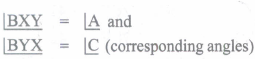
\(\therefore \Delta ABC\sim \Delta XbY\) (AAA similarity criterion)
So, \(\cfrac { ar(ABC) }{ ar(XBY) } =\left( \cfrac { AB }{ XB } \right) ^{ 2 }\) ...(1)
ar(ABC) = 2ar(XBY)
\(\cfrac { ar(ABC) }{ ar(ABC) } =\cfrac { 2 }{ 1 } \) ...(2)
From (1) and (2),
\(\left( \cfrac { AB }{ XB } \right) ^{ 2 }=\cfrac { 2 }{ 1 } i.e.,\cfrac { AB }{ XB } =\cfrac { \sqrt { 2 } }{ 1 } \)
\(\cfrac { XB }{ AB } =\cfrac { 1 }{ \sqrt { 2 } } \)
\(1-\frac{X B}{A B}=1-\frac{1}{\sqrt{2}}\)
\(\cfrac { AB-XB }{ AB } =\cfrac { \sqrt { 2 } -1 }{ \sqrt { 2 } } \)
\(\cfrac { AX }{ AB } =\cfrac { \sqrt { 2 } -1 }{ \sqrt { 2 } } =\cfrac { 2-\sqrt { 2 } }{ 2 } \)
16.
Let assumed mean A = 30
C = 5
| x | d' = \(\frac { x-30 }{ 5 } \) | d'2 |
| 20 | -2 | 4 |
| 25 | -1 | 1 |
| 30 | 0 | 0 |
| 35 | 1 | 1 |
| 40 | 2 | 4 |
| Σd' = 0 | Σd'2 = 10 |
σ =\(\sqrt { \left( \frac { \Sigma d'^{ 2 } }{ n } \right) -\left( \frac { \Sigma d' }{ n } \right) ^{ 2 } } \) x c
=\(\sqrt { \frac { 10 }{ 5 } -0 } \) x 5
=\(\sqrt { 2 } \) x 5
= 5\(\sqrt { 2 } \)
To convert the values for 100, all the values will be multiplied by 2. Therefore the new values are 40, 50, 60, 70, 80.
Let A = 60, C = 10
| x | d' = \(\frac { x-60 }{ 10 } \) | d'2 |
| 40 | -2 | 4 |
| 50 | -1 | 1 |
| 60 | 0 | 0 |
| 70 | 1 | 1 |
| 80 | 2 | 4 |
σ =\(\sqrt { \left( \frac { \Sigma d'^{ 2 } }{ n } \right) -\left( \frac { \Sigma d' }{ n } \right) ^{ 2 } } \) x c
=\(\sqrt { \frac { 10 }{ 5 } -0 } \) x 10
=\(\sqrt { 2 } \) x 10
= 10\(\sqrt { 2 } \)
S.D. also be multiplied by 2. It is also true for the division also.
17.
D= b2-4ac
⇒ 4(ac + bd)2 - 4(a2 + b2)(c2 + d2)
⇒ 4[(ac + bd)2 - (a2 + b2)(c2 + d2)]
⇒ 4(a2c2 + b2d2 + 2acbd - a2c2b2c2 - a2d2 - b2d2]
⇒ 4[2acbd - a2d2 - b2c2]
⇒ 4[a2d2 + b2c2 - 2adbc]
⇒-4[ ad - bc]2
We have ad≠ bc
∴ ad- be of 0
⇒ (ad - bc)2 > 0
⇒ 4(ad - bc)2 < 0 ⇒ D < 0
Hence the given equation has no real roots.
18.
Let us start with taking a, where a is a +ve odd integer.
We apply the division algorithm with 'a' and 'b' = 4.
Since 0 ≤ r < 4, the possible remainders are 0,1,2,3.
That is, a can be 4q, or 4q + 1, or 4q + 2 or 4q + 3, where 1 is the quotient. However, since a is odd, a cannot be 4q or 4q + 2 (since they are both divisible by 2).
Any odd integer is of the form 4q + 1 or 4q + 3
19.
Let A(1, 7), B(4, 2), C(-1, -1) and D(-4, 4) be the given paints. One way at showing that ABCD is a square is to use the property that all its sides should be equal and both its diagonals should be equal.
Now,
AB = \(\sqrt { (1-4)^{ 2 }+(7-4)^{ 2 } } =\sqrt { 9+25 } =\sqrt { 34 } \)
BC = \(\\ \sqrt { (4+1)^{ 2 }+(2+1)^{ 2 } } =\sqrt { 25+9 } =\sqrt { 34 } \)
CD = \(\sqrt { (-1+4)^{ 2 }+(-1-4)^{ 2 } } =\sqrt { 9+25 } =\sqrt { 34 } \)
DA =\(\sqrt { (1+4)^{ 2 }+(7-4)^{ 2 } } =\sqrt { 25+9 } =\sqrt { 34 } \)
AC = \(\sqrt { (1+1)^{ 2 }+(7+1)^{ 2 } } =\sqrt { 4+64 } =\sqrt { 68 } \)
BD = \(\\ \sqrt { (4+4)^{ 2 }+(2-4)^{ 2 } } =\sqrt { 64+4 } =\sqrt { 68 } \)
Since, AB = BC = CD = DA and AC = BD, all the four sides at the quadrilateral ABCD are equal and its diagonals AC and BD are also equal. Therefore, ABCD is a square.
20.
x2 + 7x + 10 here, a = -1, b = 7, c =10
if α and β are roots of the equation then,
α + β = \(\frac {-b}{a} = \frac {-7}{1}\) = -7; αβ = \(\frac {c}{a} = \frac {10}{1}\) = 10
\(\frac { \alpha }{ \beta } +\frac { \beta }{ \alpha } =\frac { { \alpha }^{ 2 }+{ \beta }^{ 2 } }{ \alpha \beta } =\frac { { \left( \alpha +\beta \right) }^{ 2 }-2\alpha \beta }{ \alpha \beta } =\frac { 49-20 }{ 10 } =\frac { 29 }{ 10 } \)
21.
Here t2 - t1 = t3 - t2
13 - 6 = 20 - 13 = 7
It is an Arithmetic series
Sum \(\mathrm{S}_{\mathrm{n}}=\frac{n}{2}(a+l)\)
a = 6 : l = 97
a + (n - 1) d = 97
6 + (n - 1) (7) = 97
(n - 1) (7) = 97 - 6
(n - 1) (7) = 91
\(n-1=\frac{91}{7}=13\)
n = 13 + 1 = 14
Now \(S_{n}=\frac{14}{2}(6+97)=7 \times 103\)
6 + 13 + 20 +...+ 97 = 721
22.
To find the coefficient of variation we need standard deviation
\(\sigma =\sqrt{\frac{\Sigma x_{i}^{2}}{n}-\left(\frac{\Sigma x_{i}}{n}\right)^{2}}
\)
\(\frac{\Sigma x^{2}}{n} =\frac{765}{5}=153
\)
\(\left(\frac{\Sigma x}{n}\right)^{2} =(\bar{x})^{2}=6^{2}=36
\)
\(\sigma =\sqrt{(153)-36}=\sqrt{117}
\)
\(=\sqrt{3 \times 3 \times 13}
\)
\(\sigma =3 \sqrt{13}
\)
Coefficient of variation \(=\frac{\sigma}{x} \times 100 \%\)
\(=\frac{3 \sqrt{13}}{6} \times 100 \%=\frac{\sqrt{13}}{2} \times 100 \%=\frac{3.60555}{2} \times 100 \%
\)
\(=1.80277 \times 100 \%=180.277 \%
\)
Coefficient of variation = 180.28 %
23.
Sum of first k natural numbers = \(\frac{k(k+1)}{2}=325\)
Sum of cube of first k natural numbers
\(=\left[\frac{k(k+1)}{2}\right]^{2}
\)
\(=(325)^{2}=1,05,625
\)
\(1^{3}+2^{3}+3^{3}+\ldots+k^{3}=1,05,625
\)
24.
Diameter of cylindrical pipe = 14 cm
Radius = 7 cm
Length of the pipe = Speed of the water
= 15 km = 15000 m
Length of the water tank = 50 m
Width of the water tank = 44 m
Height of the water tank = Water level
= 21 cm
= 0.21 cm
volume of water tank = l x b x h cu. units
= 50 x 44 x 0.21 = 462 m3
Volume of cylindrical Pipe = Volume of Rectangular tank
\(\frac{\pi r^{2} h}{} h =462
\)
\(\frac{22}{7} \times 0.07 \times 0.07 \times h =462
\)
\(\mathrm{h} =\frac{462 \times 7}{22 \times 0.07 \times 0.07}
\)
\(=\frac{3234}{0.1078}=30000
\)
Time required \(=\frac{30000}{15000}=2 \text { hrs. }
\)
25.
\(
\frac{1-\tan ^{2} \theta}{\cot ^{2} \theta-1} =\tan ^{2} \theta
\)
\(\text { LHS } =\frac{1-\tan ^{2} \theta}{\cot ^{2} \theta-1}
\)
\(=\frac{1-\frac{\sin ^{2} \theta}{\cos ^{2} \theta}}{\frac{\cos ^{2} \theta}{\sin ^{2} \theta}-1}
\)
\(=\frac{\frac{\left(\cos ^{2} \theta-\sin ^{2} \theta\right)}{\cos ^{2} \theta}}{\frac{\left(\cos ^{2} \theta-\sin ^{2} \theta\right)}{\sin ^{2} \theta}}\)
\(=\frac{\left(\cos ^{2} \theta-\sin ^{2} \theta\right)}{\cos ^{2} \theta} \times \frac{\sin ^{2} \theta}{\left(\cos ^{2} \theta-\sin ^{2} \theta\right)}
\)
\(=\frac{\sin ^{2} \theta}{\cos ^{2} \theta}=\tan ^{2} \theta=\text { RHS }\)
26.
In \(\triangle\)ABC, AD is the bisector of \(\angle\)A
Therefore by Angle Bisector of \(\angle\)A
\(\frac { AB }{ AC } =\frac { BD }{ DC } \)
\(\frac{4}{3}=\frac{6}{A C}\) gives 4AC = 18. Hence, AC \(=\frac{9}{2}=4.5 \mathrm{~cm}\)
27.
(- 6, 1) and (-3, 2)
The slope \(\frac { { y }_{ 2 }-{ y }_{ 1 } }{ { x }_{ 2 }-{ x }_{ 1 } } =\frac { 2-1 }{ -3+6 } =\frac { 1 }{ 3 } \)
28.
A x B = {(3,1), (3,7), (3,10), (4,1), (4,7), (4,10), (7,1), (7,7), (7,10), (8,1), (8,7), (8,10)}
We note that, R1 ⊆ A x B. Thus, R1 is a relation from A to B.
29.
(b)
1
30.
(c)
92%
31.
(c)
32.
(b)
\(\frac{7}{10}\)
33.
(b)
\(\frac { 1 }{ 25 } \)
34.
(a)
2a
35.
(a)
1
36.
(c)
37.
(b)
4 cm
38.
(b)
70°
39.
(a)
2:1
40.
(d)
(3,-2)
41.
(b)
2
42.
(b)
rectangular matrix
43.
-1
44.
| x | -4 | -3 | -2 | -1 | 0 | 1 | 2 | 3 | 4 | 5 |
| x2 | 16 | 9 | 4 | 1 | 0 | 1 | 4 | 9 | 16 | 25 |
| +x | -4 | -3 | -2 | -1 | 0 | 1 | 2 | 3 | 4 | 5 |
| y=x2+x | 12 | 6 | 2 | 0 | 0 | 2 | 6 | 12 | 20 | 30 |
Draw the parabola by the plotting the points (-4, 12), (-3, 6), (-2, 2), (-1, 0), (0, 0), (1, 2), (2, 6), (3, 12), (4,20), (5, 30)
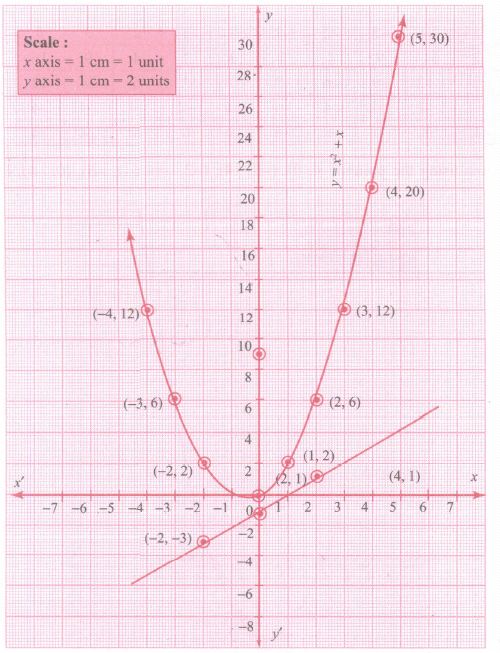
To solve: X2 + 1 = 0, subtract X2 + 1 = 0 from y = X2 + x.
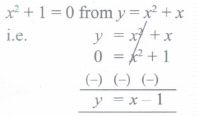
This is a straight line.
Draw the line y = x - 1.
| x | -2 | 0 | 2 |
| -1 | -1 | -1 | -1 |
| y | -3 | -1 | 1 |
Plotting the points (-2, -3), (0, -1), (2, 1) we get a straight line. This line does not intersect the parabola. Therefore there is no real roots for the equation X2 + 1 = 0.
45.
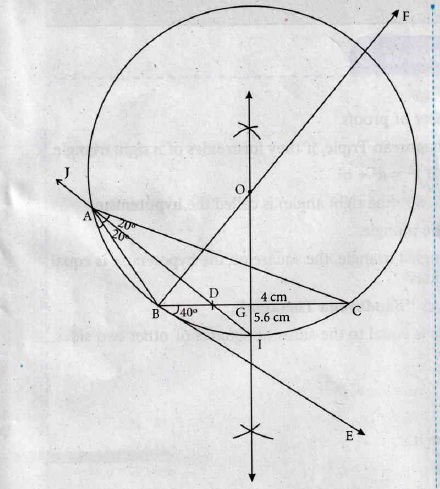
Construction:
Steps (1) Draw a line segment BC = 5.6 cm
Steps (2) At B, draw BE such that \(\angle CBE={ 60 }^{ 0 }\)
Steps (3) At B draw BF such that \(\angle EBF={ 90 }^{ 0 }\)
Steps (4) Drawn the perpendicular bisector to BC, which intersects BF at O and BC at G.
Steps (5) With O as centre and OB as radius draw a circle
Steps (6) From B, marked an arc of 4 cm on BC at D.
Steps (7) The perpendicular bisector intersects the circle at I. Joined ID.
Steps (8) ID produced meets the circle at A. Now joined AB and AC. Then \(\triangle\)ABC is the required triangle.
46.
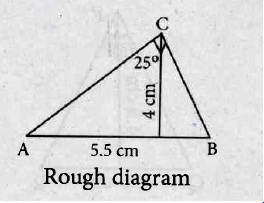
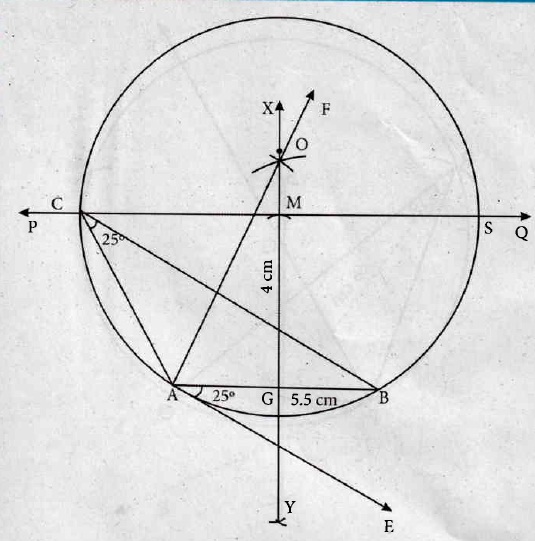
Construction:
Step (1) Draw \(\bar { AB } =5.5cm\)
Step (2) Draw \(\angle BAE={ 25 }^{ 0 }\)
Step (3) Draw \(\angle FAE={ 90 }^{ 0 }\)
Step (4) Drawn the perpendicular bisector XY to AB which intersects AF at O and AB at G.
Step (5) With O as center and OA as radius drawn a circle
Step (6) XY intersects AB at G. On XY from G marked an arc at M such that GM = 4 cm
Step (7) Drawn PQ through M which is parallel to AB.
Step (8) PQ meets the circle at C and S.
Step (9) Joined AC and BC. Now \(\triangle\)ABC is the required triangle

10th Standard Syllabus & Materials
10th Standard
TN 10th English Prose - 2 - The Night the Ghost Got in Important Questions And Answers Study Material - QB365 Set A
NEW10th Standard
TN 10th English Supplementary - 1 - The Tempest Important Questions And Answers Study Material - QB365 Set A
NEW10th Standard
TN 10th English Poem - 1 - Life Important Questions And Answers Study Material - QB365 Set A
NEW10th Standard
TN 10th English Prose - 1 - His First Flight Important Questions And Answers Study Material - QB365 Set A



Tamilnadu Stateboard 10th Standard Subjects
Tamilnadu Stateboard Standards





