
 100% FREE ACCESS
10th Standard Syllabus & Materials
10th Standard
TN 10th English Prose - 4 - The Attic Important Questions And Answers Study Material - QB365 Set A
NEW10th Standard
TN 10th English Supplementary - 3 - The Story of Mulan Important Questions And Answers Study Material - QB365 Set A
NEW10th Standard
TN 10th English Poem - 3 - I am Every Woman Important Questions And Answers Study Material - QB365 Set A
NEW10th Standard
TN 10th English Prose - 3 - Empowered Women Navigating The World Important Questions And Answers Study Material - QB365 Set A
NEW10th Standard
TN 10th English Supplementary - 2 - Zigzag Important Questions And Answers Study Material - QB365 Set A
NEW10th Standard
TN 10th English Poem - 2 - The Grumble Family Important Questions And Answers Study Material - QB365 Set A

Published on: 09/05/2020
10th Standard Maths English Medium Public Exam Model Question Paper - II June 2020
Download Tamil Nadu 10th Standard Maths question papers, model tests, one-mark questions, important questions, and public exam papers in PDF format. Free study materials and answer keys for TN State Board students.
Questions + Answers key
Take MCQ Maths Test1.
How many terms are there in the G.P : 5, 20, 80, 320,..., 20480
5
6
7
9
2.
3.
4.
5.
The angle of depression of the top and bottom of 20 m tall building from the top of a multistoried building are 30° and 60° respectively. The height of the multistoried building and the distance between two buildings (in metres) is
20, 10\(\sqrt { 3 } \)
30, 5\(\sqrt { 3 } \)
20, 10
30, 10\(\sqrt { 3 } \)
6.
If sin \(\theta \) = cos \(\theta \), then 2 tan2 \(\theta \) + sin2 \(\theta \) -1 is equal to
\(\frac { -3 }{ 2 } \)
\(\frac { 3 }{ 2 } \)
\(\frac { 2 }{ 3 } \)
\(\frac { -2 }{ 3 } \)
7.
The least number that is divisible by all the numbers from 1 to 10 (both inclusive) is
2025
5220
5025
2520
8.
9.
Two poles of heights 6 m and 11 m stand vertically on a plane ground. If the distance between their feet is 12 m, what is the distance between their tops?
13 m
14 m
15 m
12.8 m
10.
The perimeters of two similar triangles ∆ABC and ∆PQR are 36 cm and 24 cm respectively. If PQ = 10 cm, then the length of AB is
\(6\frac { 2 }{ 3 } cm\)
\(\frac { 10\sqrt { 6 } }{ 3 } cm\)
\(66\frac { 2 }{ 3 } cm\)
15 cm
11.
A spherical ball of radius r1 units is melted to make 8 new identical balls each of radius r2 units. Then r1:r2 is
2:1
1:2
4:1
1:4
12.
f(x) = (x + 1)3 - (x - 1)3 represents a function which is
linear
cubic
reciprocal
quadratic
13.
Let f(x) = \(\sqrt { 1+x^{ 2 } } \) then
f(xy) = f(x).f(y)
f(xy) ≥ f(x).f(y)
f(xy) ≤ f(x).f(y)
None of these
14.
Which of the following should be added to make x4 + 64 a perfect square
4x2
16x2
8x2
-8x2
15.
If the radii of the circular ends of a conical bucket which is 45 cm high are 28 cm and 7 cm, find the capacity of the bucket. (Use π = \(\frac{22}{7}\))
16.
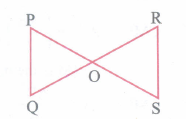
In figure if PQ || RS Prove that \(\Delta POQ\sim \Delta SOQ\)
17.
The marks scored by 5 students in a test for 50 marks are 20, 25, 30, 35, 40. Find the S.D for the marks. If the marks are converted for 100 marks, find the S.D. for newly obtained marks.
18.
Using quadratic formula solve the following equations.9x2-9(a+b)x+(2a2+5ab+2b2)=0
19.
Find the LCM and HCF of 6 and 20 by the prime factorisation method.
20.
If A (-5, 7), B (-4, -5), C (-1, -6) and D (4, 5) are the vertices of a quadrilateral, find the area of the quadrilateral ABCD.
21.
Find the values of x, y, z if
\(\left[ \begin{matrix} x & y-z & z+3 \end{matrix} \right] +\left[ \begin{matrix} y & 4 & 3 \end{matrix} \right] =\left[ \begin{matrix} 4 & 8 & 16 \end{matrix} \right] \)
22.
In fig. if PQ || BC and PR || CD prove that
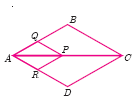
\(\frac { QB }{ AQ } =\frac { DR }{ AR } \)
23.
Find k, if f(k) = 2k - 1 and f o f(k) = 5.
24.
The following table gives the values of mean and variance of heights and weights of the 10th standard students of a school.
| Height | Weight | |
| Mean | 155 cm | 46.50 kg |
| Variance | 72.25 cm2 | 28.09 kg |
Which is more varying than the other?
25.
What is the inclination of a line whose slope is 0
26.
First term a and common difference d are given below. Find the corresponding A.P
a = 5, d = 6
27.
If the total surface area of a cone of radius 7cm is 704 cm2, then find its slant height.
28.
prove that 1+\(\frac { co{ t }^{ 2 }\theta }{ 1+cosec\theta } \) = cosec\(\theta \)
29.
If 15tan2 θ+4 sec2 θ=23 then find the value of (secθ+cosecθ)2 -sin2 θ
30.
In \(\angle ACD={ 90 }^{ 0 }\) and \(CD\bot AB\) Prove that \(\cfrac { { BC }^{ 2 } }{ { AC }^{ 2 } } =\cfrac { BD }{ AD } \)
31.
A spherical ball of iron has been melted and made into small balls. If the radius of each smaller ball is one-fourth of the radius of the original one, how many such balls can be made?
32.
C.V. of a data is 69%, S.D. is 15.6, then find its mean.
33.
Which of the following list of numbers form an AP? If they form an AP, write the next two terms:
-2, 2, -2, 2, -2
34.
A function f: (1,6) \(\rightarrow\)R is defined as follows:
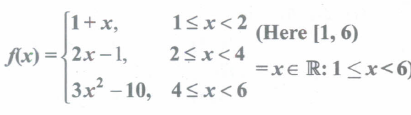
Find the value of f(5),
35.
If the points A(6, 1), B(8, 2), C(9, 4) and D(P, 3) are the vertices of a parallelogram, taken in order. Find the value of P.
36.
If A = \(\left[ \begin{matrix} 1 & -1 & 2 \end{matrix} \right] \), B = \(\left[ \begin{matrix} 1 & -1 \\ 2 & 1 \\ 1 & 3 \end{matrix} \right] \) and C = \(\left[ \begin{matrix} 1 & 2 \\ 2 & -1 \end{matrix} \right] \) show that (AB)C = A(BC)
37.
A bag contains 12 blue balls and x red balls. If one ball is drawn at random (i) what is the probability that it will be a red ball? (ii) If 8 more red balls are put in the bag, and if the probability of drawing a red ball will be twice that of the probability in (i), then find x.
38.
A man saved Rs.16500 in ten years. In each year after the first he saved Rs.100 more than he did in the preceding year. How much did he save in the first year?
39.
Find the equation of a straight line Passing through (1, -4) and has intercepts which are in the ratio 2:5
40.
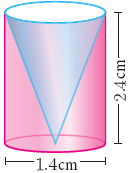
From a solid cylinder whose height is 2.4 cm and diameter 1.4 cm, a conical cavity of the same height and base is hollowed out. Find the total surface area of the remaining solid.
41.
show that \(\left( \frac { 1+ta{ n }^{ 2 }A }{ 1+co{ t }^{ 2 }A } \right) ={ \left( \frac { 1-ta{ nA } }{ 1-cotA } \right) }^{ 2 }\)
42.
If the function f is defined by
\(f(x)= \begin{cases}x+2 & \text { if } x>1 \\ 2 & \text { if }-1 \leq x \leq 1 \\ x-1 & \text { if }-3<x<-1\end{cases}\)
find the values of
i) f(3)
ii) f(0)
iii) f(-1.5)
iv) f(2) + f(-2)
43.
Graph the following quadratic equations and state their nature of solutions.
(2x - 3)(x + 2) = 0
44.
Draw the graph of y = 2x2 and hence solve 2x2 - x - 6 = 0
45.
Draw a circle of radius 4 cm. At a point L on it draw a tangent to the circle using the alternate segment.
46.
Construct a \(\triangle\)ABC such that AB = 5.5 cm, \(\angle\)C = 25o and the altitude from C to AB is 4 cm.
1.
(c)
7
2.
(b)
3.
(d)
4.
(d)
5.
(d)
30, 10\(\sqrt { 3 } \)
6.
(b)
\(\frac { 3 }{ 2 } \)
7.
(d)
2520
8.
(c)
9.
(a)
13 m
10.
(d)
15 cm
11.
(a)
2:1
12.
(d)
quadratic
13.
(c)
f(xy) ≤ f(x).f(y)
14.
(b)
16x2
15.
Clearly bucket forms frustum of a cone such that the radii of its circular ends are r1 = 28 cm, r2 = 7 cm, h = 45 cm
Capacity of the bucket = volume of the frustum
\(\Rightarrow \frac { 1 }{ 3 } \times \pi h[{ r }_{ 1 }^{ 2 }+{ r }_{ 2 }^{ 2 }+{ r }_{ 1 }{ r }_{ 2 }]\)
\(\Rightarrow \frac { 1 }{ 3 } \times \frac { 22 }{ 7 } \times 45[{ 28 }^{ 2 }+{ 7 }^{ 2 }+28\times 7)]\)
= 22 x 15 x (28 x 4 + 7 + 28)
\(\Rightarrow 330\times 147{ cm }^{ 2 }\Rightarrow 48510{ cm }^{ 2 }\)
16.
PQ II RS
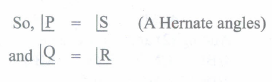
Also

\(\angle \therefore \Delta POQ\sim \Delta SOR\) (AAA similarity criterion)
17.
Let assumed mean A = 30
C = 5
| x | d' = \(\frac { x-30 }{ 5 } \) | d'2 |
| 20 | -2 | 4 |
| 25 | -1 | 1 |
| 30 | 0 | 0 |
| 35 | 1 | 1 |
| 40 | 2 | 4 |
| Σd' = 0 | Σd'2 = 10 |
σ =\(\sqrt { \left( \frac { \Sigma d'^{ 2 } }{ n } \right) -\left( \frac { \Sigma d' }{ n } \right) ^{ 2 } } \) x c
=\(\sqrt { \frac { 10 }{ 5 } -0 } \) x 5
=\(\sqrt { 2 } \) x 5
= 5\(\sqrt { 2 } \)
To convert the values for 100, all the values will be multiplied by 2. Therefore the new values are 40, 50, 60, 70, 80.
Let A = 60, C = 10
| x | d' = \(\frac { x-60 }{ 10 } \) | d'2 |
| 40 | -2 | 4 |
| 50 | -1 | 1 |
| 60 | 0 | 0 |
| 70 | 1 | 1 |
| 80 | 2 | 4 |
σ =\(\sqrt { \left( \frac { \Sigma d'^{ 2 } }{ n } \right) -\left( \frac { \Sigma d' }{ n } \right) ^{ 2 } } \) x c
=\(\sqrt { \frac { 10 }{ 5 } -0 } \) x 10
=\(\sqrt { 2 } \) x 10
= 10\(\sqrt { 2 } \)
S.D. also be multiplied by 2. It is also true for the division also.
18.
9x2-9(a+b)x+(2a2+5ab+2b2)=0
Comparing this with ax2 + bx + c = O.
a =9
b = -9(a + b)
c = (2a2 + 5ab + 2b2)
∴ ∆=B2-4AC
⇒ 81(a+b)2-36(2a2+5ab+2b2)
⇒ 9a2 + 9b2 - 18ab
⇒ 9(a - b)2> 0
∴ the roots are real and given by
\(\beta =\frac { -B-\sqrt { D } }{ 2A } =\frac { 9(a+b)+3(a-b) }{ 18 } \)
\(=\frac { 12a+6b }{ 18 } =\frac { 2a+b }{ 3 } \)
\(\beta =\frac { -B-\sqrt { D } }{ 2A } =\frac { 9(a+b)+3(a-b) }{ 18 } \)
\(=\frac { 6a+12b }{ 18 } =\frac { a+2b }{ 3 } \)
19.
We have 6 = 21 x 31 and
20 = 2 x 2 x 5 = 22 x 51
You can find HCF (6, 20) = 2 and LCM (6, 20) = 2 x 2 x 3 x 5 = 60.
As done in your earlier classes. Note that HCF (6, 20) = 21 = product of the smallest power of each common prime factor in the numbers.
LCM (6, 20) = 22 x 31 x 51 = 60.
= Product of the greatest power of each prime factor, involved in the numbers.
20.
By joining B to D, you will get too triangles ABD and BCD.
Now, the area of ΔABD
=\(\frac { 1 }{ 2 } \)[ -5(-5 - 5) + (-4)(5 -7) + 4(7 + 5)]
=\(\frac { 1 }{ 2 } \)(50 + 8 + 48)
=\(\frac { 106 }{ 2 } \) = 53 square units.
Also, the area of ΔBCD
=\(\frac { 1 }{ 2 } \) = [-4(-6 - 5) - 1(5 + 5) + 4(-5 + 6)]
=\(\frac { 1 }{ 2 } \)(44 - 10 + 4)
= 19 square units.
So, the area of quadrilateral ABCD
= 53 + 19 = 72 square units.
21.
\(\left[ \begin{matrix} x & y-z & z+3 \end{matrix} \right] +\left[ \begin{matrix} y & 4 & 3 \end{matrix} \right] =\left[ \begin{matrix} 4 & 8 & 16 \end{matrix} \right] \)
x + y = 4 ...(1)
y - z + 4 = 8 ..(2)
From (3), we get z =10
From (2), we get y -10 + 4 = 8
From (2), we get y = 14
From (1) we get x + 14 = 4
x = -10
x = -10, y = 14, z = 10
22.
From (1) and (2) we have
\(\frac{A Q}{A B} =\frac{A R}{A D}
\)
\(\frac{A B}{A Q} =\frac{A D}{A R}
\)
\(\frac{A Q+Q B}{A Q} =\frac{A R+R D}{A R}
\)
\(1+\frac{Q B}{A Q} =1+\frac{R D}{A R}
\)
\(\Rightarrow \frac{Q B}{A Q} =\frac{D R}{A R}
\)
23.
f(k) - 2k - 1
f o f(k) = 5
f(f(k)) = f(2k - 1) = 5
⇒ 2(2k-1) -1 = 5
4k - 2 -1 = 5 ⇒ 4k = 8
k = 2
24.
For comparing two data, first we have to find their coefficient of variations
Mean \(\bar { { x }_{ 1 } } \) = 155 cm, variance σ12 = 72.25 cm2
Therefore standard deviation σ1 = 8.5
Coefficient of variation C.V1 = \(\frac { { \sigma }_{ 1 } }{ \bar { { x }_{ 1 } } } \) x 100%
C.V1 = \(\frac { 8.5 }{ 15.5 } \) x 100% = 5.48% (for heights)
Mean \(\bar { { x }_{ 2 } } \) = 155 cm, variance σ22 = 72.25 kg2
Standard deviation σ2 = 5.3 kg
Coefficient of variation CV2 = \(\frac { { \sigma }_{ 2 } }{ \bar { { x }_{ 2 } } } \) x 100%
C.V2 = \(\frac { 5.3 }{ 46.50 } \) x 100% = 11.40% (for weights)
C.V1 = 5.48% = and CV2 = 11.40%
Since C.V2 > C.V1, the weight of the students is more varying than the height.
25.
Given slope 'm' = 0
tan θ = 0 = tan 00
θ = 00
26.
First term a = 5; common difference d = 6.
A.P.is given by., a + d, a + 2d, a + 3d,......
In this case 5, 5 + 6, 5 + 2(6),5 + 3 (6),...
5, 11, 17 ,23,...
The required A.P. is 5, 11,17,23,....
27.
Given that, radius r = 7 cm
Now, total surface area of the cone = \(\pi\)r(l + r)sq. units
T.S.A = 704 cm2
704 = \(\frac{22}{7}\times7(l+7)\)
32 = l + 7 implies l = 25 cm
Therefore, slant height of the cone is 25 cm.
28.
1 + \(\frac { co{ t }^{ 2 }\theta }{ 1+cosec\theta +1 } \) = 1+ \(\frac { cose{ c }^{ 2 }\theta -1 }{ cosec\theta +1 } \) [since cosec2-1 = cot2\(\theta \)
= 1+\(\frac { (cosec\theta +1)(cosec\theta -1) }{ cosec\theta +1 } \)
1 +( cosec\(\theta \)-1) = cosec\(\theta \)
29.
30.
\(\Delta ACD\sim \Delta ABC\)
So,
\(\cfrac { AC }{ AB } =\cfrac { AD }{ AC } \)
AC2 = AB ·AD
Similarly \(\Delta BCD\sim \Delta BAC\)
So,
\(\cfrac { BC }{ BA } =\cfrac { BD }{ BC } \)
BC2 = BA·BD
From (1) and (2)
\(\cfrac { { BC }^{ 2 } }{ AC^{ 2 } } =\cfrac { BA.BD }{ AB.AD } =\cfrac { BD }{ AD } \)
31.
No. of balls required \(=\frac { \frac { 4 }{ 3 } \pi { r }^{ 3 } }{ \frac { 4 }{ 3 } \pi \times { \left( \frac { r }{ 4 } \right) }^{ 3 } } \)
\(={ r }^{ 3 }\times \frac { 4 }{ r } \times \frac { 4 }{ r } \times \frac { 4 }{ r } =64\)
32.
CV =\(\frac { \sigma }{ \bar { x } } \) x 100 ⇒ \(\bar { x } =\frac { \sigma }{ CV } \) x 100
\(\bar { x } =\frac { 15.6 }{ 6.9 } \) x 100 = 22.6
33.
-2, 2, -2, 2, -2
t2 - t1 = 2-(-2) = 4
t3 - t2 = -2 -2 = -4
t4 - t3 = 2 - (-2) = 4
It is not an A.P.
34.
F(5) = 3x2 - 10
= 3(5)2- 10 = 75 - 10 = 65
35.
We know that diagonals at a parallelogram bisect each other.
So, the coordinates of the mid-point at AC = coordinates of the mid-point at BD.
i.e., \(\left[ \frac { 6+9 }{ 2 } ,\frac { 1+4 }{ 2 } \right] =\left[ \frac { 8+P }{ 2 } ,\frac { 2+3 }{ 2 } \right] \)
\(\left[ \frac { 15 }{ 2 } ,\frac { 5 }{ 2 } \right] =\left[ \frac { 8+P }{ 2 } ,\frac { 5 }{ 2 } \right] \)
\(\frac { 15 }{ 2 } =\frac { 8+P }{ 2 } \)
P = 7
36.
LHS (AB)C
AB = \({ \left[ \begin{matrix} 1 & -1 & 2 \end{matrix} \right] }_{ 1\times 3 }{ \left[ \begin{matrix} 1 & -1 \\ 2 & 1 \\ 1 & 3 \end{matrix} \right] }_{ 3\times 2 }=\left[ \begin{matrix} 1-2+2 & -1-1+6 \end{matrix} \right] =\left[ \begin{matrix} 1 & 4 \end{matrix} \right] \)
(AB)C = \({ \left[ \begin{matrix} 1 & 4 \end{matrix} \right] }_{ 1\times 2 }\times { \left[ \begin{matrix} 1 & 2 \\ 2 & -1 \end{matrix} \right] }_{ 2\times 2 }=\left[ \begin{matrix} 1+8 & 2-4 \end{matrix} \right] =\left[ \begin{matrix} 9 & -2 \end{matrix} \right] \) ....(1)
RHS = A(BC)
BC = \({ \left[ \begin{matrix} 1 & -1 \\ 2 & 1 \\ 1 & 3 \end{matrix} \right] }_{ 3\times 2 }\times { \left[ \begin{matrix} 1 & 2 \\ 2 & -1 \end{matrix} \right] }_{ 2\times 2 }=\left[ \begin{matrix} 1-2 & 2+1 \\ 2+2 & 4-1 \\ 1+6 & 2-3 \end{matrix} \right] =\left[ \begin{matrix} -1 & 3 \\ 4 & 3 \\ 7 & -1 \end{matrix} \right] \)
A(BC) = \({ \left[ \begin{matrix} 1 & -1 & 2 \end{matrix} \right] }_{ 1\times 3 }{ \left[ \begin{matrix} -1 & 3 \\ 4 & 3 \\ 7 & -1 \end{matrix} \right] }_{ 3\times 2 }\)
A(BC) = \(\left[ \begin{matrix} -1-4+14 & 3-3-2 \end{matrix} \right] =\left[ \begin{matrix} 9 & -2 \end{matrix} \right] \) ....(2)
From (1) and (2), (AB)C = A(BC).
37.
Total number of balls = blue balls + red balls
n(S) = 12 + x
(i) The probability that it will be a red ball:
Let A be the event of selecting a red ball
n(A) = x
\(\mathrm{P}(\mathrm{A})=\frac{n(A)}{n(S)} \)
\(\mathrm{P}(\mathrm{A})=\frac{x}{12+x} \)
(ii) If 8 more red balls are put in the bag then the number of red balls = x + 8
Total number of balls = 12 + x + 8
Probability of drawing a red ball
\(\mathrm{P}(\mathrm{B}) =\frac{n(B)}{n(S)} \)
\(=\frac{x+8}{12+x+8}=\frac{x+8}{x+20} \)
If the probability of drawing a red ball will be twice that of the probability (i), then
\(\frac{x+8}{x+20}=2 \times\left[\frac{x}{12+x}\right]\)
(x + 8)(12 + x) = 2x (x + 20)
12x + 96 + x2 + 8x = 2x2 + 40x
2x2 - x2 + 40x - 12x - 8x - 96 = 0
x2 + 20x - 96 = 0
(x - 4) (x + 24) = 0
x = 4 and x = - 24 (not possible)
By applying the value of x in P(A)
we get P(A) \(=\frac{4}{12+4}=\frac{4}{16}\)
\(P(A)=\frac{1}{4}\)
x = 4
38.
Let the amount he saved in the first year be x
Then x + (x + 100) + (x + 200) + ... 10 terms
= 16500
x+ x + 100 + x + 200 + ... 10 terms = 15500
(x + x + ... 10 terms) + (100 + 200 + ... 9 terms)
= 16500
\(10 x+\frac{9}{2}[2(100)+8(100)]=16500\)
10x = 16500 - 4500
10x = 12000
\(x=\frac{12000}{10}=1200\)
His 1st year saving = Rs 1200
39.
Given that intercepts are in the ratio 2 : 5
\(\frac{a}{b} =\frac{2}{5} \)
\(a =\frac{2 b}{5} \)
Equation of the line in Intercepts form is \(\frac{x}{a}+\frac{y}{b}=1\)
\(\frac{x}{\left(\frac{2 b}{5}\right)}+\frac{y}{b}=1 \)
\(\frac{5 x}{2 b}+\frac{y}{b}=1 \)
5x + 2y = 2b
This passes through ( 1, - 4)
5(1) + 2(-4) = 2b
\(5-8=2 b \Rightarrow b=-\frac{3}{2} \)
\(a =\frac{2 b}{5}=\frac{2\left(-\frac{3}{2}\right)}{5}=-\frac{3}{5} \)
Equation of a straight line is
\(\frac{x}{a}+\frac{y}{b}=1 \Rightarrow \frac{x}{\left(-\frac{3}{5}\right)}+\frac{y}{\left(-\frac{3}{2}\right)}=1\)
\(\frac{5 x}{-3}+\frac{2 y}{-3}=1\)
5x + 2y + 3 = 0.
40.
Let h and r be the height and radius of the cone and cylinder.
Let l be the slant height of the cone.
Given that, h = 2.4 cm and d = 1.4 cm ; r = 0.7 cm
Here, total surface area of the remaining solid} C.S.A. of the cylinder + C.S.A. of the cone + area of the bottom
= 2\(\pi\)rh + \(\pi\)rl + \(\pi\)r2 sq.units
Now, \(\\ \\ l=\sqrt { { r }^{ 2 }+{ h }^{ 2 } } =\sqrt { 0.49+5.76 } =\sqrt { 6.25 } =2.5cm\)
Area of the remaining solid = 2\(\pi\)rh + \(\pi\)rl + \(\pi\)r2 sq.units
= \(\pi\)r(2h + l + r)
\(\frac { 22 }{ 7 } \times 0.7\times [(2\times 2.4)+2.5+0.7]\)
Therefore, total surface area of the remaining solid is 17.6 m2
41.
LHS
\(\left( \frac { 1+ta{ n }^{ 2 }A }{ 1+co{ t }^{ 2 }A } \right) =\frac { 1+ta{ n }^{ 2 } }{ 1+\frac { 1 }{ ta{ n }^{ 2 }A } } \)
=\(\frac { 1+ta{ n }^{ 2 }A }{ \frac { ta{ n }^{ 2 }A+1 }{ ta{ n }^{ 2 }A } } =ta{ n }^{ 2 }A...(1)\)
RHS
\({ \left( \frac { 1-tanA }{ 1-cotA } \right) }^{ 2 }{ \left( \frac { 1-tanA }{ 1-\frac { 1 }{ tanA } } \right) }^{ 2 }\)
=\({ \left( \frac { 1-tanA }{ \frac { tanA-1 }{ tanA } } \right) }^{ 2 }\) = (-tan A)2 = tan2A ...(2)
From (1) and (2),\(\left( \frac { 1+ta{ n }^{ 2 }A }{ 1+co{ t }^{ 2 }A } \right) ={ \left( \frac { 1-tan }{ 1-cotA } \right) }^{ 2 }\)
42.
\(f(x)= \begin{cases}x+2 & \text { if } x>1 \\ 2 & \text { if }-1 \leq x \leq 1 \\ x-1 & \text { if }-3<x<-1\end{cases}\)
i) f(3) = 3 + 2 = 5
ii) f(0) = 2
iii) f(-1.5) = -1.5 - 1 = -2.5
iv) f(2) + f( -2) = ( 2 + 2 ) + ( -2 -1)
= 4 - 3 = 1
43.
(2x-3)(x+2)=0
2x2 - 3x + 4x - 6 = 0
2x2 + 1x-6 = 0
Let y = 2x2 +X - 6= 0
| x | -4 | -3 | -2 | -1 | 0 | 1 | 2 | 3 | 4 |
| x2 | 16 | 9 | 4 | 1 | 0 | 1 | 4 | 9 | 16 |
| 2x2 | 32 | 18 | 8 | 2 | 0 | 2 | 8 | 18 | 32 |
| x | -4 | -3 | -2 | -1 | 0 | 1 | 2 | 3 | 4 |
| -6 | -6 | -6 | -6 | -6 | -6 | -6 | -6 | -6 | -6 |
| y=x2-x-6 | 22 | 9 | 0 | -5 | -6 | -3 | -4 | 15 | 30 |
Step 2:
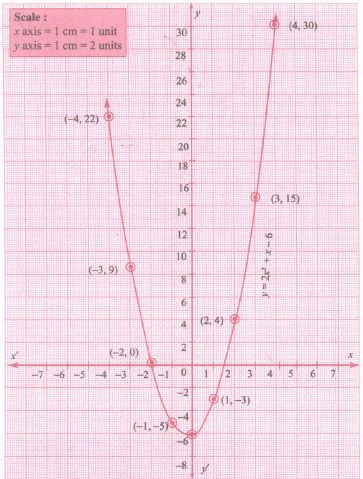
The points to be plotted: (-4,22), (-3, 9), (-2, 0), (-1, -5), (0, -6), (1, -3), (2,4), (3,15), (4, 30)
Step 3:
Draw. the parabola and mark the co-ordinates of the intersecting point of the parabola with the x-axis.
Step 4:
The points of intersection of the parabola with the x-axis are (-2, 0) and (1.5,0).
Since the parabola intersects the x-axis at two points, the equation has real and unequal roots
∴ Solution {-2, 1.5}
44.
Step 1: Draw the graph of y = 2x2 by preparing the table of values as below
| x | -2 | -1 | 0 | 1 | 2 |
| y | 3 | 2 | 0 | 2 | 8 |
Step 2 : To solve 2x2 - x - 6 = 0, subtract 2x2 - x - 6 = 0 from y = 2x2
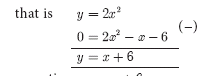
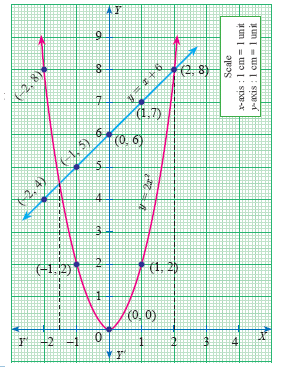
The equation y = x + 6 represents a straight line. Draw the graph of y = x + 6 by forming table of values as below
| x | -2 | -1 | 0 | 1 | 2 |
| y | 4 | 5 | 6 | 7 | 8 |
Step 3 : Mark the points of intersection of the curve y = 2x2 and the line y = x + 6. That is, (–1.5, 4.5) and (2,8)
Step 4 : The x coordinates of the respective points forms the solution set {–1.5,2} for 2x2 - x - 6 = 0
45.
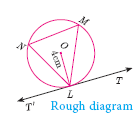
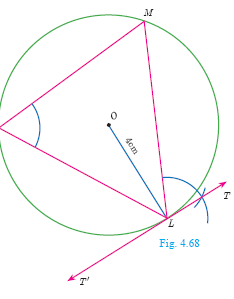
Given, radius = 4 cm
Construction
Step 1 : With O as the centre, draw a circle of radius 4 cm.
Step 2 : Take a point L on the circle. Through L draw any chord LM.
Step 3 : Take a point M distinct from L and N on the circle, so that L, M and N are in anti clockwise direction. Join LN and NM.
Step 4 : Through L draw a tangent TT' such that \(\angle\)TLM =\(\angle\)MNL
Step 5 : TT' is the required tangent.
46.
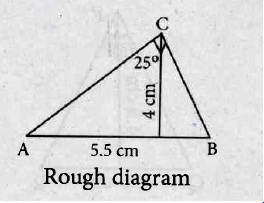
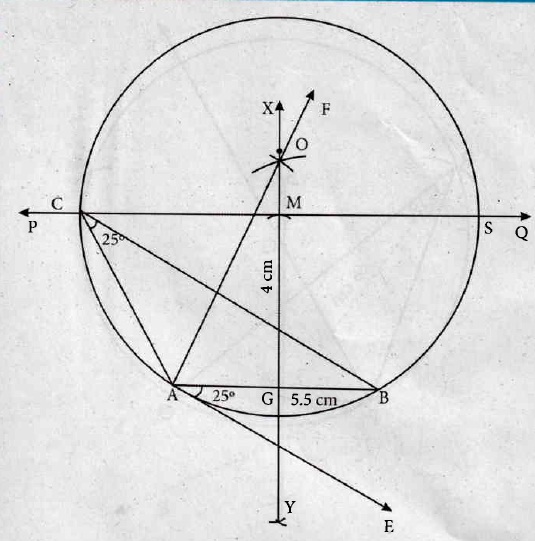
Construction:
Step (1) Draw \(\bar { AB } =5.5cm\)
Step (2) Draw \(\angle BAE={ 25 }^{ 0 }\)
Step (3) Draw \(\angle FAE={ 90 }^{ 0 }\)
Step (4) Drawn the perpendicular bisector XY to AB which intersects AF at O and AB at G.
Step (5) With O as center and OA as radius drawn a circle
Step (6) XY intersects AB at G. On XY from G marked an arc at M such that GM = 4 cm
Step (7) Drawn PQ through M which is parallel to AB.
Step (8) PQ meets the circle at C and S.
Step (9) Joined AC and BC. Now \(\triangle\)ABC is the required triangle

10th Standard Syllabus & Materials
10th Standard
TN 10th English Prose - 2 - The Night the Ghost Got in Important Questions And Answers Study Material - QB365 Set A
NEW10th Standard
TN 10th English Supplementary - 1 - The Tempest Important Questions And Answers Study Material - QB365 Set A
NEW10th Standard
TN 10th English Poem - 1 - Life Important Questions And Answers Study Material - QB365 Set A
NEW10th Standard
TN 10th English Prose - 1 - His First Flight Important Questions And Answers Study Material - QB365 Set A



Tamilnadu Stateboard 10th Standard Subjects
Tamilnadu Stateboard Standards





