
 100% FREE ACCESS
10th Standard Syllabus & Materials
10th Standard
TN 10th English Prose - 4 - The Attic Important Questions And Answers Study Material - QB365 Set A
NEW10th Standard
TN 10th English Supplementary - 3 - The Story of Mulan Important Questions And Answers Study Material - QB365 Set A
NEW10th Standard
TN 10th English Poem - 3 - I am Every Woman Important Questions And Answers Study Material - QB365 Set A
NEW10th Standard
TN 10th English Prose - 3 - Empowered Women Navigating The World Important Questions And Answers Study Material - QB365 Set A
NEW10th Standard
TN 10th English Supplementary - 2 - Zigzag Important Questions And Answers Study Material - QB365 Set A
NEW10th Standard
TN 10th English Poem - 2 - The Grumble Family Important Questions And Answers Study Material - QB365 Set A

Published on: 29/10/2022
QB365 provides a detailed and simple solution for every Possible Creative Questions in Class 12 Maths Subject - The World after World War II, English Medium. It will help Students to get more practice questions, Students can Practice these question papers in addition to score best marks.
Download Tamil Nadu 10th Standard Maths question papers, model tests, one-mark questions, important questions, and public exam papers in PDF format. Free study materials and answer keys for TN State Board students.
Questions + Answers key
Take MCQ Maths Test1.
If A = {1,2,3,4}, B = {2,4,5} , C = {2, 5} find (A - B) x (B - C)
2.
If A = {1,2,3), B = {3,4} and C = {4, 5, 6},then find \((A \times B) \cup(A \times C)\)
3.
Find f o g and g and g o f when f(x) = 2x + 1 and g(x) = x2 - 2
4.
If R = {(a, -2), (-5, b), (8, c), (d, -1)} represents the identity function, find the values of a, b, c and
5.
The following table represents a function from A = {5, 6, 8, 10} to B = {19, 15, 9, 11}, where f(x) = 2x - 1. Find the values of a and b.
| x | 5 | 6 | 8 | 10 |
|---|---|---|---|---|
| f(x) | a | 11 | b | 19 |
6.
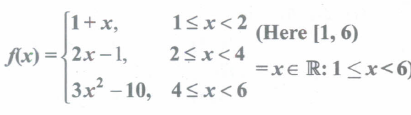
A function f: (1,6) \(\rightarrow\)R is defined as follows:
Find the value of f(2) - f( 4).
7.
A function f: (1,6) \(\rightarrow\)R is defined as follows:
Find the value of f(3),
8.
A function f: (1,6) \(\rightarrow\)R is defined as follows:
Find the value of f(5),
9.
Let A = {1, 2, 3, 4, 5}, B = N and f: A \(\rightarrow\)B be defined by f(x) = x2. Find the range of f. Identify the type of function.
10.
f(x) = (1+ x)
g(x) = (2x - 1)
Show that fo(g(x)) = gof(x)
11.
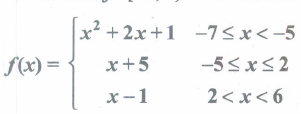
A function f: [-7,6) \(\rightarrow\) R is defined as follows.
\(\cfrac { 4f(-3)+2f(4) }{ f(-6)-3f(1) } \)
12.
A function f: [-7,6) \(\rightarrow\) R is defined as follows.
f(-7) - f(-3)
13.
A function f: [-7,6) \(\rightarrow\) R is defined as follows.
find 2f(-4) + 3f(2)
14.
Let f = {(2, 7); (3, 4), (7, 9), (-1, 6), (0, 2), (5,3)} be a function from A = {-1,0, 2, 3, 5, 7} to B = {2, 3, 4, 6, 7, 9}. Is this
(i) an one-one function
(ii) an onto function,
(iii) both one and onto function?
15.
The distance S (in kms) travelled by a particle in time ‘t’ hours is given by S(t) = \(\frac { { t }^{ 2 }+t }{ 2 } \). Find the distance travelled by the particle after
(i) three and half hours.
(ii) eight hours and fifteen minutes.
1.
\(\mathrm{A}-\mathrm{B} =\{1,2 ; 4\}-\{2,4,5\} =\{1\} \)
\(\mathrm{B}-\mathrm{C} =\{2,4,5\}-\{2,5\} =\{4\} \)
\(\therefore \ (\mathrm{A}-\mathrm{B}) \times(\mathrm{B}-\mathrm{C}) =\{1\} \times\{4\} =\{(1,4)\}
\)
2.
\(A \times B=\{1,2,3\} \times\{3,4\}\)
\(=\{(1,3) ;(1,4),(2,3),(2,4),(3,3),(3,4)\}\)
\(\mathrm{A} \times \mathrm{C}=\{1,2,3\} \times\{4,5,6\}\)
\(=\{(1,4),(1,5),(1,6),(2,4),(2,5)(2,6),(3,4),(3,5),(3,6)\}\)
\(\therefore(A \times B) \cup(A \times C)=\{(1,3),(1,4),(1,5),(1,6),(2,3),(2,4),(2,5),(2,6),(3,3),(3,4),(3,5),(3,6)\}\)
3.
f(x) = 2x + 1,g(x) = x2 - 2
f o g(x) = f(g(x) = f(x2 - 2) = 2(x2- 2) + 1 = 2x2 - 3
g o f(x) = g(f(x) = g(2x + 1) = (2x + 1)2-2 = 4 = x2 + 4x - 1
Thus f o g = 2x2 - 3,g o f = 4x2 + 4x-1 .From the above, we see that f o g ≠ g o f.
4.
R = {(a, -2), (-5, b), (8, c), (d, -1)} represents the identity function.
a = -2, b = -5, c = 8, d = -1.
5.
A = {5, 6, 8, to}, B = {19, 15,9, 11}
f(x) = 2x - 1
f(5) = 2(5) - 1 = 9
f(8) = 2(5)-1 = 15
\(\therefore\) a = 9; b = 15
6.
f(2) - f(4)
f(2) = 2x - 1
= 2(2) - 1 = 3
f(4) = 3x2 - 10
= 3(42) - 10 = 38
\(\therefore\) f(2) - f(4) = 3 - 38 = 35
7.
f(3) =. 2x - 1
= 2(3) - 1 = 6 - 1 = 5
8.
F(5) = 3x2 - 10
= 3(5)2- 10 = 75 - 10 = 65
9.
A = {1,2,3,4,5}
B = {1,2,3,4, ... }
f: A \(\rightarrow\)B, f(x) = x2
\(\therefore\) f(1) = 12 = 1
f(2) = 22= 4
f(3) = 32 = 9
f(4) = 42= 16
f(5) = 52= 25
\(\therefore\) Range of f = {1, 4, 9, 16, 25}
Elements in A have been connected with different elements in B. Therefore it is one-one function. But not all the elements in B have preimages in A. Therefore it is not on-to function.
10.
f(x) = 1 + x
g(x) = (2x - 1)
fog(x) = f(g(x) = f(2x - 1)
= 1 + 2x - 1 = 2x ...(1)
gof(x) = g(f(x) = g(1 + x) = 2(1 + x) - 1
= 2 + 2x - 1
= 2x + 1 ...(2)
(1) \(\neq \)(2)
\(\therefore\) fog(x) \(\neq \) gof(x)
It is verified
11.
\(\cfrac { 4f(-3)+2f(4) }{ f(-6)-3f(1) } \)
For f(1) & f(3)
Since 1 & 3 lies between -5 ≤ x ≤2, We take, f(x) = x +5
f(1) = 1 + 5 = 6
f(-3) = -3 +5 = 2
For f(4): Since 4 lies between 2 < x < 6 We take, f(x) = x -1
f(4) = 4 -1 = 3
For f(-6): Since -6 lies between -7≤ x < -5 ,We take, f(x) = x² + 2x +1
f(-6) = (-6)² + 2(-6) + 1 = 36 -12 + 1 = 24 +1 = 25
Now ,\(\cfrac { 4f(-3)+2f(4) }{ f(-6)-3f(1) } \) =\(\frac{ 4(2) +2(3) }{ 25 - 3(6)}\)
= \(\frac{ 8 + 6 }{ 25 -18}\)
= \(\frac{14 }{ 7}\) = 2
Hence, the value of \(\cfrac { 4f(-3)+2f(4) }{ f(-6)-3f(1) } \) = 2
12.
f(-7) = x2 + 2x + 1
= (-7)2 + 2(-7) + 1
= 49 - 14 + 1 = 36
f(3) = x + 5 = -3 + 5 = 2
f(-7) - f(-3) = 36 + 2 = 38
13.
2f(-4) + 3f(2)
f(-4) = x + 5 = -4 + 5 = 1
2f(-4) = 2 x 1 = 2
f(2) = x + 5 = 2 + 5 = 7
3f(2) = 3(7) = 21
∴ 2f(-4) + 3f(2) = 2 + 21 = 23
14.
It is both one-one and onto function
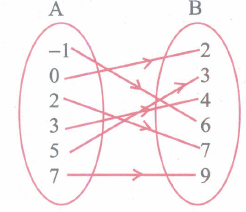
All the elements in A have their separate images in B. All the elements in B have their preimage in A. Therefore it is one-one and onto function.
15.
The distance travelled by the particle in time t hours is given by S(t)=\(\frac { { t }^{ 2 }+t }{ 2 } \).
(i) t = 3.5 hours. Therefore, S(3.5)=\(\frac { (3.5)^{ 2 }+3.5 }{ 2 } =\frac { 15.75 }{ 2 } \)=7.875
The distance travelled in 3.5 hours is 7.875 kms.
(ii) t = 8.25 hours. Therefore, S(8.25)=\(\frac { (8.25)^{ 2 }+8.25 }{ 2 } =\frac { 76.3125 }{ 2 } \)=38.15625
The distance travelled in 8.25 hours is 38.16 kms, approximately.

10th Standard Syllabus & Materials
10th Standard
TN 10th English Prose - 2 - The Night the Ghost Got in Important Questions And Answers Study Material - QB365 Set A
NEW10th Standard
TN 10th English Supplementary - 1 - The Tempest Important Questions And Answers Study Material - QB365 Set A
NEW10th Standard
TN 10th English Poem - 1 - Life Important Questions And Answers Study Material - QB365 Set A
NEW10th Standard
TN 10th English Prose - 1 - His First Flight Important Questions And Answers Study Material - QB365 Set A



Tamilnadu Stateboard 10th Standard Subjects
Tamilnadu Stateboard Standards





