
 100% FREE ACCESS
10th Standard Syllabus & Materials
10th Standard
TN 10th English Prose - 4 - The Attic Important Questions And Answers Study Material - QB365 Set A
NEW10th Standard
TN 10th English Supplementary - 3 - The Story of Mulan Important Questions And Answers Study Material - QB365 Set A
NEW10th Standard
TN 10th English Poem - 3 - I am Every Woman Important Questions And Answers Study Material - QB365 Set A
NEW10th Standard
TN 10th English Prose - 3 - Empowered Women Navigating The World Important Questions And Answers Study Material - QB365 Set A
NEW10th Standard
TN 10th English Supplementary - 2 - Zigzag Important Questions And Answers Study Material - QB365 Set A
NEW10th Standard
TN 10th English Poem - 2 - The Grumble Family Important Questions And Answers Study Material - QB365 Set A

Published on: 04/02/2020
10th Standard Maths Important Questions
Download Tamil Nadu 10th Standard Maths question papers, model tests, one-mark questions, important questions, and public exam papers in PDF format. Free study materials and answer keys for TN State Board students.
Questions + Answers key
Take MCQ Maths Test1.
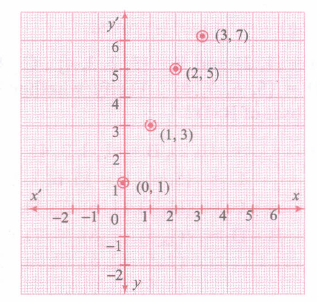
Let A = {0, 1, 2, 3} and B = {1, 3, 5, 7, 9} be two sets. Let f: A \(\rightarrow\)B be a function given by f(x) = 2x + 1. Represent this function as a graph.
2.
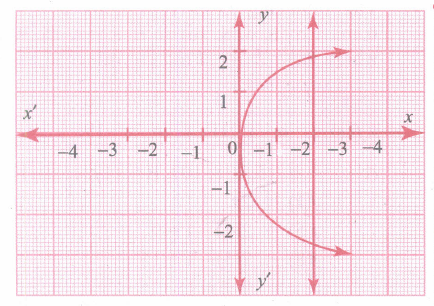
State whether the graph represent a function. Use vertical line test.
3.
Let A = {1,2, 3, 4} and B = {-1, 2, 3, 4, 5, 6, 7, 8, 9, 10, 11, 12} Let R = {(1, 3), (2, 6), (3, 10), (4, 9)} \(\subseteq \) A x B be a relation. Show that R is a function and find its domain, co-domain and the range of R.
4.
Solve the following quadratic equations by factorization method\(\sqrt { 2 } { x }^{ 2 }+7x+5\sqrt { 2 } =0\)
5.
Find the excluded values, if any of the following expressions.
\(\frac { { x }^{ 2 }+6x+8 }{ { x }^{ 2 }+x-2 } \)
6.
Write the sample space for selecting two balls from a bag containing 6 balls numbered 1 to 6 (using tree diagram).
7.
Two coins are tossed together. What is the probability of getting different faces on the coins?
8.
Find the sum of
12 + 22 +...+ 192
9.
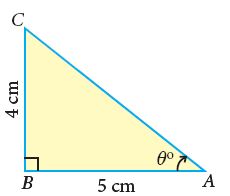
calculate \(\angle \)BAC in the given triangles (tan 38.7° = 0.8011 )
10.
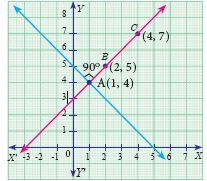
Find the equation of a line passing through the point A(1,4) and perpendicular to the line joining points (2, 5) and (4, 7).
11.
The external radius and the length of a hollow wooden log are 16 cm and 13 cm respectively. If its thickness is 4 cm then find its T.S.A.
12.
What is the slope of a line perpendicular to the line joining A(5, 1) and P where P is the mid-point of the segment joining (4, 2) and (-6, 4).
13.
Represent the function f(x) =\(\sqrt { 2x^{ 2 }-5x+3 } \) as a composition of two functions.
14.
Find the diameter of a sphere whose surface area is 154 m2.
15.
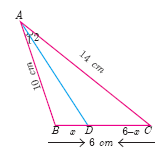
In the Figure, AD is the bisector of \(\angle\)BAC, if A = 10 cm, AC = 14 cm and BC = 6 cm. Find BD and DC.
16.
Find the area of the triangle formed by the points (1, –1), (–4, 6) and (–3, –5)
17.
18.
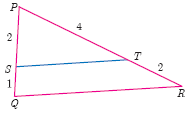
Show that \(\triangle\) PST~\(\triangle\) PQR
19.
Prove that tan2\(\theta \)-sin2 \(\theta \) = tan2 \(\theta \) sin2 \(\theta \)
20.
21.
22.
The range of first 10 prime number is ___________
9
20
27
5
23.
When Karuna divided surface area of a sphere by the sphere's volume, he got the answer as \(\frac { 1 }{ 3 } \). What is the radius of the sphere?
24 cm
9cm
54cm
4.5cm
24.
The radius of a wire is decreased to one-third of the original. If volume the same, then the length will be increased _______of the original.
3 times
6 times
9 times
27 times
25.
The ratio of the volumes of two spheres is 8 : 27. If r and R are the radii of sphere respectively, Then (R - r) : r is ___________
1:2
1:3
2:3
4:9
26.
27.
Find the value of P, given that the line \(\frac { y }{ 2 } =x-p\) passes through the point (-4, 4) is ____________
-4
-6
0
8
28.
Three circles are drawn with the vertices of a triangle as centres such that each circle touches the other two if the sides of the triangle are 2cm,3cm and 4 cm. find the diameter of the smallest circle.
1 cm
3 cm
5 cm
4 cm
29.
A line which intersects a circle at two distinct points is called ____________
Point of contact
secant
diameter
tangent
30.
If ABC is a triangle and AD bisects A, AB = 4cm, BD = 6cm, DC = 8cm then the value of AC is ____________
\(\frac { 16 }{ 3 } cm\)
\(\frac { 32 }{ 3 } cm\)
\(\frac { 3 }{ 16 } cm\)
\(\frac { 1 }{ 2 } cm\)
31.
32.
\(\frac { { x }^{ 2 }+7x12 }{ { x }^{ 2 }+8x+15 } \times \frac { { x }^{ 2 }+5x }{ { x }^{ 2 }+6x+8 } =\_ \_ \_ \_ \_ \_ \_ \_ \_ \)
x+2
\(\frac { x }{ x+2 } \)
\(\frac { 35{ x }^{ 2 }+60x }{ { 48x }^{ 2 }+120 } \)
\(\frac { 1 }{ x+2 } \)
33.
Consider the following statements:
(i) The HCF of x+y and x8-y8 is x+y
(ii) The HCF of x+y and x8+y8 is x+y
(iii) The HCF of x-y nd x8+y8 is x-y
(iv) The HCF of x-y and x8-y8 is x-y
(i) and (ii)
(ii) and (iii)
(i) and (iv)
(ii) and (iv)
34.
35.
44 ≡ 8 (mod12), 113 ≡ 85 (mod 12), thus 44 x 113 ≡______(mod 12):
4
3
2
1
36.
If f is identify function, then the value of f(1) - 2f(2) + f(3) is:
-1
-3
1
0
37.
If f(x) = ax - 2, g(x) = 2x - 1 and fog = gof, the value of a is ___________
3
-3
\(\frac { 1 }{ 3 } \)
13
38.
The function t which maps temperature in degree Celsius into temperature in degree Fahrenheit is defined Fahrenheit degree is 95, then the value of C \(t(C)=\frac { 9c }{ 5 } +32\) is ___________
37
39
35
36
39.
If f : R⟶R is defined by (x) = x2 + 2, then the preimage 27 are _________
0.5
5, -5
5, 0
\(\sqrt { 5 } ,-\sqrt { 5 } \)
40.
41.
42.
If sin A + sin2A = 1, then the value of the expression (cos2A + cos4A) is ___________
1
\(\frac{1}{2}\)
2
3
43.
If (sin α + cosec α)2 + (cos α + sec α)2 = k + tan2α + cot2α, then the value of k is equal to
9
7
5
3
44.
The probability of getting a job for a person is \(\frac{x}{3}\). If the probability of not getting the job is \(\frac{2}{3}\) then the value of x is
2
1
3
1.5
45.
Which of the following is not a measure of dispersion?
Range
Standard deviation
Arithmetic mean
Variance
46.
a cot \(\theta \) + b cosec\(\theta \) = p and b cot \(\theta \) + a cosec\(\theta \) = q then p2- q2 is equal to
a2 - b2
b2 - a2
a2 + b2
b - a
47.
An A.P. consists of 31 terms. If its 16th term is m, then the sum of all the terms of this A.P. is
16 m
62 m
31 m
\(\frac { 31 }{ 2 } \) m
48.
If the HCF of 65 and 117 is expressible in the form of 65m - 117 , then the value of m is
4
2
1
3
49.
When proving that a quadrilateral is a trapezium, it is necessary to show
Two sides are parallel
Two parallel and two non-parallel sides
Opposite sides are parallel
All sides are of equal length
50.
A straight line has equation 8y = 4x + 21. Which of the following is true
The slope is 0.5 and the y intercept is 2.6
The slope is 5 and the y intercept is 1.6
The slope is 0.5 and the y intercept is 1.6
The slope is 5 and the y intercept is 2.6
51.
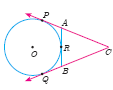
In figure CP and CQ are tangents to a circle with centre at O. ARB is another tangent touching the circle at R. If CP = 11 cm and BC = 7 cm, then the length of BR is
6 cm
5 cm
8 cm
4 cm
52.
If in triangles ABC and EDF,\(\cfrac { AB }{ DE } =\cfrac { BC }{ FD } \) then they will be similar, when
\(\angle B=\angle E\)
\(\angle A=\angle D\)
\(\angle B=\angle D\)
\(\angle A=\angle F\)
53.
A frustum of a right circular cone is of height 16 cm with radii of its ends as 8 cm and 20 cm. Then, the volume of the frustum is
3328\(\pi\) cm3
3228\(\pi\) cm3
3240\(\pi\) cm3
3340\(\pi\) cm3
54.
In a hollow cylinder, the sum of the external and internal radii is 14 cm and the width is 4 cm. If its height is 20 cm, the volume of the material in it is
5600\(\pi\) cm3
1120\(\pi\) cm3
56\(\pi\) cm3
3600\(\pi\) cm3
55.
If {(a, 8 ),(6, b)}represents an identity function, then the value of a and b are respectively
(8,6)
(8,8)
(6,8)
(6,6)
56.
If n(A x B) = 6 and A = {1,3} then n(B) is
1
2
3
6
57.
The values of a and b if 4x4 - 24x3 + 76x2 + ax + b is a perfect square are
100, 120
10, 12
-120, 100
12, 10
58.
\(\frac {3y - 3}{y} \div \frac {7y - 7}{3y^{2}}\) is
\(\frac {9y}{7}\)
\(\frac {9y^{2}}{(21y - 21)}\)
\(\frac {21y^2 - 42y + 21}{3y^{2}}\)
\(\frac {7(y^{2} - 2y + 1)}{y^{2}}\)
59.
From a point on a bridge across a river, the angles of depression of the banks on opposite sides at the river are 30° and 45°, respectively. If the bridge is at a height at 3 m from the banks, find the width at the river.
60.
Express the ratios cos A, tan A and sec A in terms of sin A.
61.
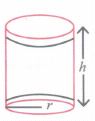
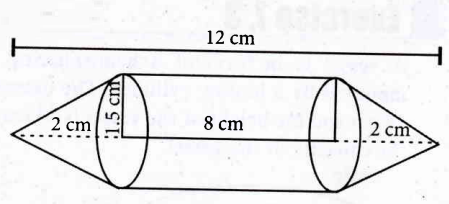
A wooden article was made by scooping out a hemisphere from each end of a cylinder as shown in figure. If the height of the cylinder is 10 cm and its base is of radius 3.5 cm find the total surface area of the article.
62.
Final the probability of choosing a spade or a heart card from a deck of cards.
63.
Find two consecutive natural numbers whose product is 20.
64.
A two digit number is such that the product of its digits is 12. When 36 is added to the number the digits interchange their places. Find the number.
65.
How many terms of the AP: 24, 21, 18, ... must be taken so that their sum is 78?
66.
If the sum of the first 14 terms of an AP is 1050 and its first term is 10, find the 20th term.
67.
Let A = {1, 2, 3, 4, 5}, B = N and f: A \(\rightarrow\)B be defined by f(x) = x2. Find the range of f. Identify the type of function.
68.
Find the area of the triangle formed by the points P(-1, 5, 3), Q(6, -2) and R(-3, 4).
69.
A function f: [-7,6) \(\rightarrow\) R is defined as follows.
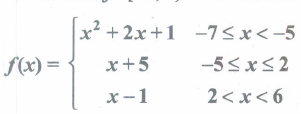
find 2f(-4) + 3f(2)
70.
Reduce the given Rational expressions to its lowest form
\(\frac { 10{ x }^{ 3 }-25{ x }^{ 2 }+4x-10 }{ -4-10{ x }^{ 2 } } \)
71.
Find the square root of the following expressions
\(\left[ \sqrt { 15 } { x }^{ 2 }+\left( \sqrt { 3 } +\sqrt { 10 } \right) x+\sqrt { 2 } \right] \left[ \sqrt { 5 } { x }^{ 2 }+\left( 2\sqrt { 5 } +1 \right) x+2 \right] \left[ \sqrt { 3 } { x }^{ 2 }+\left( \sqrt { 2 } +2\sqrt { 3 } \right) x+2\sqrt { 2 } \right] \)
72.
Three unbiased coins are tossed once. Find the probability of getting at most 2 tails or at least 2 heads.
73.
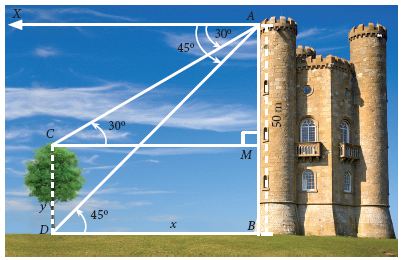
From the top of a tower 50 m high, the angles of depression of the top and bottom of a tree are observed to be 30° and 45° respectively. Find the height of the tree.(\(\sqrt { 3 } \) = 1.732)
74.
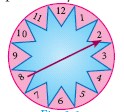
A game of chance consists of spinning an arrow which is equally likely to come to rest pointing to one of the numbers 1, 2, 3, …12. What is the probability that it will point to (i) 7 (ii) a prime number (iii) a composite number?
75.
A bird is sitting on the top of a 80 m high tree. From a point on the ground, the angle of elevation of the bird is 45°. The bird flies away horizontally in such away that it remained at a constant height from the ground. After 2 seconds, the angle of elevation of the bird from the same point is 30°. Determine the speed at which the bird flies.(\(\sqrt { 3 } \) = 1.732)
76.
A teacher asked the students to complete 60 pages of a record note book. Eight students have completed only 32, 35, 37, 30, 33, 36, 35 and 37 pages. Find the standard deviation of the pages yet to be completed by them.
77.
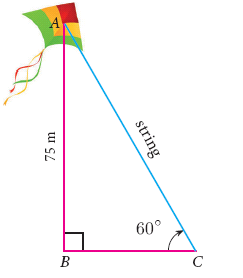
A kite is flying at a height of 75m above the ground, the string attached to the kite is temporarily tied to a point on the ground. The inclination of the string with the ground is \(60°\).find the length of the string ,assuming that there is no slack in the string.
78.
Find the equation of a line whose intercepts on the x and y axes are given below. 4, -6
79.
A hemispherical bowl is filled to the brim with juice. The juice is poured into a cylindrical vessel whose radius is 50% more than its height. If the diameter is same for both the bowl and the cylinder then find the percentage of juice that can be transferred from the bowl into the cylindrical vessel.
80.
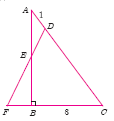
In Fig, ABC is a triangle with \(\angle\)B=90o, BC=3cm and AB=4 cm. D is point on AC such that AD=1 cm and E is the midpoint of AB. Join D and E and extend DE to meet CB at F. Find BF.
81.
82.
If f(x) = \(\frac { x-1 }{ x+1 } \), x ≠ 1 show that f(f(x)) = -\(\frac{1}{x}\), provided x ≠ 0.
83.
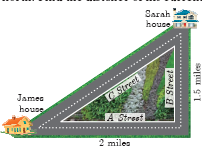
There are two paths that one can choose to go from Sarah’s house to James house. One way is to take C street, and the other way requires to take B street and then A street. How much shorter is the direct path along C street? (Using figure).
84.
A right angled triangle PQR where ∠Q = 90o is rotated about QR and PQ. If QR = 16 cm and PR = 20 cm, compare the curved surface areas of the right circular cones so formed by the triangle.
85.
In each of the following cases state whether the function is bijective or not. Justify your answer.
i. f : R ⟶ R defined by f(x) = 2x + 1
ii. f : R ⟶ R defined by f(x) = 3 - 4x2
86.
Find the value of k, if the area of a quadrilateral is 28 sq. units, whose vertices are (–4, –2), (–3, k), (3, –2) and (2, 3)
87.
If α and β are the roots of the polynomial f(x) = x2 - 2x + 3, find the polynomial whose roots are
α + 2, β + 2
88.
Construct a \(\triangle\)PQR in which QR = 5 cm, \(\angle\)P = 40o and the median PG from P to QR is 4.4 cm. Find the length of the altitude from P to QR.
89.
Construct a triangle similar to a given triangle PQR with its sides equal to \(\frac { 7 }{ 4 } \) of the corresponding sides of the triangle PQR (scale factor \(\frac { 7 }{ 4 } \)>1)
1.
A Graph f = {(x, f(x) / x \(\epsilon \) A}
{(0, 1), (1, 3), (2, 5), (3, 7)}
2.
It is not a function as the vertical line PQ cuts the graph at two points
3.
Domain of R = {1,2,3,4}
Co-domain of R = B = {-1, 2, 3,4,5,6, 7, 9, 10, 11,12}
Range of R = {3, 6,10, 9}
4.
\(\sqrt { 2 } { x }^{ 2 }+7x+5\sqrt { 2 } =0\)
\(\sqrt{2} x^{2}+2 x+5 x+5 \sqrt{2}=0\)
\(
\sqrt{2} x^{2}+\sqrt{2} \sqrt{2} x+5 x+5 \sqrt{2} =0
\)
\(\sqrt{2} x(x+\sqrt{2})+5(x+\sqrt{2}) =0
\)
\((x+\sqrt{2})(\sqrt{2} x+5) =0
\)
\(
x+\sqrt{2} =0
\) \(
\sqrt{2 x+5} =0
\)
\(x =-\sqrt{2}\) \(x =-\frac{5}{\sqrt{2}}\)
Solution is x \(=-\sqrt{2},-\frac{5}{\sqrt{2}}\)
5.
\(\frac { { x }^{ 2 }+6x+8 }{ { x }^{ 2 }+x-2 } \) is undefined when x2+x-2 = 0 i.e.
(x+2) (x-1) = 0.
∴ The excluded values are -2.1.
6.
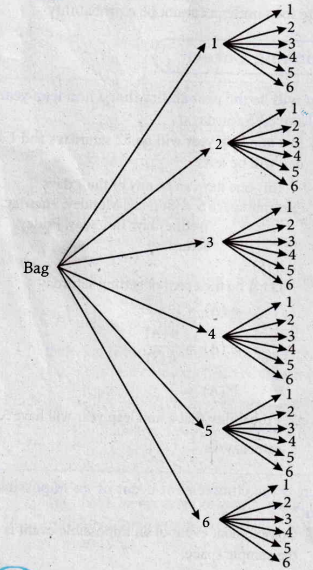
Sample Space
s = {(1, 1) (1,2) (1,3) (1,4) (1, 5) (1,6)
(2, 1) (2,2) (2, 3) (2, 4) (2, 5) (2, 6)
(3, 1) (3,2) (3, 3) (3, 4) (3, 5) (3, 6)
(4, 1) (4,2) (4, 3) (4, 4) (4, 5) (4, 6)
(5, 1) (5,2) (5,3) (5,4) (5, 5) (5,6)
(6, 1) (6,2) (6, 3) (6, 4) (6, 5) (6, 6)}
Total number of outcomes = 36
7.
When two coins are tossed together, the sample space is
S = {HH, HT, TH, TT} n(S) = 4
Let A be the event of getting different faces on the coins.
A = {HT, TH}; n(A) = 2
Probability of getting different faces on the coins is P(A) = \(\frac { n(A) }{ n(S) } =\frac { 2 }{ 4 } =\frac { 1 }{ 2 } \).
8.
12 + 22 +...+ 192 = \(\frac { 19\times \left( 19+1 \right) \left( 2\times 19+1 \right) }{ 6 } =\frac { 19\times 20\times 39 }{ 6 } =2470\)
9.
in the right triangle ABC [see figure. (a)]
tan \(\theta \) =\(\frac { opposite\ side\ }{ adjacent\ side\ } =\frac { 4 }{ 5 } \)
= tan-1(0.8)
\(\theta \) = \(38.7°\)(since tan \(38.7°\) = 0.8011)
\(\angle \)BAC = \(38.7°\)
10.
Let the given points be A(1, 4) , B(2, 5) and C(4, 7).
Slope of line BC = \(\frac { 7-5 }{ 4-2 } =\frac { 2 }{ 2 } =1\)
Let m be the slope of the required line.
Since the required line is perpendicular to BC,
m x 1 = −1
m = −1
The required line also pass through the point A(1, 4).
The equation of the required straight line is y − y1 = m(x - x1)
y - 4 = − 1(x − 1)
y - 4 = − x + 1
we get, x + y − 5 = 0
11.
External radius of hollow cylinder R = 16 cm
length h = 13 cm
Thickness R - r = 4
16 - r = 4
r = 12 cm
Total surface area of hollow cylinder \(=2 \pi(\mathrm{R}+\mathrm{r})(\mathrm{R}-\mathrm{r}+\mathrm{h}) \text { sq. units }\)
\(=2 \times \frac{22}{7} \times(16+12)(4+13) \)
\(=2 \times \frac{22}{7} \times 28 \times 17 \)
= 2992 sq. cm
12.
Mid point of line segment joining (4, 2) and (-6, 4)
\(\text { Mid point } =\left(\frac{x_{1}+x_{2}}{2}, \frac{y_{1}+y_{2}}{2}\right) \)
\(=P\left(\frac{4-6}{2}, \frac{2+4}{2}\right)
\)
\(=P\left(-\frac{2}{2}, \frac{6}{2}\right)=\mathrm{P}(-1,3)
\)
Now, slope of a line joining A (5, 1) and P (- 1, 3)
\(\mathrm{m}=\frac{y_{1}-y_{2}}{x_{1}-x}=\frac{1-3}{5+1}=\frac{-2}{6}=-\frac{1}{3}\)
Slope of a perpendicular to the line joining A and P
\(=-\frac{1}{m}=-\frac{1}{\left(-\frac{1}{3}\right)}=3\)
13.
We set f2(x) = 2x2 - 5x + 3 and f1(x) =\(\sqrt { x } \)
Then, f(x) = \(\\ \sqrt { 2x^{ 2 }-5x+3 } =\sqrt { { f }_{ 2 }(x) } \)
= f1{f2(x)} = f1f2(x)
14.
Let r be the radius of the sphere. Given that, surface area of sphere = 154 m2
4\(\pi\)r2 = 154
\(4\times \frac { 22 }{ 7 } \times { r }^{ 2 }=154\)
gives \({ r }^{ 2 }=154\times \frac { 1 }{ 4 } \times \frac { 7 }{ 22 } \)
hence, \({ r }^{ 2 }=\frac { 49 }{ 4 } \)We get r = \(\frac{7}{2}\)
Therefore, diameter is 7 m
15.
Let BD = x cm, then DC = (6 – x)cm
AD is bisector of\(\angle\) A
Therefore by Angle Bisector Theorem
\(\frac { AB }{ AC } =\frac { BD }{ DC } \)
\(\frac { 10 }{ 14 } =\frac { x }{ 6-x } \quad \frac { 5 }{ 7 } =\frac { x }{ 6-x } \)
So, 12x = 30 we get, \(x=\frac { 30 }{ 12 } =2.5\)
Therefore, BD = 2.5 cm, DC = 6−x = 6−2.5 = 3.5 cm
16.
(1,–1), (–4, 6) and (–3, –5)
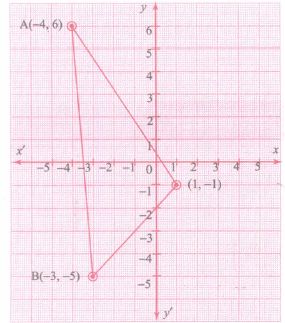
A(-4, 6), B(-3, -5), C(1, -1)
Area of triangle ABC \(
=\frac{1}{2}\left[\left(x_{1} y_{2}+x_{2} y_{3}+x_{3} y_{1}\right)\right.
\left.-\left(x_{2} y_{1}+x_{3} y_{2}+x_{1} y_{3}\right)\right]
\)
\(=\frac{1}{2}\left[x_{1}\left(y_{2}-y_{3}\right)+x_{2}\left(y_{3}-y_{1}\right)\right.
\left.+x_{3}\left(y_{1}-y_{2}\right)\right] \text { sq. units }
\)
\(=\frac{1}{2}[-4(-5+1)-3(-1-6)+1(6+5)]
\)
\(=\frac{1}{2}[-4 \times(-4)-3 \times(-7)+1 \times(11)]
\)
\(=\frac{1}{2}[16+21+11]
\)
\(=\frac{1}{2}(48)=24 \text { sq. units. }
\)
17.
18.
In \(\triangle\)PST and \(\triangle\)PQR,
\(\frac { PS }{ PQ } =\frac { 2 }{ 2+1 } =\frac { 2 }{ 3 } ,\frac { PT }{ PR } =\frac { 4 }{ 4+2 } =\frac { 2 }{ 3 } \)
Thus, \(\frac { PS }{ PQ } =\frac { PT }{ PR } \) and \(\angle\)P is common
Therefore, by SAS similarity,
\(\triangle\) PST~\(\triangle\)PQR
19.
tan2 \(\theta \) - sin 2\(\theta \) = tan2 \(\theta \) -\(\frac { si{ n }^{ 2 }\theta }{ co{ s }^{ 2 }\theta } \),cos2\(\theta \)
= tan2 \(\theta \) (1-cos2 \(\theta \) ) = tan2 \(\theta \) sin2 \(\theta \)
20.
(a)
21.
(a)
22.
(c)
27
23.
(b)
9cm
24.
(c)
9 times
25.
(a)
1:2
26.
(d)
27.
(b)
-6
28.
(a)
1 cm
29.
(b)
secant
30.
(a)
\(\frac { 16 }{ 3 } cm\)
31.
(c)
32.
(b)
\(\frac { x }{ x+2 } \)
33.
(a) Capital employed - Goodwill + current liabilities
34.
(c)
35.
(a)
4
36.
(d)
0
37.
(a)
3
38.
(c)
35
39.
(b)
5, -5
40.
(d)
41.
(c)
42.
(a)
1
43.
(b)
7
44.
(b)
1
45.
(c)
Arithmetic mean
46.
(b)
b2 - a2
47.
(i) To check if h is one – one, we assume that h(b1) = h(b2)
Then we get 2.47 b1 + 54.10 = 2.47 b2 + 54.10
2.47b1 = 2.47b2 ⇒ b1 = b2
Thus, h(b1) = h(b2) ⇒ b1 = b2, So, the function h is one – one.
(ii) If the length of the thigh bone b = 50, then the height is
h(50) = (2.47 x 50) + 54.10 = 177.6 cms
(iii) If the height of a person is 147.96 cms, then h(b) = 147.96 and so the length of the thigh bone is given by 2.47b + 54.10 = 147.96.
b = \(\frac { 93.86 }{ 2.47 } \)
Therefore, the length of the thigh bone is 38 cms.
48.
(b)
2
49.
(b)
Two parallel and two non-parallel sides
50.
(a)
The slope is 0.5 and the y intercept is 2.6
51.
(d)
4 cm
52.
(c)
\(\angle B=\angle D\)
53.
(a)
3328\(\pi\) cm3
54.
(b)
1120\(\pi\) cm3
55.
(a)
(8,6)
56.
(c)
3
57.
(c)
-120, 100
58.
(a)
\(\frac {9y}{7}\)
59.
A and B represent points on the bank on opposite sides at the river, so that AB is the width of the river. P is a point on the bridge at a height of 3m i.e., DP = 3 m. We are interested to determine the width at the river which is the length at the side AB of the ΔAPB.
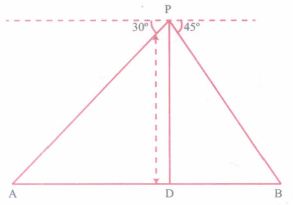
Now, AB = AD + DB
In right ΔAPD,
ㄥA = 30o
So, tan 30° = \(\frac { 1 }{ \sqrt { 3 } } =\frac { 3 }{ AD } \)
i.e., \(\frac { 1 }{ \sqrt { 3 } } =\frac { 3 }{ AD } \) (or) AD = 3\(\sqrt { 3 } \)
Also, in right ΔPBD,
B = 45o
So, BD = PD = 3m
Now, AB = BD + AD
= 3 + 3\(\sqrt { 3 } \) = 3(1+\(\sqrt { 3 } \))m
Therefore, the width at the river is 3(+\(\sqrt { 3 } \))m
60.
Since
cos2A + sin2A = 1 therefore
cos2A = 1 - sin2A
i.e., cos A = 土 \(\sqrt { 1-{ sin }^{ 2 }A } \)
This gives cos A = \(\sqrt { 1-{ sin }^{ 2 }A } \)
Hence, \(tanA=\frac { sinA }{ cosA } =\frac { sinA }{ \sqrt { { 1-sin }^{ 2 }A } } \)
and \(secA=\frac { 1 }{ cosA } =\frac { 1 }{ \sqrt { 1-{ sin }^{ 2 }A } } \)
61.
Radius of the cylinder be r
Height of the cylinder be h
Total surface area of the article
= CSA of cylinder + CSA of 2 hemispheres
= 2ㅠrh + 2πr2 = 2πr(h + 2r)
\(=2\times \frac { 22 }{ 7 } \times 3.5\times (10+2\times 3.5)\)
= 22 x 17 = 374 cm2
62.
Total number of cards = 52
Event of selecting a spade card = A
Event of selecting a heart card = B
n(A) = 13, n(B) = 13
P(A) =\(\frac { 13 }{ 52 } =\frac { 1 }{ 4 } \), P(B) =\(\frac { 13 }{ 52 } =\frac { 1 }{ 4 } \).
A ⋂ B refers to a card is both spade and heart. It is not possible

A, B are exclusive events.
P(A,B) = P(A) + P(B) =\(\frac { 1 }{ 4 } +\frac { 1 }{ 4 } =\frac { 1 }{ 2 } \).
63.
Let a natural number be x.
The next number = x + 1
x (x + 1) = 20
X2+x-20 = 0
(x + 5)(x - 4) = 0
x=-5,4
∴ x=4
(∵ x≠-5, x is a natural number
The next number = 4 + 1= 5
Two consecutive numbers are 4,5.
64.
Let the ten's digit of the number be x. It is given that the product of the digits is 12.
Unit's digit \(\frac{12}{x}\)
Number =10x+\(\frac{12}{x}\)
It 36 is added to the number the digits interchange their places.
\(\therefore 10x+\frac { 12 }{ x } +36=10\times \frac { 12 }{ x } +x\)
\(\Rightarrow 10x+\frac { 12 }{ x } +36=\frac { 120 }{ x } +x\)
\(\Rightarrow 9x-\frac { 108 }{ x } +36=0\)
⇒9x2 - 108 + 36x = 0
⇒X2+ 4x - 12 = 0
⇒ (x + 6)(x - 2) = 0 (∵ (x + 6) ≠ 0 as x >0)
x=-6,2
But a number can never be (-ve). So, x = 2. The
number is 10x2+\(\frac{12}{2}\)=26
65.
Here a = 24, d = 21-24 = -3, Sn = 78. We need to find n.
We know that,
Sn= \(\frac{n}{2}\) (2a + (n - 1)d)
78 = \(\frac{n}{2}\) 48 + (n -1)(-3))
78 = \(\frac{n}{2}\) 2(51-3n)
or 3n2 - 51n + 156 = 0
n2 -17n + 52 = 0
(n - 4)(n - 13) = 0
n = 4 or 13
The number of terms are 4 or 13.
66.
Here S14 = 1050
n = 14
a = 10
Sn = \(\frac{n}{2}\) 2(2a + (n -1)d)
1050 = \(\frac{14}{2}\)(20 + 13d)
= 140 + 91d
910 = 91d
d = 10
a20 = 10 + (20 - 1) x 10
= 20
∴ 20th term = 200.
67.
A = {1,2,3,4,5}
B = {1,2,3,4, ... }
f: A \(\rightarrow\)B, f(x) = x2
\(\therefore\) f(1) = 12 = 1
f(2) = 22= 4
f(3) = 32 = 9
f(4) = 42= 16
f(5) = 52= 25
\(\therefore\) Range of f = {1, 4, 9, 16, 25}
Elements in A have been connected with different elements in B. Therefore it is one-one function. But not all the elements in B have preimages in A. Therefore it is not on-to function.
68.
The area of the triangle formed by the given points is equal to
= \(\frac { 1 }{ 2 } \) [-1.5 (-2 - 4) + 6 (4 - 3) + (-3) (3 + 2)]
= \(\frac { 1 }{ 2 } \) [9 + 6 - 15] = 0
We can have a triangle at area 0 square units? What does this mean?
If the area of a triangle is 0 square units, then its vertices will be collinear.
69.
2f(-4) + 3f(2)
f(-4) = x + 5 = -4 + 5 = 1
2f(-4) = 2 x 1 = 2
f(2) = x + 5 = 2 + 5 = 7
3f(2) = 3(7) = 21
∴ 2f(-4) + 3f(2) = 2 + 21 = 23
70.
\(\frac { 10{ x }^{ 3 }-25{ x }^{ 2 }+4x-10 }{ -4-10{ x }^{ 2 } } \)
\(=\frac { { 5x }^{ 2 }\left( 2x-5 \right) +2\left( 2x-5 \right) }{ -2({ 5x }^{ 2 }+2) } \)=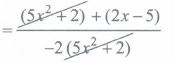
\(=\frac { (2x-5) }{ -2 } =-x+\frac { 5 }{ 2 } \)
71.
First let us factorize the polynomials
\(\sqrt { 15 } { x }^{ 2 }+\left( \sqrt { 3 } +\sqrt { 10 } \right) x+\sqrt { 2 } \) = \(\sqrt { 15 } { x }^{ 2 }+\sqrt { 3 } x+\sqrt { 10 } x+\sqrt { 2 } \)
= \(\sqrt { 3 } x\left( \sqrt { 5 } x+1 \right) +\sqrt { 2 } \left( \sqrt { 5 } x+1 \right) \)
= \(\left( \sqrt { 5 } x+1 \right) \times \left( \sqrt { 3 } x+\sqrt { 2 } \right) \)
\(\sqrt { 5 } { x }^{ 2 }+\left( 2\sqrt { 5 } +1 \right) x+2=\sqrt { 5 } { x }^{ 2 }+2\sqrt { 5 } x+x+2\)
= \(\sqrt { 5 } x\left( x+2 \right) +1\left( x+2 \right) =\left( \sqrt { 5 } x+1 \right) \left( x+2 \right) \)
\(\sqrt { 3 } { x }^{ 2 }+\left( \sqrt { 2 } +2\sqrt { 3 } \right) x+2\sqrt { 2 } =\sqrt { 3 } { x }^{ 2 }+\sqrt { 2 } x+2\sqrt { 3 } x+2\sqrt { 2 } \)
= \(x\left( \sqrt { 3 } x+\sqrt { 2 } \right) +2\left( \sqrt { 3 } x+\sqrt { 2 } \right) =\left( x+2 \right) \left( \sqrt { 3 } x+\sqrt { 2 } \right) \)
Therefore,
\(\left[ \sqrt { 15 } { x }^{ 2 }+\left( \sqrt { 3 } +\sqrt { 10 } \right) x+\sqrt { 2 } \right] \left[ \sqrt { 5 } { x }^{ 2 }+\left( 2\sqrt { 5 } +1 \right) x+2 \right] \left[ \sqrt { 3 } { x }^{ 2 }+\left( \sqrt { 2 } +2\sqrt { 3 } \right) x+2\sqrt { 2 } \right] \)
= \(\left| \left( \sqrt { 5 } x+1 \right) \left( \sqrt { 3 } x+\sqrt { 2 } \right) \left( x+2 \right) \right| \)
72.
When three coins are tossed, the sample space
S = {HHH, HHT HTH, HTT, THH, THT, TTH, TTT}
n(S) = 3
Let A be the event of getting atmost 2 tails (i.e., 0 tail, 1 tail,2 tails)
A = {HHH, HHT, FITH, HTT THH, THT, TTH}
n(A) = 7
\(\mathrm{P}(\mathrm{A})=\frac{n(A)}{n(S)}=\frac{7}{8}\)
Let B be the event of getting atleast 2 heads. (i.e.,2 heads,3 heads)
B = {HHT, HTH, THH, HHH}
n(B) = 4
\(\mathrm{P}(\mathrm{B})=\frac{n(B)}{n(S)}=\frac{4}{8}\)
A n B = {HHT, HTH, THH, HHH}
\(\mathrm{n}(A \cap B)=4 \)
\(\mathrm{P}(A \cap B)=\frac{n(A \cap B)}{n(\mathrm{~S})}=\frac{4}{8} \)
\(\mathrm{P}(A \cup B)=\mathrm{P}(\mathrm{A})+\mathrm{P}(\mathrm{B})-\mathrm{P}(A \cap B) \)
\(\mathrm{P}(A \cup B)=\frac{7}{8}+\frac{4}{8}-\frac{4}{8}=\frac{7+4-4}{8}=\frac{7}{8} \)
Probability of getting atmost two tails or atleast 2 heads = \(\frac{7}{8}\)
73.
The height of the tower AB = 50 m
Let the height of the tree CD = y and BD = x
From the diagram,\(\angle \)XAC = 30° = \(\angle \)ACM and\(\angle \) = XAD = 45° =\(\angle \) ADB
In right triangle ABD,
tan45° = \(\frac { AB }{ BD } \)
1 = \(\frac { 50 }{ x } \) gives x = 50 m
In right triangle AMC,
tan30° = \(\frac { AM }{ CM } \)
\(\frac { 1 }{ \sqrt { 3 } } =\frac { AM }{ 50 } \)[since DB = CM]
AM = \(\frac { 50 }{ \sqrt { 3 } } =\frac { 50\sqrt { 3 } }{ 3 } =\frac { 50\times 1.732 }{ 3 } \) = 28.87 m.
Therefore, height of the tree = CD = MB = AB − AM = 50 – 28.87 = 21.13 m
74.
Sample space S = {1, 2, 3, 4, 5, 6, 7, 8, 9, 10, 11, 12}; n(S) = 12
(i) Let A be the event of resting in 7. n(A) = 1
P(A) = \(\frac { n(A) }{ n(S) } =\frac { 1 }{ 12 } \)
(ii) Let B be the event that the arrow will come to rest in a prime number.
B = {2 , 3, 5, 7, 11}; n(B) = 5
P(B) = \(\frac { n(B) }{ n(S) } =\frac { 5 }{ 12 } \)
(iii) Let C be the event that arrow will come to rest in a composite number.
C = {4, 6, 8, 9, 10, 12}; n(C) = 6
P(C) = \(\frac { n(C) }{ n(S) } =\frac { 6 }{ 12 } =\frac { 1 }{ 2 } \)
75.
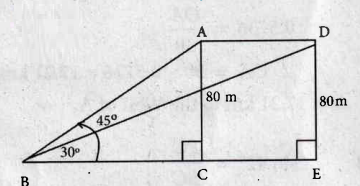
Let the initial position of the bird be A and after two seconds its position is at D.
AC = DE = 80m
∠DBC = 30°
\(\tan 45^{\circ} =\frac{A C}{B C} \)
\(1 =\frac{80}{B C} \)
BC = 80 m
In right triangle DBE
\(\tan 30^{\circ} =\frac{D E}{B E} \)
\(\frac{1}{\sqrt{3}} =\frac{80}{B C+C E} \)
\(\frac{1}{\sqrt{3}} =\frac{80}{80+C E} \)
\(80+\mathrm{CE} =80 \sqrt{3} \)
\(\mathrm{CE} =(80 \sqrt{3}-80) \)
\(=80(\sqrt{3}-1) \)
= 80 (1.732 - 1)
= 80 x 0.732
CE = 58.56 m
The bird travelled 58.56 m in 2 seconds.
Speed of the bird \(=\frac{\text { Distance travelled }}{\text { Time taken }} \)
\(=\frac{58.56}{2} \)
= 29.28 m/s
Speed of flying bird = 29.28 m/s.
76.
Total pages = 60
Completed pages by the students are
32, 35, 37, 30, 33, 36, 35, 37
Let the pages yet to be completed by 8 students be xi
| Completed Pages (xi) | \(\left(\mathbf{x}_{\mathrm{i}}^{2}\right)\) |
| 32 | 1024 |
| 35 | 1225 |
| 37 | 1369 |
| 30 | 900 |
| 33 | 1089 |
| 36 | 1296 |
| 35 | 1225 |
| 37 | 1369 |
| \(\Sigma x_{i}=275\) | \(\Sigma x_{i}^{2}=9497\) |
Standard deviation \(\sigma=\sqrt{\frac{\sum x_{i}^{2}}{n}-\left(\frac{\sum x_{i}}{n}\right)^{2}}\)
\(=\sqrt{\frac{9497}{8}-\left(\frac{275}{8}\right)^{2}}
\)
\(=\sqrt{1187.125-(34.375)^{2}}=\sqrt{1187.125-1181.64063}
\)
\(=\sqrt{5.48437}=2.34\)
77.
Let AB be the height of the kite above the ground. Then, AB = 75.
Let AC be the length of the string.
In right triangle ABC,\(\angle \)ACB = \(60°\)
\(sin\theta =\frac { AB }{ AC } \)
\(sin60°=\frac { 75 }{ AC } \)
gives \(\frac { \sqrt { 3 } }{ 2 } =\frac { 75 }{ AC } \) so, AC = \(\frac { 150 }{ \sqrt { 3 } } =50\sqrt { 3 } \)
Hence, the length of the string is 50\(\sqrt { 3 } m\)
78.
Given intercepts are 4, - 6
a = 4, b = - 6
Equation of the line in the intercepts form is
\(\frac{x}{a}+\frac{y}{b}=1
\)
\(\frac{x}{4}+\frac{y}{-6}=1
\)
3x - 2y - 12 = 0
79.
Let the radius of hemispherical bowl = r
Volume of hemispherical bowl
\(=\frac{2}{3} \pi r^{3} \text { cu. units }\)
Let the height of cylindrical vessel = h
Given \(r=h+h \frac{50}{100} \Rightarrow \mathrm{r}=\mathrm{h}\left(1+\frac{50}{100}\right)
\)
\(\mathrm{h}= \frac{2}{3} r
\)
Now, Volume of cylindrical vessel
\(=\pi r^{2}\left(\frac{2 r}{3}\right)=\frac{2}{3} \pi r^{3}\)
Hence, Volume of juice in the cylindrical vessel
\(=\frac{\frac{2}{3} \pi r^{3}}{\frac{2}{3} \pi r^{3}} \times 100 \%=100 \%\)
80.
Consider\(\triangle\)ABC. Then D, E and F are respective points on the sides CA, AB and BC. By construction D, E, F are collinear
By Menelaus’ theorem \(\frac { AE }{ EB } \times \frac { BF }{ FC } \times \frac { CD }{ DA } =1\)
By assumption, AE = EB = 2, DA = 1 and
FC = FB + BC = BF + 3
By Pythagoras theorem,AC2=AB2+BC2=16+9=25. Therefore AC=5
and So, CD = AC – AD = 5 – 1 = 4.
Substituting the values of FC, AE, EB, DA, CD in (1)
we get, \(\frac { 2 }{ 2 } \times \frac { BF }{ BF+3 } \times \frac { 4 }{ 1 } =1\)
4BF=BF+3
4F-BF=8 therefore BF=1
81.
82.
\(f(x)=\frac { x-1 }{ x+1 } ,x\neq 0\)
\(f(f(x))=f\left( \frac { x-1 }{ x+1 } \right) =\frac { \left( \frac { x-1 }{ x+1 } \right) -1 }{ \left( \frac { x-1 }{ x+1 } \right) +1 } \)
\(=\frac{\frac{\not x-1-x-1}{(\not x+1)}}{\frac{\not x-1+x+1}{(\not x+1)}}=\frac{-2}{2 x}=\frac{-1}{x}\)
Hence it is proved.
83.
Let Sarah's house is at A and James's house is at 'B' from the picture.
Distance between Sarah's house to James house through Street B and C
= 1.5 miles + 2 miles = 3.5 miles
Distance through street C is AC2 = AB2 + BC2
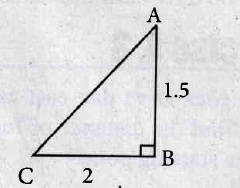
AC2 = = (1.5)2 + (2),
= 2.25 + 4
= 6.25
\(A C=\sqrt{6.25}=2.5\)
AC = 2.5 miles
Difference between two paths = 3.5 - 2.5 = 1 mile
Direct path along C street is 1 mile shorter
84.
Right triangle PQR, right angled at Q and
PR = 20 cm, QR = 16 cm
PQ2 = PR2 - QR2
= (20)2 - (16)2
= 400 - 256 = 144
PQ = 12 cm
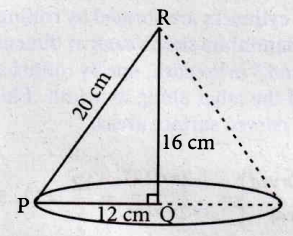
When right triangle PQR, rotates about QR, a right circular cone is formed with PQ = 12 cm as base radius and PR = 20 cm as
slant height.
C.S.A of the Cone = \(\pi r l\) sq. units
\(=\frac{22}{7} \times 12 \times 20=754.29 \mathrm{~cm}^{2}\)
When right triangle PQR, rotates about PQR, a right circular cone is formed with
QR = 16 cm as base radius and PR = 20 cm as slant height
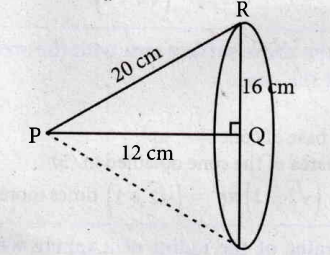
C.S.A of the Cone \(=\pi r l \text { sq.units } \)
\(=\frac{22}{7} \times 16 \times 20 \)
= 1005.71 cm2
Hence, C.S.A of the cone when rotates about PQ is larger.
85.
i) f: R ⟶ R and f(x) = 2x + 1
when x = -1,f(- 1) = 2(- 1) + 1 =- 1 \( \in\) R
when x = 0, f(0) = 2 (0) + 1 = 1 \( \in\) R
when x = 1,f (1) = 2(1) + 1 = 3 \( \in\) R and soon
For every value of x \( \in\) R, f (x) also \( \in\) R.
The function is well defined and it is one-to-one function (Injective)
For f (x) : R ⟶ R , the domain and range are also well defined. So it is an onto function (Surjective)
Thus, the function is one - to one onto i.e. Bijective function.
(ii) f : R ⟶ R , f(x) = 3 - 4x2
when x = 0, f (0) = 3 - 4(0) = 3 \( \in\) R
when x = 1, f (1) = 3 - 4(1)2 = -1 \( \in\) R
when x = 2, f (2) = 3 - 4(2)2 = 13 \( \in\) R
when x = -1, f (-1) = 3 - 4(-1)2 = -1 \( \in\) R
when x = -2, f (-2) = 3 - 4(-2)2 = -13 \( \in\) R
From this, it is clear that two or more elements having same image in the co-domain So, it is not one-to-one and it is many-to-one function. Hence it is not Bijective.
86.
Given vertices are (- 4, - 2),(- 3, k), (3, - 2) and (2,3) and area of quadrilateral is 28 sq. units.
Area of quadrilateral \(=\frac{1}{2}\left[\left(x_{1}-x_{3}\right)\left(y_{2}-y_{4}\right)-\right. \left.\left(x_{2}-x_{4}\right)\left(y_{1}-y_{3}\right)\right] \)
\(\frac{1}{2}\) [(- 4 - 3) (k - 3) - (- 3 - 2) (- 2 + 2)] = 28
(-7) (k - 3) - (- 5) (0) = 56
-7k + 21 = 56
-7k = 56 - 21 = 35
\(k=\frac{35}{-7}=-5\)
k = -5
87.
\(f(x)=\frac { 1{ x }^{ 2 } }{ a } -\frac { 2x }{ b } +\frac { 3 }{ c } \)
Sum of the roots \((\alpha +\beta )=\frac { -b }{ a } =-\frac { (-2) }{ 1 } \)
Product of the roots \((\alpha \beta )=\frac { c }{ a } =\frac { 3 }{ 1 } =3\)
∝+2, β+2 are the roots (given)
Sum of the roots = ∝ + 2 + β + 2
= ∝ + β + 4
= 2 + 4 = 6
Product of the roots = (∝ + 2) (β + 2)
= ∝β + 2∝ + 2β + 4
= ∝β + 2(∝ + β) + 4
= 3 + 2 x 2 + 4
= 3 + 4 + 4 = 11
∴ The required equation x2 - 6x + 11 = 0.
88.
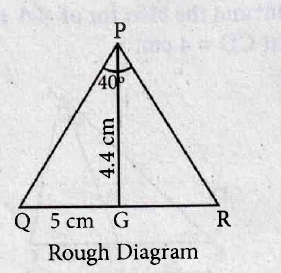
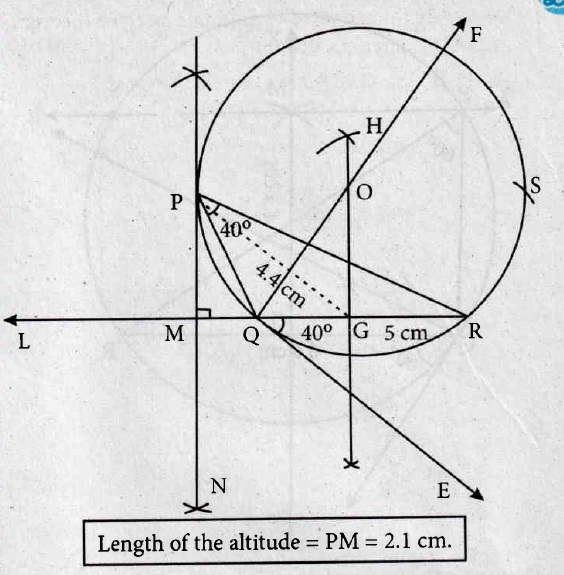
Construction:
Step (1) Draw a line segment QR = 5 cm.
Step (2) At Q, draw QE such that \(\angle RQE\) = 40°.
Step (3) At Q, draw QF such that \(\angle EQF\) = 90o
Step (4)Drawn a perpendicular bisector to QR, which intersects QF at 'O' and QR at G.
Step (5) With O as centre and OQ as radius, draw a circle
Step (6) From G marked arcs of radius 4.4 cm on the circle. Marked them as P and S.
Step (7) Joined QP and PR. Now \(\triangle\)PQR is the required triangle
Step (8) From P draw a line PN which is \(\bot \) to LR. LR meets PN at M.
Step (9) The length of the altitude is PM = 2.1cm
89.
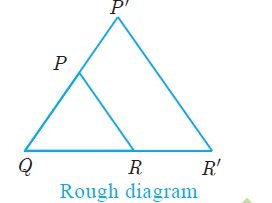
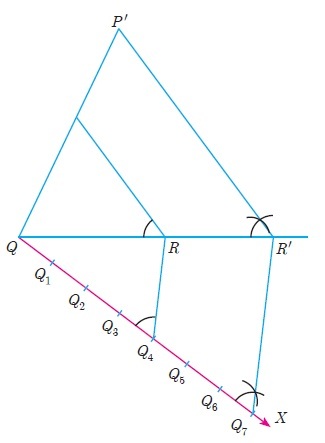
Given a triangle PQR, we are required to construct another triangle whose sides are \(\frac { 7 }{ 4 } \) of the corresponding sides of the triangle PQR.
Steps of construction
1. Construct a DPQR with any measurement.
2. Draw a ray QX making an acute angle with QR on the side opposite to vertex P.
3. Locate 7 points (the greater of 7 and 4 in \(\frac { 7 }{ 4 } \))
Q1,Q2,Q3,Q4,Q5,Q6 and Q7 on QX so that
QQ1 = Q1Q2 = Q2Q3 = Q4Q5 = Q5Q6 = Q6Q7
4. Join Q4 (the 4th point, 4 being smaller of 4 and 7 in \(\frac { 7 }{ 4 } \)) to R and draw a line through Q7 parallel to Q4R, intersecting the extended line segment QR at R'.
5. Draw a line through R' parallel to RP intersecting the extended line segment QP at P'.
Then \(\triangle\)P'QR' is the required triangle each of whose sides is seven-fourths of the corresponding sides of \(\triangle\)PQR.

10th Standard Syllabus & Materials
10th Standard
TN 10th English Prose - 2 - The Night the Ghost Got in Important Questions And Answers Study Material - QB365 Set A
NEW10th Standard
TN 10th English Supplementary - 1 - The Tempest Important Questions And Answers Study Material - QB365 Set A
NEW10th Standard
TN 10th English Poem - 1 - Life Important Questions And Answers Study Material - QB365 Set A
NEW10th Standard
TN 10th English Prose - 1 - His First Flight Important Questions And Answers Study Material - QB365 Set A



Tamilnadu Stateboard 10th Standard Subjects
Tamilnadu Stateboard Standards





