
 100% FREE ACCESS
10th Standard Syllabus & Materials
10th Standard
TN 10th English Prose - 4 - The Attic Important Questions And Answers Study Material - QB365 Set A
NEW10th Standard
TN 10th English Supplementary - 3 - The Story of Mulan Important Questions And Answers Study Material - QB365 Set A
NEW10th Standard
TN 10th English Poem - 3 - I am Every Woman Important Questions And Answers Study Material - QB365 Set A
NEW10th Standard
TN 10th English Prose - 3 - Empowered Women Navigating The World Important Questions And Answers Study Material - QB365 Set A
NEW10th Standard
TN 10th English Supplementary - 2 - Zigzag Important Questions And Answers Study Material - QB365 Set A
NEW10th Standard
TN 10th English Poem - 2 - The Grumble Family Important Questions And Answers Study Material - QB365 Set A

Published on: 12/10/2019
Statistics and Probability
Download Tamil Nadu 10th Standard Maths question papers, model tests, one-mark questions, important questions, and public exam papers in PDF format. Free study materials and answer keys for TN State Board students.
Questions + Answers key
Take MCQ Maths Test1.
What is the probability that a leap year selected at random will contain 53 saturdays. (Hint: 366 = 52 x 7 + 2)
2.
The following table gives the values of mean and variance of heights and weights of the 10th standard students of a school.
| Height | Weight | |
| Mean | 155 cm | 46.50 kg |
| Variance | 72.25 cm2 | 28.09 kg |
Which is more varying than the other?
3.
Find the range and coefficient of range of the following data: 25, 67, 48, 53, 18, 39, 44.
4.
If A and B are two events such P(A) = \(\frac{1}{4}\), P(B) = \(\frac{1}{2}\) and P(A and B) = \(\frac{1}{8}\), find (i) P(A or B) (ii) P(not A and not B)
5.
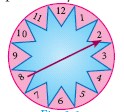
A game of chance consists of spinning an arrow which is equally likely to come to rest pointing to one of the numbers 1, 2, 3, …12. What is the probability that it will point to (i) 7 (ii) a prime number (iii) a composite number?
6.
Two dice are rolled. Find the probability that the sum of outcomes is (i) equal to 4 (ii) greater than 10 (iii) less than 13.
7.
The time taken (in minutes) to complete a homework by 8 students in a day are given by 38, 40, 47, 44, 46, 43, 49, 53. Find the coefficient of variation.
8.
The rainfall recorded in various places of five districts in a week are given below..
| Rainfall (in mm) | 45 | 50 | 55 | 60 | 65 | 70 |
| Number of places | 5 | 13 | 4 | 9 | 5 | 4 |
Find its standard deviation.
9.
The mean and standard deviation of 15 observations are found to be 10 and 5 respectively. On rechecking it was found that one of the observation with value 8 was incorrect. Calculate the correct mean and standard deviation if the correct observation value was 23?
10.
The marks scored by the students in a slip test are given below.
| x | 4 | 6 | 8 | 10 | 12 |
| f | 7 | 3 | 5 | 9 | 5 |
Find the standard deviation of their marks.
11.
Find the mean and variance of the first n natural numbers.
12.
The amount that the children have spent for purchasing some eatables in one day trip of a school are 5, 10, 15, 20, 25, 30, 35, 40. Using step deviation method, find the standard deviation of the amount they have spent.
13.
The amount of rainfall in a particular season for 6 days are given as 17.8 cm, 19.2 cm, 16.3 cm, 12.5 cm, 12.8 cm and 11.4 cm. Find its standard deviation.
14.
15.
A girl calculates the probability of her winning in a match is 0.08 what is the probability of her losing the game ___________
91%
8%
92%
80%
16.
17.
The probability of getting a job for a person is \(\frac{x}{3}\). If the probability of not getting the job is \(\frac{2}{3}\) then the value of x is
2
1
3
1.5
18.
If the mean and coefficient of variation of a data are 4 and 87.5% then the standard deviation is
3.5
3
4.5
2.5
19.
Which of the following is not a measure of dispersion?
Range
Standard deviation
Arithmetic mean
Variance
1.
leap year has 366 days. So it has 52 full weeks and 2 days. 52 Saturdays must be in 52 full weeks.
The possible chances for the remaining two days will be the sample space.
S = {(Sun-Mon, Mon-Tue, Tue-Wed, Wed-Thu, Thu-Fri, Fri-Sat, Sat-Sun)}
n(S) = 7
Let A be the event of getting 53rd Saturday.
Then A = {Fri-Sat, Sat-Sun}; n(A) = 2
Probability of getting 53 Saturdays in a leap year is P(A0 = \(\frac { n(A) }{ n(S) } =\frac { 2 }{ 7 } \).
2.
For comparing two data, first we have to find their coefficient of variations
Mean \(\bar { { x }_{ 1 } } \) = 155 cm, variance σ12 = 72.25 cm2
Therefore standard deviation σ1 = 8.5
Coefficient of variation C.V1 = \(\frac { { \sigma }_{ 1 } }{ \bar { { x }_{ 1 } } } \) x 100%
C.V1 = \(\frac { 8.5 }{ 15.5 } \) x 100% = 5.48% (for heights)
Mean \(\bar { { x }_{ 2 } } \) = 155 cm, variance σ22 = 72.25 kg2
Standard deviation σ2 = 5.3 kg
Coefficient of variation CV2 = \(\frac { { \sigma }_{ 2 } }{ \bar { { x }_{ 2 } } } \) x 100%
C.V2 = \(\frac { 5.3 }{ 46.50 } \) x 100% = 11.40% (for weights)
C.V1 = 5.48% = and CV2 = 11.40%
Since C.V2 > C.V1, the weight of the students is more varying than the height.
3.
Largest value L = 67; Smallest value S =18
Range R = L = S = 67 - 18 = 49
Coefficient of range = \(\frac { L-S }{ L+S } \)
Coefficient of range = \(\frac { 67-18 }{ 67+18 } =\frac { 49 }{ 85 } \) = 0.576
4.
(i) P(A or B) = P(AUB)
= P(A) + P(B) - P(A∩B)
P(A or B) = \(\frac { 1 }{ 4 } +\frac { 1 }{ 2 } -\frac { 1 }{ 8 } =\frac { 5 }{ 8 } \)
(ii) P(not A and not B) = \(P(\bar { A } \cap \bar { B } )\)
=\(P(\overline { A\cup B) } \)
= 1 - P(AUB)
P(not A and not B) = 1-\(\frac { 5 }{ 8 } =\frac { 3 }{ 8 } \).
5.
Sample space S = {1, 2, 3, 4, 5, 6, 7, 8, 9, 10, 11, 12}; n(S) = 12
(i) Let A be the event of resting in 7. n(A) = 1
P(A) = \(\frac { n(A) }{ n(S) } =\frac { 1 }{ 12 } \)
(ii) Let B be the event that the arrow will come to rest in a prime number.
B = {2 , 3, 5, 7, 11}; n(B) = 5
P(B) = \(\frac { n(B) }{ n(S) } =\frac { 5 }{ 12 } \)
(iii) Let C be the event that arrow will come to rest in a composite number.
C = {4, 6, 8, 9, 10, 12}; n(C) = 6
P(C) = \(\frac { n(C) }{ n(S) } =\frac { 6 }{ 12 } =\frac { 1 }{ 2 } \)
6.
When we roll two dice, the sample space is given by
S = \(\{ (1,1),(1,2),(1,3),(1,4),(1,5),(1,6)\\ (2,1),(2,2),(2,3),(2,4),(2,5),(2,6)\\ (3,1),(3,2),(3,3),(3,4),(3,5),(3,6)\\ (4,1),(4,2),(4,3),(4,4),(4,5),(4,6)\\ (5,1),(5,2),(5,3),(5,4),(5,5),(5,6)\\ (6,1),(6,2),(6,3),(6,4),(6,5),(6,6)\} \)
n(S) = 36
(i) Let A be the event of getting the sum of outcome values equal to 4.
Then A = {(1, 3),(2, 2),(3, 1)}; n(A) = 3.
Probability of getting the sum of outcomes equal to 4 is P(A) = \(\frac { n(A) }{ n(S) } =\frac { 3 }{ 36 } =\frac { 1 }{ 12 } \)
(ii) Let B be the event of getting the sum of outcome values greater than 10.
Then B = {(5,6),(6,5),(6,6)}; n(B) = 3
Probability of getting the sum of outcomes greater than 10 is P(B) = \(\frac { n(B) }{ n(S) } =\frac { 3 }{ 36 } =\frac { 1 }{ 12 } \)
(iii) Let C be the event of getting the sum of outcomes less than 13. Here all the outcomes have the sum value less than 13. Hence C = S
Therefore, n(C) = n(S) = 36
Probability of getting the sum value less than 13 is P(C) = \(\frac { n(C) }{ n(S) } =\frac { 36 }{ 36 } \) = 1
7.
Given data are 38, 40, 43,44, 46, 47, 49, 53
Standard deviation \(\sigma=\sqrt{\frac{\Sigma d_{i}^{2}}{N}-\left(\frac{\Sigma d_{i}}{N}\right)^{2}}\)
Let us take the assumed mean A = 44
| xi | \(\mathrm{d}_{\mathrm{i}}=\mathrm{x}_{\mathrm{i}}-\mathrm{A}
\) \(\mathrm{d}_{\mathrm{i}}=\mathrm{x}_{\mathrm{i}}-44 \) |
\(\mathrm{d}_{\mathrm{i}}^{2}\) |
| 38 | -6 | 36 |
| 40 | -4 | 16 |
| 43 | -1 | 1 |
| 44 | 0 | 0 |
| 46 | 2 | 4 |
| 47 | 3 | 9 |
| 49 | 5 | 25 |
| 53 | 9 | 81 |
| \(\Sigma d_{i}\) = 8 | \(\sum d_{i}^{2}\) = 172 |
\(\sigma=\sqrt{\frac{\sum d_{i}^{2}}{N}-\left(\frac{\sum d_{i}}{N}\right)^{2}}\)
\(\sigma=\sqrt{\frac{172}{8}-\left(\frac{8}{8}\right)^{2}}=\sqrt{21.5-(1)^{2}}
\)
\(\sigma=\sqrt{21.5-1}=\sqrt{20.5}=4.53
\)
\(\text { Mean } \bar{x}=\frac{\text { Sum of the given observations }}{\text { Number of observations }}\)
\(\bar{x}=\frac{38+40+43+44+46+47+49+53}{8}
\)
\(\bar{x}=\frac{360}{8}=45
\)
Co-efficient of variation C.V \(=\frac{\sigma}{x} \times 100 \%\)
\(=\frac{4.53}{45} \times 100 \%=\frac{453}{45}\)
Co-efficient of variation = 10.07%
8.
| x1 | f1 | di = xi - A di = xi - 55 |
fidi | \({ d }_{ i }^{ 2 }\) | \({ f }_{ i }{ d }_{ i }^{ 2 }\) |
|---|---|---|---|---|---|
| 45 | 5 | -10 | -50 | 100 | 500 |
| 50 | 13 | -5 | -65 | 25 | 325 |
| 55 | 4 | 0 | 0 | 0 | 0 |
| 60 | 9 | 5 | 45 | 25 | 225 |
| 65 | 5 | 10 | 50 | 100 | 500 |
| 70 | 4 | 15 | 60 | 225 | 900 |
| \(\Sigma f_{i}\) = 40 | \(\Sigma f_{i} d_{i}\) = 40 | \(\Sigma f_{i} d_{i}^{2}\) = 2450 |
N = 40
Standard deviation \(\sigma=\sqrt{\frac{\sum f_{i} d_{i}^{2}}{N}-\left(\frac{\sum f_{i} d_{i}}{N}\right)^{2}}\)
\(=\sqrt{\frac{2450}{40}-\left(\frac{40}{40}\right)^{2}}=\sqrt{61.25-1^{2}} \)
\(=\sqrt{61.25-1}=\sqrt{60.25} \)
Standard deviation \(\sigma=7.76\)
9.
n = 15, \(\bar { x } \) = 10, σ = 5; \(\bar { x } =\frac { \Sigma x }{ n } \); Σx = 15 x 10 = 150
Wrong observation value = 8, Correct observation value = 23.
Correct total = 150 - 8 + 23 = 165
Correct mean \(\bar { x } \) = \(\frac { 165 }{ 15 } \) = 11
Standard deviation σ = \(\sqrt { \frac { \Sigma x^{ 2 } }{ n } -\left( \frac { \Sigma x }{ n } \right) ^{ 2 } } \)
Incorrect value of σ = 5 = \(\sqrt { \frac { \Sigma x^{ 2 } }{ 15 } -(10)^{ 2 } } \)
25 = \(\frac { \Sigma x^{ 2 } }{ 15 } \)-100 gives, \(\frac { \Sigma x^{ 2 } }{ 15 } \) = 125
Incorrect value of Σx2 = 1875
Correct value of Σx2 = 1875 - 82 + 232 = 2340
Correct standard deviation σ = \(\\ \sqrt { \frac { 2340 }{ 15 } -(11)^{ 2 } } \)
σ = \(\\ \sqrt { 156-121 } =\sqrt { 35 } \) σ ≃ 5.9
10.
Let the assumed mean, A = 8
| xi | fi | di = xi - A | fidi | fidi2 |
| 4 | 7 | -4 | -28 | 112 |
| 6 | 3 | -2 | -6 | 12 |
| 8 | 5 | 0 | 0 | 0 |
| 10 | 9 | 2 | 18 | 36 |
| 12 | 5 | 4 | 20 | 80 |
| N = 29 | Σfidi = 4 | Σfidi2 = 240 |
Standard deviation
σ = \(\sqrt { \frac { \Sigma { f }_{ i }{ d }_{ i }^{ 2 } }{ N } -\left( \frac { \Sigma { f }_{ i }{ d }_{ i } }{ N } \right) ^{ 2 } } \)
= \(\sqrt { \frac { 240 }{ 29 } -\left( \frac { 4 }{ 29 } \right) ^{ 2 } } =\sqrt { \frac { 240\times 29-16 }{ 29\times 29 } } \)
σ = \(\sqrt { \frac { 6944 }{ 29\times 29 } } \); σ ≃ 2.87
Calculation of Standard deviation for continuous frequency distribution
(i) Mean method:
Standard deviation σ = \(\sqrt { \frac { \Sigma { f }_{ i }({ x }_{ i }-\bar { x } )^{ 2 } }{ N } } \)
Where, xi = Middle value of the i th class
fi = Frequency of the i th class
(ii) Shortcut method (or) Step deviation method:
To make the calculation simple, we provide the following formula. Let A be the assumed mean, xi be the middle value of the ith class and c is the width of the class interval.
Let di = \(\frac { { x }_{ i }-A }{ c } \)
σ = \(\sqrt { \frac { \Sigma { f }_{ i }{ d }_{ i }^{ 2 } }{ N } -\left( \frac { \Sigma { f }_{ i }{ d }_{ i } }{ N } \right) ^{ 2 } } \).
11.
Mean \(\bar { x } \) = \(\frac { Sum\ of\ all\ observations }{ Number\ of\ observation } \)
= \(\frac { \Sigma x_{ i } }{ n } =\frac { 1+2+3+...+n }{ n } =\frac { n(n+1) }{ 2\times n } \)
Mean \(\bar { x } \) = \(\frac { n+1 }{ 2 } \)
Variance σ2 = \(\frac { \Sigma x_{ i }^{ 2 } }{ n } -\left( \frac { \Sigma x_{ i } }{ n } \right) ^{ 2 }\left[ \begin{matrix} \Sigma x_{ i }^{ 2 }={ 1 }^{ 2 }+{ 2 }^{ 2 }+{ 3 }^{ 2 }+...+{ n }^{ 2 } \\ (\Sigma x_{ i })^{ 2 }=(1+2+3+...+n)2 \end{matrix} \right] \)
= \(\frac { n(n+1)(2n+1) }{ 6\times n } -\left[ \frac { n(n+1) }{ 2\times n } \right] ^{ 2 }\)
= \(\frac { 2n^{ 2 }+3n+1 }{ 6 } -\frac { { n }^{ 2 }+2n+1 }{ 4 } \)
Variance σ2 = \(\frac { 4n^{ 2 }+6n+2-3n^{ 2 }-6n-3 }{ 12 } =\frac { { n }^{ 2 }-1 }{ 12 } \).
12.
We note that all the observations are divisible by 5. Hence we can use the step deviation method. Let the Assumed mean A = 20, n = 8.
| xi | di = xi - A di = xi - 20 |
di = \(\frac { { x }_{ i }-A }{ c } \) c = 5 |
di2 |
| 5 | -15 | -3 | 0 |
| 10 | -10 | -2 | 4 |
| 15 | -5 | -1 | 1 |
| 20 | 0 | 0 | 0 |
| 25 | 5 | 1 | 1 |
| 30 | 10 | 2 | 4 |
| 35 | 15 | 3 | 9 |
| 40 | 20 | 4 | 16 |
| Σdi = 4 | Σdi2 = 44 |
Standard deviation
σ = \(\sqrt { \frac { { \Sigma d }_{ i }^{ 2 } }{ n } -\left( \frac { { \Sigma d }_{ i } }{ n } \right) ^{ 2 } } \)xc
= \(\sqrt { \frac { 44 }{ 8 } -\left( \frac { 4 }{ 8 } \right) ^{ 2 } } \times 5=\sqrt { \frac { 11 }{ 2 } -\frac { 1 }{ 4 } \times 5 } \)
= \(\sqrt { 5.5-0.25 } \) = 2.29 x 5
σ ≃ 11.45
13.
Arranging the numbers in ascending order we get, 11.4, 12.5, 12.8, 16.3, 17.8, 19.2 Number of observations
n = 6
Mean = \(\frac { 11.4+12.5+12.8+16.3+17.8+19.2 }{ 6 } =\frac { 90 }{ 6 } \)=15
| xi | di = xi - \(\bar { x } \) = x - 15 | \({ \Sigma d }_{ i }^{ 2 }\) |
| 11.4 | -3.6 | 12.96 |
| 12.5 | -2.5 | 6.25 |
| 12.8 | -2.2 | 4.84 |
| 16.3 | 1.3 | 1.69 |
| 17.8 | 2.8 | 7.84 |
| 19.2 | 4.2 | 17.64 |
| \({ \Sigma d }_{ i }^{ 2 }\) = 51.22 |
Standard deviation σ = \(\sqrt { \frac { { \Sigma d }_{ i }^{ 2 } }{ n } } \)
=\(\sqrt { \frac { 51.22 }{ 6 } } =\sqrt { 8.53 } \)
Hence, σ ≃2.9
Assumed Mean method:
When the mean value is not an integer (since calculations are very tedious in decimal form) then it is better to use the assumed mean method to find the standard deviation.
Ler x1, x2, x3, .....xn be the given data values and let \(\bar { x } \) be their mean
Let di be the deviation of xi from the assumed mean A, which is usually the middle value or near the middle value of the given data.
di = xi - A gives, xi = di + A ...(1)
Σdi = Σ(xi - A)
= Σxi-(A + A + A + ..to n times)
Σdi = Σxi - A x n
\(\frac { \Sigma { d }_{ i } }{ n } =\frac { \Sigma { x }_{ i } }{ n } \) - A
\(\bar { d } \) = \(\bar { x } \) - A (or) \(\bar { x } \) = \(\bar { d } \)+ A ..(2)
Now, Standard deviation
σ = \(\\ \sqrt { \frac { \Sigma ({ x }_{ i }-\bar { x } )^{ 2 } }{ n } } =\sqrt { \frac { \Sigma ({ d }_{ i }+A-\bar { d } -A)^{ 2 } }{ n } } \) (using (1) and (2))
= \(\sqrt { \frac { \Sigma (d_{ i }-\bar { d } )^{ 2 } }{ n } } =\sqrt { \frac { \Sigma ({ d }_{ i }^{ 2 }+2d_{ i }-\bar { d } -\bar { d } ^{ 2 }) }{ n } } \)
= \(\sqrt { \frac { { \Sigma d }_{ i }^{ 2 } }{ n } -2\bar { d } \frac { \Sigma { d }_{ i } }{ n } +\frac { { \bar { d } }^{ 2 } }{ n } (1+1+1+...to\quad n\quad times) } \)
\(=\sqrt { \frac { { \Sigma d }_{ i }^{ 2 } }{ n } -2\bar { d } \times \bar { d } +\frac { { \bar { d } }^{ 2 } }{ n } \times n } \) (since \(\bar { d } \) is a constant)
= \(\sqrt { \frac { { \Sigma d }_{ i }^{ 2 } }{ n } -{ \bar { d } }^{ 2 } } \)
Standard deviationσ = \(\sqrt { \frac { { \Sigma d }_{ i }^{ 2 } }{ n } -\left( \frac { { \Sigma d }_{ i } }{ n } \right) ^{ 2 } } \).
14.
(b)
15.
(c)
92%
16.
(d)
17.
(b)
1
18.
(a)
3.5
19.
(c)
Arithmetic mean

10th Standard Syllabus & Materials
10th Standard
TN 10th English Prose - 2 - The Night the Ghost Got in Important Questions And Answers Study Material - QB365 Set A
NEW10th Standard
TN 10th English Supplementary - 1 - The Tempest Important Questions And Answers Study Material - QB365 Set A
NEW10th Standard
TN 10th English Poem - 1 - Life Important Questions And Answers Study Material - QB365 Set A
NEW10th Standard
TN 10th English Prose - 1 - His First Flight Important Questions And Answers Study Material - QB365 Set A



Tamilnadu Stateboard 10th Standard Subjects
Tamilnadu Stateboard Standards





