
 100% FREE ACCESS
10th Standard Syllabus & Materials
10th Standard
TN 10th English Prose - 4 - The Attic Important Questions And Answers Study Material - QB365 Set A
NEW10th Standard
TN 10th English Supplementary - 3 - The Story of Mulan Important Questions And Answers Study Material - QB365 Set A
NEW10th Standard
TN 10th English Poem - 3 - I am Every Woman Important Questions And Answers Study Material - QB365 Set A
NEW10th Standard
TN 10th English Prose - 3 - Empowered Women Navigating The World Important Questions And Answers Study Material - QB365 Set A
NEW10th Standard
TN 10th English Supplementary - 2 - Zigzag Important Questions And Answers Study Material - QB365 Set A
NEW10th Standard
TN 10th English Poem - 2 - The Grumble Family Important Questions And Answers Study Material - QB365 Set A

Published on: 29/10/2019
Download Tamil Nadu 10th Standard Maths question papers, model tests, one-mark questions, important questions, and public exam papers in PDF format. Free study materials and answer keys for TN State Board students.
Questions + Answers key
Take MCQ Maths Test1.
Using the functions f and g given below, find f o g and g o f. Check whether f o g = g o f
f(x) = 3 + x, g(x) = x - 4
2.
Find the LCM of the following
x3 - 27, (x - 3)2, x2 - 9.
3.
If A = \(\left[ \begin{matrix} 1 & 2 & 0 \\ 3 & 1 & 5 \end{matrix} \right] \), B = \(\left[ \begin{matrix} 8 & 3 & 1 \\ 2 & 4 & 1 \\ 5 & 3 & 1 \end{matrix} \right] \), find AB.
4.
Determine the nature of roots for the following quadratic equation. 2x2 - x - 1 = 0
5.
Find the sum of
12 + 22 +...+ 192
6.
Show that the straight lines 2x + 3y - 8 = 0 and 4x + 6y + 18 = 0 are parallel.
7.
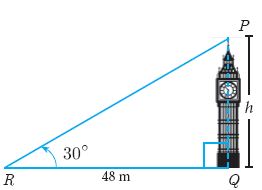
A tower stands vertically on the ground. from a point on the ground, which is 48m away from the foot of the tower, the angel of elevation of the top of the tower is 30°.find the height of the tower.
8.
Find the volume of a cylinder whose height is 2 m and whose base area is 250 m2.
9.
The radius of a conical tent is 7 m and the height is 24 m. Calculate the length of the canvas used to make the tent if the width of the rectangular canvas is 4 m?
10.
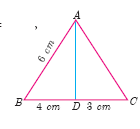
In the figure, AD is the bisector of \(\angle\)A. If BD = 4 cm, DC = 3 cm and AB = 6 cm, find AC.
11.
Let A = {1, 2, 3, 7} and B = {3, 0, –1, 7}, which of the following are relation from A to B ?
R1 = {(2, 1), (7,1)}
12.
Can the number 6n, n being a natural number end with the digit 5 ? Give reason for your answer.
13.
Let A = {3,4,7,8} and B = {1,7,10}. Which of the following sets are relations from A to B?
R1 = {(3,7), (4,7), (7,10), (8,1)}
14.
If A x B = {(3,2), (3, 4), (5,2), (5, 4)} then find A and B.
15.
A pole 6 m high a shadow 2\(\sqrt{3}\) m long on the ground, then the sun's elevation is ___________
60o
45o
30o
90o
16.
17.
18.
The range of the data 8, 8, 8, 8, 8. . . 8 is
0
1
8
3
19.
The electric pole subtends an angle of 30° at a point on the same level as its foot. At a second point ‘b’ metres above the first, the depression of the foot of the pole is 60°. The height of the pole (in metres) is equal to
\(\sqrt { 3 } \) b
\(\frac { b }{ 3 } \)
\(\frac { b }{ 2 } \)
\(\frac { b }{ \sqrt { 3 } } \)
20.
tan \(\theta \) cosec2\(\theta \) - tan\(\theta \) is equal to
sec\(\theta \)
\(cot^{ 2 }\theta \)
sin\( \theta \)
\(cot\theta \)
21.
If the HCF of 65 and 117 is expressible in the form of 65m - 117 , then the value of m is
4
2
1
3
22.
If (5, 7), (3, p) and (6, 6) are collinear, then the value of p is
3
6
9
12
23.
24.
If \(\triangle\)ABC is an isosceles triangle with \(\angle\)C = 90o and AC = 5 cm, then AB is
2.5 cm
5 cm
10 cm
\(5\sqrt { 2 } \)cm
25.
In a hollow cylinder, the sum of the external and internal radii is 14 cm and the width is 4 cm. If its height is 20 cm, the volume of the material in it is
5600\(\pi\) cm3
1120\(\pi\) cm3
56\(\pi\) cm3
3600\(\pi\) cm3
26.
f(x) = (x + 1)3 - (x - 1)3 represents a function which is
linear
cubic
reciprocal
quadratic
27.
If n(A x B) = 6 and A = {1,3} then n(B) is
1
2
3
6
28.
A system of three linear equations in three variables is inconsistent if their planes
intersect only at a point
intersect in a line
coincides with each other
do not intersect
29.
The number of televisions sold in each day of a week are 13, 8, 4, 9, 7, 12, 10. Find its standard deviation.
30.
31.
Find the sum of all natural numbers between 300 and 600 which are divisible by 7.
32.
if cosec\(\theta \) + cot\(\theta \) = p, then prove that cos\(\theta \) = \(\frac { { p }^{ 2 }-1 }{ { p }^{ 2 }+1 } \)
33.
Solve x + 2y - z = 5; x - y + z = -2; -5x - 4y + z = -11
34.
Show that the points P(-1, 5), Q(6, -2) , R(-3, 4) are collinear.
35.
Find the HCF of 396, 504, 636.
36.
Draw a circle of radius 4 cm. At a point L on it draw a tangent to the circle using the alternate segment.
1.
f(x) = 3 + x, g(x) = x - 4
fog(x) = f(g(x)) =f(x - 4) = 3 + x - 4 = x - 1
gof(x) = g(f(x)) = g(3 + x) = 3 + x - 4 = x - 1
f o g = g o f
2.
x2 - 27, (x - 3)2, x2 - 9
x2 - 27 = (x - 3)(x2 + 3x + 9); (x - 3)2 = (x - 3)2; (x2 - 9) = (x + 3)(x - 3)
Therefore, LCM [(x3 - 27), (x-3)2, (x2 - 9)] = (x - 3)2(x + 3)(x2 + 3x + 9)
3.
We observe that A is a 2 x 3 matrix and B is a 3 x 3 matrix, hence AB is defined and it will be of the order 2 × 3..
Given A = \({ \left[ \begin{matrix} 1 & 2 & 0 \\ 3 & 1 & 5 \end{matrix} \right] }_{ 2\times 3 }\), B = \({ \left[ \begin{matrix} 8 & 3 & 1 \\ 2 & 4 & 1 \\ 5 & 3 & 1 \end{matrix} \right] }_{ 2x3 }\)
AB = \({ \left[ \begin{matrix} 1 & 2 & 0 \\ 3 & 1 & 5 \end{matrix} \right] }\times \left[ \begin{matrix} 8 & 3 & 1 \\ 2 & 4 & 1 \\ 5 & 3 & 1 \end{matrix} \right] \)
= \(\left[ \begin{matrix} 8+4+0 & 3+8+0 & 1+2+0 \\ 24+2+25 & 9+4+15 & 3+1+5 \end{matrix} \right] =\left[ \begin{matrix} 12 & 11 & 3 \\ 51 & 28 & 9 \end{matrix} \right] \)
4.
2x2 - x - 1 = 0
\({ x }^{ 2 }-\frac { x }{ 2 } -\frac { 1 }{ 2 } \) = 0 (÷2 make co-efficient of x2 as 1)
\({ x }^{ 2 }-\frac { x }{ 2 } =\frac { 1 }{ 2 } \)
\({ x }^{ 2 }-\frac { x }{ 2 } +{ \left( \frac { 1 }{ 4 } \right) }^{ 2 }=\frac { 1 }{ 2 } +{ \left( \frac { 1 }{ 4 } \right) }^{ 2 }\)
\({ \left( x-\frac { 1 }{ 4 } \right) }^{ 2 }=\frac { 9 }{ 16 } ={ \left( \frac { 3 }{ 4 } \right) }^{ 2 }\)
\(x-\frac { 1 }{ 4 } =\pm \frac { 3 }{ 4 } \) ⇒ x = 1, \(\frac {-1}{2}\)
5.
12 + 22 +...+ 192 = \(\frac { 19\times \left( 19+1 \right) \left( 2\times 19+1 \right) }{ 6 } =\frac { 19\times 20\times 39 }{ 6 } =2470\)
6.
Slope of the straight line 2x + 3y - 8 = 0 is
m1 = \(\frac { -coefficient\quad of\quad x }{ cofficient\quad of\quad y } \)
m2 = \(\frac{-2}{3}\)
Slope of the straight line 4x + 6y + 18 = 0 is
m2 = \(\frac { -4 }{ 6 } =\frac { -2 }{ 3 } \)
Here, m1 = m2
That is, slopes are equal. Hence, the two straight lines are parallel.
7.
Let PQ the height of the tower.
Take PQ = h and QR is the distance between the tower and the point R.in right triangle PQR,\(\angle \)PRQ=30°
tan\(\theta =\frac { PQ }{ QR } \)
tan30° = \(\frac { h }{ 48 } \) gives,\(\frac { 1 }{ \sqrt { 3 } } =\frac { h }{ 48 } \) so, h =\(16\sqrt { 3 } \)
Therefore the height of the tower \(16\sqrt { 3 } \) m
8.
Let r and h be the radius and height of the cylinder respectively.
Given that, height h = 2 m, base area = 250 m2
Now, volume of a cylinder = \(\pi\)r h 2 cu. units
= base area x h
= 250 x 2 = 500 m3
Therefore, volume of the cylinder = 500 m3
9.
Let r and h be the radius and height of the cone respectively.
Given that, radius r = 7 m and height h = 24 m
Hence, l = \(\sqrt { { r }^{ 2 }+{ h }^{ 2 } } \)
\(=\sqrt { 49+576 } \)
\(l=\sqrt { 625 } =25m\)
C.S.A. of the conical tent = \(\pi\)rl sq. units
Area of the canvas \(=\frac { 22 }{ 7 } \times 7\times 25={ 550 }m^{ 2 }\)
Now, length of the canvas \(\frac{Area\ of\ the\ canvas}{width}=\frac{550}{4}=137.5m\)
Therefore, the length of the canvas is 137.5 m
10.
In \(\triangle\)ABC, AD is the bisector of \(\angle\)A
Therefore by Angle Bisector of \(\angle\)A
\(\frac { AB }{ AC } =\frac { BD }{ DC } \)
\(\frac{4}{3}=\frac{6}{A C}\) gives 4AC = 18. Hence, AC \(=\frac{9}{2}=4.5 \mathrm{~cm}\)
11.
A = { 1, 2, 3, 7}, B = { 3, 0, -1, 7}
A x B = {(1, 3), (1, 0), (1, - 1), (1, 7),(2,3), (2, 0), (2, -1), (2, 7), (3,3), (3, 0), (3, - 1), (3, 7), (7, 3)., (7, 0), (7, -1), (7 ,7)}
R1 = {(2, 1), (7, 1)}
Since (2, 1) and (7,1) are not the elements of A x B, R1 is not a relation from A to B. Moreover \(1 \notin B .\)
12.
Since 6n = (2 x 3)n = 2n x 3n
2 is a factor of 6n. So, 6 n is always even.
But any number whose last digit is 5 is always odd.
Hence, 6n cannot end with the digit 5
13.
A x B = {(3,1), (3,7), (3,10), (4,1), (4,7), (4,10), (7,1), (7,7), (7,10), (8,1), (8,7), (8,10)}
We note that, R1 ⊆ A x B. Thus, R1 is a relation from A to B.
14.
A x B = {(3,2), (3,4), (5,2), (5,4)}
We have A = {set of all first coordinates of elements of A x B}. Therefore, A = {3,5}
B = {set of all second coordinates of elements of A x B}. Therefore, B = {2,4}
Thus A = {3,5} and B = {2,4}.
15.
(a)
60o
16.
(b)
17.
(d)
18.
(a)
0
19.
(b)
\(\frac { b }{ 3 } \)
20.
(d)
\(cot\theta \)
21.
(b)
2
22.
(c)
9
23.
(b)
24.
(d)
\(5\sqrt { 2 } \)cm
25.
(b)
1120\(\pi\) cm3
26.
(d)
quadratic
27.
(c)
3
28.
(d)
do not intersect
29.
| xi | xi2 |
| 13 | 169 |
| 8 | 64 |
| 4 | 16 |
| 9 | 81 |
| 7 | 49 |
| 12 | 144 |
| 10 | 100 |
| \({ \Sigma x }_{ i }\) = 63 | \({ \Sigma x }_{ i }^{ 2 }\) = 623 |
Standard deviation
σ =\(\sqrt { \frac { \Sigma x_{ i }^{ 2 } }{ n } -\left( \frac { { \Sigma x }_{ i } }{ n } \right) ^{ 2 } } \)
=\(\sqrt { \frac { 623 }{ 7 } -\left( \frac { 63 }{ 7 } \right) ^{ 2 } } \)
=\(\\ \sqrt { 89-81 } =\sqrt { 8 } \)
Hence, σ ≃ 2.83
(ii) Mean method:
Another convenient way of finding standard deviation is to use the following formula.
Standard deviation (by mean method) σ = \(\sqrt { \frac { \Sigma ({ x }_{ i }-\bar { x } )^{ 2 } }{ n } } \)
If di = xi - \(\bar { x } \) are the deviations, then σ = \(\sqrt { \frac { { \Sigma d }_{ i }^{ 2 } }{ n } } \).
30.
31.
The natural numbers between 300 and 600 which are divisible by 7 are 301, 308, 315, …, 595.
The sum of all natural numbers between 300 and 600 is 301 + 308 + 315 +...+ 595
The terms of the above series are in A.P.
First term a = 301; common difference d = 7; Last term l = 595.
\(n=\left( \frac { l-a }{ d } \right) +1=\left( \frac { 595-301 }{ 7 } \right) +1=43\)
Since, \({ S }_{ n }=\frac { n }{ 2 } \left[ a+l \right] \), we have \({ s }_{43 }=\frac { 43 }{ 2 } \left[ 301+595 \right] \) = 19264
32.
Given cosec\(\theta \) + cot\(\theta \) = p ...(1)
cosec2\(\theta \) - cot2\(\theta \) = 1 (identity)
\(\operatorname{cosec} \theta-\cot \theta=\frac{1}{\operatorname{cosec} \theta+\cot \theta}\)
cosec\(\theta \) - cot\(\theta \) =\(\frac { 1 }{ { p } } \) .... (2)
Adding(1) and (2) we get, 2cosec\(\theta \) = \(p+\frac { 1 }{ p } \)
2cosec\(\theta \)\(\frac { { p }^{ 2 }+1 }{ p } \) ....(3)
Subtracting (2) from (1), we get, 2cot\(\theta \) = \(p-\frac { 1 }{ p } \)
2cot\(\theta \) = \(\frac { { p }^{ 2 }-1 }{ p } \) ...(4)
Dividing (4) by (3) we get,\(\frac { 2cot\theta }{ 2cosec\theta } =\frac { { p }^{ 2 }-1 }{ p } \times \frac { p }{ { p }^{ 2 }+1 } gives,cos\theta =\frac { { p }^{ 2 }-1 }{ { p }^{ 2 }+1 } \)
33.
Let, x + 2y - z = 5... (1)
x - y + z = -2....(2)
-5x - 4y + z = -11... (3)
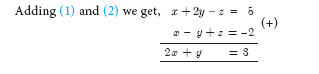
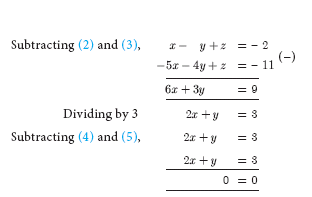
Here we arrive at an identity 0 = 0
Hence the system has an infinite number of solutions.
34.
The points are P(-1, 5, 3), Q(6, -2) , R(-3, 4)
Area of Δ PQR = \(\frac{1}{2}\) { (x1y2 + x2y3 + x3y1) - (x2y1 + x3y2 + x1y3) }
= \(\frac{1}{2}\) { (3 + 24 - 9) - (18 + 6 - 6) }
= \(\frac{1}{2}\) { 18 - 18 } = 0
Therefore, the given points are collinear.
35.
To find HCF of three given numbers, first we have to find HCF of the first two numbers.
To find HCF of 396 and 504
Using Euclid’s division algorithm we get 504 = 396 x 1 + 108
The remainder is 108 \(\neq \) 0
Again applying Euclid’s division algorithm 396 = 108 x 3 + 72
The remainder is 72 \(\neq \) 0
Again applying Euclid’s division algorithm 108 = 72 x 1 + 36
The remainder is 36 \(\neq \) 0
Again applying Euclid division algorithm 72 = 36 x 2 + 0
Here the remainder is zero. Therefore HCF of 396 , 504 = 36, To find the HCF of 636 and 36
Using Euclid’s division algorithm we get 636 = 36 x 17 + 24
The remainder is 24 \(\neq \) 0
Again applying Euclid's division algorithm 36 = 24 x 1 + 12
The remainder is 12 \(\neq \) 0
Again applying Euclid's division algorithm 24 = 12 x 2 + 0
Here the remainder is zero. Therefore HCF of 636,36 = 12
Therefore Highest Common Factor of 396, 504 and 636 is 12.
36.
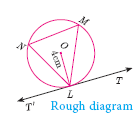
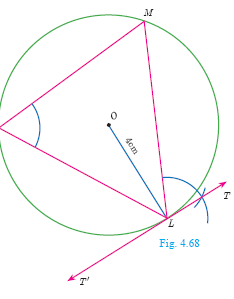
Given, radius = 4 cm
Construction
Step 1 : With O as the centre, draw a circle of radius 4 cm.
Step 2 : Take a point L on the circle. Through L draw any chord LM.
Step 3 : Take a point M distinct from L and N on the circle, so that L, M and N are in anti clockwise direction. Join LN and NM.
Step 4 : Through L draw a tangent TT' such that \(\angle\)TLM =\(\angle\)MNL
Step 5 : TT' is the required tangent.

10th Standard Syllabus & Materials
10th Standard
TN 10th English Prose - 2 - The Night the Ghost Got in Important Questions And Answers Study Material - QB365 Set A
NEW10th Standard
TN 10th English Supplementary - 1 - The Tempest Important Questions And Answers Study Material - QB365 Set A
NEW10th Standard
TN 10th English Poem - 1 - Life Important Questions And Answers Study Material - QB365 Set A
NEW10th Standard
TN 10th English Prose - 1 - His First Flight Important Questions And Answers Study Material - QB365 Set A



Tamilnadu Stateboard 10th Standard Subjects
Tamilnadu Stateboard Standards





