
 100% FREE ACCESS
10th Standard Syllabus & Materials
10th Standard
TN 10th English Prose - 4 - The Attic Important Questions And Answers Study Material - QB365 Set A
NEW10th Standard
TN 10th English Supplementary - 3 - The Story of Mulan Important Questions And Answers Study Material - QB365 Set A
NEW10th Standard
TN 10th English Poem - 3 - I am Every Woman Important Questions And Answers Study Material - QB365 Set A
NEW10th Standard
TN 10th English Prose - 3 - Empowered Women Navigating The World Important Questions And Answers Study Material - QB365 Set A
NEW10th Standard
TN 10th English Supplementary - 2 - Zigzag Important Questions And Answers Study Material - QB365 Set A
NEW10th Standard
TN 10th English Poem - 2 - The Grumble Family Important Questions And Answers Study Material - QB365 Set A

Published on: 07/02/2020
10th Standard Science All Chapter Creative Questions-I-2019-2020
Download Tamil Nadu 10th Standard Science question papers, model tests, one-mark questions, important questions, and public exam papers in PDF format. Free study materials and answer keys for TN State Board students.
Questions + Answers key
Take MCQ Science Test1.
__________is not obtained from petroleum.
Biogas
Diesel
Gasoline
LPG
2.
Notes can be collected, edited and printed using______
Paint
Scratch
Notepad
LINUX
3.
______________ is not related to NIDDM.
Insulin administration
Controlled by medicine
Obese
Insulin action impaired
4.
_________ is an example of auto triploid
Coffee
Banana
Potato
Peanut
5.
______ is not a function of thyroid.
BMR
Body temperature
Carbo hydratemetabolism
Anti-allergic
6.
According to IUPAC rules, the secondary suffix used to represent carboxylic acids is _________________.
al
ol
ate
oic
7.
8.
_____ second largest part of the brain formed of two large sized hemispheres.
Cerebellum
Cerebrum
Thalamus
Diencephalon
9.
When Zinc metal is placed in hydrochloric acid, the gas evolved is _________________
CO
CO2
H2
H2O
10.
The degree of hotness or coldness of a body is called _____
Energy
Thermal energy
Temperature
Heat capacity
11.
_______ rays contain 1 - unit of negative charge.
Alpha
Beta
Gamma
Hydrogen
12.
Quick lime is dissolved in water is a ______________ process.
exothermic
endothermic
reversible
both (a) and (b)
13.
An object is placed at 12 cm from a convex lens whose focal length is 10 cm. The image must
Virtual and enlarged
real and reduced in size
virtual and reduced size
real and enlarged size
14.
15.
The enzyme called________ bind to the origin of replication site.
Replicase
Helicase
Amylase
Ligase
16.
Metals are ______________
Electro positive
Electronegative
both (a) and (b)
neither (a) nor (b)
17.
Which is an example of self - pollination
Hibiscus
Grasses
Apples
Rose
18.
Identify the wrong statement
Guttation occurs through stomata
Water molecules stick to xylem because of adhesion
Stomata closes when guard cells are not turgid
Elements like calcium are not remobilised
19.
Leeches have ___________
heart
lungs
true blood vessels
excretory organs
20.
The magnitude of the weight is expressed in the units of
displacement
mass (kg)
force (Newton)
none
21.
Atoms of different elements with different atomic numbers, but same mass number are known as _________
isobars
isotopes
isotones
isomers
22.
The S1 unit of power is
joule
ampere
Watt
ohm
23.
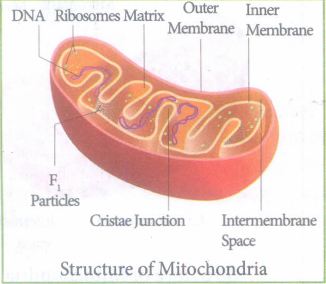
Draw the ultrastructure of mitochondria and label the parts.
24.
List out the advantages of tidal energy.
25.
Mention some behavioural changes seen in drug users.
26.
Differentiate Embryonic and Adult stem cells.
27.
Write a note on 'Visual Communication Device'.
28.
Write the uses of ethanoic acid.
29.
What is theory of Cosmic origin?
30.
What is a neurotransmitter?
31.
What happens during a chemical change?
32.
What is Nuclear Fusion?
33.
What is meant by real expansion?
34.
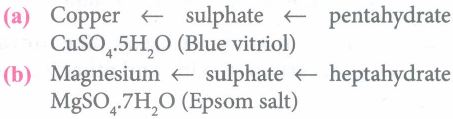
What is (a) Blue vitriol (b) Epsom
35.
List any three traits of pea plant selected by Mendel for his experiments and mention their dominant & recessive form
36.
Name a metal that can be cut with a knife.
37.
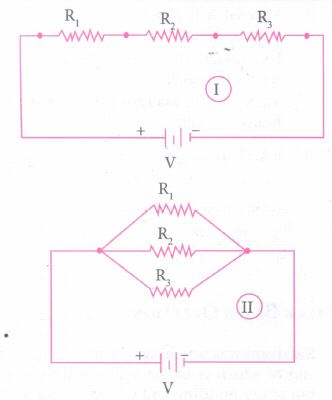
Two electric circuits I and II are shown in figure.
(i) Which of the two circuits has more resistance?
(ii) Through which circuit, more current passes?
(iii) In which circuit, the potential difference across each resistor is equal.
38.
Mention the significance of fertilization?
39.
Write the components of the blood.
40.
What is meant by natural motion?
41.
Pick out the heteronuclear polyatomic molecules among the following and classify them based on their atomicity.
C6H12O6, Cl2, NH3, HCl, N2CO, O3, NH4Cl, CaCO3, O2, SO2
42.
Write a note on female reproductive system of rabbit.
43.
Can Human beings survive with anaerobic respiration - Justify.
44.
Write a note on biogas.
45.
Write a note an prevention and control of AIDS.
46.
Why are Genetically modified organisms produced? Explain the purpose and advantages.
47.
In a biology period, the teacher drew the heart of rabbit on the board and explained its structure and functions. After the class, your friend told you that he finds it difficult to understand the concept and felt he wanted a detailed explanation.
(i) In what way the teaching can be made easily understandable?
(ii) Do you think using technologies like Visual Communication help students to understand the difficult concepts in a simple way?
(iii) By what means the Visual Communication improve the learning ability?
48.
What are the advantages of detergents over soaps?
49.
Write a note on Thyroid Dysfunctions.
50.
X is the oldest fossil bird. The animal X became extinct a long time ago. But the study of fossils of X tells us that it had features like birds and some like reptiles.
(i) Identify 'X'?
(ii) Name one feature in which 'X' resembled birds.
(iii) Name one feature in which 'X' resembled reptiles.
51.
Explain the classification based on the direction of the reaction.
52.
Distinguish between Nuclear fission and nuclear fusion.
53.
With an illustration, explain the method of Calculation for linear expansion of an object.
54.
Explain Solid solution, Liquid solution and Gaseous solution.
55.
State the laws of refraction.
56.
What are the various possibilities of relative motion between source and listener?
57.
Man is a mammal and has incisors and canine. Rabbits are mammals but lack canines. Explain.
58.
How are magnetic ores separated from non magnetic impurities? Explain.
59.
How are chromosomes classified based on the position of centromere?
60.
Write a note on agents of pollination.
61.
Derive the Relation between g and G?
62.
List the difference between RBC and WBC.
63.
Write any five electrical components used in electrical circuit and draw its symbol.
64.
How will you determine the atomicity of gases using Avogadro's hypothesis?
65.
Balance the following equation.
6C14-➝-1e0+?.
66.
A metal scale is graduated at 0°C so what would be original length of the object when measured at 25°C, reads 50 Cm? For a metal, the coefficient of linear expansion is 18 x 10-6/ °C.
67.
A concave lens has focal length of 20 cm. At what distance from the lens a 5 cm tall object be placed so that it forms an image at 15 cm from the lens? Calculate the size of the image formed.
68.
A boy hears two different sounds when a race car is moving toward and moving away. If the speed of sound in air is 340 ms-1. The frequency emitted by the car is 800 Hz and the car velocity is 120 ms-1. Find the frequency heard by the boy? (when the car moving forward).
69.
100 W bulb draws 680 mA current. How much time will be required to pass 30 C of charge through the bulb?
70.
A 20 g bullet moving at 300 m/s stops after penetrating 2 cm of bone. Calculate the average force exerted by the bullet.
71.
Calculate the number of molecules in 11g of CO2
72.
Rani fell from her bike and had a head injury. She was hospitalized and discharged later. What do you think she could have done to save herself from this accident.
73.
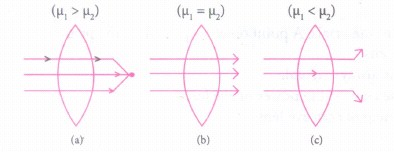
A convex lens of refractive in μ1 is kept in a medium of refractive index (μ2). A parallel beam of light is incident on the lens. Draw the path of the rays of light emerging from a lens. If
(a) μ1 > μ2
(b) μ1 = μ2
(c) μ1 < μ2
74.
Why does sound travel faster in solids than in gases?
1.
(a)
Biogas
2.
(c)
Notepad
3.
(a)
Insulin administration
4.
(b)
Banana
5.
(d)
Anti-allergic
6.
(d)
oic
7.
(d)
8.
(a)
Cerebellum
9.
(c)
H2
10.
(c)
Temperature
11.
(b)
Beta
12.
(a)
exothermic
13.
(d)
real and enlarged size
14.
(b)
15.
(b)
Helicase
16.
(a)
Electro positive
17.
(a)
Hibiscus
18.
(a)
Guttation occurs through stomata
19.
(d)
excretory organs
20.
(c)
force (Newton)
21.
(a)
isobars
22.
(c)
Watt
23.
24.
(i) Tidal energy does not produce any pollution.
(ii) It does not use any fuel and does not produce any waste.
(iii) Tides are predictable, so tidal energy can be produced at any time.
(iv) water is denser than air and therefore can generate electricity at lower speeds than wind turbines.
25.
Behavioural Changes:
Adverse effects among adolescents are:
(i) Drop in academic performance, absence from school or college.
(ii) Lack of interest in personal hygiene, isolation, depression, fatigue and aggressive behaviour.
(iii) Deteriorating relationship with family and friends.
(iv) Change in food and sleeping habits.
(v) Fluctuation in body weight and appetite.
26.
|
S.No |
Embryonic stem cells |
Adult stem cell/ Somatic stem cells |
|---|---|---|
| (i) | They can be extracted and cultured from early embryos and are derived from inner cell mass of the blastocyst. | They are found in the newborn and adults. |
| (ii) | They can be developed into any cell in the body. | They have the ability to divide and give rise the specific cell types. |
27.
The device which helps in explaining the concepts easily through pictures is known as 'Visual Communication Device: For example photos, audio-visuals, drawings, animations all these can be created easily with the help of computer. Cinema is a good example for 'Visual Communication Device'.
28.
Ethanoic acid is used
(i) as a laboratory reagent.
(ii) for coagulating rubber from latex.
(iii) in the preparation of dyes, perfumes and medicines.
29.
Extraterrestrial or Cosmic orgin: Some scientists still believe that life came from outer space. This states that units of life called spores (Panspermia) were transferred to different planets including Earth. This is still an idea of some Astronomers.
30.
Neurotransmitters are the chemicals which allow the transmission of nerve impulse from the axon terminal of one neuron to the dendron of another neuron or to an effector organ. eg. Acetylholine.
31.
(i) In a chemical reaction, the atoms of the reacting molecules or elements are rearranged to form new molecules
(ii) Old chemical bonds between atoms are broken and new chemical bonds are formed.
(iii) Bond breaking absorbs energy where as bond formation releases energy
32.
The process in which two lighter nuclei combine to form a heavier nucleus is termed as "nuclear fusion".
Eg: 1H2 + 1H2- 2He4 + Q (Energy)
Here, 1H2 represents an isotope of hydrogen known as "deuterium". The average energy released in each fusion reaction is about 3.84 x 10⁻¹²J.
33.
If a liquid is heated directly without using any container, then the expansion that we observe is termed as "real expansion" of the liquid.
34.
35.
| Characteristic studied | Dominant character | Recessive character |
|---|---|---|
| Seed shape | Round | Wrinkled |
| Seed colour | Yellow | Green |
| Seed-coat colour | Coloured | White |
36.
Sodium
37.
(i) Equivalent resistance of series combination of resistors is more than the equivalent resistance of the parallel combination of resistors.
So, the resistance of circuit I is more than the resistance of circuit II.
(ii) Since, current \(\alpha \frac{1}{resistance}\)
∴ So current in circuit II is more than the current in circuit I.
(iii) Potential difference across each resistor is equal in circuit II.
38.
(i) It stimulates the ovary to develop into fruit.
(ii) It helps in development of new characters from two different individuals
39.
(i) Components of blood: The blood consists of two main components. The fluid plasma and the formed elements (blood cells) which are found suspended in the plasma.
(ii) Blood cells are classified into erythrocytes, leucocytes and platelets.
40.
(i) According to Aristotle, A moving object naturally comes to rest without any external influence or force. Such motions are termed as "natural motion".
(ii) Natural motion is an unforced motion. According to Newtonian mechanics, the natural motion is a uniform rectilinear motion, following its first law of motion. In general relatively, a natural motion may be linear or curved.
41.
| Heteronuclear |
Diatomic HCl CO |
Triatomic SO2 |
Polyatomic NH4Cl CaCO3 C6H12O6 NH3 |
42.
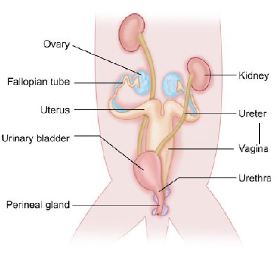
(i) The female reproductive system of rabbit consists of a pair of ovaries which are small ovoid structures. They are located behind the kidneys in the abdominal cavity.
(ii) A pair of oviducts opens into the body cavity by a funnel shaped opening from each side of the ovary.
(iii) The anterior part of the oviduct is the fallopian tube. It leads into a wider tube called the uterus.
(iv) The uterus join together to form a median tube called vagina.
(v) The common tube is formed by the union of urinary bladder and the vagina and is called the urinogenital canal or vestibule. It runs backwards and opens to the exterior by a slit-like aperture called vulva.
(vi) A pair of Cowper's gland and perineal gland are the accessory glands present in the female reproductive system
43.
(i) In anaerobic respiration the amount of energy produced is very less.
(ii) Aerobic respiration is seen is humans wherein the number of ATP molecules produced from a glucose molecule is more than an aerobic respiration.
44.
Biogas is the mixture of methane (nearly 75 %), hydrogen sulphide, carbon dioxide and hydrogen. It is produced by the decomposition of animal wastes (cow dung) and plant wastes in the absence of oxygen. It is also commonly called as 'Gobar gas' since the starting material used is cow dung called as gobar.
Uses of biogas:
(i) It is used as fuel for cooking.
(ii) It is used to run motors and pump sets.
(iii) It is used to generate electricity.
Advantages of biogas:
(i) It burns without smoke and therefore causes less pollution.
(ii) An excellent way to get rid of organic wastes like bio-waste and sewage material.
(iii) Left over slurry is good manure rich in nitrogen and phosphorus
(iv) It is safe and convenient to use.
(v) It can reduce the amount of greenhouse gases emitted.
45.
The following steps may help in controlling and prevent the spreading of HIV infection:
(i) Screening of blood from blood banks for HIV before transfusion.
(ii) Ensuring the use of disposable needles and syringes in hospitals and clinics.
(iii) Advocating safe sex and advantages of using condoms.
(iv) Creating awareness campaign and educating people on the consequences of AIDS.
(v) Persons with HIV/AIDS should not be isolated from the family and society.
46.
Genetically Modified Organisms:
(i) Genetic modification refers to the alteration or manipulation of genes in the organisms using rDNA techniques in order to produce the desired characteristics.
(ii) The DNA fragment inserted is called transgene. Plants or animals expressing a modified endogenous gene or a foreign gene are also known as transgenic organisms.
Advantages:
(i) The transgenic plants are much stable, with improved nutritional quality, resistant to diseases and tolerant to various environment conditions.
(ii) Similarly transgenic animals are used to produce proteins of medicinal importance at low cost and improve livestock quality. eg Golden Rice is a genetically modified Rice which can produce Beta carotene.
47.
(i) Pictures and Audio-Visuals give us more understanding than teaching and writing on black board. So, any visual representation of the concepts would help us to understand better and make teaching simple
(ii) Yes. Visual Communication helps us to easily conceptualize complicated theorems and concepts. When the teacher shows pictures / videos that represent the concept, we would easily relate to its application and firmly understand the concept without any mis-perception
(iii) Pictures, Audio-Visuals, animations provide additional information and helps us to easily correlate the concepts. We could easily remember the visuals than black board writing, and visualize it, so that we do not forget and we could easily recollect at the time of examination.
48.
Detergents are better than soaps because they,
(i) can be used in both hard and soft water and can clean more effectively in hard water than soap.
(ii) can also be used in saline and acidic water.
(iii) do not leave any soap scum on the tub or clothes.
(iv) dissolve freely even in cool water and rinse freely in hard water.
(v) can be used for washing woollen garments, where as soap cannot be used.
(vi) have a linear hydrocarbon chain, which is biodegradable.
(vii) are active emulsifiers of motor grease.
(viii) do an effective and safe cleansing, keeping even synthetic fabrics brighter and whiter.
49.
When the thyroid gland fails to secrete the normal level of hormones, the condition is called thyroid dysfunction. It leads to the following conditions.
Hypothyroidism: It is caused due to the decreased secretion of the thyroid hormones. The abnormal conditions are simple goitre, cretinism and myxoedema.
Goitre:
(i) It is caused due to the inadequate supply of iodine in our diet.
(ii) This is commonly prevalent in Himalayan regions due to low level of iodine content in the soil.
(iii) It leads to the enlargement of thyroid gland which protrudes as a marked swelling in the neck and is called as goitre.
Cretinism:
(i) It is caused due to decreased secretion of the thyroid hormones in children.
(ii) The conditions are stunted growth, mental defect, lack of skeletal development and deformed bones. They are called as cretins
Myxoedema:
(i) It is caused by deficiency of thyroid hormones in adults.
(ii) They are mentally sluggish, increase in body weight, puffiness of the face and hand, oedematous appearance.
Hyperthyroidism:
(i) It is caused due to the excess secretion of the thyroid hormones which leads to Grave's disease (Exopthalmic goitre).
(ii) The symptoms are protrusion of the eyeballs (Exopthalmia), increased metabolic rate, high body temperature, profuse sweating, loss of body weight and nervousness.
50.
(i) Arachaeopteryx.
(ii) It had wings with feathers like a bird.
(iii) It had conical teeth like a reptile.
51.
Reversible Reactions: A reversible reaction is a reaction that can be reversed, i.e., the products can be converted back to the reactants. A reversible reaction is represented by a double arrow with their heads in the direction opposite to each other. Thus, a reversible reaction can be kept

Explanation: The compound 'AB' undergoes decomposition to form the products 'A' and 'B'. It is the forward reaction. As soon as the products are formed, they combine together to form 'AB': It is the backward reaction
PCl5(g) ⇌ PCl3(g) + CI2(g)
Irreversible Reactions: The reaction that cannot be reversed is called irreversible reaction. Consider the combustion of coal into carbon dioxide and water.
C(s) + O2(g) ⟶ CO2(g)+ Heat
Coal oxygen Carbon dioxide
In this reaction, solid coal burns with oxygen and gets converted into carbon dioxide gas and water. As the product is a gas, as soon as it is formed it escapes out of the reaction container. It is hard to decompose a gas into a solid. Thus, the backward reaction is not possible in this case. So, it is an irreversible reaction
52.
| S. No |
Nuclear fission |
Nuclear fusion |
|---|---|---|
| i | The process of breaking (splitting) up of a heavy nucleus into two smaller nuclei is called "nuclear fission". | Nuclear fusion is the combination of two lighter nuclei to form a heavier nucleus. |
| ii | Can be performed at room temperature. | Extreme high temperature and pressure is needed. |
| iii | Alpha, beta and gamma radiations are emitted. | Alpha ray, Positron, and neutrinos are emitted. |
| iv | Fission leads to the emission of gamma radiation. This triggers mutation in the human genes and causes genetic transform diseases. | Only light and heat energy is emitted. No harmful radiation and will not cause any genetic transform diseases. |
| v | Deflected by both the fields; but the direction of deflection is opposite to alpha rays. (in accordance with Fleming's left hand rule). | They are not deflected by both fields. |
53.
Linear expansion:
(i) When a body is heated or cooled, the length of the body changes due to change in its temperature. This expansion is said to be a linear or longitudinal expansion.
(ii) The ration of increase in length of a body per degree celsius rise in temperature to its unit length is called the coefficient of linear expansion. Its SI unit is per Kelvin. The value of coefficient of linear expansion is different for different materials.
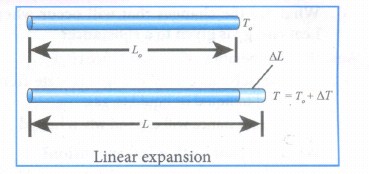
(iii) The equation relating the change in length to the change in temperature of a body is given below:
\(\frac { \triangle L }{ { L }_{ 0 } } \) =αL ΔT
ΔL - Change in length
L0 - Original length
ΔT - Change in temperature
αL - Coefficient of linear expansion.
54.
| Solute | Solvent | Example |
|---|---|---|
| Solid solution | ||
| Solid | Solid | Copper dissolved in gold (Alloys) |
| Liquid | Solid | Mercury with sodium (amalgam) |
| Liquid solution | ||
| Solid | Liquid | Sodium chloride dissolved in water |
| Liquid | Liquid | Ethyl alcohol dissolved in water |
| Gas | Liquid | carbon-di-oxide dissolved in water (Soda water) |
| Gaseous solution | ||
| Liquid | Gas | Water vapour in air (cloud) |
| Gas | Gas | Mixture of Helium-Oxygen gases, |
55.
(i) First law of refraction : The incident ray of light, the refracted ray of light and the normal to the refracting surface all lie in the same plane.
(ii) Second law of refraction : The ratio of the sine of the angle of incidence and sine of the angle of refraction is equal to the ratio of refractive indices of the two media. This law is also known as Snell's law.
\(\frac{\operatorname{sin i}}{\sin x}=\frac{\mu_2}{\mu_1} .\).
56.
(i) The listener moves towards or away from a stationary source.
(ii) The source moves towards or away from a stationary listener.
(iii) Both source and listener move towards or away from each other.
(iv) The medium moves when both source and listener are at rest
57.
Man is omnivorous in his food habit. He eats plant and animal food. Therefore he has well CI developed incisors and canines. Rabbits are herbivorous in mode of nutrition. They need sharp incisors only. Canines or tearing teeth are hence absent in rabbits.
58.
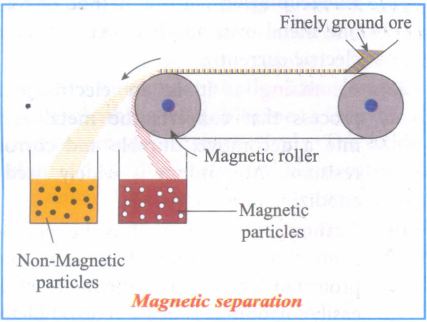
Magnetic separation method:
(i) Principle: Magnetic properties of the ores form the basis of separation. When either the ore or the gangue is magnetic, this method is employed. E.g. Tin stone SnO2 The ore of tin.
(ii) Method: The crushed ore is placed over a conveyer belt which rotates around two metal wheels, one of which is magnetic. The magnetic particles are attracted to the magnetic wheel and fall separately apart from the non-magnetic particles.
59.
Based on the position of centromere, the chromosomes are classified as Telocentric, Acrocentric, Submetacentric andMetacentric.
(i) Telocentric - The centromere is found on the proximal end. They are rod shaped chromosomes.
(ii) Acrocentric - The centromere is found at the one end with a short arm and long arm. They are also rod - shaped chromosomes.
(iii) Submetacentric - The centromere is found near the centre of the chromosome. Thus forming two unequal arms. They are J
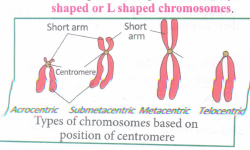
(iv) Metacentric - The centromere occurs in the centre of the chromosome and form two equal arms. They are V shaped chromosomes.
60.
Cross pollination takes place through the agency of animals, insects, wind and water.
Pollination by wind (Anemophily):
(i) The pollination with the help of wind is called anemophily.
(ii) The anemophilous flowers produce enormous amount of pollen grains.
(iii) The pollen grains are small, smooth, dry and light in weight.
(iv) The stigmas are comparatively large, protruding and sometimes hairy, to trap the pollen grains. E.g: Grasses and some cacti.
Pollination by insects (Entomophily):
(i) Pollination with the help of insects like honey bees, flies are called entomophily.
(ii) To attract insects these flowers are brightly coloured, have smell and nectar
(iii) The pollen grains are larger in size, the exine is pitted, spiny etc., so they can be adhered firmly on the sticky stigma. Approximately, 80% of the pollination done by the insects is carried by honey bees.
Pollination by Water: The pollination with the help of water is called hydrophily. This takes place in aquatic plants.
(i) Pollen grains are produced in large numbers.
(ii) Pollen grains float on surface of water till they land on the stigma of female flowers. E.g:Hydrilla, Vallisneria. Pollination by Animals :
(i) When pollination takes place with the help of animals, it is called Zoophily.
(ii) Flowers of such plants attract animals by their bright color, size, scent etc. E.g: Sun bird pollinates flowers of Canna, Gladioli etc., Squirrels pollinate flowers of silk cotton tree.
61.
(i) Let M be the mass of the Earth and m be the mass of the object.
(ii) The entire mass of the earth is assumed to be concentrated at its centre. The radius of the earth is R (= 6378 km = 6400 km approximately).
(iii) By Newton's law of gravitation, the force acting on the object is given by
F = G M m / R2 ............. (A)
(iv) According to Newton's second law, the force acting on the object is given by the product of its mass and acceleration. Here acceleration of the is under action of gravity hence a =g.
F=ma =mg
F = weight = mg
Comparing equations (A) and (B), we get
g= GM/ R2
Acceleration due to gravity
g=\(\frac { GM }{ { R }^{ 2 } } \).
62.
| S.No |
RBC |
WBC |
|---|---|---|
| i | They are red in colour due to the presence of respiratory pigment hemoglobin. | They are colourless. |
| ii | They are biconcave/disc-shaped. | They are amoeboid in shape. |
| iii | The RBC is not classified into types, all red blood cells are the same. | They are classified into granulocytes and agranulocytes. |
| iv | The mature RBC's lack a nucleus. | They are nucleated. |
| v | They cannot change their shape. | They can change their shape and are capable of amoeboid movement. |
| vi | They are smaller than leucocytes. | They are larger than erythrocytes. |
| vii | They are responsible for the transport of respiratory gases (CO2 and O2). | They help to defend the body against pathogens. |
63.
| Component | Use Of The Component | Symbol Used | |
| i) | A resistor of resistance R | Used to fix the magnitude of the current through the circuit | 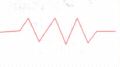 |
| ii) | Variable resistor or Rheostat | Used to select the magnitude of the current through the circuit. | 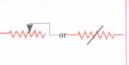 |
| iii) | Ammeter | Used to measure the current. | 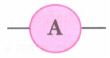 |
| iv) | Voltmeter | Used to measure the potential difference. | 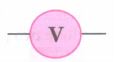 |
| v) | Galvano meter | Used to indicate the direction of current. | 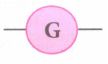 |
64.
The atomicity of an element can be derived using Avogadro's hypothesis. Let us consider the following equation
| H2(g) | + | CI2(g) | ➝ | 2HCI(g) |
| 1 volume | + | 1 volume | ➝ | 2 volumes (By Gay-Lussac's Law) |
According to Avogadro's law, 1 volume of any gas occupy 'n' number of molecules.
| n molecules |
+ n molecules |
➝ 2n molecules |
if n = 1 then
| 1 molecule | + | 1 molecule | ⟶ | 2 molecules. |
| \(\frac{1}{2}\) molecule | + | \(\frac{1}{2}\) molecule | ➝ | 1 molecule |
(i) 1 molecule of hydrogen chloride gas is made up of \(\frac{1}{2}\) molecule of hydrogen and \(\frac{1}{2}\) molecule of chlorine
(ii) But 1 molecule of hydrogen chloride contains one atom of hydrogen and I atom of chlorine
(iii) Hence \(\frac{1}{2}\) molecule of hydrogen = 1 atom of hydrogen
(iv) Or 1 molecule of hydrogen = 2 atoms of hydrogen
(v) So the atomicity of hydrogen is 2, and molecular formula is H2
Similarly,
\(\frac{1}{2}\) molecule of chlorine = 1 atom of chlorine 1molecule of chlorine = 2 atoms of chlorine So the atomicity of chlorine is 2, and its molecular formula is Cl2
65.
6C14-→ -1e0+ 7N14
66.
Initial temperature, t1 = 0°C
Final temperature, t2 = 25°C
Coefficient of linear expansion of metal,
α1 =18 x 10-6 C-1
Measured length, l1 = 50 cm
To find: True (or) Actual length l2 = ?
\(\frac { \triangle l }{ l\triangle T } =\frac { ({ l }_{ 2 }-{ l }_{ 1 }) }{ { l }_{ 1 }(t_{ 2 }-{ t }_{ 1 }) } \)
l2 = I1 (1 + α (t2 - t1)
∴ l2 = 50 x (1 + 18 x 10 -6 x (25 - 0)
= 50 x (1 + 450 x 10-6)
= 50 x (1 + 0.00045)
∴ l2 = 50.225 cm
The true length of the object at 00C =50.225 cm.
67.
Focal length, f = - 20 cm (concave lens)
h0 = 5 cm
Height of the object, h0 = 5 cm
Image distance v = -15 cm
\(\frac { 1 }{ f } =\frac { 1 }{ v } -\frac { 1 }{ u } \quad \frac { 1 }{ v } -\frac { 1 }{ f } \)
=\(\frac { 1 }{ u } \)
\(\frac { 1 }{ u } =\frac { 1 }{ -15 } +\frac { 1 }{ (20) } \)
=\(\frac { -20+15 }{ 300 } =\frac { -5 }{ 300 } \)
u = -60 cm
Magnification, m = \(\frac { { h }_{ i } }{ { h }_{ 0 } } =\frac { v }{ u } \)
hi = \(\frac { v }{ u } \).h0
Size of the image, hi =\(\frac { -15 }{ -60 } \) x 5
= \(\frac { 5 }{ 4 } \) = 12.5 cm
Image is diminished & Virtual
68.
Given
Frequency g car's distance, n = 800 Hz
Velocity of source, Vs = 120ms-1
Velocity of sound, v = 340 ms-1
To find: Frequency emitted by the car, n' = ?
Solution
Apparent frequency, n' =\(\left( \frac { v }{ v-{ v }_{ s } } \right) \times n\)
\(=\frac { 340 }{ 340-120 } \times 800\)
\(=\frac { 340 }{ 220 } \times 80\)
Apparent frequency, n' = 1236 Hz
69.
Given :
Charge passing through bulb, q = 30C
Current drawn by 100 W bulb, I = 680 x 10-3 A
To find: Time taken to pass
through the bulb t =? t=\(\frac{q}{I}\)
Solution :
\(I=\frac { q }{ t } =\frac { 30 }{ 680\times { 10 }^{ -3 } } \)
=441.173
Time required, t =7.35 min
70.
Given:
Mass of the bullet, m = 20 x 10-3 kg
Initial velocity, u = 300 m/s
Final velocity, v = 0
Distance, s = 2 cm = 2 x 10⁻²m
To find: Force exerted by the bullet, f = ?
Using equations of motion,
v2 = u2 + 2 as
0 = (300)2 + 2(a) x 2 x 10⁻²
a=\(\frac { (300)^{ 2 } }{ 4\times 10^{ -2 } } =\frac { 9\times 10^{ 4 } }{ 4\times { 10 }^{ -2 } } \)
a = -2.25 x 10⁶ m/s2
a = 2.25 x 10⁶ m/s2
Average force,
F = ma
= 20 x 10-3 x 2.25 X 106
F = 45 x 10-3 = 4.5 x 10⁴ N
71.
Gram molecular of CO2 = 44g
Number of molecules present in 44g of CO2
= 6.023 X 10²³
∴ Number of molecules present in 11g of CO2
= \(\frac{6.023\times{10}^{23}}{44}\)x 11
= 1.53 x 10²³ molecules.
72.
Rani did not wear a helmet. Some people wear a helmet but don't fasten the strap. When they fall down from the bike, the helmet falls off and they are injured. Thus a helmet worn properly can save lives.
73.
74.
The speed of the sound, \(v\alpha \sqrt { \frac { I }{ d } } \)
The value of \(\frac { I }{ d } \) is much higher for solids. So sound travels faster in solids then gases.

10th Standard Syllabus & Materials
10th Standard
TN 10th English Prose - 2 - The Night the Ghost Got in Important Questions And Answers Study Material - QB365 Set A
NEW10th Standard
TN 10th English Supplementary - 1 - The Tempest Important Questions And Answers Study Material - QB365 Set A
NEW10th Standard
TN 10th English Poem - 1 - Life Important Questions And Answers Study Material - QB365 Set A
NEW10th Standard
TN 10th English Prose - 1 - His First Flight Important Questions And Answers Study Material - QB365 Set A



Tamilnadu Stateboard 10th Standard Subjects
Tamilnadu Stateboard Standards





