
 100% FREE ACCESS
10th Standard Syllabus & Materials
10th Standard
TN 10th English Prose - 4 - The Attic Important Questions And Answers Study Material - QB365 Set A
NEW10th Standard
TN 10th English Supplementary - 3 - The Story of Mulan Important Questions And Answers Study Material - QB365 Set A
NEW10th Standard
TN 10th English Poem - 3 - I am Every Woman Important Questions And Answers Study Material - QB365 Set A
NEW10th Standard
TN 10th English Prose - 3 - Empowered Women Navigating The World Important Questions And Answers Study Material - QB365 Set A
NEW10th Standard
TN 10th English Supplementary - 2 - Zigzag Important Questions And Answers Study Material - QB365 Set A
NEW10th Standard
TN 10th English Poem - 2 - The Grumble Family Important Questions And Answers Study Material - QB365 Set A

Published on: 07/02/2020
10th Standard Science All Chapter Creative Questions-I-2020
Download Tamil Nadu 10th Standard Science question papers, model tests, one-mark questions, important questions, and public exam papers in PDF format. Free study materials and answer keys for TN State Board students.
Questions + Answers key
Take MCQ Science Test1.
Water is denser than air and therefore can generate electricity at________than wind turbines.
lower speeds
high speeds
very low speeds
very high speeds
2.
Which button we use to select a required program?
Program button
Program button
My Computer
Start Button
3.
Excess hunger is called ______________
polyphagia
polydipsia
polyuria
glycosuria
4.
The human genome has _________ base pairs.
3 billion
3 million
30 million
30 billion
5.
6.
Alcohols + Acids 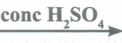 Esters. This reaction is ___________
Ester hydrolysis
Esterification
Dehydrogenation
Oxidation
7.
Most _________ and wood fossils are petrified.
bone
soils
sands
rocks
8.
The _____ is the second largest part of the brain.
cerebrum
medulla
cerebellum
pons
9.
When Zinc metal is placed in hydrochloric acid, the gas evolved is _________________
CO
CO2
H2
H2O
10.
The amount of heat energy required to rise the temperature of 1gram of water through 10C is _____
One kilo calorie
One joule
One kelvin
One caloric
11.
__________ R is the safe limit of radiation exposure per week.
25 milli
2.5 milli
250 milli
2500 milli
12.
Quick lime is dissolved in water is a ______________ process.
exothermic
endothermic
reversible
both (a) and (b)
13.
Lens formula is
\(\frac { { h }^{ 1 } }{ h } \)
\(\frac { 1 }{ f } =\frac { 1 }{ v } -\frac { 1 }{ u } \)
\(\frac { v }{ u } \)
\((\mu -1)\left( \frac { 1 }{ { R }_{ 1 } } -\frac { 1 }{ { R }_{ 2 } } \right) \)
14.
The pitch of sound depends on
frequency
amplitude
both
none
15.
L shaped chromosomes are described as_______
acrocentric
metacentric
submetacentric
telocentric
16.
The process of extraction of aluminium from bauxite is called ____________ process
Hall's
Baeyer's
Smelting
Calcination
17.
_________is a basal part of the Ovule.
Chalaza
Micropyle
Nucellus
Funiculus
18.
Identify the wrong statement
Guttation occurs through stomata
Water molecules stick to xylem because of adhesion
Stomata closes when guard cells are not turgid
Elements like calcium are not remobilised
19.
20.
21.
A small wire presents inside the bulb is called
Conductor
Filament
Insulator
None of the above
22.
Atomicity of Chlorine and Neon is
Mono atomic and mono atomic
Mono atomic and diatomic
Diatomic and diatomic
Diatomic and mono atomic
23.
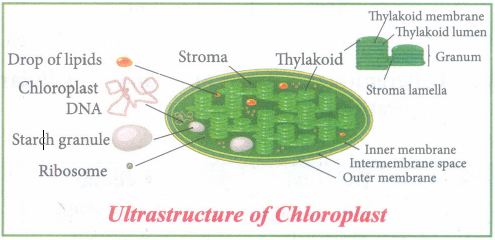
Draw the ultrastructure of a chloroplast and label the parts.
24.
Define Conservation?
25.
How can we prevent Child Sexual Abuse?
26.
Name the methods of plant breeding to develop high yielding varieties or crop improvment.
27.
Write a note on 'Visual Communication Device'.
28.
An organic compound of molecular formula C2H6O(A) which is used as an antifreeze when oxidised with K2Cr2O7/H+ gives compound (B) which is used for making Vinegar. Identify compound (A) and (B). Write the reactions involved.
29.
Define a fossil
30.
What is the function of myelin sheath?
31.
What are the changes that will occur when heat energy is given to a substance?
32.
When does Mie scattering take place? Write the causes.
33.
How can we measure the depth of a sea by using "SONAR"?
34.
Iron when dipped in cone, HNO3 becomes chemically inert. Give reason.
35.
Differentiate diploid and haploid condition.
36.
What is egg apparatus?
37.
Differentiate xylem and phloem.
38.
Handle in a door is always placed at the edge of door. Why?
39.
Write a note on female reproductive system of rabbit.
40.
Why is a dicot leaf described as dorsiventral?
41.
All forms of energy got from different sources comes from the sun. Do you agree with this? Give reasons.
42.
Explain the hazards and effects of Tobacco.
43.
Write a note an selection.
44.
In a biology period, the teacher drew the heart of rabbit on the board and explained its structure and functions. After the class, your friend told you that he finds it difficult to understand the concept and felt he wanted a detailed explanation.
(i) In what way the teaching can be made easily understandable?
(ii) Do you think using technologies like Visual Communication help students to understand the difficult concepts in a simple way?
(iii) By what means the Visual Communication improve the learning ability?
45.
How will you classify organic compounds based on the pattern of carbon chain?
46.
Write a note on Thyroid Dysfunctions.
47.
Explain Use and Disuse theory.
48.
Tabulate the different parts of the brain and their functions.
49.
Explain the classification based on the direction of the reaction.
50.
Explain the principle & structure of atom bomb.
51.
State and explain Boyle's law.
52.
Explain Solid solution, Liquid solution and Gaseous solution.
53.
Write the sign convention for lenses.
54.
Write the difference between the sound and light waves.
55.
Is hirudin used in medical science.
56.
How is zinc blende concentrated? Explain it with a neat diagram
57.
How are chromosomes classified based on the position of centromere?
58.
Arun and Ram were good friends. But Ram slowly started loosing interest in studies as they grew up. The teacher found out that Ram had three siblings and their parents could not give him good food or personal care. What value does this episode give us.
59.
Discuss the apparent weight of a man in lift?
60.
List the difference between RBC and WBC.
61.
Write any five electrical components used in electrical circuit and draw its symbol.
62.
Give the applications of Avogadro's hypothesis.
63.
Three hundred and fifty atoms of Ur-235 split. If 2.9 x 10⁻⁸ J of energy is released from each atom when fission occurs. What nuclear mass was converted into energy?
64.
At 303 k the volume of an aluminium sphere is 0.3 m3. The coefficient linear expansion αL=24 K-1. If the final volume is 0.35 m3. What is the final temperature of aluminium sphere?
65.
The refractive index of kerosene is 1.44 & that of diamond is 2.42. Calculate the refractive index of diamond with respect to kerosene.
66.
Find the speed of sound in air at 9.23° C.
67.
Calculate the force of gravitation between two bodies of weight 50 kg and 10 kg respectively place at 10 m apart. If their distance increased to 100 % then find the change in percentage of force. (New force is 75% less than the original force)
68.
A 110 V light bulb takes 0.9 A current and operates 12h / day. Determine the energy consumed by the bulb for 30 days.
69.
Calculate the gram molecular mass of carbon dioxide (CO2)
70.
What is meant by critical size?
71.
A, B and C are three elements which undergo chemical reactions according to following equations.
A2O3 + 2B ⟶ B2O3 + 2A
3CSO4 + 2B ⟶ B2(SO4)3 + 3C
3CO + 2A ⟶ A2O3 + 3C
Answer the following questions:
(a) Which element is the most reactive?
(b) Which element is the least reactive?
72.
Butter is an example of one type of colloidal solution. Name it. Give a reason for your choice.
73.
V-I graphs for the two wires A and B are shown in the figure. If we connect both the wires one by one to the same battery, which of the two will produce more heat per unit time? Give justification for your answer.
74.
On analysing an impure sample of sodium chloride, the percentage of chloride was found to be 45.5. What is the percentage of pure sodium chloride in the sample?
1.
(a)
lower speeds
2.
(d)
Start Button
3.
(a)
polyphagia
4.
(a)
3 billion
5.
(a)
6.
(b)
Esterification
7.
(a)
bone
8.
(c)
cerebellum
9.
(c)
H2
10.
(d)
One caloric
11.
(c)
250 milli
12.
(a)
exothermic
13.
(b)
\(\frac { 1 }{ f } =\frac { 1 }{ v } -\frac { 1 }{ u } \)
14.
(a)
frequency
15.
(c)
submetacentric
16.
(b)
Baeyer's
17.
(a)
Chalaza
18.
(a)
Guttation occurs through stomata
19.
(b)
20.
(b)
21.
(b)
Filament
22.
(d)
Diatomic and mono atomic
23.
24.
It refers to protection of plants and animals, natural areas, important buildings from the damaging effects of human activity.
25.
Instructions to be given by parents and teachers to the child are.
(i) Do not talk to any suspected person or strangers and to maintain a distance.
(ii) Not to be alone with any unknown person.
(iii) To be careful while traveling alone public or private transport.
(iv) Not to receive any money, toys, gifts or chocolates from person known or unknown to them without the knowledge of their parents,
(v) Not to allow any known or unknown person to touch them.
26.
Methods of plant breeding to develop high yielding varieties are given below:
(i) Introduction of new varieties of plants.
(ii) Selection.
(iii) Polyploidy breeding.
(iv) Mutation breeding.
(v) Hybridization.
27.
The device which helps in explaining the concepts easily through pictures is known as 'Visual Communication Device: For example photos, audio-visuals, drawings, animations all these can be created easily with the help of computer. Cinema is a good example for 'Visual Communication Device'.
28.
Compound (A) with molecular formula C2H6O is ethanol C2H5OH.
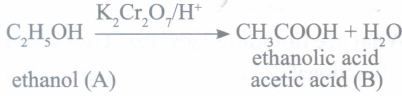
| A | C2H5OH | Ethanol |
| B | CH3COOH | Acetic acid or ethanoic acid |
29.
A plant fossil is any preserved part of a plant that has died long back. Fossils may be a prehistoric impression that may be hundred to millions of years old. Majority of the plant fossils are disarticulated parts of plants, it is rare to find plants to be preserved as whole.
30.
Myelin sheath of a neuron acts as insulator and ensures rapid transmission of nerve impulses.
31.
(i) Temperature of the substance rises.
(ii) The substance may change its state from solid to liquid or liquid to gas.
(iii) The substance will expand when heated.
32.
(i) Mie scattering takes place when the diameter of the scatterer is similar to or larger than the wavelength of the incident light. It is also an elastic scattering. The amount of scattering is independent of wave length.
(ii) Mie scattering is caused by pollen, dust, smoke, water droplets, and other particles in the lower portion of the atmosphere.
33.
In SONAR, by measuring the change in the frequency between the sent signal and received signal, the speed of marine animals and submarines can be determined.
34.
When iron is dipped in con. HNO3 it becomes chemically passive or inert due to the formation of a layer of iron oxide (Fe3O4) on its surface.
35.
(i) In the body cells of sexually reproducing organisms, the chromosomes generally occur in pairs. This condition is called diploid (2n).
(ii) The gametes produced by the organisms contain a single set of chromosomes. Hence, the gametes are said to be haploid (n).
36.
The three cells in the micropylar end of a ovule in which middle one is the egg with two synergids on either side is called egg apparatus.
37.
| S.No |
Xylem |
Phloem |
|---|---|---|
| (i) | It is the tissue that transports water and mineral salts absorbed by the roots to all parts of the plant. | It is the tissue that transports the food synthesized by the leaves to the area of requirement as storage parts. |
| (ii) | The movement of water through xylem is an upward direction. | The movement of food through phloem is bidirectional. |
38.
The door can be easily opened or closed if we apply the force at a point far away from the fixed edge.
(i) In this case, the effect of the force we apply is to rotate the door about the fixed edge.
(ii) This rotational effect of the applied force is more about the 'axis of rotation' when the distance between the fixed edge and the point of application of force is more.
39.
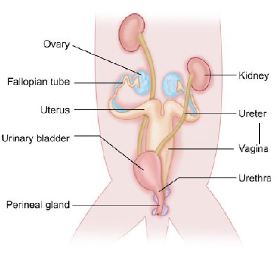
(i) The female reproductive system of rabbit consists of a pair of ovaries which are small ovoid structures. They are located behind the kidneys in the abdominal cavity.
(ii) A pair of oviducts opens into the body cavity by a funnel shaped opening from each side of the ovary.
(iii) The anterior part of the oviduct is the fallopian tube. It leads into a wider tube called the uterus.
(iv) The uterus join together to form a median tube called vagina.
(v) The common tube is formed by the union of urinary bladder and the vagina and is called the urinogenital canal or vestibule. It runs backwards and opens to the exterior by a slit-like aperture called vulva.
(vi) A pair of Cowper's gland and perineal gland are the accessory glands present in the female reproductive system
40.
(i) The dorsal and ventral surfaces of a dicot leaf can be clearly distinguished
(ii) The dorsal surface is darker is appearance and the ventral surface is lighter.
(iii) This is due to distribution of palisade parenchyma below the upper epidermis which as rich in chloroplasts.
(iv) Hence the dicot left is described as dorsiventral.
41.
Yes. Sun is the ultimate source of energy. Directly or indirectly all forms of energy are got from solar energy examples are discussed below:
(i) Fossil fuels are formed due to the burial of plants and animals.
(ii) Renewable sources of energy are also got indirectly from the sun as follows.
(a) The water in lakes, rivers, evaporates due to solar energy and forms clouds. This brings rainfall.
(b) Wind energy is due to uneven heating of earth's surface by the sun rays.
(c) Solar energy is dependent on sunlight directly.
42.
When smoke is inhaled the chemicals get absorbed by the tissues and cause the following harmful effects.
(i) Benzopyrene and polycyclic hydrocarbons present in tobacco smoke is carcinogenic causing lung cancer.
(ii) Causes inflammation of throat and bronchi leading to conditions like bronchitis and pulmonary tuberculosis.
(iii) Inflammation of lung alveoli decrease surface area for gas exchange and cause emphysema.
(iv) Carbon monoxide of tobacco smoke binds to hemoglobin of RBC and decreases its oxygen carrying capacity causing hypoxia in body tissues.
(v) Increased blood pressure caused by smoking leads to increased risk of heart disease.
(vi) Causes increased gastric secretion which leads to gastric and duodenal ulcers.
(vii) Tobacco chewing causes oral cancer (mouth cancer).
43.
Selection is one of the oldest methods of plant breeding in which individual plants or groups of plants are sorted out from a mixed population based on the morphological characters.
Methods of selection:
There are three methods of selection. They are
a) Mass selection
b) Pure line selection
c) Clonal selection
a) Mass selection:
(i) Seeds of best plants showing desired characters are collected from a mixed population.
(ii) The collected seeds are allowed to raise the second generation. This process is carried out for seven or eight generations.
(iii) At the end, they will be multiplied and distributed to the farmers for cultivation. Eg: Groundnut varieties like TMV-2 and AK-10.
b) Pureline selection :
(i) Pureline is "the progeny of a single individual obtained by self breeding":
(ii) This is also called as individual plant selection. In pureline selection large numbers of plants are selected from a self pollinated crop and harvested individually.
(iii) Individual plant progenies from them are evaluated separately. The best one is released as a pureline variety.
(iv) Progeny is similar both genotypically and phenotypically.
c) Clonal selection:
(i) A group of plants produced from a single plant through vegetative or asexual reproduction are called clones.
(ii) All the plants of a clone are similar both in genotype and phenotype.
(iii) Selection of desirable clones from the mixed population of vegetatively propagated crop is called clonal selection.
44.
(i) Pictures and Audio-Visuals give us more understanding than teaching and writing on black board. So, any visual representation of the concepts would help us to understand better and make teaching simple
(ii) Yes. Visual Communication helps us to easily conceptualize complicated theorems and concepts. When the teacher shows pictures / videos that represent the concept, we would easily relate to its application and firmly understand the concept without any mis-perception
(iii) Pictures, Audio-Visuals, animations provide additional information and helps us to easily correlate the concepts. We could easily remember the visuals than black board writing, and visualize it, so that we do not forget and we could easily recollect at the time of examination.
45.
Organic compounds are classified into two types as follows:
(i) Acyclic or Open chain compounds:
These are the compounds in which the carbon atoms are linked in a linear pattern to form the chain. If all the carbon atoms in the chain are connected by single bonds, then the compound is called as saturated. If one or more double bonds or triple bonds exist between the carbon atoms, then the compound is said to unsaturated.
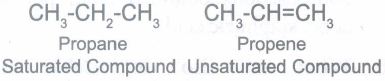
(ii) Cyclic Compounds:
Organic compounds in which the chain of carbon atoms is closed or cyclic are called Cyclic compounds. If the chain contains only carbon atoms, such compounds are called carbocyclic compounds. If the chain contains carbon and other atoms like oxygen, nitrogen, sulphur, etc., these compounds are called heterocyclic compounds. Carbocyclic compounds are further subdivided into alicyclic and aromatic compounds. In alicyclic compounds, the carbon cycle contains only single bonds whereas aromatic compounds contain one or more benzene rings (ring containing alternate double bonds between carbon atoms).
E.g:
.JPG)
46.
When the thyroid gland fails to secrete the normal level of hormones, the condition is called thyroid dysfunction. It leads to the following conditions.
Hypothyroidism: It is caused due to the decreased secretion of the thyroid hormones. The abnormal conditions are simple goitre, cretinism and myxoedema.
Goitre:
(i) It is caused due to the inadequate supply of iodine in our diet.
(ii) This is commonly prevalent in Himalayan regions due to low level of iodine content in the soil.
(iii) It leads to the enlargement of thyroid gland which protrudes as a marked swelling in the neck and is called as goitre.
Cretinism:
(i) It is caused due to decreased secretion of the thyroid hormones in children.
(ii) The conditions are stunted growth, mental defect, lack of skeletal development and deformed bones. They are called as cretins
Myxoedema:
(i) It is caused by deficiency of thyroid hormones in adults.
(ii) They are mentally sluggish, increase in body weight, puffiness of the face and hand, oedematous appearance.
Hyperthyroidism:
(i) It is caused due to the excess secretion of the thyroid hormones which leads to Grave's disease (Exopthalmic goitre).
(ii) The symptoms are protrusion of the eyeballs (Exopthalmia), increased metabolic rate, high body temperature, profuse sweating, loss of body weight and nervousness.
47.
Use and disuse theory
(i) Lamarck's Use and Disuse theory states that if an organ is used constantly, the organ develops well and gets strengthened.
(ii) When an organ is not used for a long time, it gradually degenerates.
(iii) The ancestors of Giraffe were provided with short neck and short forelimbs.
(iv) Due to shortage of grass, they were forced to feed on leaves from trees. The continuous stretching of their neck and forelimbs resulted in the development of long neck and long forelimbs which is an example for constant use of an organ.
(v) The degenerated wing of Kiwi is an example for organ of disuse.
48.
| Structure | Functions |
| Cerebral cortex | Sensory perception, control of voluntary functions, language, thinking, memory, decision making, creativity. |
| Thalamus | Acts as relay station. |
| Hypothalamus | Temperature control, thirst, hunger, urination, important link between nervous system and endocrine glands. |
| Cerebellum | Maintenance of posture and balance, coordinate voluntary muscle activity. |
| Pons and medulla | Role in sleep-awake cycle, cardiovascular, respiratory and digestive control centers. |
49.
Reversible Reactions: A reversible reaction is a reaction that can be reversed, i.e., the products can be converted back to the reactants. A reversible reaction is represented by a double arrow with their heads in the direction opposite to each other. Thus, a reversible reaction can be kept

Explanation: The compound 'AB' undergoes decomposition to form the products 'A' and 'B'. It is the forward reaction. As soon as the products are formed, they combine together to form 'AB': It is the backward reaction
PCl5(g) ⇌ PCl3(g) + CI2(g)
Irreversible Reactions: The reaction that cannot be reversed is called irreversible reaction. Consider the combustion of coal into carbon dioxide and water.
C(s) + O2(g) ⟶ CO2(g)+ Heat
Coal oxygen Carbon dioxide
In this reaction, solid coal burns with oxygen and gets converted into carbon dioxide gas and water. As the product is a gas, as soon as it is formed it escapes out of the reaction container. It is hard to decompose a gas into a solid. Thus, the backward reaction is not possible in this case. So, it is an irreversible reaction
50.
(i) Atom bomb is based on the principle of uncontrolled chain reaction.
(ii) In an uncontrolled chain reaction, the number of neutrons and the number of fission reactions multiply almost in a geometrical progression.
(iii) This releases a huge amount of energy in a very small time interval and leads to explosion.
Structure:
(i) An atom bomb consists of a piece of fissile material whose mass is sub critical.
(ii) This piece has a cylindrical void. It has a cylindrical fissile material which can fit into this void and its mass is also sub critical.
(iii) When the bomb has to be exploded, this cylinder is injected into the void using a conventional explosive.
(iv) Now, the two pieces of fissile material add up to form super critical mass which leads to an explosion.
(v) During this explosion tremendous amount of energy in the form of heat, light and radiation is released.
(vi) A very high temperature and pressure are experienced in fraction of second along with hazardous radiation like ૪ rays which adversely affect the living creatures.
51.
Statement of Boyle's law:
When the temperature of a gas is kept constant, the volume of a fixed mass of gas is inversely proportional to its pressure.
∴ P α 1/V
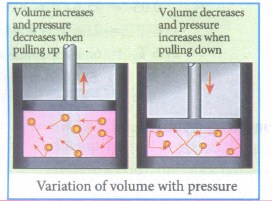
In other words, for an invariable mass of a perfect gas, at constant temperature, the product of pressure and volume is a constant.
Pressure x Volume = constant
PV = constant
52.
| Solute | Solvent | Example |
|---|---|---|
| Solid solution | ||
| Solid | Solid | Copper dissolved in gold (Alloys) |
| Liquid | Solid | Mercury with sodium (amalgam) |
| Liquid solution | ||
| Solid | Liquid | Sodium chloride dissolved in water |
| Liquid | Liquid | Ethyl alcohol dissolved in water |
| Gas | Liquid | carbon-di-oxide dissolved in water (Soda water) |
| Gaseous solution | ||
| Liquid | Gas | Water vapour in air (cloud) |
| Gas | Gas | Mixture of Helium-Oxygen gases, |
53.
| S.No. | Convex Lens | Concave Lens |
| i | Focal length | + for convex lens - for concave lens |
| ii | Distance of object | - if the object is to the left object of the lens + if the object is to the right of the lens |
| iii | Distance of image | + if the image is formed on the right of the lens (real image) - if the image is formed one the left of the lens (virtual image) |
| iv | Magnification | + for erect images - for inverted images |
54.
| S. No. |
Sound |
Light |
|---|---|---|
| i) | Medium is required for the propagation. | Medium is not required for the propagation. |
| ii) | Sound waves are longitudinal. | Light waves are transverse. |
| iii) | Wavelength ranges from 1.65 cm to 1.65m. | Wavelength ranges from 4 x 10⁻⁷m to 7 x 10⁻⁷m. |
| iv) | Sound waves travel in air with a speed of about 340 ms-1 at NTP. | Light waves travel in air with a speed of 3 x 10⁸ ms-1. |
55.
Yes. Hirudin is used as an anticoagulant in medical science.
56.
Froth floatation:
(i) Principle: This process depends on the preferential wettability of the ore with oil (pine oil) and the gangue particles by water. Lighter ores, such as sulphide ores, are concentrated by this method. E.g. Zinc blende ZnS
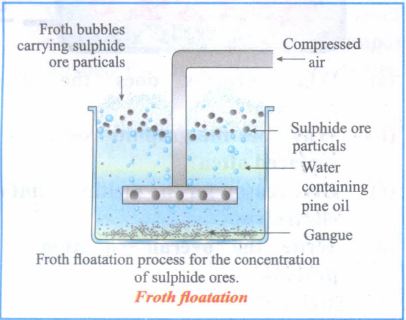
(ii) Method: The crushed ore is taken in a large tank containing oil and water and agitated with a current of compressed air. The ore is wetted by the oil and gets separated from the gangue in the form of froth. Since the 4 ore is lighter, it comes on the surface with the froth and impurities are left behind
57.
Based on the position of centromere, the chromosomes are classified as Telocentric, Acrocentric, Submetacentric andMetacentric.
(i) Telocentric - The centromere is found on the proximal end. They are rod shaped chromosomes.
(ii) Acrocentric - The centromere is found at the one end with a short arm and long arm. They are also rod - shaped chromosomes.
(iii) Submetacentric - The centromere is found near the centre of the chromosome. Thus forming two unequal arms. They are J
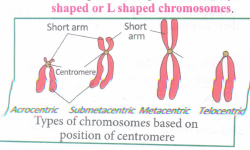
(iv) Metacentric - The centromere occurs in the centre of the chromosome and form two equal arms. They are V shaped chromosomes.
58.
A small family is a happy family. If there are one or two children in a family, the parents can afford to give them good education, food, personal care and other facilities required for them to grow into healthy and happy individuals. Thus it is important for parents to plan a small family which will also build a healthy nation.
59.
| Case 1: Lift is moving upward with an acceleration a |
Case 2: Lift is moving downward with an acceleration a |
Case 3: Lift is at rest | Case 4: Lift is falling down freely |
| R-W =Fnet= ma R=W + ma R=mg + ma R=m (g+a) R>W |
W -R=Fnet =ma R=W -ma R=mg-ma R = m (g-a) R < W |
Here acceleration is zero (a= 0) R=W R=mg R=W |
R = m(g-a) Here acceleration is equals to g (a = g) R= m(g-g) R=0 R=0 |
| Apparent weight is greater than the actual weight |
Apparent weight is lesser than the actual weight |
Apparent weight is equals to actual weight. |
Apparent weight is equals to zero |
60.
| S.No |
RBC |
WBC |
|---|---|---|
| i | They are red in colour due to the presence of respiratory pigment hemoglobin. | They are colourless. |
| ii | They are biconcave/disc-shaped. | They are amoeboid in shape. |
| iii | The RBC is not classified into types, all red blood cells are the same. | They are classified into granulocytes and agranulocytes. |
| iv | The mature RBC's lack a nucleus. | They are nucleated. |
| v | They cannot change their shape. | They can change their shape and are capable of amoeboid movement. |
| vi | They are smaller than leucocytes. | They are larger than erythrocytes. |
| vii | They are responsible for the transport of respiratory gases (CO2 and O2). | They help to defend the body against pathogens. |
61.
| Component | Use Of The Component | Symbol Used | |
| i) | A resistor of resistance R | Used to fix the magnitude of the current through the circuit | 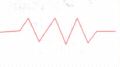 |
| ii) | Variable resistor or Rheostat | Used to select the magnitude of the current through the circuit. | 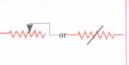 |
| iii) | Ammeter | Used to measure the current. | 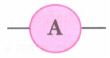 |
| iv) | Voltmeter | Used to measure the potential difference. | 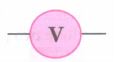 |
| v) | Galvano meter | Used to indicate the direction of current. | 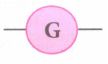 |
62.
Applications of Avogadro's hypothesis
(i) It explains Gay-Lussac's law.
(ii) It helps in the determination of atomicity of gases.
(iii) Molecular formula of gases can be derived using Avogadro's law.
(iv) It determines the relation between molecular mass and vapour density.
(v) It helps to determine Gram molar volume of all gases (i.e. 22.4 lit at S.T.P)
63.
Given
The energy released from one atom = 2.9 x 10⁻⁸ J
For 350 atoms, E = 2.9 x 10-8 x 350
To find: mass, m = ?
E = mc2,
\(m=\frac { E }{ { c }^{ 2 } } =\frac { 2.9\times { 10 }^{ 8 }350 }{ { ({ 3\times 10 }^{ 8 }) }^{ 2 } } \)
mass, m=1.13 x 10⁻²²kg
64.
The coefficient of linear expansion,
αL =24 K-1
The coefficient of cubical expansion,
αv =3αL= 3 x 24
= 72 K-1
The initial temperature, T1 = 303 K
The initial volume, V0 = 0.3 m3
The final volume, V1 = 0.35 m3
Change in volume ΔV = 0.35 - 0.30
= 0.05 m3
To find: The final temperature T2= ?
ΔV = αv. V0 (ΔT)
0.05 = 72 x 0.3 x (T2 - 303)
0.05 = 21.6 (T2 - 303)
= 21.6 T2 - 6544.8
21.6 T2 = 6544.8 - 0.05
T2 =\(\frac { 6544.8 }{ 21.6 } \)
Final temperature, T2 = 303K
65.
Refractive index of diamond with respect to kerosene
=\(=\frac{\text { Refractive index of diamond }}{\text { Refractive index of kerosene }}\)
=\(\frac { 3.42 }{ 1.44 } \)=1.68
66.
Given
Air temperature = 23°C
Velocity of sound in air, Vs = (331.4 + 0.61T) ms-1
= 331.4 + 0.61 x 23
= 331.4 +13.8
Vs = 345.2 ms-1
67.
Mass of body 1, m1 = 50 kg
Mass of body 2, m2 = 10kg
Distance, R = 10m
Universal gravitation
constant, G = 6.67 x 10⁻¹¹ Nm2 kg-2
To find :Force of gravitation, F =\(\frac { G{ m }_{ 1 }{ m }_{ 2 } }{ { R }^{ 2 } } \)
F=\(\frac { 6.67\times 10^{ -11 }\times 50\times 10 }{ 10^{ 2 } } \)
Force, F = 33.35 x 10⁻¹¹ N
68.
Given :
Potential V = 110 V
Current passing through bulb, I = 0.9 A
Time, t = 12h / day
For 30 days, time t = 12 x 30
= 360h
To find: Energy consumed, E = ?
Solution
E = VIt
= 0.9 x 110 x 12 x 30
= 35.64 kwh
Energy, E = 35.64 kwh
69.
Atomic masses of C= 12, O= 16
Gram molecular mass of CO2 = 1(C) + 2(O) = 1(12) + 2(16) = 12 + 32 = 44
Gram molecular mass of CO2 = 44g.
70.
An uncontrolled nuclear chain reaction can occur only when the uranium is greater than a certain minimum size. This is called critical size.
71.
(a) The most reactive element is 'B' as it has displaced both 'A' and 'C' from their compounds
(b) The least reactive element is 'C' as it has been replaced by both 'A' and 'B'.
72.
The colloidal solution is an example in which solid acts are the dispersion medium while liquid as the dispersed phase. It is also called gel. Reason for the choice. On pressing butter, liquid drops come out of it leaving behind a solid. This clearly shows the butter is a gel.
73.
Heat produced per unit time = V^2/R
Now slope of V-I graph = R (resistance of wire).
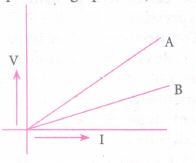
Since slope of V-I graph for wire A is greater than the slope of V-I graph for wire B, therefore, resistance of wire A is greater than the resistance of wire B, Hence, more heat will be produced per unit time in wire B than in wire A.
74.
Molecular (or Formula)
mass of pure NaCl = Atomic mass of Na + Atomic mass of CI
= 23 + 35.5 = 58.5 u
Percentage of chlorine in pure NaCl = \(\frac{35.5}{58.5}\) x 100 = 60.6
Now, if chlorine is 60.6 parts, NaCl = 100 parts
if chlorine is 45.5 parts, NaCl = \(\frac{45.5}{60.6}\) x 100 = 75
Thus, percentage of pure NaCl = 75%

10th Standard Syllabus & Materials
10th Standard
TN 10th English Prose - 2 - The Night the Ghost Got in Important Questions And Answers Study Material - QB365 Set A
NEW10th Standard
TN 10th English Supplementary - 1 - The Tempest Important Questions And Answers Study Material - QB365 Set A
NEW10th Standard
TN 10th English Poem - 1 - Life Important Questions And Answers Study Material - QB365 Set A
NEW10th Standard
TN 10th English Prose - 1 - His First Flight Important Questions And Answers Study Material - QB365 Set A



Tamilnadu Stateboard 10th Standard Subjects
Tamilnadu Stateboard Standards





