
 100% FREE ACCESS
10th Standard Syllabus & Materials
10th Standard
TN 10th English Prose - 4 - The Attic Important Questions And Answers Study Material - QB365 Set A
NEW10th Standard
TN 10th English Supplementary - 3 - The Story of Mulan Important Questions And Answers Study Material - QB365 Set A
NEW10th Standard
TN 10th English Poem - 3 - I am Every Woman Important Questions And Answers Study Material - QB365 Set A
NEW10th Standard
TN 10th English Prose - 3 - Empowered Women Navigating The World Important Questions And Answers Study Material - QB365 Set A
NEW10th Standard
TN 10th English Supplementary - 2 - Zigzag Important Questions And Answers Study Material - QB365 Set A
NEW10th Standard
TN 10th English Poem - 2 - The Grumble Family Important Questions And Answers Study Material - QB365 Set A

Published on: 07/02/2020
10th Standard Science All Chapter Creative Questions-II-2020
Download Tamil Nadu 10th Standard Science question papers, model tests, one-mark questions, important questions, and public exam papers in PDF format. Free study materials and answer keys for TN State Board students.
Questions + Answers key
Take MCQ Science Test1.
2.
Mitochondria was discovered by ___________
Sachs
Kelvin
Melvin
Kolliker
3.
Notes can be collected, edited and printed using______
Paint
Scratch
Notepad
LINUX
4.
____________ is not a symptom of AIDS.
Increase in number of WBC
Lack of appetite
Weight loss
Swelling of lymph nodes
5.
Dr. M. S. Swaminathan did experiments in _________.
rice
cotton
flax
linseed
6.
_____ is a gaseous plant hormone.
Auxin
Ethylene
Cytokinin
Abscisic Acid
7.
Ethanol is used as ______________
a preservative for biological specimen
an antifreeze
an antiseptic
all the above
8.
_______ is the only planet in the Goldilock zone for life.
Mercury
Earth
Mars
Venus
9.
_____ is an inflammation of the meninges.
Meningitis
Myelin sheath
Piameter
Arachnoid membrane
10.
Chemically rust is
hydrated ferrous oxide
Ferrous oxide
hydrated ferric oxide
Ferric oxide
11.
Thermal expansion at particular temperature is less in
solid
liquid
gas
all above
12.
૪ rays are ________ in charge.
positive
negative
neutral
none
13.
The solubility of gases in liquid increases with ____________
increased volume
increased pressure
decreased pressure
none of these
14.
An object is placed at 12 cm from a convex lens whose focal length is 10 cm. The image must
Virtual and enlarged
real and reduced in size
virtual and reduced size
real and enlarged size
15.
Ultrasound waves compared to audible sound waves have.
Lower frequency and Shorter wavelength
Lower frequency and longer wavelength
higher frequency and longer wavelength
higher frequency and shorter wavelength
16.
The sex chromosomes in a human cell refer to the______
22nd pair
20th pair
23rd pair
21st pair
17.
As the positive charge increases, the size of the cation _________
decreases
increases
remains constant
First increases and then decreases
18.
The pollen is produced in________
Filament
Anther
Ovule
Stigma
19.
Identify the wrong statement
Guttation occurs through stomata
Water molecules stick to xylem because of adhesion
Stomata closes when guard cells are not turgid
Elements like calcium are not remobilised
20.
Volume of a gas at STP is 1.12 x 10⁻⁷ cc Calculate the number of molecules in it:
3.01 x 10²⁰
3.01 x 10¹⁵
3.01 x 10²³
3.01 x 1024
21.
The third Ventricle in brain of Rabbit lives in______
cerebrum
cerebellum
diencephalon
medulla
22.
A 110 W, 220 V bulb draws a current.
2 A
440 A
0.5 A
5.5 A
23.
24.
List the functions of mitochondria.
25.
List out the advantages of tidal energy.
26.
What is cancer.
27.
Mention two characteristics of stem cells.
28.
Write a short note on script editor.
29.
What does TFM refer?
30.
What is Geologic time scale.
31.
Define a catalyst.
32.
What is meant by
(i) Sub critical
(ii) Super critical
33.
What are the changes that will occur when heat energy is given to a substance?
34.
What is water of crystallization?
35.
Define Resolving power of a Telescope.
36.
Why does sound wave travel faster in solids?
37.
State the law of purity of gametes or the law of segregation.
38.
What is the significance of modem periodic table?
39.
What is gametogenesis?
40.
Differentiate open type and dosed type of circulation.
41.
How does a parallel circuit differ from a series circuit?
42.
Define 1 dyne.
43.
Measurement of atomic mass of an element is very difficult? Give reason.
44.
Explain respiratory system of a rabbit.
45.
Can Human beings survive with anaerobic respiration - Justify.
46.
What are the solutions suggested for disposal of e-wastes for companies / Organizations?
47.
Write a note an prevention and control of AIDS.
48.
Plants seeds got from other countries are tested in plant quarantine. Reason out.
49.
In a biology period, the teacher drew the heart of rabbit on the board and explained its structure and functions. After the class, your friend told you that he finds it difficult to understand the concept and felt he wanted a detailed explanation.
(i) In what way the teaching can be made easily understandable?
(ii) Do you think using technologies like Visual Communication help students to understand the difficult concepts in a simple way?
(iii) By what means the Visual Communication improve the learning ability?
50.
What are the advantages of detergents over soaps?
51.
Explain the role of growth hormone produced by pituitary gland.
52.
Two kittens (Leo and Joe) from the same mother were separated and sent to different habitual conditions. Leo was sent to a high mountain wild region and Joe was domesticated and lived in a city. After a good 5 years) it was found that Leo was aggressive and built strong with hunting skills. Leo looked tall with strong legs and muscled structure) whereas Joe was a well mannered cat looked puffy with soft legs.
(i) Do you think habitual condition impact animal characters?
(ii) What acquired characters does Leo inherit?
(iii) Is it true but Leo's offspring would be a hunter?
53.
Differentiate simple reflexes and conditional reflexes.
54.
Explain the classification based on the direction of the reaction.
55.
Explain the principle & structure of atom bomb.
56.
With an illustration, explain the method of Calculation for cubical expansion of an object.
57.
Write some solubility substances in water at 25°C.
58.
Explain Raman Scattering.
59.
(i) How to analyse the planets are irregular shaped?
(ii) What is the method used to find it?
(iii) Planets are sensitive to different frequencies Justify.
60.
Is hirudin used in medical science.
61.
Explain the variation of electronegativity down a group and across a period.
62.
Mala had a huge scar on her cheek after she met with fire accident during her college days. She is worried if her baby would inherit the scar she had acquired. She clarified with her doctor, she need not worry about it, as her scar is an acquired trait.
(i) What are acquired traits?
(ii) How is it different from inherited traits?
63.
Kalaivani was watching at a metal pipe, one end of which is connected to a tank at the top of her building and the other end to the tap, which is near the ground level. She was admiring how the water flows from top to the bottom through the pipe. She went and asked her mother, who was an engineer.
(i) Also Kalaivani asked her mother that can she able to compare this with any other scientific concepts?
(ii) How would her mother have compared the resistance in a water pipe as well as in a conductor.
(iii) Give the expression for resistors connected in series and parallel.
64.
My friend Manisha received a marriage proposal from a boy living abroad. Before they met and finalised the wedding, Manisha requested her parents to get the boy's blood test report.
(i) Do you think blood test report is necessary for both boy & girl?
(ii) Do you think, blood test report is not " necessary for the boy living in India?
65.
Derive the Relation between g and G?
66.
Write a note an ABO blood grouping.
67.
How will you determine the atomicity of gases using Avogadro's hypothesis?
68.
In the equation 6C14⟶ 7N14+-1e0 which decay of radioactive carbon-14 results in the new nitrogen - 14 atom.
69.
An aluminium sheet of length 30 m is made into cone for temperature range ΔT = 300 k. Find the change in length of AI sheet?
70.
A convex lens of power +6D and a concave lens of power -4D are combined together (in contact). Find the power of the combination of two lenses.
71.
What is the frequency heard by a stationary observer when a train approaches with a speed of 30 ms-1. The frequency of the train is 600 Hz and the speed of sound is 340 m/s?
72.
What is the resistance of heating element of the heater when 20 A current passing through it at a potential of 220 V?
73.
A body of mass 20 x 10-3 kg when acted upon by a force for 4 second, attains a velocity of 100 m/s. If the same force is applied for 2 minutes, on a body of mass 10 kg at rest, what will be its velocity?
74.
Find the mass of 2.5 mole of oxygen atom.
75.
What would happen if the parathyroid gland was removed?
76.
When we touch a cactus unknowingly, we get pricked by the thorns. We withdraw our hands immediately. Which type of neuron gets activated first.
1.
(d)
2.
(d)
Kolliker
3.
(c)
Notepad
4.
(a)
Increase in number of WBC
5.
(a)
rice
6.
(b)
Ethylene
7.
(d)
all the above
8.
(b)
Earth
9.
(a)
Meningitis
10.
(c)
hydrated ferric oxide
11.
(a)
solid
12.
(c)
neutral
13.
(b)
increased pressure
14.
(d)
real and enlarged size
15.
(d)
higher frequency and shorter wavelength
16.
(c)
23rd pair
17.
(a)
decreases
18.
(b)
Anther
19.
(a)
Guttation occurs through stomata
20.
(b)
3.01 x 10¹⁵
21.
(c)
diencephalon
22.
(c)
0.5 A
23.
(c)
24.
Functions of Mitochondria :
(i) Mitochondria is the main organelle of cell respiration. They produce a large number of ATP molecules. So they are called as power houses of the cell or ATP factory of the cell.
(ii) It helps the cells to maintain normal concentration of calcium ions.
(iii) It regulates the metabolic activity of the cell.
25.
(i) Tidal energy does not produce any pollution.
(ii) It does not use any fuel and does not produce any waste.
(iii) Tides are predictable, so tidal energy can be produced at any time.
(iv) water is denser than air and therefore can generate electricity at lower speeds than wind turbines.
26.
(i) Cancer is an abnormal and uncontrolled division of cells that invade and destroy surrounding tissue forming a tumor or neoplasm (new growth).
27.
The two important properties of stem cells that differentiate them from other cells are:
(i) Its ability to divide and give rise to more stem cells by self-renewal
(ii) Its ability to give rise to specialised cells with specific functions by the process of differentiation.
28.
Script editor is where you edit your programs or your sprite's pictures.
The script editor has three main parts:
(i) Script area: Where you build scripts.
(ii) Block menu: Where you choose the category of blocks (programming statements) to use.
(iii) Block palette: Where you choose the block to use.
29.
TFM means Total Fatty Matter. It is the one of the important factors to be considered to assess the quality of the soap. Soap which have higher TFM, is a good bathing soap.
30.
The Geological time scale is a system of chronological dating that relates geological rock strata to time, and is used by geologists, paleontologists, and other Earth scientists to describe the timing and relationships of events that have occurred during Earth's history.
31.
A catalyst is a substance which increase reaction rate without being consumed in the reaction.
32.
Sub critical: The mass of fissile material necessary to sustain chain reaction is called sub critical.
Super critical: The mass of the fissile material is more than the critical mass, is termed as super critical.
33.
(i) Temperature of the substance rises.
(ii) The substance may change its state from solid to liquid or liquid to gas.
(iii) The substance will expand when heated.
34.
The number of water molecules found in the crystalline substance is called water of crystallization
35.
(i) Resolving power of a telescope is defined as the ability to distinguish between two objects distinctly which is placed at infinite distance.
(ii) Resolving power of a telescope \(\frac { D }{ 1.22\lambda } \).
(iii) D is the diameter/aperture of the objective lens, λ be the wave length of the light.
(iv) The resolving power is inversely proportional to wavelength and directly proportional to the aperture of the lens.
36.
The elasticity of a solid is higher than a liquid or a gas and so sound travels faster in solids than in liquids.
37.
The law of segregation states that "When a pair of contrasting factors or genes or allelomorphs are brought together in a heterozygote or hybrid, the two members of the allelic pair remain together without mixing and when gametes are formed, the two separate out, so that only one enters each gamete".
38.
(i) The main significance of modem periodic table is it gives a clear understanding of the general properties and trends within a group or a period.
(ii) To predict with accuracy the properties of any element.
39.
The formation of the sperm in male and the ovum in female is called gametogenesis. It involves spermatogenesis (formation of spermatozoa) and oogenesis (the formation of ova).
40.
Animals posses two types of circulatory system. They are.
i. Open type
ii. Closed type
(i) Open type : In open type the blood is pumped by heart into blood vessels that open into blood spaces called as sinuses. These sinuses are the body cavities which are called haemoceol. Capillary system is absent. E.g: Arthropods, Molluscs and Ascidians.
(ii) Closed type In closed type the blood flows in a complete circuit around the body through specific blood vessels. The blood flows from arteries to veins through small blood vessels called capillaries. E.g: Vertebrates
41.
| Criteria | Series | Parallel |
| Equivalent resistance | More than the highest resistance. | Less than the lowest resistance. |
| Amount of current | Current is less as resistance is more. | Current is more as resistance is less. |
| Switch ON/OFF | If ore appliance is disconnected, others also do not work. | If ore appliance is disconnected, others will work independently. |
42.
(i) If a force acting on a body of mass. 1 gram produces an acceleration of 1 cm s-2, then the force is said to be 1 dyne.
(ii) 1 dyne = 1g cm s-2, 1N = 105 dyne
43.
(i) Measurement of atomic mass of an element is somewhat more complicated since most of the elements exist as a mixture of isotopes, each of which has its own mass.
(ii) Thus, it is essential to consider this isotopic mixture while calculating atomic mass of an element.
44.
(i) Respiration takes place by a pair of lungs, which are light spongy tissues enclosed in the thoracic cavity.
(ii) Each lung is enclosed by a double membranous pleura.
(iii) Atmospheric air passes through the external nostril and nasal passages into the pharynx. From the pharynx it passes through the glottis into the wind pipe.
(iv) The anterior part of the wind pipe is enlarged to form the larynx or voice box with its wall supported by four cartilaginous plates. Inside the larynx lies the vocal cord and its vibrations result in the production of sound.
(v) The larynx leads into trachea or wind pipe. Tracheal walls are supported by rings of cartilage which help in the free passage of air.
(vi) The epiglottis prevents the entry of food into the trachea through the glottis.
(vii) The trachea divides into two branches called the bronchi one entering into each lung and dividing into further branches called bronchioles which end in alveoli.
45.
(i) In anaerobic respiration the amount of energy produced is very less.
(ii) Aerobic respiration is seen is humans wherein the number of ATP molecules produced from a glucose molecule is more than an aerobic respiration.
46.
There are companies who are doing e-waste management an a commercial scale. Therefore organizations which generate a lot of e-waste must not throw the same in garbage bins but channelise the e-waste through the organizations meant for the same.
47.
The following steps may help in controlling and prevent the spreading of HIV infection:
(i) Screening of blood from blood banks for HIV before transfusion.
(ii) Ensuring the use of disposable needles and syringes in hospitals and clinics.
(iii) Advocating safe sex and advantages of using condoms.
(iv) Creating awareness campaign and educating people on the consequences of AIDS.
(v) Persons with HIV/AIDS should not be isolated from the family and society.
48.
Plant materials brought into a country must be free from pathogens. It may lead to outbreak of new disease or introduction of a new pathogen into the environment. Thus plant materials (seeds / saplings) are tested in plant quarantine.
49.
(i) Pictures and Audio-Visuals give us more understanding than teaching and writing on black board. So, any visual representation of the concepts would help us to understand better and make teaching simple
(ii) Yes. Visual Communication helps us to easily conceptualize complicated theorems and concepts. When the teacher shows pictures / videos that represent the concept, we would easily relate to its application and firmly understand the concept without any mis-perception
(iii) Pictures, Audio-Visuals, animations provide additional information and helps us to easily correlate the concepts. We could easily remember the visuals than black board writing, and visualize it, so that we do not forget and we could easily recollect at the time of examination.
50.
Detergents are better than soaps because they,
(i) can be used in both hard and soft water and can clean more effectively in hard water than soap.
(ii) can also be used in saline and acidic water.
(iii) do not leave any soap scum on the tub or clothes.
(iv) dissolve freely even in cool water and rinse freely in hard water.
(v) can be used for washing woollen garments, where as soap cannot be used.
(vi) have a linear hydrocarbon chain, which is biodegradable.
(vii) are active emulsifiers of motor grease.
(viii) do an effective and safe cleansing, keeping even synthetic fabrics brighter and whiter.
51.
(i) Growth hormone is produced by anterior to be of pituitary gland.
(ii) GH promotes the development and enlargement of all tissues of the body.
(iii) It stimulates the growth of muscles, cartilage and long bones.
(iv) It controls the cell metabolism The improper secretion of this hormone leads to the following conditions.
Dwarfism:
(i) It is caused by less secretion of growth hormone in children.
(ii) The characteristic features are stunted growth, delayed skeletal formation, retarded sexual development and mental disability.
Gigantism:
(i) Over secretion of growth hormone leads to gigantism in children.
(ii) It is characterised by overgrowth of all body tissues and organs. Individuals attain abnormal increase in height.
Acromegaly: Excess secretion of growth hormone in adults may lead to abnormal enlargement of head, "face,hands and feet.
52.
Yes. When there is a change in the environment, the animals respond to the change. They develop adaptive structures. The characters developed by the animals during their life time, in response to the environmental changes are called acquired characters.
(i) Leo lived in the mountain region and it was wild. It developed hunting skills for survival and this made his legs and body strong. So the muscled physical body, strong legs and hunting skills were the acquired characters inherited by Leo.
(ii) According to Lamarck, the. acquired characters are transmitted to the offspring by the process of inheritance.
53.
| Simple reflexes | Conditional reflexes | |
| i) | These reflexes are inbuilt and unlearned responses. | These reflexes are the result of practice and learning. |
| ii) | Eg: Winking of eyes when any dust particle enters. | Eg: Playing harmonium by striking a particular key on seeing a music note. |
54.
Reversible Reactions: A reversible reaction is a reaction that can be reversed, i.e., the products can be converted back to the reactants. A reversible reaction is represented by a double arrow with their heads in the direction opposite to each other. Thus, a reversible reaction can be kept

Explanation: The compound 'AB' undergoes decomposition to form the products 'A' and 'B'. It is the forward reaction. As soon as the products are formed, they combine together to form 'AB': It is the backward reaction
PCl5(g) ⇌ PCl3(g) + CI2(g)
Irreversible Reactions: The reaction that cannot be reversed is called irreversible reaction. Consider the combustion of coal into carbon dioxide and water.
C(s) + O2(g) ⟶ CO2(g)+ Heat
Coal oxygen Carbon dioxide
In this reaction, solid coal burns with oxygen and gets converted into carbon dioxide gas and water. As the product is a gas, as soon as it is formed it escapes out of the reaction container. It is hard to decompose a gas into a solid. Thus, the backward reaction is not possible in this case. So, it is an irreversible reaction
55.
(i) Atom bomb is based on the principle of uncontrolled chain reaction.
(ii) In an uncontrolled chain reaction, the number of neutrons and the number of fission reactions multiply almost in a geometrical progression.
(iii) This releases a huge amount of energy in a very small time interval and leads to explosion.
Structure:
(i) An atom bomb consists of a piece of fissile material whose mass is sub critical.
(ii) This piece has a cylindrical void. It has a cylindrical fissile material which can fit into this void and its mass is also sub critical.
(iii) When the bomb has to be exploded, this cylinder is injected into the void using a conventional explosive.
(iv) Now, the two pieces of fissile material add up to form super critical mass which leads to an explosion.
(v) During this explosion tremendous amount of energy in the form of heat, light and radiation is released.
(vi) A very high temperature and pressure are experienced in fraction of second along with hazardous radiation like ૪ rays which adversely affect the living creatures.
56.
Cubical expansion:
(i) If there is an increase in the volume of a solid body due to heating, then the expansion is called cubical or volumetric expansion.
(ii) As in the cases of linear and areal expansion, cubical expansion is also expressed in terms of coefficient of cubical expansion. The ratio of increase in volume of the body per degree rise in temperature to its unit volume is called coefficient of cubical expansion. This is also measured in K-1.
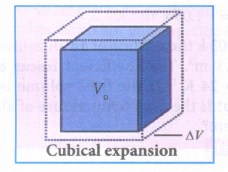
(iii) The equation relating to the change in volume to the change in temperature is given below:
\(\frac { \triangle V }{ { V }_{ 0 } } \) = αv ΔT
ΔV - Change in volume
V0 - Original volume
ΔT - Change in temperature
αv - Coefficient of cubical expansion.
57.
| Name of the solute | Formula of the solute | Solubility g/100 g water |
|---|---|---|
| Calcium carbonate | CaCO3(s) | 0.0013 |
| Sodium chloride | NaCI (s) | 36 |
| Ammonia | NH3(g) | 48 |
| Sodium hydroxide | NaOH(s) | 80 |
| Glucose | C6H12O6(s) | 91 |
| Sodium bromide | NaBr(s) | 95 |
| Sodium iodide | NaI(s) | 184 |
58.
(i) When a parallel beam of monochromatic (single coloured ) light passes through a gas or liquid or transparent solid, a part of light rays are scattered. This scattering is called Raman scattering (inelastic scattering).
(ii) Raman Scattering is defined as "The interaction of light ray with the particles of pure liquids or transparent solids, which leads to a change in wavelength or frequency".
(iii) The scattered light contains some additional frequencies (or wavelengths) other than that of incident frequency (or wavelength). This is known as Raman scattering or Raman Effect.
(iv) The modified lines are called 'Raman lines' and the unmodified lines are called as 'Rayleigh lines'. The lines having frequencies lower than the incident frequency is called stokes lines and the lines having frequencies higher than the incident frequency are called Anti-stokes lines.
59.
(i) To analyse that the planets are irregular shaped objects, Doppler effect is applied.
(ii) Using Doppler effect, an electromagnetic wave or a high frequency sound wave can be made to incident on different points of planet's surface. By finding the frequency shifts of the reflected waves from different points on planets surface, one can analyse that the planet is made of hills and valleys. From this analysis, we can come to a conclusion the planets are irregularly shaped objects.
(iii) Jagadish Chandra Bose, a famous Indian scientist and Biologist, discovered that plants can feel sadness, happiness, pain etc., for that, he invented device named crescograph. The feelings of sadness, happiness, pain etc.. have different frequencies. When we touch a plant with a lovable thought, the frequency of that thought can be sensed by plants and trees.
60.
Yes. Hirudin is used as an anticoagulant in medical science.
61.
(i) Along the period, from left to right in the periodic table, the electronegativity increases because of increase in nuclear charge.
(ii) On moving down a group, the electronegativity of elements decreases because of increased number of energy levels.
62.
(i) Acquired traits are the characters that cannot be passed from one generation to the next generation.
(ii) Characters which are inherited by the offspring from the parents and carried from one generation to another generation are called Inherited traits.
63.
(i) Kalaivani's mother took a small PVC pipe which has water in it and held in a horizontal position. Water came out drop by drop. When she raised one of the ends of the pipe, the water through the other end came out with a greater speed. She said initially when I was holding the pipe in a horizontal position, pressure at the both the ends are same. So water did not come out. The difference in pressure (Pressure difference) between the two ends is zero. But when I raised one of the ends, the top end has high pressure, and the bottom end has low pressure. Due to this pressure difference, water came out with a faster rate. So compare a conductor or a wire to this PVC pipe The wire is connected to a battery, whose one end has higher potential and the other end has lower potential. Due to this difference in potential, electrons from negative terminal (lower potential end) flow towards the positive terminal (higher potential end). Here electron flow is compared with the water flow and the electric potential is compared with the pressure. Kalaivani felt very happy, after hearing her mother's genius explanation.
(ii) When Kalaivani asked how to understand about the concept of resistance from her mother's scientific explanations, her mother continued. If the water pipe is smooth inside, then there is no charge in the speed of flow of water. i.e., zero resistance. But when the pipe has some blocks inside at different points, the water changes its speed of flow at different points, likewise, whenever electrons flow inside the conductor, they may collide with each other, due to which their speed will be resisted (blocked), which forms as electrical resistance. Her explanation made Kalaivani satisfied.
(iii) When two resistors of resistances, R1 & R2 are connected in series to a battery source.
\({ R }_{ s }={ R }_{ 1 }+{ R }_{ 2 }\)
When R1 & R2 are connected in parallel,
\(\frac { 1 }{ { R }_{ p } } +\frac { 1 }{ { R }_{ 1 } } +\frac { 1 }{ { R }_{ 2 } } \Rightarrow \frac { 1 }{ { R }_{ p } } =\frac { { R }_{ 2 }+{ R }_{ 1 } }{ { R }_{ 1 }{ R }_{ 2 } } \)
\({ R }_{ p }=\frac { { R }_{ 1 }{ R }_{ 2 } }{ { R }_{ 1 }+{ R }_{ 2 } } \)
64.
(i) Yes, it is necessary to take the blood reports for both boy and girl to ensure that he or she is free of any sexually transmitted diseases (STD) like syphilis, AIDS.
(ii) No, blood test report is necessary for both boys and girls living all over the world.
65.
(i) Let M be the mass of the Earth and m be the mass of the object.
(ii) The entire mass of the earth is assumed to be concentrated at its centre. The radius of the earth is R (= 6378 km = 6400 km approximately).
(iii) By Newton's law of gravitation, the force acting on the object is given by
F = G M m / R2 ............. (A)
(iv) According to Newton's second law, the force acting on the object is given by the product of its mass and acceleration. Here acceleration of the is under action of gravity hence a =g.
F=ma =mg
F = weight = mg
Comparing equations (A) and (B), we get
g= GM/ R2
Acceleration due to gravity
g=\(\frac { GM }{ { R }^{ 2 } } \).
66.
Blood Groups
(i) The concept of blood grouping was discovered by Karl Landsteiner. He identified blood groups A, B and O. AB blood group was recognized by Decastello and Steini.
(ii) Human blood contains certain specific substances called agglutinogens or antigens (Ag) and agglutinins or antibodies (Ab). Antigens are found on the membrane surface of RBC. Antibodies are present in blood plasma. Based on the presence or absence of antigen and antibodies human blood group is classified into four groups called A, B, AB, and O. An individual has one of the four blood groups.
(iii) 'A' group individuals: Antigen 'A' is present on the surface of RBC and antibody b (anti-b) is present in the plasma.
(iv) 'B' group individuals: Antigen 'B' is present on the surface of RBC and antibody an (anti-a) is present in the plasma.
(v) 'AB' group individuals: Antigens A and B are present on the surface of RBC and antibodies are absent in the plasma.
(vi) 'O' group individuals: No antigen A or B are absent on the surface of RBC. However, the plasma contains both antibodies 'a' and 'b' (anti a and b).
Blood donation :
(i) In blood transfusion one must consider the antigen and antibody compatibility (matching) between the donor and the person receiving blood (recipient). When an individual receives a mismatched blood group from the donor agglutination (clumping) of blood occurs in the body which leads to death.
67.
The atomicity of an element can be derived using Avogadro's hypothesis. Let us consider the following equation
| H2(g) | + | CI2(g) | ➝ | 2HCI(g) |
| 1 volume | + | 1 volume | ➝ | 2 volumes (By Gay-Lussac's Law) |
According to Avogadro's law, 1 volume of any gas occupy 'n' number of molecules.
| n molecules |
+ n molecules |
➝ 2n molecules |
if n = 1 then
| 1 molecule | + | 1 molecule | ⟶ | 2 molecules. |
| \(\frac{1}{2}\) molecule | + | \(\frac{1}{2}\) molecule | ➝ | 1 molecule |
(i) 1 molecule of hydrogen chloride gas is made up of \(\frac{1}{2}\) molecule of hydrogen and \(\frac{1}{2}\) molecule of chlorine
(ii) But 1 molecule of hydrogen chloride contains one atom of hydrogen and I atom of chlorine
(iii) Hence \(\frac{1}{2}\) molecule of hydrogen = 1 atom of hydrogen
(iv) Or 1 molecule of hydrogen = 2 atoms of hydrogen
(v) So the atomicity of hydrogen is 2, and molecular formula is H2
Similarly,
\(\frac{1}{2}\) molecule of chlorine = 1 atom of chlorine 1molecule of chlorine = 2 atoms of chlorine So the atomicity of chlorine is 2, and its molecular formula is Cl2
68.
Beta decay.
69.
Length of AI sheet, L = 30 m
Coefficient of linear expansion, Δl = 23 x 10-6 K-1
Change in temperature ΔT = 300 k
To find: Change in length ΔL =?
ΔL = L αL ΔL
= 30 x 23 x 10-6 x 300
= 2.07 x 10⁻¹
ΔL = 0.207 m
70.
Power of convex lens, P1 = + 6 D
Power of concave lens, P2 = - 4 D
Power of combination of two lenses
P = ?
P = P1 + P2 = 6 - 4 = 2D
P = 2D.
71.
Given
Speed of the train, Vs =30 rns-1
Frequency of the train, n =600Hz
Speed of sound, v =340 ms-1
To find: Apparent frequency n =?
Solution
\(n'=\left( \frac { v }{ v-{ v }_{ s } } \right) \times 600\)
\(=\frac { 340 }{ 310 } \times 600\)
Apparent frequency n' = 658 Hz
72.
Given:
Current passing through heater I= 20 A
To find: Resistance of heating element R = ?
Solution
\(V=IR\Rightarrow \frac { V }{ I } =\frac { 220 }{ 20 } =11\Omega \)
Resistance, R = 11Ω
73.
During impulse on first body:
Mass of the first body,
m1 = 20 x 10-3 kg
Time, t1 = 4 s
Initial velocity, u1= 0
Final velocity, v1 =100 m/s
During impulse on second body:
Mass of the second body,
m2 =10kg
Time, t2 = 2 minutes
= 2 x 60 s = 120 s
To find: Final velocity, v2 =?
Initial velocity, u2 = 0
(i) Impulse on the first body,
F.t1 =m1(v1-u1) [∵ u1=0]
F.t1 =m1v1
F.t1 =20 x 10-3 x 100
F.t1 =2 x 10-3 x 103 =2 Js .............(1)
(ii) Impulse on the second body
F.t2 =m2(v2-u2) [∵ u2=0]
F.t2 =m2v2
Ft2 =10 x v2 ...............(2)
Dividing al and CD, we get
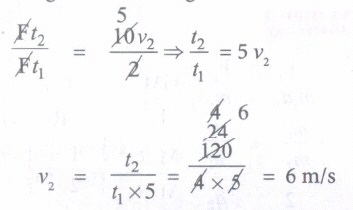
Velocity of the second body, v2 =6 m/s.
74.
Number of moles = \(\frac{Mass}{Atomic \ mass}\)
∴ Mass = Number of moles x Atomic mass
= 0.5 x 16
= 8g.
75.
Removal of parathyroid glands during thyroidectomy (removal of thyroid) causes decreased secretion of parathormone, The conditions are
(i) Muscle spasm known as Tetany.
(ii) Painful cramps of the limb muscles.
76.
When we are pricked by a cactus, the sensory neurons are activated immediately. They take the message to the brain or spinal cord. The message given by the brain or spinal cord is brought back by the Motor neuron. The motor neuron carries the message to the hand muscles. We immediately pull our hand away from the cactus.

10th Standard Syllabus & Materials
10th Standard
TN 10th English Prose - 2 - The Night the Ghost Got in Important Questions And Answers Study Material - QB365 Set A
NEW10th Standard
TN 10th English Supplementary - 1 - The Tempest Important Questions And Answers Study Material - QB365 Set A
NEW10th Standard
TN 10th English Poem - 1 - Life Important Questions And Answers Study Material - QB365 Set A
NEW10th Standard
TN 10th English Prose - 1 - His First Flight Important Questions And Answers Study Material - QB365 Set A



Tamilnadu Stateboard 10th Standard Subjects
Tamilnadu Stateboard Standards





