
 100% FREE ACCESS
10th Standard Syllabus & Materials
10th Standard
TN 10th English Prose - 4 - The Attic Important Questions And Answers Study Material - QB365 Set A
NEW10th Standard
TN 10th English Supplementary - 3 - The Story of Mulan Important Questions And Answers Study Material - QB365 Set A
NEW10th Standard
TN 10th English Poem - 3 - I am Every Woman Important Questions And Answers Study Material - QB365 Set A
NEW10th Standard
TN 10th English Prose - 3 - Empowered Women Navigating The World Important Questions And Answers Study Material - QB365 Set A
NEW10th Standard
TN 10th English Supplementary - 2 - Zigzag Important Questions And Answers Study Material - QB365 Set A
NEW10th Standard
TN 10th English Poem - 2 - The Grumble Family Important Questions And Answers Study Material - QB365 Set A

Published on: 07/02/2020
10th Standard Science All Chapter Important Creative Questions-I- 2019-2020
Download Tamil Nadu 10th Standard Science question papers, model tests, one-mark questions, important questions, and public exam papers in PDF format. Free study materials and answer keys for TN State Board students.
Questions + Answers key
Take MCQ Science Test1.
2.
Exarch and tetrarch xylem are a feature of ___________.
dicot stem
dicot leaf
monocot root
dicot root
3.
Windows and LINUX are examples of________
Files
Folders
Operating Systems
Programs
4.
Obesity is not a risk factor for ___________
AIDS
diabetes
arthritis
CHD
5.
An organism having more than two sets of chromosomes is called
Diploid
Haploid
Monoploid
Polyploid
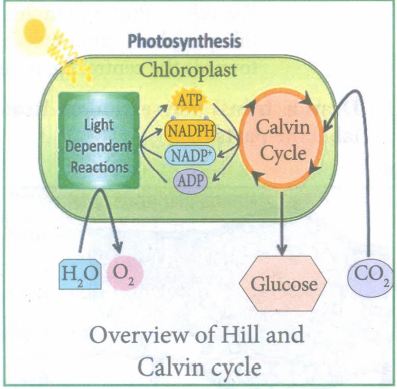
6.
Which of the following is formed when soap water acts on clothes to remove dirt or grease?
acetic acid
Micelle
Ethyl alcohol
all the above
7.
_____ is found in the chloroplast of plants.
Auxin
Abscisic Acid
Ethylene
Cytokinin
8.
The Big Bang theory explains the ________
Origin of Universe
Origin of sea
Origin of mountain
Origin of water
9.
10.
Pick out a chemical reaction which is not feasible
2NaCI ⟶ 2Na + Cl2
2NaCI + F ⟶ 2NaF + Cl2
2NaF + Cl2 ⟶ 2NaCI + F
NaOH + HCI ⟶ NaCl + H2O
11.
SI unit of temperature is
Celsius
Fahrenheit
Kelvin
None
12.
Chain reaction is possible, only if the size of system is __________ the critical size.
less than
greater than
equal to
independent of
13.
Which is a non-aqueous solution?
sugar in water
common salt in water
sulphur in carbon disulphide
None
14.
The point at which the principal axis meets the surface of the lens is
centre of curvature
radius of curvature
focus
pole
15.
16.
Franklin and Wilkin were awarded nobel prize for_______.
studying DNA replication
studying about RNA
X - ray diffraction studies of DNA.
isolating DNA
17.
Modern periodic law is based on __________
atomic mass
atomic number
number of neutrons
Both (a) and (b)
18.
After fertilization the _________disintegrates.
Ovule
Polar nuclei
Antipodals
Endosperm
19.
Persons with __________ blood group can receive blood from 'AB' group individuals.
'A' only
B only
AB and O
A, B, AB and O
20.
The_______ glands are modified glands of the skin
perineal
mammary
gastric
salivary
21.
A complete electric circuit is called_____ circuit.
open
closed
complete
none of these
22.
If lift is accelerated in the upward direction, then the apparent weight of a body is
more than true weight
equal to the true weight
less than true weight
not equal to the true weight
23.
17Cl35, 17Cl37 form the pair of
Isotope
Isonar
Isotone
Isomer
24.
What is starch sheath?
25.
What is the need to look for non conventional energy sources?
26.
Define drug addiction.
27.
List the objective of animals breeding?
28.
What are hard and soft soap?
29.
What is Geologic time scale.
30.
Powdered CaCO3 reacts much faster with HCI than with solid marble chips. Account for the following
31.
Write the two factors which lead to loss of neutrons.
32.
Find the concentration of solution in terms of weight percent if 20g of sugar is dissolved in 40g of water
33.
Write the application of convex lenses.
34.
What is time period of sound wave?
35.
Differentiate diploid and haploid condition.
36.
Answer the following questions with respect to periods of the modern periodic table.
(i) Longest period
(ii) Shortest period
(iii) Number of elements in 1st period
(iv) Elements of period 1
(v) Number of elements in period 4
37.
Mention the significance of fertilization?
38.
Define Osmosis.
39.
If 25 N of force is used to compress a spring, then how much reactive force exerted by spring?
40.
Find the effective resistance of series connection of parallel resistors.
41.
What is gram molecular mass?
42.
Explain respiratory system of a rabbit.
43.
Explain the role of sunlight in photosynthesis.
44.
What are the solutions suggested for disposal of e-wastes for companies / Organizations?
45.
Explain the hazards and effects of Tobacco.
46.
Write a note an DNA fingerprinting.
47.
Explain in detail the uses and main parts of the 'SCRATCH' animation software.
48.
What are the advantages of detergents over soaps?
49.
Describe the role of pancreas in maintenance of blood sugar level.
50.
Write a note on evidences from Morphology and Anatomy in favour of Evolution.
51.
Explain the classification based on the direction of the reaction.
52.
Distinguish between Nuclear fission and nuclear fusion.
53.
Define and describe thermal expansion.
54.
Write some solubility substances in water at 25°C.
55.
Explain the types of Telescope.
56.
What are the various possibilities of relative motion between source and listener?
57.
Is hirudin used in medical science.
58.
Explain the variation of electronegativity down a group and across a period.
59.
Write a note on DNA replication.
60.
Write a note on agents of pollination.
61.
Derive the Relation between g and G?
62.
List the difference between RBC and WBC.
63.
Water boils in an electric kettle in 15 mins after switching on. If the length of the heating wire is decreased to \(\frac{1}{3}\) of its initial value, then in how much time will the same amount of water boil with the same supply voltage?
64.
How will you determine the atomicity of gases using Avogadro's hypothesis?
65.
If Gadolinium - 150 undergoes through a - decay what is the new atomic mass of the resulting element?
66.
If boiling point of water is 95°F, What will be the reading in kelvin scale?
67.
The far position of a myopic person is 90 cm in front of the eye. What is the nature and power of the lens required to correct the problem?
68.
An observer approaches a stationary sound source 1000 Hz at twice the speed of sound. What frequency does the observer hear?
69.
The masses of two planets are in the ratio 1 : 2 their radii are in the ratio 1 : 2. Find the ratio of the acceleration due to gravity on the planets.
70.
Find the
(i) equivalent resistance,
(ii) current through each reactor,
(iii) Total current for the given circuit,
(iv) Voltage drop across each resistor.
71.
Find the mass of 2.5 mole of oxygen atom.
72.
If you are an artist, which computer applications will be relevant for you?
73.
What would happen if the parathyroid gland was removed?
74.
Rani fell from her bike and had a head injury. She was hospitalized and discharged later. What do you think she could have done to save herself from this accident.
75.
When we touch a cactus unknowingly, we get pricked by the thorns. We withdraw our hands immediately. Which type of neuron gets activated first.
76.
Why will a watermelon stay cool for a longer time than sandwiches when both are removed from a cooler on a hot day?
1.
(d)
2.
(d)
dicot root
3.
(c)
Operating Systems
4.
(a)
AIDS
5.
(d)
Polyploid
6.
(b)
Micelle
7.
(b)
Abscisic Acid
8.
(a)
Origin of Universe
9.
(d)
10.
(c)
2NaF + Cl2 ⟶ 2NaCI + F
11.
(c)
Kelvin
12.
(b)
greater than
13.
(c)
sulphur in carbon disulphide
14.
(d)
pole
15.
(c)
16.
(c)
X - ray diffraction studies of DNA.
17.
(b)
atomic number
18.
(c)
Antipodals
19.
(d)
A, B, AB and O
20.
(b)
mammary
21.
(b)
closed
22.
(a)
more than true weight
23.
(a)
Isotope
24.
In a dicot stem endodermis is the inner most layer of cortex. It consists of a single layer of barrel shaped cells, which contain starch grains and is called starch sheath.
25.
(i) The energy crisis has shown that for sustainable development in energy sector we must conserve the non-renewable conventional sources from its rapid depletion and replace them by nonpolluting, renewable sources which are environmentally clean.
(ii) Efforts are made to develop new sources of energy which is called non-conventional sources of energy. Such as wind energy, solar energy etc.
26.
A person who is habituated to a drug due to its prolonged use is called drug addict. This is called drug addiction or drug abuse.
27.
(i) Animal breeding aims at improving the genotypes of domesticated animals to increase their yield and improve the desirable qualities to produce milk, egg and meat.
(ii) When breeding takes place between animals of the same breed, it is called inbreeding. The cross between different breeds is called out breeding.
28.
Sodium salts of fatty acids are known as hard soaps and potassium salts of fatty acids are known as soft soaps.
29.
The Geological time scale is a system of chronological dating that relates geological rock strata to time, and is used by geologists, paleontologists, and other Earth scientists to describe the timing and relationships of events that have occurred during Earth's history.
30.
Powdering of the reactants increases the surface area and more energy on collision of reactant particles. Thus the reaction rate is increased.
31.
(i) "Leakage of neutrons" during nuclear fission.
(ii) Absorption of neutrons by the non fissionable materials.
32.
Concentration of a solution
= \(\frac{Amount \ of \ the \ solute}{Amount \ of \ solvent }\) x 100
= \(\frac{20}{40}\) x 100
= 50
33.
(i) Convex lenses are used as camera lenses.
(ii) Convex lenses are used as magnifying lenses.
(iii) Convex lenses are used in making microscope, telescope and slide projectors.
(iv) Convex lenses are used to correct the defect of vision called hypermetropia.
34.
Time required to produce one complete vibration of particles of the medium or time in which a wave moves a distance equal to its wavelength is called time period of the sound wave. The SI unit of time period is second (s).
35.
(i) In the body cells of sexually reproducing organisms, the chromosomes generally occur in pairs. This condition is called diploid (2n).
(ii) The gametes produced by the organisms contain a single set of chromosomes. Hence, the gametes are said to be haploid (n).
36.
(i) 6th period
(ii) 1st period
(iii) 2
(iv) Hydrogen and Helium
(v) 18
37.
(i) It stimulates the ovary to develop into fruit.
(ii) It helps in development of new characters from two different individuals
38.
Osmosis is the movement of solvent or water molecules from the region of higher concentration to the region of lower concentration through a semi-permeable membrane.
39.
Reactive force by spring = -25 N.
When a 25 N of forces is used to compress a spring, then same amount of force will be exerted by the spring in the opposite direction. This is according to Newton's III law of motion. i.e., To very action there is an equal and opposite reaction.
40.
The connection of a set of parallel resistors that are connected in series, is a series - parallel circuit
Let R1 and R2 be connected in parallel to give an effective resistance of Rp1. Similarly, let R3 and R4 be connected in parallel to give an effective resistance of Rp2. Then, both of these parallel segments are connected in series (Figure).
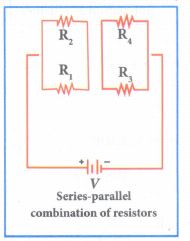
For parallel connection, the effective resistance is \(\frac { 1 }{ { R }_{ p } } =\frac { 1 }{ { R }_{ 1 } } +\frac { 1 }{ { R }_{ 2 } } \)
Using equation
\(\frac { 1 }{ { R }_{ p1 } } =\frac { 1 }{ { R }_{ 1 } } +\frac { 1 }{ { R }_{ 2 } } \)
\(\frac { 1 }{ { R }_{ p2 } } =\frac { 1 }{ { R }_{ 3 } } +\frac { 1 }{ { R }_{ 4 } } \)
Rp1 & Rp2 are connected in series Finally, using equation Rs = R1 + R2 the net effective resistance is given by
\({ R }_{ total }={ R }_{ p1 }+{ R }_{ p2 }\)
41.
It the molecular mass of a given substance is expressed in gram, it is known as gram molecular mass of that substance.
42.
(i) Respiration takes place by a pair of lungs, which are light spongy tissues enclosed in the thoracic cavity.
(ii) Each lung is enclosed by a double membranous pleura.
(iii) Atmospheric air passes through the external nostril and nasal passages into the pharynx. From the pharynx it passes through the glottis into the wind pipe.
(iv) The anterior part of the wind pipe is enlarged to form the larynx or voice box with its wall supported by four cartilaginous plates. Inside the larynx lies the vocal cord and its vibrations result in the production of sound.
(v) The larynx leads into trachea or wind pipe. Tracheal walls are supported by rings of cartilage which help in the free passage of air.
(vi) The epiglottis prevents the entry of food into the trachea through the glottis.
(vii) The trachea divides into two branches called the bronchi one entering into each lung and dividing into further branches called bronchioles which end in alveoli.
43.
The entire process of photosynthesis takes place inside the chloroplast. The structure of chloroplast is such that the light dependent (Light reaction) and light independent (Dark reaction) take place at different sites in the organelle.
a) Light dependent photosynthesis:
(Hill reaction \ Light reaction)
(i) Discovered by Robin Hill (1939). This reaction takes place in the presence of light energy in thylakoid membranes (grana) of the chloroplasts.
(ii) Photosynthetic pigments absorb the light energy and convert it into chemical energy ATP and NADPH2. These products of light reaction move out from the thylakoid to the stroma of the chloroplast.
b) Light independent reactions:
(Biosynthetic phase):
(i) The second steps (dark reaction or biosynthetic pathway) is carried out in the stroma.
(ii) During this reaction CO2 is reduced into carbohydrates with the help of light generated ATP and NADPH2.
(iii) This is also called as Calvin cycle and is carried out in the absence of light.
(iv) In Calvin cycle the inputs are CO2 from the atmosphere and the ATP and NADPH2 produced from light reaction
44.
There are companies who are doing e-waste management an a commercial scale. Therefore organizations which generate a lot of e-waste must not throw the same in garbage bins but channelise the e-waste through the organizations meant for the same.
45.
When smoke is inhaled the chemicals get absorbed by the tissues and cause the following harmful effects.
(i) Benzopyrene and polycyclic hydrocarbons present in tobacco smoke is carcinogenic causing lung cancer.
(ii) Causes inflammation of throat and bronchi leading to conditions like bronchitis and pulmonary tuberculosis.
(iii) Inflammation of lung alveoli decrease surface area for gas exchange and cause emphysema.
(iv) Carbon monoxide of tobacco smoke binds to hemoglobin of RBC and decreases its oxygen carrying capacity causing hypoxia in body tissues.
(v) Increased blood pressure caused by smoking leads to increased risk of heart disease.
(vi) Causes increased gastric secretion which leads to gastric and duodenal ulcers.
(vii) Tobacco chewing causes oral cancer (mouth cancer).
46.
(i) The human genome has 3 billion base pairs. Each person's DNA sequence is unique due to the small difference in the base pairs.
(ii) DNA finger printing is the easier & quicker method to compare the genetic difference among the two individuals. This technique was developed by Alec Jeffrey.
(iii) The technique analyses each individual's unique DNA sequences and provides distinctive characteristics of individual which helps in identification.
(iv) Variable Number of Tandem Repeat sequences (VNTRs) serve as molecular markers for identification.
(v) In human beings, 99% of the DNA base sequences are the same and this is called as bulk genomic DNA.
(vi) The remaining 1% DNA sequence differs from one individual to another. and is present as small stretch of repeated sequences which is known as satellite DNA.
(vii) The number of copies of the repeat sequence also called as VNTRs differs from one individual to another, and results in variation in the size of the DNA segment.
(viii) Satellite DNA bring about variation within the population. Variation in DNA banding pattern reveals differences among the individuals.
Applications of DNA Fingerprinting:
(ix) DNA fingerprinting technique is widely used in forensic applications like crime investigation such as identifying the culprit. It is also used for paternity testing in case of disputes.
(x) It also helps in the study of genetic diversity
47.
'Scratch' is a software used to create animations, cartoons and games easily. Scratch, on the other hand, is a Visual Programming Language. It was developed in the Massachusetts Institute of Technology (MIT) Media Lab to make programming easier and more fun to learn.
Scratch Environment Editor:
(i) The Scratch editor has three main parts: They are Stage, Sprite and Script editor.
(ii) Stage: Stage is the background appearing when we open the scratch window. The background will most often be white. You can change the background colour as you like.
(iii) Sprite: The characters on the background of a Scratch window are known as Sprite. Usually a cat appears as a sprite when the Scratch window is opened. The software provides facilities to make alternations in sprite.
(iv) Script editor / Costume editor: Where you edit your programs or your sprite's pictures.
The script editor has three main parts :
(a) Script area: Where you build scripts.
(b) Block menu: Where you choose the category of blocks (programming statements) to use.
(c) Block palette: Where you choose the block to use.
48.
Detergents are better than soaps because they,
(i) can be used in both hard and soft water and can clean more effectively in hard water than soap.
(ii) can also be used in saline and acidic water.
(iii) do not leave any soap scum on the tub or clothes.
(iv) dissolve freely even in cool water and rinse freely in hard water.
(v) can be used for washing woollen garments, where as soap cannot be used.
(vi) have a linear hydrocarbon chain, which is biodegradable.
(vii) are active emulsifiers of motor grease.
(viii) do an effective and safe cleansing, keeping even synthetic fabrics brighter and whiter.
49.
The endocrine portion of pancreas is made up of Islets of Langerhans.
Structure of Pancreas:
The Islets of Langerhans consists of two types of cells namely alpha cells and beta cells. The alpha cells secrete glucagon and beta cells secrete insulin.
Functions of Pancreatic hormones:
A balance between insulin and glucagon production is necessary to maintain blood glucose concentration.
Insulin :
(i) Insulin helps in the conversion of glucose into glycogen which is stored in liver and skeletal muscles.
(ii) It promotes the transport of glucose into the cells.
(iii) It decreases the concentration of glucose in blood.
Glucagon:
(i) Glucagon helps in the breakdown of glycogen to glucose in the liver.
(ii) It increases blood glucose levels.
Diabetes mellitus :
The deficiency of insulin causes Diabetes mellitus. It is characterised by
(i) Increase in blood sugar level (Hyperglycemia)
(ii) Excretion of excess glucose in the urine (Glycosuria).
(iii) Frequent urination (Polyuria).
(iv) Increased thirst (Polydipsia).
(v) Increase in appetite (Polyphagia).
50.
The comparative study of Morphology and Anatomy of animals, reveal that they possess common set of characteristics.
(a) Homologous organs:
(i) The homologous organs are those which have inherited from common ancestors with similar developmental pattern in embryos.
(ii) E.g: The fore limbs of mammals are homologous structures. A Human hand, a front leg of a Cat, flipper of a Whale and a Bat's wing look dissimilar and adapted for different functions. Their mode of development and basic structure of bone are similar.
(b) Analogous organs:
(i) The analogous organs look similar and perform similar functions but they have different origin and developmental pattern.
(ii) The function of the wings of a Bat, the wings of a bird and wings of an insect are similar, but their basic structures are different.
(c) Vestigial organs:
(i) The degenerated and non-functional organs of animals are called Vestigial organs. The same organs are found to be well-developed and functional, in some of the related forms.
(ii) E.g: Some of the Vestigial organs in man are Vermiform appendix, Nictitating membrane, Caudal Vertebra, Coccyx etc.
(d) Atavism:
(i) The reappearance of ancestral characters in some individuals is called Atavism.
(ii) E.g: Presence of rudimentary tail in new born babies, presence of thick hair on the Human body.
51.
Reversible Reactions: A reversible reaction is a reaction that can be reversed, i.e., the products can be converted back to the reactants. A reversible reaction is represented by a double arrow with their heads in the direction opposite to each other. Thus, a reversible reaction can be kept

Explanation: The compound 'AB' undergoes decomposition to form the products 'A' and 'B'. It is the forward reaction. As soon as the products are formed, they combine together to form 'AB': It is the backward reaction
PCl5(g) ⇌ PCl3(g) + CI2(g)
Irreversible Reactions: The reaction that cannot be reversed is called irreversible reaction. Consider the combustion of coal into carbon dioxide and water.
C(s) + O2(g) ⟶ CO2(g)+ Heat
Coal oxygen Carbon dioxide
In this reaction, solid coal burns with oxygen and gets converted into carbon dioxide gas and water. As the product is a gas, as soon as it is formed it escapes out of the reaction container. It is hard to decompose a gas into a solid. Thus, the backward reaction is not possible in this case. So, it is an irreversible reaction
52.
| S. No |
Nuclear fission |
Nuclear fusion |
|---|---|---|
| i | The process of breaking (splitting) up of a heavy nucleus into two smaller nuclei is called "nuclear fission". | Nuclear fusion is the combination of two lighter nuclei to form a heavier nucleus. |
| ii | Can be performed at room temperature. | Extreme high temperature and pressure is needed. |
| iii | Alpha, beta and gamma radiations are emitted. | Alpha ray, Positron, and neutrinos are emitted. |
| iv | Fission leads to the emission of gamma radiation. This triggers mutation in the human genes and causes genetic transform diseases. | Only light and heat energy is emitted. No harmful radiation and will not cause any genetic transform diseases. |
| v | Deflected by both the fields; but the direction of deflection is opposite to alpha rays. (in accordance with Fleming's left hand rule). | They are not deflected by both fields. |
53.
(i) When heat energy is supplied to a body, there can be an increase in the dimension of the object. This change in the dimension due to rise in temperature is called thermal expansion of the object.
(ii) The expansion of liquids (eg. mercury) can be seen when a thermometer is placed in warm water. All forms of matter (solid, liquid and gas) undergo expansion on heating.
(iii) When a solid is heated, the atoms gain energy and vibrate more vigorously. This results in the expansion of the solid.
(iv) The different types of expansion of solid are
i) Linear expansion
ii) Superficial expansion
iii) Cubical expansion
(v) When heated, the atoms in a liquid or gas gain energy and are forced further apart. The extent of expansion varies from substance to substance. For a given rise in temperature, a liquid will have more expansion than a solid and a gaseous substance has the highest expansion when compared with the other two.
54.
| Name of the solute | Formula of the solute | Solubility g/100 g water |
|---|---|---|
| Calcium carbonate | CaCO3(s) | 0.0013 |
| Sodium chloride | NaCI (s) | 36 |
| Ammonia | NH3(g) | 48 |
| Sodium hydroxide | NaOH(s) | 80 |
| Glucose | C6H12O6(s) | 91 |
| Sodium bromide | NaBr(s) | 95 |
| Sodium iodide | NaI(s) | 184 |
55.
According to optical property, it is classified into two types.
(i) Refracting telescope
(ii Reflecting telescope
(i) Refracting telescope: Lenses are used in this kind of telescopes. Galilean telescope, Keplerian telescope, Achromatic refractors, Apochromatic refractors are some Refracting telescope.
(ii) Reflecting telescope: Parabolic mirrors are used in these kind telescopes. Gregorian, Newtonian, Cassegrain telescope, Ritchey- Chretien telescope are some Reflecting telescopes. According to the things which are observed, Astronomical Telescope and Terrestrial Telescopes are the two major types of telescope.
56.
(i) The listener moves towards or away from a stationary source.
(ii) The source moves towards or away from a stationary listener.
(iii) Both source and listener move towards or away from each other.
(iv) The medium moves when both source and listener are at rest
57.
Yes. Hirudin is used as an anticoagulant in medical science.
58.
(i) Along the period, from left to right in the periodic table, the electronegativity increases because of increase in nuclear charge.
(ii) On moving down a group, the electronegativity of elements decreases because of increased number of energy levels.
59.
(i) DNA molecule produces exact copies of its own structure during replication process.
(ii) The two strands of a DNA molecule have complementary base pairs. The nucleotides of each strand provide the information needed to produce its new strand.
Origin of replication: The specific points on the DNA, where the replication begins. It is the site of origin of replication. The two strands open and separate at this point forming the replication fork.
Unwinding of DNA molecule:
(i) The enzyme called helicase, bind to the origin of replication site.
(ii) They separate the two strands of the DNA. The enzyme called topoisomerase seperates the double helix above the replication fork and removes the twists formed during the unwinding process.
(iii) Each of the separated DNA strands function as template.
Formation of RNA primer: An RNA primer is a short segment of RNA nucleotides. The primer is synthesized by the DNA template close to the origin of replication.
Synthesis of new complimentary strand from the parent strand :
(i) After the formation of RNA primer, nucleotides are added with the help of an enzyme DNA polymerase and new complimentary strand of DNA is formed from each of the parent strand. The synthesis is unidirectional.
(ii) In one strand the daughter strand is synthesized as a continuous strand which is called leading strand.
(iii) In the order stand, short segment of DNA are synthesized. This strand is called lagging strand.
(iv) The short segments of DNA are called Okazaki fragments. The fragments are joined together by the enzyme DNA ligase.
(v) The replication stops when the replication fork of the two sides meet at a site called terminus which is situated opposite to origin of replication site
60.
Cross pollination takes place through the agency of animals, insects, wind and water.
Pollination by wind (Anemophily):
(i) The pollination with the help of wind is called anemophily.
(ii) The anemophilous flowers produce enormous amount of pollen grains.
(iii) The pollen grains are small, smooth, dry and light in weight.
(iv) The stigmas are comparatively large, protruding and sometimes hairy, to trap the pollen grains. E.g: Grasses and some cacti.
Pollination by insects (Entomophily):
(i) Pollination with the help of insects like honey bees, flies are called entomophily.
(ii) To attract insects these flowers are brightly coloured, have smell and nectar
(iii) The pollen grains are larger in size, the exine is pitted, spiny etc., so they can be adhered firmly on the sticky stigma. Approximately, 80% of the pollination done by the insects is carried by honey bees.
Pollination by Water: The pollination with the help of water is called hydrophily. This takes place in aquatic plants.
(i) Pollen grains are produced in large numbers.
(ii) Pollen grains float on surface of water till they land on the stigma of female flowers. E.g:Hydrilla, Vallisneria. Pollination by Animals :
(i) When pollination takes place with the help of animals, it is called Zoophily.
(ii) Flowers of such plants attract animals by their bright color, size, scent etc. E.g: Sun bird pollinates flowers of Canna, Gladioli etc., Squirrels pollinate flowers of silk cotton tree.
61.
(i) Let M be the mass of the Earth and m be the mass of the object.
(ii) The entire mass of the earth is assumed to be concentrated at its centre. The radius of the earth is R (= 6378 km = 6400 km approximately).
(iii) By Newton's law of gravitation, the force acting on the object is given by
F = G M m / R2 ............. (A)
(iv) According to Newton's second law, the force acting on the object is given by the product of its mass and acceleration. Here acceleration of the is under action of gravity hence a =g.
F=ma =mg
F = weight = mg
Comparing equations (A) and (B), we get
g= GM/ R2
Acceleration due to gravity
g=\(\frac { GM }{ { R }^{ 2 } } \).
62.
| S.No |
RBC |
WBC |
|---|---|---|
| i | They are red in colour due to the presence of respiratory pigment hemoglobin. | They are colourless. |
| ii | They are biconcave/disc-shaped. | They are amoeboid in shape. |
| iii | The RBC is not classified into types, all red blood cells are the same. | They are classified into granulocytes and agranulocytes. |
| iv | The mature RBC's lack a nucleus. | They are nucleated. |
| v | They cannot change their shape. | They can change their shape and are capable of amoeboid movement. |
| vi | They are smaller than leucocytes. | They are larger than erythrocytes. |
| vii | They are responsible for the transport of respiratory gases (CO2 and O2). | They help to defend the body against pathogens. |
63.
Supply Voltage is same
Amount of heat produced is also same
Time taken to heat water t = 15 min.
\(H=\frac { { V }^{ 2 } }{ R } .t\quad [H={ I }^{ 2 }Rt\Rightarrow (V=IR)\therefore I=\frac { V }{ R } ]\)
\(\therefore \frac { { R }_{ 1 } }{ { R }_{ 2 } } =\frac { { t }_{ 1 } }{ { t }_{ 2 } } \quad ...(1)\)
\(R\alpha l\quad \quad \quad [R=\rho \frac { l }{ A } ]\)
\(\frac { { R }_{ 1 } }{ { R }_{ 2 } } =\frac { { l }_{ 1 } }{ { l }_{ 2 } } \quad \quad \quad ...(2)\)
From (i) and (2)
\(\frac { { l }_{ 1 } }{ { l }_{ 2 } } =\frac { { t }_{ 1 } }{ { t }_{ 2 } } =\frac { 15 }{ { t }_{ 2 } } \quad \quad ....(iii)\)
\({ l }_{ 2 }=\frac { 1 }{ 3 } { l }_{ 1 }\Rightarrow \frac { { l }_{ 1 } }{ { l }_{ 2 } } =3\)
Sub in (iii) \(3=\frac { 15 }{ { t }_{ 2 } } \)
\(\therefore { t }_{ 2 }=\frac { 15 }{ 3 } =5min\)
Time taken to heat \(\frac{1}{3}\) length of the wire = 5 min
64.
The atomicity of an element can be derived using Avogadro's hypothesis. Let us consider the following equation
| H2(g) | + | CI2(g) | ➝ | 2HCI(g) |
| 1 volume | + | 1 volume | ➝ | 2 volumes (By Gay-Lussac's Law) |
According to Avogadro's law, 1 volume of any gas occupy 'n' number of molecules.
| n molecules |
+ n molecules |
➝ 2n molecules |
if n = 1 then
| 1 molecule | + | 1 molecule | ⟶ | 2 molecules. |
| \(\frac{1}{2}\) molecule | + | \(\frac{1}{2}\) molecule | ➝ | 1 molecule |
(i) 1 molecule of hydrogen chloride gas is made up of \(\frac{1}{2}\) molecule of hydrogen and \(\frac{1}{2}\) molecule of chlorine
(ii) But 1 molecule of hydrogen chloride contains one atom of hydrogen and I atom of chlorine
(iii) Hence \(\frac{1}{2}\) molecule of hydrogen = 1 atom of hydrogen
(iv) Or 1 molecule of hydrogen = 2 atoms of hydrogen
(v) So the atomicity of hydrogen is 2, and molecular formula is H2
Similarly,
\(\frac{1}{2}\) molecule of chlorine = 1 atom of chlorine 1molecule of chlorine = 2 atoms of chlorine So the atomicity of chlorine is 2, and its molecular formula is Cl2
65.
Ga150⇾X146+ 2He4
New atomic number - 146
66.
F to (kelvin) K =(F--32) x \(\frac{5}{9}\) + 273
=(95 - 32) x \(\frac{5}{9}\) + 273
=\(\frac { 315 }{ 9 } \) + 273
=35+273 =308 K
67.
Concave lens should be used to correct myopic eye.
Object distance u = Infinity
Far position of the defective eye v = -90 cm
To find: Power of the lens, P = ?
Nature of the lens =?
\(\frac { 1 }{ f } =\frac { 1 }{ v } -\frac { 1 }{ u } \)
\(\frac { 1 }{ f } =\frac { 1 }{ -90 } +\frac { 1 }{ \infty } \)
\(\frac { 1 }{ f } =\frac { 1 }{ -90 } \)
∴ f=-90 cm (or) 0.9 m
Power of the lens, P \(\frac { 1 }{ f } =\frac { 1 }{ 0.9 } \) =1.11 D
Concave lens of 1.11D is used to see distance object.
68.
Given
Frequency of the source, n = 1000 Hz
Speed of observer, vL = 2 v
To find: Observer approaches the source
apparent frequency n' =?
Solution
\(n'=\left( \frac { v+{ v }_{ L } }{ v } \right) n\)
\(=\left( \frac { v+2v }{ v } \right) \times 1000\)
\(=\frac { 3b }{ v } \times 1000\)
Apparent frequency n' = 3000 Hz
69.
Ratio of mass of two planets = M1 : M2 = 1:2
Ratio of radius of the planets = R1 : R2 = 1:2
To find : Acceleration due two planets
= g1 : g2 =?
g = \(\frac { GM }{ { R }^{ 2 } } \) gravitational
Constituent G = 6.674 x 10⁻¹¹ Nm2 kg-2
g1 = \(\frac { { GM }_{ 1 } }{ { R }_{ 1 }^{ 2 } } ;{ g }_{ 2 }=\frac { { GM }_{ 2 } }{ { R }_{ 2 }^{ 2 } } \)
\(\frac { { g }_{ 1 } }{ { g }_{ 2 } } =\frac { { M }_{ 1 }{ R }_{ 2 }^{ 2 } }{ { M }_{ 2 }{ R }_{ 1 }^{ 2 } } =\frac { 1 }{ 2 } \times \frac { 1 }{ 2 } \)
=\(\frac { 1 }{ 4 } \) = 1:4 (or) 1:2
g1 : g2 = 1:2
70.
Given
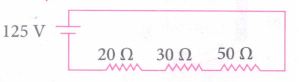
V= 125 V, R1 = 20\(\Omega \); R2=30\(\Omega \);R350\(\Omega \)
To find:
(i) Rs =?
(ii) Is =?
(iii) Is = ?
(iv) V1= ?, V2 = ?, V3= ?
(i) Resistance in series, Rs = R1+R2+R3
Rs = 20 + 30 + 50
= 1000
Rs = 100 \(\Omega \)
(ii) Total current, Is =\(\frac { V }{ { R }_{ s } } \)
\(\\ I=\frac { 125 }{ 100 } =1.25A\)
I=1.25A
(iii) Since resistors are in series, the current through each resistor is same.
Is = I1= I2=I3 =1.25A
Voltage drop across R1 is V1 = I1 R1
1.25 x 20
= 25V
V1 = 25V
Voltage drop across R2 is V2 = I2R2
Voltage drop across V2 1.25 x 30
V2 = 37.5 V
Voltage drop across R3is V3 = I3R3
V3 = 1.25 x 50
V3 = 62.5 V
Total Voltage, V1 + V2 + V3
25 + 37.5 + 62.5
= 125V
71.
Number of moles = \(\frac{Mass}{Atomic \ mass}\)
∴ Mass = Number of moles x Atomic mass
= 0.5 x 16
= 8g.
72.
If I were an artist, I would be using Paint application to draw images.
73.
Removal of parathyroid glands during thyroidectomy (removal of thyroid) causes decreased secretion of parathormone, The conditions are
(i) Muscle spasm known as Tetany.
(ii) Painful cramps of the limb muscles.
74.
Rani did not wear a helmet. Some people wear a helmet but don't fasten the strap. When they fall down from the bike, the helmet falls off and they are injured. Thus a helmet worn properly can save lives.
75.
When we are pricked by a cactus, the sensory neurons are activated immediately. They take the message to the brain or spinal cord. The message given by the brain or spinal cord is brought back by the Motor neuron. The motor neuron carries the message to the hand muscles. We immediately pull our hand away from the cactus.
76.
Watermelon having higher specific heat will enhance its temperature slowly compared to the sandwiches which has lower specific heat.

10th Standard Syllabus & Materials
10th Standard
TN 10th English Prose - 2 - The Night the Ghost Got in Important Questions And Answers Study Material - QB365 Set A
NEW10th Standard
TN 10th English Supplementary - 1 - The Tempest Important Questions And Answers Study Material - QB365 Set A
NEW10th Standard
TN 10th English Poem - 1 - Life Important Questions And Answers Study Material - QB365 Set A
NEW10th Standard
TN 10th English Prose - 1 - His First Flight Important Questions And Answers Study Material - QB365 Set A



Tamilnadu Stateboard 10th Standard Subjects
Tamilnadu Stateboard Standards





