
 100% FREE ACCESS
10th Standard Syllabus & Materials
10th Standard
TN 10th English Prose - 4 - The Attic Important Questions And Answers Study Material - QB365 Set A
NEW10th Standard
TN 10th English Supplementary - 3 - The Story of Mulan Important Questions And Answers Study Material - QB365 Set A
NEW10th Standard
TN 10th English Poem - 3 - I am Every Woman Important Questions And Answers Study Material - QB365 Set A
NEW10th Standard
TN 10th English Prose - 3 - Empowered Women Navigating The World Important Questions And Answers Study Material - QB365 Set A
NEW10th Standard
TN 10th English Supplementary - 2 - Zigzag Important Questions And Answers Study Material - QB365 Set A
NEW10th Standard
TN 10th English Poem - 2 - The Grumble Family Important Questions And Answers Study Material - QB365 Set A

Published on: 07/02/2020
10th Standard Science All Chapter Important Creative Questions-I- 2020
Download Tamil Nadu 10th Standard Science question papers, model tests, one-mark questions, important questions, and public exam papers in PDF format. Free study materials and answer keys for TN State Board students.
Questions + Answers key
Take MCQ Science Test1.
Wild life preservation society of India is located in_______
Delhi
Uttarakhand
Dehradun
Chattisgarh
2.
Exarch and tetrarch xylem are a feature of ___________.
dicot stem
dicot leaf
monocot root
dicot root
3.
Which one is used to draw and edit pictures?
Notepad
Paint
Scratch
Windows OS
4.
____________ is not a method of treatment for cancer.
Surgery
Immunotherapy
Vasectomy
Radiation therapy
5.
An organism having more than two sets of chromosomes is called
Diploid
Haploid
Monoploid
Polyploid
6.
The organic acid present in Vinegar is ___________ acid.
methanoic
ethanoic
Propanoic
Butanoic
7.
_____ is also called as Stress hormone.
Auxin
Abscisic Acid
Ethylene
Cytokinin
8.
Biogenetic law or Recapitulation theory was given by__________
Leonardo da vinci
Ernst Haeckel
Oparin
Haldane
9.
_____ carry command from spinal cord to our arm.
Motor neurons
Sensory neurons
Unipolar neurons
Afferent neurons
10.
Copper displaces - metal from its solution.
Zn
AI
Ag
all the above
11.
Temperature is a property which determines
amount of heat a body contains
total absolute energy a body has
direction of flow of heat
thermal energy
12.
If the exposure is about 600 R, it causes __________.
skin disorder
hair loss
teeth loss
death
13.
Example for solid in solid ___________
Soda water
Camphor in air
Charcoal
alloy
14.
Device used to see very very small object is ____
Simple microscope
Compound microscope
Telescope
Mirror
15.
A source emits a frequency of 1 kHz is moving toward a rest listener with a speed of 0.9 V, where V is the speed of sound wave. The frequency heard by the listener is ________.
10 Hz
0.1 Hz
100 Hz
10 kHz
16.
Down's syndrome is a case of___________
Euploidy
Deletion
Translocation
Aneuploidy
17.
The number of elements present in sixth period of modern periodic table is __________
8
18
16
32
18.
An outgrow arises on the parent body during________
Fragmentation
Fission
Budding
Regeneration
19.
Salt added to pickles brings about__________
diffusion
plasmolysis
imbibition
translocation
20.
21.
The motion of falling bodies towards earth is due to
gravitational rotation
weightless mass
acceleration due to gravity
gravitational force
22.
Mass of an electron is
9.1083 x 10⁻³¹kg
9.1083 x 10⁻²⁴kg
1.67262 x 10⁻²⁷kg
1.67 x 10⁻²⁴gm
23.
The resistance of a conductor is inversely proportional to its _______.
Volt
Length
Area
None of the above
24.
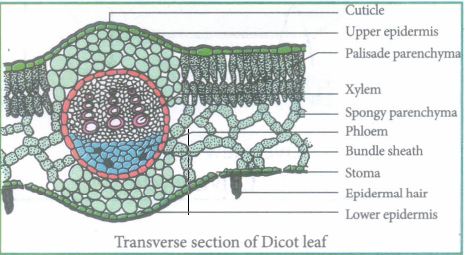
Draw a transverse section of dicot leaf and label the parts
25.
Write a note an solar cells.
26.
What is diabetes? Explain the types.
27.
Plants seeds got from other countries are tested in plant quarantine. Reason out.
28.
Explain in detail the uses and main parts of the 'SCRATCH' animation software.
29.
Explain how ethanol is manufactured from molasses?
30.
Describe the role of pancreas in maintenance of blood sugar level.
31.
Explain Use and Disuse theory.
32.
Explain the classification based on the direction of the reaction.
33.
What are the precautions to be taken by people working in radiation labs?
34.
Define and describe thermal expansion.
35.
Write some solubility substances in water at 25°C.
36.
Explain the refraction of light through a glass prism.
37.
(i) How to analyse the planets are irregular shaped?
(ii) What is the method used to find it?
(iii) Planets are sensitive to different frequencies Justify.
38.
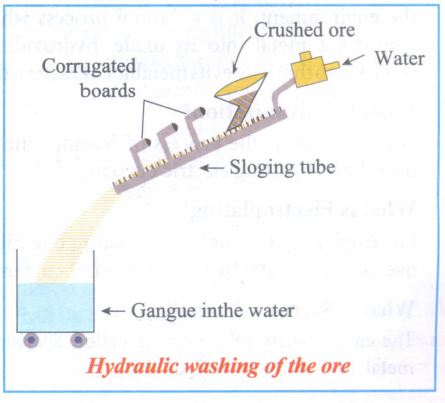
Explain hydraulic washing with a neat diagram.
39.
Mala had a huge scar on her cheek after she met with fire accident during her college days. She is worried if her baby would inherit the scar she had acquired. She clarified with her doctor, she need not worry about it, as her scar is an acquired trait.
(i) What are acquired traits?
(ii) How is it different from inherited traits?
40.
Kalaivani was watching at a metal pipe, one end of which is connected to a tank at the top of her building and the other end to the tap, which is near the ground level. She was admiring how the water flows from top to the bottom through the pipe. She went and asked her mother, who was an engineer.
(i) Also Kalaivani asked her mother that can she able to compare this with any other scientific concepts?
(ii) How would her mother have compared the resistance in a water pipe as well as in a conductor.
(iii) Give the expression for resistors connected in series and parallel.
41.
Government has brought in lot of measures to focus on health of a pregnant woman. Answer the following questions based on the same
(a) Name the tissue responsible for transfer of nutrients from mother to the offspring during pregnancy.
(b) Suggest two measures to maintain a woman's health during pregnancy.
42.
Give examples for Newton's third law.
43.
List the difference between RBC and WBC.
44.
Give the applications of Avogadro's hypothesis.
45.
Describe the heart of rabbit.
46.
Draw the ultrastructure of mitochondria and label the parts.
47.
What is the role of hydropower plants?
48.
Differentiate Malignant and Non malignant tumour.
49.
Mention two characteristics of stem cells.
50.
Distinguish file and folder.
51.
What are Bio degradable and Nonbiodegradable detergents?
52.
Write a note on mineralocorticoids
53.
Give some examples of vestigial organs in man.
54.
How are neurons classified based on function.
55.
Define ionic product of water
56.
Define radioactivity. What are radioactive elements?
57.
Define one mole of a substances.
58.
7.5 litre of ethanol is present in 15 litre of aqueous solution of ethanol. Calculate volume percent of ethanol solution.
59.
The colour of the sun is reddish during the sun rise and sunset. Explain why?
60.
Differentiate diploid and haploid condition.
61.
What is Gangue?
62.
Write a notes on Placenta.
63.
Define Osmosis.
64.
What is MCB?
65.
What is meant by natural motion?
66.
What is a poly atomic molecule?
67.
If the loss in mass during a fission reaction is 0.20 g, how much energy will have been produced?
68.
If boiling point of water is 95°F, What will be the reading in kelvin scale?
69.
Alight travels from air into water, the angle of refraction is 25° to the normal. Find the angle of incidence. Refractive index of water is 1.33. μa=1.
70.
At 10° C, how for away is a reflecting surface if you hear an echo in 0.274s?
71.
Find the
(i) equivalent resistance,
(ii) current through each reactor,
(iii) Total current for the given circuit,
(iv) Voltage drop across each resistor.
72.
A 20 g bullet moving at 300 m/s stops after penetrating 2 cm of bone. Calculate the average force exerted by the bullet.
73.
Calculate the gram molecular mass of carbon dioxide (CO2)
74.
Rani fell from her bike and had a head injury. She was hospitalized and discharged later. What do you think she could have done to save herself from this accident.
75.
Why longitudinal waves are called pressure waves?
1.
(c)
Dehradun
2.
(d)
dicot root
3.
(b)
Paint
4.
(c)
Vasectomy
5.
(d)
Polyploid
6.
(b)
ethanoic
7.
(b)
Abscisic Acid
8.
(b)
Ernst Haeckel
9.
(a)
Motor neurons
10.
(c)
Ag
11.
(c)
direction of flow of heat
12.
(d)
death
13.
(d)
alloy
14.
(b)
Compound microscope
15.
(d)
10 kHz
16.
(d)
Aneuploidy
17.
(d)
32
18.
(c)
Budding
19.
(b)
plasmolysis
20.
(b)
21.
(d)
gravitational force
22.
(a)
9.1083 x 10⁻³¹kg
23.
(c)
Area
24.
25.
The various devices used for harvesting sun's energy are called solar energy devices.
Solar cells:
(i) Solar cells (Photovoltaic devices) is made up of silicon that converts sunlight directly into electricity.
(ii) Solar cell produces electricity without polluting the environment.
(iii) Since it uses no fuel other than sunlight, no harmful gases, no burning and no wastes are produced. These can be installed in remote and inaccessible areas (forests and hilly regions) where setting up of power plant is expensive
Uses of Solar cells:
(i) It can be used for street lighting, traffic signals, water pumping, battery charging system etc.
(ii) It is used in artificial satellites and space probes.
(iii) It provides radio and TV transmission to remote areas
(iv) It is used in calculators, electronic toys and watches.
26.
Diabetes Mellitus is a chronic metabolic disorder. It is characterized by increased blood glucose level due to insufficient, deficient or failure of insulin secretion. This is the most common pancreatic endocrine disorder.
Type I Insulin dependent diabetes mellitus (IDDM):
(i) IDDM accounts for 10 to 20% of the known diabetics.
(ii) The condition also occurs in children (Juvenile onset diabetes) and young adults, the onset is usually sudden and can be life threatening.
(iii) This is caused by the destruction of cells of the pancreas.
(iv) It is characterized by abnormally elevated blood glucose levels (hyperglycemia) resulting from inadequate insulin secretion.
Causes: Genetic inheritance and environmental factors (infections due to virus, acute stress) are the cause for this condition.
Type II Non-Insulin Dependent Diabetes Mellitus (NIDDM):
(i) This is also called as adult onset diabetes and accounting for 80 to 90% of the diabetic population.
(ii) It develops slowly, usually milder and more stable.
(iii) Insulin production by the pancreas is normal but its action is impaired. (iv) The target cells do not respond to insulin.
(v) It does not allow the movement of glucose into cells.
Causes: The causes are multifactorial which include increasing age obesity, sedentary lifestyle, overeating and physically inactive.
27.
Plant materials brought into a country must be free from pathogens. It may lead to outbreak of new disease or introduction of a new pathogen into the environment. Thus plant materials (seeds / saplings) are tested in plant quarantine.
28.
'Scratch' is a software used to create animations, cartoons and games easily. Scratch, on the other hand, is a Visual Programming Language. It was developed in the Massachusetts Institute of Technology (MIT) Media Lab to make programming easier and more fun to learn.
Scratch Environment Editor:
(i) The Scratch editor has three main parts: They are Stage, Sprite and Script editor.
(ii) Stage: Stage is the background appearing when we open the scratch window. The background will most often be white. You can change the background colour as you like.
(iii) Sprite: The characters on the background of a Scratch window are known as Sprite. Usually a cat appears as a sprite when the Scratch window is opened. The software provides facilities to make alternations in sprite.
(iv) Script editor / Costume editor: Where you edit your programs or your sprite's pictures.
The script editor has three main parts :
(a) Script area: Where you build scripts.
(b) Block menu: Where you choose the category of blocks (programming statements) to use.
(c) Block palette: Where you choose the block to use.
29.
(i) Dilution: Molasses is first diluted with water to bring down the concentration of sugar to about 8 to 10 percent.
(ii) Addition of yeast: Yeast is added to this solution and the mixture is kept at about 300 K for a few days during this period, the enzymes invertase and zymase present in yeast, bring about the conversion of sucrose into ethanol.
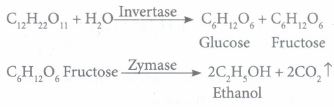
(iii) Distillation of wash: The fermented liquid (i.e. wash), containing 15 to 18 percent alcohol, is now subjected to fractional distillation. The main fraction drawn is an aqueous solution of ethanol which contain 95.5% of ethanol and 4.5% of water. This is called rectified spirit. This mixture is then refluxed over quicklime for about 5 to 6 hours and then allowed to stand for 12 hours. On distillation of this mixture, pure alcohol (100%) is obtained. This is called absolute alcohol.
30.
The endocrine portion of pancreas is made up of Islets of Langerhans.
Structure of Pancreas:
The Islets of Langerhans consists of two types of cells namely alpha cells and beta cells. The alpha cells secrete glucagon and beta cells secrete insulin.
Functions of Pancreatic hormones:
A balance between insulin and glucagon production is necessary to maintain blood glucose concentration.
Insulin :
(i) Insulin helps in the conversion of glucose into glycogen which is stored in liver and skeletal muscles.
(ii) It promotes the transport of glucose into the cells.
(iii) It decreases the concentration of glucose in blood.
Glucagon:
(i) Glucagon helps in the breakdown of glycogen to glucose in the liver.
(ii) It increases blood glucose levels.
Diabetes mellitus :
The deficiency of insulin causes Diabetes mellitus. It is characterised by
(i) Increase in blood sugar level (Hyperglycemia)
(ii) Excretion of excess glucose in the urine (Glycosuria).
(iii) Frequent urination (Polyuria).
(iv) Increased thirst (Polydipsia).
(v) Increase in appetite (Polyphagia).
31.
Use and disuse theory
(i) Lamarck's Use and Disuse theory states that if an organ is used constantly, the organ develops well and gets strengthened.
(ii) When an organ is not used for a long time, it gradually degenerates.
(iii) The ancestors of Giraffe were provided with short neck and short forelimbs.
(iv) Due to shortage of grass, they were forced to feed on leaves from trees. The continuous stretching of their neck and forelimbs resulted in the development of long neck and long forelimbs which is an example for constant use of an organ.
(v) The degenerated wing of Kiwi is an example for organ of disuse.
32.
Reversible Reactions: A reversible reaction is a reaction that can be reversed, i.e., the products can be converted back to the reactants. A reversible reaction is represented by a double arrow with their heads in the direction opposite to each other. Thus, a reversible reaction can be kept

Explanation: The compound 'AB' undergoes decomposition to form the products 'A' and 'B'. It is the forward reaction. As soon as the products are formed, they combine together to form 'AB': It is the backward reaction
PCl5(g) ⇌ PCl3(g) + CI2(g)
Irreversible Reactions: The reaction that cannot be reversed is called irreversible reaction. Consider the combustion of coal into carbon dioxide and water.
C(s) + O2(g) ⟶ CO2(g)+ Heat
Coal oxygen Carbon dioxide
In this reaction, solid coal burns with oxygen and gets converted into carbon dioxide gas and water. As the product is a gas, as soon as it is formed it escapes out of the reaction container. It is hard to decompose a gas into a solid. Thus, the backward reaction is not possible in this case. So, it is an irreversible reaction
33.
(i) Radioactive materials should be kept in thick walled lead container.
(ii) Lead coated aprons and lead gloves should be used while working with hazardous radioactive materials.
(iii) We should avoid eating while handling radioactive materials.
(iv) The radioactive materials should be handled only by tongs or by a remote control process.
(v) Dosimeters should be worn by the users to check the level of radiation.
34.
(i) When heat energy is supplied to a body, there can be an increase in the dimension of the object. This change in the dimension due to rise in temperature is called thermal expansion of the object.
(ii) The expansion of liquids (eg. mercury) can be seen when a thermometer is placed in warm water. All forms of matter (solid, liquid and gas) undergo expansion on heating.
(iii) When a solid is heated, the atoms gain energy and vibrate more vigorously. This results in the expansion of the solid.
(iv) The different types of expansion of solid are
i) Linear expansion
ii) Superficial expansion
iii) Cubical expansion
(v) When heated, the atoms in a liquid or gas gain energy and are forced further apart. The extent of expansion varies from substance to substance. For a given rise in temperature, a liquid will have more expansion than a solid and a gaseous substance has the highest expansion when compared with the other two.
35.
| Name of the solute | Formula of the solute | Solubility g/100 g water |
|---|---|---|
| Calcium carbonate | CaCO3(s) | 0.0013 |
| Sodium chloride | NaCI (s) | 36 |
| Ammonia | NH3(g) | 48 |
| Sodium hydroxide | NaOH(s) | 80 |
| Glucose | C6H12O6(s) | 91 |
| Sodium bromide | NaBr(s) | 95 |
| Sodium iodide | NaI(s) | 184 |
36.
(i) When a beam of white light or composite light is refracted through any transparent media such as glass or water, it is split into its component colours.
(ii) This phenomenon is called as 'dispersion of light'.
(iii) The band of colours is termed as spectrum. This spectrum consists of following colours: Violet, Indigo, Blue, Green, Yellow, Orange, and Red. These colours are represented by the acronym "VIBGYOR".
(iv ) When white light is refracted by a transparent medium. Different coloured lights are bent through different angles. That is the angle of refraction is different for different colours.
(v) Angle of refraction is the smallest for red and the highest for violet.
(vi) From Snell's law, we know that the angle of refraction is determined in terms of the refractive index of the medium.
(vii) Hence, the refractive index of the medium is different for different coloured lights.
37.
(i) To analyse that the planets are irregular shaped objects, Doppler effect is applied.
(ii) Using Doppler effect, an electromagnetic wave or a high frequency sound wave can be made to incident on different points of planet's surface. By finding the frequency shifts of the reflected waves from different points on planets surface, one can analyse that the planet is made of hills and valleys. From this analysis, we can come to a conclusion the planets are irregularly shaped objects.
(iii) Jagadish Chandra Bose, a famous Indian scientist and Biologist, discovered that plants can feel sadness, happiness, pain etc., for that, he invented device named crescograph. The feelings of sadness, happiness, pain etc.. have different frequencies. When we touch a plant with a lovable thought, the frequency of that thought can be sensed by plants and trees.
38.
Hydraulic (Gravity separation) method:
(i) Principle: The difference in the densities or specific gravities of the ore and gangue is the main principle behind this method. Oxide are are purified by this method. E.g. Hematite Fe2O3 the ore of iron
(ii) Method: The ore is poured over a sloping, vibrating corrugated table with grooves and a jet of water is allowed to flow over it. The denser ore particles settle down in the grooves and lighter gangue particles are washed down by water.
39.
(i) Acquired traits are the characters that cannot be passed from one generation to the next generation.
(ii) Characters which are inherited by the offspring from the parents and carried from one generation to another generation are called Inherited traits.
40.
(i) Kalaivani's mother took a small PVC pipe which has water in it and held in a horizontal position. Water came out drop by drop. When she raised one of the ends of the pipe, the water through the other end came out with a greater speed. She said initially when I was holding the pipe in a horizontal position, pressure at the both the ends are same. So water did not come out. The difference in pressure (Pressure difference) between the two ends is zero. But when I raised one of the ends, the top end has high pressure, and the bottom end has low pressure. Due to this pressure difference, water came out with a faster rate. So compare a conductor or a wire to this PVC pipe The wire is connected to a battery, whose one end has higher potential and the other end has lower potential. Due to this difference in potential, electrons from negative terminal (lower potential end) flow towards the positive terminal (higher potential end). Here electron flow is compared with the water flow and the electric potential is compared with the pressure. Kalaivani felt very happy, after hearing her mother's genius explanation.
(ii) When Kalaivani asked how to understand about the concept of resistance from her mother's scientific explanations, her mother continued. If the water pipe is smooth inside, then there is no charge in the speed of flow of water. i.e., zero resistance. But when the pipe has some blocks inside at different points, the water changes its speed of flow at different points, likewise, whenever electrons flow inside the conductor, they may collide with each other, due to which their speed will be resisted (blocked), which forms as electrical resistance. Her explanation made Kalaivani satisfied.
(iii) When two resistors of resistances, R1 & R2 are connected in series to a battery source.
\({ R }_{ s }={ R }_{ 1 }+{ R }_{ 2 }\)
When R1 & R2 are connected in parallel,
\(\frac { 1 }{ { R }_{ p } } +\frac { 1 }{ { R }_{ 1 } } +\frac { 1 }{ { R }_{ 2 } } \Rightarrow \frac { 1 }{ { R }_{ p } } =\frac { { R }_{ 2 }+{ R }_{ 1 } }{ { R }_{ 1 }{ R }_{ 2 } } \)
\({ R }_{ p }=\frac { { R }_{ 1 }{ R }_{ 2 } }{ { R }_{ 1 }+{ R }_{ 2 } } \)
41.
(a) Placenta.
(b) A pregnant woman should eat a balanced diet and take lot of fresh fruits and vegetables.
(i) She should be stress free.
(ii) She should not take any medicines without the advice of a doctor
42.
(i) When birds fly they push the air downwards by their wings (Action).
(ii) The air pushes the bird upwards (Reaction).
(iii) When a person swims he pushes the water using hands backwards (Action), the water pushes the swimmer in forward direction (Reaction).
(iv) Rockets expel gas at high velocity (Action). The downward moving gas pushes the rocket in upward direction (Reaction).
(v) When we fire a bullet, the gun recoils back, Bullet is moving forward (action). The gun equalise this forward action by moving backward (reaction).
43.
| S.No |
RBC |
WBC |
|---|---|---|
| i | They are red in colour due to the presence of respiratory pigment hemoglobin. | They are colourless. |
| ii | They are biconcave/disc-shaped. | They are amoeboid in shape. |
| iii | The RBC is not classified into types, all red blood cells are the same. | They are classified into granulocytes and agranulocytes. |
| iv | The mature RBC's lack a nucleus. | They are nucleated. |
| v | They cannot change their shape. | They can change their shape and are capable of amoeboid movement. |
| vi | They are smaller than leucocytes. | They are larger than erythrocytes. |
| vii | They are responsible for the transport of respiratory gases (CO2 and O2). | They help to defend the body against pathogens. |
44.
Applications of Avogadro's hypothesis
(i) It explains Gay-Lussac's law.
(ii) It helps in the determination of atomicity of gases.
(iii) Molecular formula of gases can be derived using Avogadro's law.
(iv) It determines the relation between molecular mass and vapour density.
(v) It helps to determine Gram molar volume of all gases (i.e. 22.4 lit at S.T.P)
45.
(i) The heart is pear shaped and lies in the thoracic cavity in between the lungs. It is enclosed by pericardium, a double layered membrane.
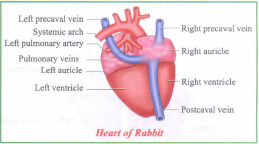
(ii) The heart is four chambered with two auricles and two ventricles. The right and left auricles are separated by interauricular septum, similarly right and left ventricles are separated by interventricular septum.
(iii) The right auricle opens into the right ventricle by right auriculoventricular aperture, guarded by a tricuspid valve.
(iv) The left auricle opens into the left ventricle by left auriculoventricular aperture guarded by a bicuspid valve or mitral valve.
(v) The opening of the pulmonary artery and aorta are guarded by three semilunar valves.
(vi) The right auricle receives deoxygenated blood through two precaval (superior vena cava) and one postcaval (inferior vena cava) veins from all parts of the body.
(vii) The left auricle receives oxygenated blood from the pulmonary veins from the lungs.
(viii) From the right ventricle arises pulmonary trunk which carries the deoxygenated blood to the lungs and from the left ventricle arises the systemic arch (aorta) which supplies oxygenated blood to all parts of the body.
46.
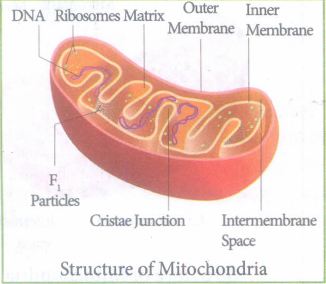
47.
(i) Hydropower plants converts the kinetic energy of flowing water into electricity.
(ii) Electricity produced by hydropower plants is called hydroelectricity.
48.
| Malignant tumours | Non-malignant |
|---|---|
| Mass of proliferating cells which grow very rapidly invading and damaging the surrounding normal tissues. | Remain confined in the organ affected and do not spread to other parts of the body. |
| It causes cancer. | It is not cancerous. |
49.
The two important properties of stem cells that differentiate them from other cells are:
(i) Its ability to divide and give rise to more stem cells by self-renewal
(ii) Its ability to give rise to specialised cells with specific functions by the process of differentiation.
50.
| File | Folder | ||
|---|---|---|---|
| (i) | The output from any application is referred as 'File' | 1. | A folder is a storage space,contains multiple files. |
| (ii) | A file cannot contain a folder | 2. | A folder can contain many files. |
51.
(i) Bio-degradable detergents have straight hydrocarbon chains which can be easily degraded by bacteria.
(ii) Non - biodegradable have highly branched hydrocarbon chains which cannot be degraded by bacteria.
52.
The mineralocorticoids are secreted by zona glomerulosa of cortex of Adrenal gland.
(i) The chief hormone is Aldosterone.
(ii) It helps to reabsorb sodium ions from the renal tubules.
(iii) It causes increased excretion of potassium ions.
(iv) It regulates electrolyte balance, body fluid volume, osmotic pressure and blood pressure.
53.
Vermiform appendix, Nictitating membrane, Caudal Vertebra and Coccyx.
54.
(i) Sensory or afferent neurons
(ii) Motor or efferent neurons
(iii) Association neurons
55.
The product of the concentration of hydronium ion and hydroxyl ion is called 'Ionic product of water'. It is denoted as 'Kw' It is mathematically expressed as follows:
Kw = [Hp+] [OH-]
56.
The phenomenon of nuclear decay of certain elements with the emission of radiations like alpha, beta and gamma rays is called as "radioactivity" and the elements which undergo this phenomenon are called as "radioactive elements".
57.
It is defined as the mass of substance containing the same number of atoms as in exactly 12 g of C12 atoms.
58.
Volume percentage = \(\frac{Volume \ of \ the \ solute}{Volume \ of \ the \ solution}\)
= \(\frac{7.5}{15}\) x 100 = 50%
59.
(i) At sunrise and sunset, the light rays from the sun have to travel a larger distance in the atmosphere than at noon.
(ii) Hence, most of the blue lights are scattered away and only the red light which gets least scattered reaches us.
(iii) Therefore, the colour of the sun is red at sunrise and sunset.
60.
(i) In the body cells of sexually reproducing organisms, the chromosomes generally occur in pairs. This condition is called diploid (2n).
(ii) The gametes produced by the organisms contain a single set of chromosomes. Hence, the gametes are said to be haploid (n).
61.
The rocky impurity associated with ore is called gangue or matrix.
62.
(i) The placenta is a disc shaped structure attached to the uterine wall and is a temporary association between the developing embryo and maternal tissues.
(ii) A cord containing blood vessels that connects the placenta with the foetus is called the umbilical- cord
63.
Osmosis is the movement of solvent or water molecules from the region of higher concentration to the region of lower concentration through a semi-permeable membrane.
64.
An MCB is a switching device, which can be activated automatically as well as manually. It has a spring attached to the switch, which is attracted by an electromagnet when an excess current passes through the circuit. Hence, the circuit is broken and the protection of the appliance is ensured.
65.
(i) According to Aristotle, A moving object naturally comes to rest without any external influence or force. Such motions are termed as "natural motion".
(ii) Natural motion is an unforced motion. According to Newtonian mechanics, the natural motion is a uniform rectilinear motion, following its first law of motion. In general relatively, a natural motion may be linear or curved.
66.
If a molecule contains mote than two atoms, then it is called polyatomic molecule.
67.
Given
Loss in mass, m = 0.20 g = 2 x 10⁻⁴ kg
To find: E = mc2
Solution
E = 2 x 10-4 x (3 x 108)2
E = 1.8 x 10¹³J
68.
F to (kelvin) K =(F--32) x \(\frac{5}{9}\) + 273
=(95 - 32) x \(\frac{5}{9}\) + 273
=\(\frac { 315 }{ 9 } \) + 273
=35+273 =308 K
69.
μ1 sin i = μ2 sin r
μa sin i = μw sin r
μa = 1
μw = 1.33
r = 25'
To find : Angle of incidence, i = ?
sin i =\(\frac { { \mu }_{ w } }{ { \mu }_{ a } } \)
sin r =\(\frac { 1.33\times sin25^{ 0 } }{ 1 } \)
i=sin-1\(\left( \frac { 1.33\times sin25^{ 0 } }{ 1 } \right) \)
Angle of incidence,
i=34.20.
70.
Given
Temperature, T 10°C
Time, t = 0.274 s
Distance, D = ?
Velocity, v = (vo + 0.61T) ms-1
v = [331.4 + 0.61 x 10]
= 331.4 + 6.1
v = 337.5 ms-1
Distance, D = v x t
D = 337.5 x 0.274
D = 92.48 m
Distance due to reflecting surface = \(\frac{distance}{2}\)
= 46.2 m
71.
Given
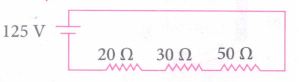
V= 125 V, R1 = 20\(\Omega \); R2=30\(\Omega \);R350\(\Omega \)
To find:
(i) Rs =?
(ii) Is =?
(iii) Is = ?
(iv) V1= ?, V2 = ?, V3= ?
(i) Resistance in series, Rs = R1+R2+R3
Rs = 20 + 30 + 50
= 1000
Rs = 100 \(\Omega \)
(ii) Total current, Is =\(\frac { V }{ { R }_{ s } } \)
\(\\ I=\frac { 125 }{ 100 } =1.25A\)
I=1.25A
(iii) Since resistors are in series, the current through each resistor is same.
Is = I1= I2=I3 =1.25A
Voltage drop across R1 is V1 = I1 R1
1.25 x 20
= 25V
V1 = 25V
Voltage drop across R2 is V2 = I2R2
Voltage drop across V2 1.25 x 30
V2 = 37.5 V
Voltage drop across R3is V3 = I3R3
V3 = 1.25 x 50
V3 = 62.5 V
Total Voltage, V1 + V2 + V3
25 + 37.5 + 62.5
= 125V
72.
Given:
Mass of the bullet, m = 20 x 10-3 kg
Initial velocity, u = 300 m/s
Final velocity, v = 0
Distance, s = 2 cm = 2 x 10⁻²m
To find: Force exerted by the bullet, f = ?
Using equations of motion,
v2 = u2 + 2 as
0 = (300)2 + 2(a) x 2 x 10⁻²
a=\(\frac { (300)^{ 2 } }{ 4\times 10^{ -2 } } =\frac { 9\times 10^{ 4 } }{ 4\times { 10 }^{ -2 } } \)
a = -2.25 x 10⁶ m/s2
a = 2.25 x 10⁶ m/s2
Average force,
F = ma
= 20 x 10-3 x 2.25 X 106
F = 45 x 10-3 = 4.5 x 10⁴ N
73.
Atomic masses of C= 12, O= 16
Gram molecular mass of CO2 = 1(C) + 2(O) = 1(12) + 2(16) = 12 + 32 = 44
Gram molecular mass of CO2 = 44g.
74.
Rani did not wear a helmet. Some people wear a helmet but don't fasten the strap. When they fall down from the bike, the helmet falls off and they are injured. Thus a helmet worn properly can save lives.
75.
Longitudinal waves travels in a medium as a series of alternate compression and rarefactions i.e., they travel as variations in pressure. So they are called pressure waves.

10th Standard Syllabus & Materials
10th Standard
TN 10th English Prose - 2 - The Night the Ghost Got in Important Questions And Answers Study Material - QB365 Set A
NEW10th Standard
TN 10th English Supplementary - 1 - The Tempest Important Questions And Answers Study Material - QB365 Set A
NEW10th Standard
TN 10th English Poem - 1 - Life Important Questions And Answers Study Material - QB365 Set A
NEW10th Standard
TN 10th English Prose - 1 - His First Flight Important Questions And Answers Study Material - QB365 Set A



Tamilnadu Stateboard 10th Standard Subjects
Tamilnadu Stateboard Standards





