
 100% FREE ACCESS
10th Standard Syllabus & Materials
10th Standard
TN 10th English Prose - 4 - The Attic Important Questions And Answers Study Material - QB365 Set A
NEW10th Standard
TN 10th English Supplementary - 3 - The Story of Mulan Important Questions And Answers Study Material - QB365 Set A
NEW10th Standard
TN 10th English Poem - 3 - I am Every Woman Important Questions And Answers Study Material - QB365 Set A
NEW10th Standard
TN 10th English Prose - 3 - Empowered Women Navigating The World Important Questions And Answers Study Material - QB365 Set A
NEW10th Standard
TN 10th English Supplementary - 2 - Zigzag Important Questions And Answers Study Material - QB365 Set A
NEW10th Standard
TN 10th English Poem - 2 - The Grumble Family Important Questions And Answers Study Material - QB365 Set A

Published on: 25/07/2019
Optics
Download Tamil Nadu 10th Standard Science question papers, model tests, one-mark questions, important questions, and public exam papers in PDF format. Free study materials and answer keys for TN State Board students.
Questions + Answers key
Take MCQ Science Test1.
Violet and red light ______ wavelengths.
lowest, highest
highest, lowest
same
standard
2.
Which of the following lens would you prefer to use while reading small letters found in a dictionary?
A convex lens of focal length 5 cm
A concave lens of focal length 5 cm
A convex lens of focal length 10 cm
A concave lens of focal length 10 cm
3.
4.
In a myopic eye, the image of the object is formed
behind the retina
on the retina
in front of the retina
on the blind spot
5.
Power of a lens is –4D, then its focal length is
4m
–40m
–0.25 m
–2.5 m
6.
The interacting particle of the medium is called as _______
7.
Refractive index of a medium is dependent on ______ of the light.
8.
Angle of refraction is _____ for red and _____ for violet.
9.
The refractive index of a transparent medium is always greater than__________
10.
The path of the light is called as_____________
11.
Lens maker's formula
12.
red light
13.
violet light
14.
Myopia
15.
Ciliary muscles
16.
Name and explain the types of scattering?
17.
How is a rainbow formed?
18.
What are the conclusions obtained from laws of refraction?
19.
Why are traffic signals red in colour?
20.
Why does the sky appear in blue colour?
21.
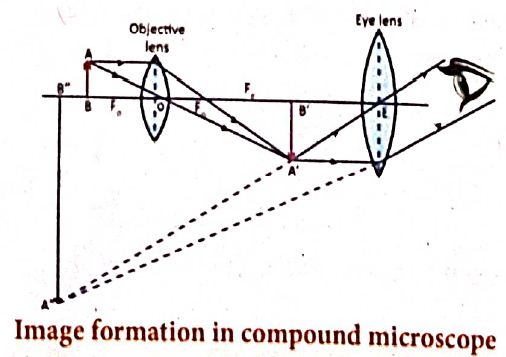
Explain the construction and working of a 'Compound Microscope'.
22.
Differentiate the eye defects: Myopia and Hypermetropia.
23.
Explain the refraction of light through a glass prism.
24.
Explain the types of Telescope.
25.
Write the sign convention for lenses.
26.
Explain Raman Scattering.
27.
State the laws of refraction.
1.
(a)
lowest, highest
2.
(a)
A convex lens of focal length 5 cm
3.
(d)
4.
(c)
in front of the retina
5.
(c)
–0.25 m
6.
()
Scatterer
7.
()
wavelength
8.
()
smallest, highest
9.
()
one
10.
()
ray of light
11.
\((\mu -1)\left( \frac { 1 }{ { R }_{ 1 } } -\frac { 1 }{ { R }_{ 2 } } \right) \)
12.
highest wavelength
13.
highest frequency
14.
Far point comes closer
15.
Power of accommodation
16.
Based on initial and final energy of the light beam, scattering can be classified as, (i) Elastic scattering, (ii) Inelastic scattering.
(i) Elastic scattering : If the energy of the incident beam of light and the scattered beam of light are same, then it is called as 'elastic scattering'
(ii) Inelastic scattering : If the energy of the incident beam of light and the scattered beam of light are not same, then it is called as 'inelastic scattering:
17.
(i) Tiny water droplets are formed in the atmosphere due to rainfall. The rainbow is formed when sun light falling on these tiny water droplets undergoes dispersion.
(ii) When the sun light is incident on them, it is first refracted and dispersed at the front surface. When the refracted light falls on the back surface of the water droplet, it undergoes total internal reflection.
(iii) This reflected beam of coloured lights are refracted at the front surface of the water droplet. Thus, the rainbows can always be seen opposite to the sun.
18.
(i) The speed of light in a medium is low if the refractive index of the medium is high and vice versa.
(ii) When light travels from a denser medium into a rarer medium, the refracted ray is bent away from the normal drawn to the interface.
(iii) When light travels from a rarer medium into a denser medium, the refracted ray is bent towards the normal drawn to the interface.
19.
(i) The red colour has longer wavelength.
(ii) So, it can travel for longer distance and will be seen clearly. So red colour is used in traffic signals.
20.
(i) When sunlight passes through the atmosphere the blue colour (shorter wavelength) is scattered to a greater extent than the red colour (longer wavelength).
(ii) This scattering causes the sky to appear in blue colour.
21.
Compound microscope:
A Compound microscope is used to see the tiny objects has better magnification power than simple microscope.
Construction:
(i) A compound microscope consists of two convex lenses.
(ii) The lens with the shorter focal length is placed near the object, and is called as 'objective lens' or 'objective piece'.
(iii) The lens with larger focal length and larger aperture placed near the observer's eye is called as 'eye lens' or 'eye piece'.
(iv) Both the lenses are fixed in a narrow tube with adjustable provision.
Working:
(i) The object (AB) is placed at a distance slightly greater than the focal length of objective lens \(\left(u>f_{0}\right)\).
(ii) A real, inverted and magnified image \(\left(\mathrm{A}^{\prime} \mathrm{B}^{\prime}\right)\) is formed at the other side of the objective lens.
(iii) This image behaves as the object for the eye lens.
(iv) The position of the eye lens is adjusted in such a way, that the image (A' B') falls within the principal focus of the eye piece.
(v) This eye piece forms a virtual, enlarged and erect image (A" B") on the same side of the object.
(vi) Compound microscope has 50 to 200 times more magnification power than simple microscope.
22.
| S. No |
Myopia |
Hypermetropia |
|---|---|---|
| (i) | It is also known as Short sightedness. | It is also known as Long sightedness. |
| (ii) | It occurs due to the lengthening of eye ball. | It occurs due to the shortening of eye ball. |
| (iii) | With this defect near by objects can be seen clearly, but distant objects cannot be seen clearly. | With this defect nearby objects cannot be seen clearly but distant objects can be seen clearly. |
| (iv) | The focal length of eye lens is reduced. | The focal length of eye lens is increased. |
| (v) | The far point will not be infinity for such eyes and the far points have come closer. | The near point will not be at 25 cm for such eyes and the near point have moved farther. |
| (vi) | The image of distant objects are formed before the retina. |
The image of nearby objects are formed behind the retina. |
| (vii) | The defect can be corrected using concave lens. | The defect can be corrected using convex lens. |
23.
(i) When a beam of white light or composite light is refracted through any transparent media such as glass or water, it is split into its component colours.
(ii) This phenomenon is called as 'dispersion of light'.
(iii) The band of colours is termed as spectrum. This spectrum consists of following colours: Violet, Indigo, Blue, Green, Yellow, Orange, and Red. These colours are represented by the acronym "VIBGYOR".
(iv ) When white light is refracted by a transparent medium. Different coloured lights are bent through different angles. That is the angle of refraction is different for different colours.
(v) Angle of refraction is the smallest for red and the highest for violet.
(vi) From Snell's law, we know that the angle of refraction is determined in terms of the refractive index of the medium.
(vii) Hence, the refractive index of the medium is different for different coloured lights.
24.
According to optical property, it is classified into two types.
(i) Refracting telescope
(ii Reflecting telescope
(i) Refracting telescope: Lenses are used in this kind of telescopes. Galilean telescope, Keplerian telescope, Achromatic refractors, Apochromatic refractors are some Refracting telescope.
(ii) Reflecting telescope: Parabolic mirrors are used in these kind telescopes. Gregorian, Newtonian, Cassegrain telescope, Ritchey- Chretien telescope are some Reflecting telescopes. According to the things which are observed, Astronomical Telescope and Terrestrial Telescopes are the two major types of telescope.
25.
| S.No. | Convex Lens | Concave Lens |
| i | Focal length | + for convex lens - for concave lens |
| ii | Distance of object | - if the object is to the left object of the lens + if the object is to the right of the lens |
| iii | Distance of image | + if the image is formed on the right of the lens (real image) - if the image is formed one the left of the lens (virtual image) |
| iv | Magnification | + for erect images - for inverted images |
26.
(i) When a parallel beam of monochromatic (single coloured ) light passes through a gas or liquid or transparent solid, a part of light rays are scattered. This scattering is called Raman scattering (inelastic scattering).
(ii) Raman Scattering is defined as "The interaction of light ray with the particles of pure liquids or transparent solids, which leads to a change in wavelength or frequency".
(iii) The scattered light contains some additional frequencies (or wavelengths) other than that of incident frequency (or wavelength). This is known as Raman scattering or Raman Effect.
(iv) The modified lines are called 'Raman lines' and the unmodified lines are called as 'Rayleigh lines'. The lines having frequencies lower than the incident frequency is called stokes lines and the lines having frequencies higher than the incident frequency are called Anti-stokes lines.
27.
(i) First law of refraction : The incident ray of light, the refracted ray of light and the normal to the refracting surface all lie in the same plane.
(ii) Second law of refraction : The ratio of the sine of the angle of incidence and sine of the angle of refraction is equal to the ratio of refractive indices of the two media. This law is also known as Snell's law.
\(\frac{\operatorname{sin i}}{\sin x}=\frac{\mu_2}{\mu_1} .\).

10th Standard Syllabus & Materials
10th Standard
TN 10th English Prose - 2 - The Night the Ghost Got in Important Questions And Answers Study Material - QB365 Set A
NEW10th Standard
TN 10th English Supplementary - 1 - The Tempest Important Questions And Answers Study Material - QB365 Set A
NEW10th Standard
TN 10th English Poem - 1 - Life Important Questions And Answers Study Material - QB365 Set A
NEW10th Standard
TN 10th English Prose - 1 - His First Flight Important Questions And Answers Study Material - QB365 Set A



Tamilnadu Stateboard 10th Standard Subjects
Tamilnadu Stateboard Standards





