
 100% FREE ACCESS
10th Standard Syllabus & Materials
10th Standard
TN 10th English Prose - 4 - The Attic Important Questions And Answers Study Material - QB365 Set A
NEW10th Standard
TN 10th English Supplementary - 3 - The Story of Mulan Important Questions And Answers Study Material - QB365 Set A
NEW10th Standard
TN 10th English Poem - 3 - I am Every Woman Important Questions And Answers Study Material - QB365 Set A
NEW10th Standard
TN 10th English Prose - 3 - Empowered Women Navigating The World Important Questions And Answers Study Material - QB365 Set A
NEW10th Standard
TN 10th English Supplementary - 2 - Zigzag Important Questions And Answers Study Material - QB365 Set A
NEW10th Standard
TN 10th English Poem - 2 - The Grumble Family Important Questions And Answers Study Material - QB365 Set A

Published on: 07/02/2020
10th Standard science creative test model
Download Tamil Nadu 10th Standard Science question papers, model tests, one-mark questions, important questions, and public exam papers in PDF format. Free study materials and answer keys for TN State Board students.
Questions + Answers key
Take MCQ Science Test1.
2.
The inner mitochondrial membrane gives rise to finger like projections called ____________
oxysomes
matrix
cristae
stalk
3.
Which button we use to select a required program?
Program button
Program button
My Computer
Start Button
4.
____________ is not a method of treatment for cancer.
Surgery
Immunotherapy
Vasectomy
Radiation therapy
5.
________ is father of "Indian Green Revolution"
Dr. M. S. Swaminathan
Dr. Norman
Alec Jeffrey
Dr. Ian Wilmut
6.
_____ is known as father of Endocrinology.
Thomas Addison
W. M. Bayliss
E. H. Starling
Frits Warmolt Went
7.
Cyclobutane is an example of ______________ compounds.
a cyclic
cyclic
aromatic
alicyclic
8.
Charles Darwin was a great __________.
Chemist
Naturalist
Doctor
Physicist
9.
______ is not a characteristic of neuron.
dendrites
axon
axolemma
can divide
10.
Pb(NO3)2 + 2KI ⟶ Pbl2 + 2KNO3 is a ______________ reaction
neutralization
Precipitation
decomposition
Combustion
11.
The amount of heat energy required to rise the temperature of 1gram of water through 10C is _____
One kilo calorie
One joule
One kelvin
One caloric
12.
For production of radio - isotopes, we use _______ reactions
research
power
production
absorber
13.
Which of the following factors affect solubility?
temperature
pressure
nature of solute and solvent
all the above
14.
For air, the refractive index is
1
infinity
0
1
15.
A sound wave passes through gold rod and comes into the surrounding air. What is the relation between original wavelength A and new wavelength λ'?
λ=λ'
λ>λ'
λ<λ'
None of the above
16.
Choose the correct pair
A ≡ T
G ≡ A
A ≡ C
G ≡ C
17.
The distance from the centre of the nucleus to the outer most electron in an ion is termed as _________ radii.
atomic
ionic
Covalent
both (b) and (c)
18.
Lack of menstruation generally indicates________
Pregnancy
Anemia
Amenorrhea
Over weight
19.
The number of______ increases during allergy.
Basophil
RBC
Eosinophil
Monocyte
20.
The third Ventricle in brain of Rabbit lives in______
cerebrum
cerebellum
diencephalon
medulla
21.
One mole of a gas occupies a volume of 22.4 l. This is derived from:
Berzelius's hypothesis
Gay-Lussac's law
Avogadro's law
Dalton's law
22.
Which of the following produces large joule heating effect?
1A current through 2Ω resister for 3 seconds
1A current through 3Ω resistor for 2 seconds
2A current through 1Ω resistor for 2 seconds
3A current through 1Ω resistor for 1 second
23.
______ deals with the bodies which are at rest under the action of forces.
Statics
Kinematics
Dynamics
Mechanics
24.
List the functions of chloroplast.
25.
List the environmental concerns of shale gas
26.
Mention some behavioural changes seen in drug users.
27.
Mention two characteristics of stem cells.
28.
Distinguish file and folder.
29.
Mention the physiological effects of ABA.
30.
Explain Atavism?
31.
What are neuroglia.
32.
Define concentration
33.
Why nuclei fusion is called thermonuclear reaction?
34.
What is real gas?
35.
Define hygroscopic substance.
36.
Name and explain the types of scattering?
37.
How can we measure the depth of a sea by using "SONAR"?
38.
Define metallic radius.
39.
Define menstrual cycle?
40.
Write the components of the blood.
41.
Take two eggs and drop them from a certain height one by one. Drop one egg onto a concrete floor and another one onto a cushion pillow. What changes do you notice? When the egg is dropped onto a concrete floor, it breaks. But, the egg dropped onto the cushion pillow does not break. Can you explain why?
42.
What is gram atomic mass? Give example?
43.
Why is a dicot leaf described as dorsiventral?
44.
A family has 3 three cars and can afford to buy fuel. They prefer to go out independently. Is it right to suggest car pooling for such people. Justify.
45.
What is diabetes? Explain the types.
46.
Why are Genetically modified organisms produced? Explain the purpose and advantages.
47.
Explain in detail the uses and main parts of the 'SCRATCH' animation software.
48.
How will you classify organic compounds based on the pattern of carbon chain?
49.
(a) Describe the structure of thyroid gland?
(b) List the functions of thyroid hormones.
50.
Write a note on evidences from Morphology and Anatomy in favour of Evolution.
51.
Tabulate the different parts of the brain and their functions.
52.
Explain the classification based on the direction of the reaction.
53.
What are the precautions to be taken by people working in radiation labs?
54.
With an illustration, explain the method of Calculation for linear expansion of an object.
55.
Write some solubility substances in water at 25°C.
56.
Explain Raman Scattering.
57.
Write any two applications for reflection of sound?
58.
Man is a mammal and has incisors and canine. Rabbits are mammals but lack canines. Explain.
59.
How are magnetic ores separated from non magnetic impurities? Explain.
60.
Write a note on mutation.
61.
Describe the structure of human sperm.
62.
What are the concepts prepared by Galileo?
63.
Write a note an ABO blood grouping.
64.
Write any five electrical components used in electrical circuit and draw its symbol.
65.
Give the applications of Avogadro's hypothesis.
66.
Complete the following fission reactions:
(a) 92U235+ 0n1 ⇾38Sr90+Xe+30n1
(b) 92U235+ 0n1 ⇾43Tc107+n+50n1
67.
If boiling point of water is 95°F, What will be the reading in kelvin scale?
68.
When an object is placed at 25 cm from a concave lens, a virtual image is produced at a distance of 10 cm. Calculate the magnification produced by the lens.
69.
What is the frequency heard by a stationary observer when a train approaches with a speed of 30 ms-1. The frequency of the train is 600 Hz and the speed of sound is 340 m/s?
70.
A body of mass 2 kg moving with uniform velocity of 40 ms-1 collides with another body at rest. If two bodies move together with a velocity of 20 m-1, Find the mass of the other body.
71.
What is the resistance of heating element of the heater when 20 A current passing through it at a potential of 220 V?
72.
Calculate the number of molecules in 11g of CO2
73.
An organic compound A' of molecular formula C2H6O on oxidation with dilute alkaline KMnO4 solution gives an acid 'B' with the same number of carbon atoms. Compound A' is often used for sterilization of skin by doctors. Name the compound. Write the chemical equation involved in the formation of 'B' from A.
74.
Why do all the gametes formed in human females have an X - chromosome?
75.
Three V-I graphs are drawn individually for two resistors and their series combination. Out of A, B, C which one represents the graph for series combination of the other two. Give reason for y or answer.
1.
(d)
2.
(c)
cristae
3.
(d)
Start Button
4.
(c)
Vasectomy
5.
(a)
Dr. M. S. Swaminathan
6.
(a)
Thomas Addison
7.
(d)
alicyclic
8.
(b)
Naturalist
9.
(d)
can divide
10.
(b)
Precipitation
11.
(d)
One caloric
12.
(a)
research
13.
(d)
all the above
14.
(a)
1
15.
(b)
λ>λ'
16.
(d)
G ≡ C
17.
(b)
ionic
18.
(a)
Pregnancy
19.
(c)
Eosinophil
20.
(c)
diencephalon
21.
(c)
Avogadro's law
22.
(d)
3A current through 1Ω resistor for 1 second
23.
(a)
Statics
24.
(i) Photosynthesis.
(ii) Storage of starch.
(iii) Synthesis of fatty acids.
(iv) Storage of lipids.
(v) Formation of chloroplasts.
25.
(i) Shale drilling could affect groundwater reserves, which can contaminate the drinking water resources and also affect the fertility of the soil.
(ii) Million gallons of water is needed to break and release the shale gas, which in turn can affect the water table.
(iii) It would provide greater initiative to local people who could assess their needs and resources and plan usage
26.
Behavioural Changes:
Adverse effects among adolescents are:
(i) Drop in academic performance, absence from school or college.
(ii) Lack of interest in personal hygiene, isolation, depression, fatigue and aggressive behaviour.
(iii) Deteriorating relationship with family and friends.
(iv) Change in food and sleeping habits.
(v) Fluctuation in body weight and appetite.
27.
The two important properties of stem cells that differentiate them from other cells are:
(i) Its ability to divide and give rise to more stem cells by self-renewal
(ii) Its ability to give rise to specialised cells with specific functions by the process of differentiation.
28.
| File | Folder | ||
|---|---|---|---|
| (i) | The output from any application is referred as 'File' | 1. | A folder is a storage space,contains multiple files. |
| (ii) | A file cannot contain a folder | 2. | A folder can contain many files. |
29.
(i) ABA stands for Abscisic Acid.
(ii) ABA promotes the process of separation of leaves, flowers and fruits (abscission).
(iii) During water stress and drought conditions ABA causes stomatal closure.
(iv) ABA promotes senescence in leaves by causing loss of chlorophyll.
(v) ABA induces bud dormancy towards the approach of winter in trees like birch.
(vi) ABA is a powerful inhibitor of lateral bud growth in tomato.
30.
The reappearance of ancestral characters in some individuals is called atavism. Presence of rudimentary tail in new born babies, presence of thick hair on the Human body are examples of atavism.
31.
Neuroglia: Neuroglia are also called as glial cells. They are the non-exciting, supporting cell of the nervous system. They do not initiate or conduct nerve impulse.
32.
The amount of the substance present in certain volume of the solution is called 'concentration'.
33.
Nuclear fusion can take place only under certain conditions. Nuclear fusion is possible only at extreme high temperature of the order of 107 to 109 K and a high pressure to push the hydrogen nuclei closer to fuse with each other. Hence, It is named as "Thermonuclear reaction".
34.
If the molecules or atoms of a gas interact with each other with a definite amount of intermolecular or inter atomic force of attraction, then, the gas is said to be real.
35.
Some substances when exposed to the atmospheric air at ordinary temperature, absorb moisture without changing their physical state. Such substances are called hygroscopic substances.
36.
Based on initial and final energy of the light beam, scattering can be classified as, (i) Elastic scattering, (ii) Inelastic scattering.
(i) Elastic scattering : If the energy of the incident beam of light and the scattered beam of light are same, then it is called as 'elastic scattering'
(ii) Inelastic scattering : If the energy of the incident beam of light and the scattered beam of light are not same, then it is called as 'inelastic scattering:
37.
In SONAR, by measuring the change in the frequency between the sent signal and received signal, the speed of marine animals and submarines can be determined.
38.
It is defined as half the distance between nuclei of adjacent metal atoms.
39.
The cyclic events that take place in a rhythmic fashion during the reproductive period of a woman's life is called menstrual cycle.
40.
(i) Components of blood: The blood consists of two main components. The fluid plasma and the formed elements (blood cells) which are found suspended in the plasma.
(ii) Blood cells are classified into erythrocytes, leucocytes and platelets.
41.
(i) Egg dropped on concrete: A large force acting for a short period of time and a smaller force acting for a longer period time.
Egg dropped on cushion pillow: A smaller force acting for a longer period.
(ii) In this activity for the egg dropped to a cushion pillow, the time of interaction of force is large and makes the magnitude of force small.
(iii) So, it does not break. When the same egg is dropped onto a concrete floor, the time of interaction is very short and hence the force becomes large, which breaks the egg.
(iv) Such a force is known as "impulsive force".
42.
If the atomic mass of an element is expressed in grams it is known as gram atomic mass
Eg: Gram atomic mass of hydrogen = 1g
Gram atomic mass of oxygen = 16 g
43.
(i) The dorsal and ventral surfaces of a dicot leaf can be clearly distinguished
(ii) The dorsal surface is darker is appearance and the ventral surface is lighter.
(iii) This is due to distribution of palisade parenchyma below the upper epidermis which as rich in chloroplasts.
(iv) Hence the dicot left is described as dorsiventral.
44.
Car pooling is an initiative being advocated to the public because more people can make use of a vehicle. It has multiple uses like Judicious use of fuel, reducing traffic congestion and so on. Further it is also economic for the users. Thus car pooling is a eco friendly initiative which can save resources for the future generation. It is not linked to the economic status of an individual.
45.
Diabetes Mellitus is a chronic metabolic disorder. It is characterized by increased blood glucose level due to insufficient, deficient or failure of insulin secretion. This is the most common pancreatic endocrine disorder.
Type I Insulin dependent diabetes mellitus (IDDM):
(i) IDDM accounts for 10 to 20% of the known diabetics.
(ii) The condition also occurs in children (Juvenile onset diabetes) and young adults, the onset is usually sudden and can be life threatening.
(iii) This is caused by the destruction of cells of the pancreas.
(iv) It is characterized by abnormally elevated blood glucose levels (hyperglycemia) resulting from inadequate insulin secretion.
Causes: Genetic inheritance and environmental factors (infections due to virus, acute stress) are the cause for this condition.
Type II Non-Insulin Dependent Diabetes Mellitus (NIDDM):
(i) This is also called as adult onset diabetes and accounting for 80 to 90% of the diabetic population.
(ii) It develops slowly, usually milder and more stable.
(iii) Insulin production by the pancreas is normal but its action is impaired. (iv) The target cells do not respond to insulin.
(v) It does not allow the movement of glucose into cells.
Causes: The causes are multifactorial which include increasing age obesity, sedentary lifestyle, overeating and physically inactive.
46.
Genetically Modified Organisms:
(i) Genetic modification refers to the alteration or manipulation of genes in the organisms using rDNA techniques in order to produce the desired characteristics.
(ii) The DNA fragment inserted is called transgene. Plants or animals expressing a modified endogenous gene or a foreign gene are also known as transgenic organisms.
Advantages:
(i) The transgenic plants are much stable, with improved nutritional quality, resistant to diseases and tolerant to various environment conditions.
(ii) Similarly transgenic animals are used to produce proteins of medicinal importance at low cost and improve livestock quality. eg Golden Rice is a genetically modified Rice which can produce Beta carotene.
47.
'Scratch' is a software used to create animations, cartoons and games easily. Scratch, on the other hand, is a Visual Programming Language. It was developed in the Massachusetts Institute of Technology (MIT) Media Lab to make programming easier and more fun to learn.
Scratch Environment Editor:
(i) The Scratch editor has three main parts: They are Stage, Sprite and Script editor.
(ii) Stage: Stage is the background appearing when we open the scratch window. The background will most often be white. You can change the background colour as you like.
(iii) Sprite: The characters on the background of a Scratch window are known as Sprite. Usually a cat appears as a sprite when the Scratch window is opened. The software provides facilities to make alternations in sprite.
(iv) Script editor / Costume editor: Where you edit your programs or your sprite's pictures.
The script editor has three main parts :
(a) Script area: Where you build scripts.
(b) Block menu: Where you choose the category of blocks (programming statements) to use.
(c) Block palette: Where you choose the block to use.
48.
Organic compounds are classified into two types as follows:
(i) Acyclic or Open chain compounds:
These are the compounds in which the carbon atoms are linked in a linear pattern to form the chain. If all the carbon atoms in the chain are connected by single bonds, then the compound is called as saturated. If one or more double bonds or triple bonds exist between the carbon atoms, then the compound is said to unsaturated.
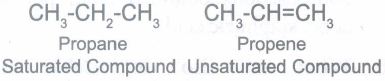
(ii) Cyclic Compounds:
Organic compounds in which the chain of carbon atoms is closed or cyclic are called Cyclic compounds. If the chain contains only carbon atoms, such compounds are called carbocyclic compounds. If the chain contains carbon and other atoms like oxygen, nitrogen, sulphur, etc., these compounds are called heterocyclic compounds. Carbocyclic compounds are further subdivided into alicyclic and aromatic compounds. In alicyclic compounds, the carbon cycle contains only single bonds whereas aromatic compounds contain one or more benzene rings (ring containing alternate double bonds between carbon atoms).
E.g:
.JPG)
49.
(i) The thyroid gland is composed of two distinct lobes lying one on either side of the trachea.
(ii) The two lobes are connected by means of a narrow band of tissue known as the isthmus.
(iii) This gland is composed of glandular follicles and lined by cuboidal epithelium.
(iv) The follicles are filled with colloid material called thyroglobulin.
An amino acid tyrosine and iodine are involved in the formation of thyroid hormone. The hormones secreted by the thyroid gland are
(a) Triiodothyronine (T3)
(b) Tetraiodothyronine or Thyroxine (T4)
Functions of thyroid hormones:
(i) Production of energy by maintaining the Basal Metabolic Rate (BMR) of the body.
(ii) Helps to maintain normal body temperature.
(iii) Influences the activity of central nervous system.
(iv) Controls growth of the body and bone formation.
(v) Essential for normal physical, mental and personality development. It is also known as personality hormone.
(vi) Regulates cell metabolism.
50.
The comparative study of Morphology and Anatomy of animals, reveal that they possess common set of characteristics.
(a) Homologous organs:
(i) The homologous organs are those which have inherited from common ancestors with similar developmental pattern in embryos.
(ii) E.g: The fore limbs of mammals are homologous structures. A Human hand, a front leg of a Cat, flipper of a Whale and a Bat's wing look dissimilar and adapted for different functions. Their mode of development and basic structure of bone are similar.
(b) Analogous organs:
(i) The analogous organs look similar and perform similar functions but they have different origin and developmental pattern.
(ii) The function of the wings of a Bat, the wings of a bird and wings of an insect are similar, but their basic structures are different.
(c) Vestigial organs:
(i) The degenerated and non-functional organs of animals are called Vestigial organs. The same organs are found to be well-developed and functional, in some of the related forms.
(ii) E.g: Some of the Vestigial organs in man are Vermiform appendix, Nictitating membrane, Caudal Vertebra, Coccyx etc.
(d) Atavism:
(i) The reappearance of ancestral characters in some individuals is called Atavism.
(ii) E.g: Presence of rudimentary tail in new born babies, presence of thick hair on the Human body.
51.
| Structure | Functions |
| Cerebral cortex | Sensory perception, control of voluntary functions, language, thinking, memory, decision making, creativity. |
| Thalamus | Acts as relay station. |
| Hypothalamus | Temperature control, thirst, hunger, urination, important link between nervous system and endocrine glands. |
| Cerebellum | Maintenance of posture and balance, coordinate voluntary muscle activity. |
| Pons and medulla | Role in sleep-awake cycle, cardiovascular, respiratory and digestive control centers. |
52.
Reversible Reactions: A reversible reaction is a reaction that can be reversed, i.e., the products can be converted back to the reactants. A reversible reaction is represented by a double arrow with their heads in the direction opposite to each other. Thus, a reversible reaction can be kept

Explanation: The compound 'AB' undergoes decomposition to form the products 'A' and 'B'. It is the forward reaction. As soon as the products are formed, they combine together to form 'AB': It is the backward reaction
PCl5(g) ⇌ PCl3(g) + CI2(g)
Irreversible Reactions: The reaction that cannot be reversed is called irreversible reaction. Consider the combustion of coal into carbon dioxide and water.
C(s) + O2(g) ⟶ CO2(g)+ Heat
Coal oxygen Carbon dioxide
In this reaction, solid coal burns with oxygen and gets converted into carbon dioxide gas and water. As the product is a gas, as soon as it is formed it escapes out of the reaction container. It is hard to decompose a gas into a solid. Thus, the backward reaction is not possible in this case. So, it is an irreversible reaction
53.
(i) Radioactive materials should be kept in thick walled lead container.
(ii) Lead coated aprons and lead gloves should be used while working with hazardous radioactive materials.
(iii) We should avoid eating while handling radioactive materials.
(iv) The radioactive materials should be handled only by tongs or by a remote control process.
(v) Dosimeters should be worn by the users to check the level of radiation.
54.
Linear expansion:
(i) When a body is heated or cooled, the length of the body changes due to change in its temperature. This expansion is said to be a linear or longitudinal expansion.
(ii) The ration of increase in length of a body per degree celsius rise in temperature to its unit length is called the coefficient of linear expansion. Its SI unit is per Kelvin. The value of coefficient of linear expansion is different for different materials.
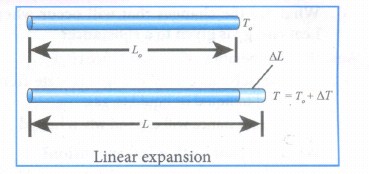
(iii) The equation relating the change in length to the change in temperature of a body is given below:
\(\frac { \triangle L }{ { L }_{ 0 } } \) =αL ΔT
ΔL - Change in length
L0 - Original length
ΔT - Change in temperature
αL - Coefficient of linear expansion.
55.
| Name of the solute | Formula of the solute | Solubility g/100 g water |
|---|---|---|
| Calcium carbonate | CaCO3(s) | 0.0013 |
| Sodium chloride | NaCI (s) | 36 |
| Ammonia | NH3(g) | 48 |
| Sodium hydroxide | NaOH(s) | 80 |
| Glucose | C6H12O6(s) | 91 |
| Sodium bromide | NaBr(s) | 95 |
| Sodium iodide | NaI(s) | 184 |
56.
(i) When a parallel beam of monochromatic (single coloured ) light passes through a gas or liquid or transparent solid, a part of light rays are scattered. This scattering is called Raman scattering (inelastic scattering).
(ii) Raman Scattering is defined as "The interaction of light ray with the particles of pure liquids or transparent solids, which leads to a change in wavelength or frequency".
(iii) The scattered light contains some additional frequencies (or wavelengths) other than that of incident frequency (or wavelength). This is known as Raman scattering or Raman Effect.
(iv) The modified lines are called 'Raman lines' and the unmodified lines are called as 'Rayleigh lines'. The lines having frequencies lower than the incident frequency is called stokes lines and the lines having frequencies higher than the incident frequency are called Anti-stokes lines.
57.
Ear trumpet:
(i) Ear trumpet is a hearing aid, which is useful for people who have difficulty in hearing.
(ii) In this device, one end is wide and the other end is narrow.
(iii) The sound from the sources fall into the wide end and are reflected by its walls into the narrow part of the device.
(iv) This helps in concentrating the sound and the sound enters the ear drum with more intensity. and to hear the sound better.
Mega phone:
(i) A megaphone is a horn-shaped device used to address a small gathering of people.
(ii) Its one end is wide and the other end is narrow.
(iii) When a person speaks at the narrow end, the sound of his speech is concentrated by the multiple reflections from the walls of the tube.
(iv) Thus, his voice can be heard loudly over a long distance.
58.
Man is omnivorous in his food habit. He eats plant and animal food. Therefore he has well CI developed incisors and canines. Rabbits are herbivorous in mode of nutrition. They need sharp incisors only. Canines or tearing teeth are hence absent in rabbits.
59.
Magnetic separation method:
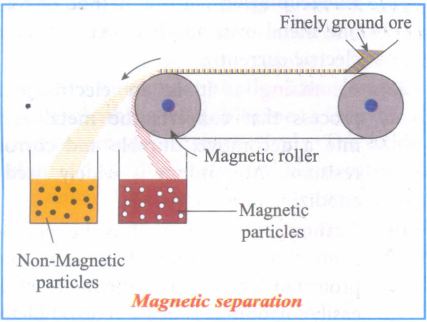
(i) Principle: Magnetic properties of the ores form the basis of separation. When either the ore or the gangue is magnetic, this method is employed. E.g. Tin stone SnO2 The ore of tin.
(ii) Method: The crushed ore is placed over a conveyer belt which rotates around two metal wheels, one of which is magnetic. The magnetic particles are attracted to the magnetic wheel and fall separately apart from the non-magnetic particles.
60.
(i) The term mutation was introduced by Hugo De Vries in 1901 when he observed phenotypic changes in the evening Primrose plant, Oenothera lamarckiana.
(ii) Mutation is an inheritable sudden change in the genetic material (DNA) of an organism.
(iii) Mutations are classified into two main types, namely chromosomal mutation and gene mutation. Chromosomal mutation: The sudden change in the structure or number of chromosomes is called chromosomal mutation. This may result in
Changes in the structure of chromosomes:
Structural changes in the chromosomes usually occurs due to errors in cell division. Changes in the number and arrangement of genes takes place as a result of deletion, duplication, inversion and translocation in chromosomes. Changes in the number of chromosomes: They involve addition or deletion in the number of chromosomes present in a cell. This is called ploidy. There are 2 types of ploidy:
Euploidy in plants and animals:
(a) Euploidy: It is the condition in which the individual bears more than the usual number of diploid (2n) chromosomes. If an individual has three haploid sets of chromosomes, the condition is called triploidy (3n). If it has four haploid sets of chromosomes. It is called Tetraploidy. Tetraploid plants are advantageous as they often result in increased fruit and flower size.
(b) Aneuploidy: It is the loss or gain of one or more chromosomes in a set. It is of 3 types:
(i) Monosomy (2n-1),
(ii) Trisomy (2n+1)
(iii) Nullisomy (2n-2). In man, Down's syndrome is one of the commonly known aneuploid condition.
Gene or point mutation:
(i) Gene mutation is the changes occurring in nucleotide sequence of a gene.
(ii) It involves substitution, deletion, insertion or inversion of a single or more than one nitrogenous base.
(iii) Gene alteration results in abnormal protein formation in an organism.
61.
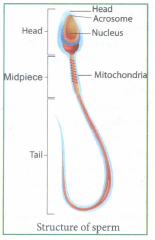
(i) The spermatozoan consists of head, a middle piece and tail.
(ii) The sperm head is elongated and formed by the condensation of nucleus.
(iii) The anterior portion has a cap like structure called acrosome.
(iv) It contains hyaluronidase, an enzyme that helps the sperm to enter the ovum during fertilization.
(v) A short neck connects the head and middle piece which comprises the centrioles.
(vi) The middle piece contains the mitochondria which provides energy for the movement of tail.
(vii) It brings about sperm motility which is essential for fertilization.
62.
(i) The natural state of all earthly objects is either the state of rest or the state of uniform motion.
(ii) An object in motion will continue to be in the same state of motion as long as no external force is applied.
(iii) When force is applied on objects, they resist any change in their state. This property of objects is called "inertia".
(iv) When dropped from a height in vacuum, objects of different size, shape and mass fall at the same rate arid reach the ground at the same time.
63.
Blood Groups
(i) The concept of blood grouping was discovered by Karl Landsteiner. He identified blood groups A, B and O. AB blood group was recognized by Decastello and Steini.
(ii) Human blood contains certain specific substances called agglutinogens or antigens (Ag) and agglutinins or antibodies (Ab). Antigens are found on the membrane surface of RBC. Antibodies are present in blood plasma. Based on the presence or absence of antigen and antibodies human blood group is classified into four groups called A, B, AB, and O. An individual has one of the four blood groups.
(iii) 'A' group individuals: Antigen 'A' is present on the surface of RBC and antibody b (anti-b) is present in the plasma.
(iv) 'B' group individuals: Antigen 'B' is present on the surface of RBC and antibody an (anti-a) is present in the plasma.
(v) 'AB' group individuals: Antigens A and B are present on the surface of RBC and antibodies are absent in the plasma.
(vi) 'O' group individuals: No antigen A or B are absent on the surface of RBC. However, the plasma contains both antibodies 'a' and 'b' (anti a and b).
Blood donation :
(i) In blood transfusion one must consider the antigen and antibody compatibility (matching) between the donor and the person receiving blood (recipient). When an individual receives a mismatched blood group from the donor agglutination (clumping) of blood occurs in the body which leads to death.
64.
| Component | Use Of The Component | Symbol Used | |
| i) | A resistor of resistance R | Used to fix the magnitude of the current through the circuit | 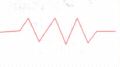 |
| ii) | Variable resistor or Rheostat | Used to select the magnitude of the current through the circuit. | 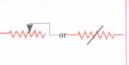 |
| iii) | Ammeter | Used to measure the current. | 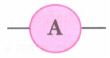 |
| iv) | Voltmeter | Used to measure the potential difference. | 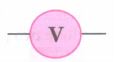 |
| v) | Galvano meter | Used to indicate the direction of current. | 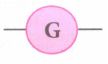 |
65.
Applications of Avogadro's hypothesis
(i) It explains Gay-Lussac's law.
(ii) It helps in the determination of atomicity of gases.
(iii) Molecular formula of gases can be derived using Avogadro's law.
(iv) It determines the relation between molecular mass and vapour density.
(v) It helps to determine Gram molar volume of all gases (i.e. 22.4 lit at S.T.P)
66.
(a) 92U235+ 0n1 → 38Sr90+ 54Xe143+ 30n1
(b) 92U235+ 0n1 → 43TC107+ 49In124+ 50n1
67.
F to (kelvin) K =(F--32) x \(\frac{5}{9}\) + 273
=(95 - 32) x \(\frac{5}{9}\) + 273
=\(\frac { 315 }{ 9 } \) + 273
=35+273 =308 K
68.
Object distance, u =25 cm
virtual image distance, v =-10 cm
To find: Magnification, m = ?
m = \(\frac{\text { Distance of the image }}{\text { Distance of the object }}=\frac{v}{u}\)
= \(\frac { -10 }{ 25 } \) = -0.4
Magnification,
m = -0.4
69.
Given
Speed of the train, Vs =30 rns-1
Frequency of the train, n =600Hz
Speed of sound, v =340 ms-1
To find: Apparent frequency n =?
Solution
\(n'=\left( \frac { v }{ v-{ v }_{ s } } \right) \times 600\)
\(=\frac { 340 }{ 310 } \times 600\)
Apparent frequency n' = 658 Hz
70.
Mass of first body, m1 = 2 kg
Initial velocity of first body, u1 = 40 ms-1
Initial velocity of second body, u2 = 0
Final velocity of first body,
v1 z = Final velocity of the second body, v2
i.e., v1 = v2= 20 ms-1
To find : Mass of second body, m2 = ?
According to law of conservation of momentum,
m1u1 + m2u2 = m1v1+ m2v2
m1u1 + m2u2 = v1m2 + m2v2
2 x 40 + m2 x 0 =20 x 2 + 20 m2
80 =40 + 20m2
20 m2 =40 ⇒ m2
=\(\frac{40}{20}\) =2 kg
Mass of second body, m2 = 2 kg
71.
Given:
Current passing through heater I= 20 A
To find: Resistance of heating element R = ?
Solution
\(V=IR\Rightarrow \frac { V }{ I } =\frac { 220 }{ 20 } =11\Omega \)
Resistance, R = 11Ω
72.
Gram molecular of CO2 = 44g
Number of molecules present in 44g of CO2
= 6.023 X 10²³
∴ Number of molecules present in 11g of CO2
= \(\frac{6.023\times{10}^{23}}{44}\)x 11
= 1.53 x 10²³ molecules.
73.
The compound 'B' should contain a - COOH group as it is an acid. Since it has only two carbon atoms, the other carbon atom must represent CH3 group. Thus, compound 'B' is ethanoic acid (CH3COOH). The compound A used for the sterilization of skin by doctors is ethanol C2H5OH (C2H6O). The chemical reaction involved in the oxidation by dilute alkaline KMnO4 solution also called Baeyer's reagent is :

74.
Human females. have two similar sex chromosomes (XX). Hence, during meiosis at the time of gamete formation, one X - chromosome enters each gamete. Hence, all the gametes possess an X - chromosome. Therefore human females are said to be homogenetic.
75.
Slope of V-I graph = resistance of a resistor. When two resistors are connected in series, volts the resistance of this combination (R = R1 + R2) is more than the resistance of both the resistors.
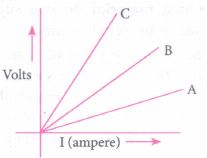
Since, slope of C is greater than the slopes of A and B. Therefore, C represents the graph for series combination of the other two.

10th Standard Syllabus & Materials
10th Standard
TN 10th English Prose - 2 - The Night the Ghost Got in Important Questions And Answers Study Material - QB365 Set A
NEW10th Standard
TN 10th English Supplementary - 1 - The Tempest Important Questions And Answers Study Material - QB365 Set A
NEW10th Standard
TN 10th English Poem - 1 - Life Important Questions And Answers Study Material - QB365 Set A
NEW10th Standard
TN 10th English Prose - 1 - His First Flight Important Questions And Answers Study Material - QB365 Set A



Tamilnadu Stateboard 10th Standard Subjects
Tamilnadu Stateboard Standards





