
 100% FREE ACCESS
10th Standard Syllabus & Materials
10th Standard
TN 10th English Prose - 4 - The Attic Important Questions And Answers Study Material - QB365 Set A
NEW10th Standard
TN 10th English Supplementary - 3 - The Story of Mulan Important Questions And Answers Study Material - QB365 Set A
NEW10th Standard
TN 10th English Poem - 3 - I am Every Woman Important Questions And Answers Study Material - QB365 Set A
NEW10th Standard
TN 10th English Prose - 3 - Empowered Women Navigating The World Important Questions And Answers Study Material - QB365 Set A
NEW10th Standard
TN 10th English Supplementary - 2 - Zigzag Important Questions And Answers Study Material - QB365 Set A
NEW10th Standard
TN 10th English Poem - 2 - The Grumble Family Important Questions And Answers Study Material - QB365 Set A

Published on: 30/09/2019
Electricity
Download Tamil Nadu 10th Standard Science question papers, model tests, one-mark questions, important questions, and public exam papers in PDF format. Free study materials and answer keys for TN State Board students.
Questions + Answers key
Take MCQ Science Test1.
State Ohm’s law.
2.
Define electric potential and potential difference.
3.
In the circuit diagram given below, three resistors R1, R2 and R3 of 5 Ω, 10 Ω and 20 Ω respectively are connected as shown. Calculate:
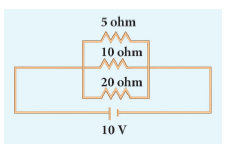
A) Current through each resistor
B) Total current in the circuit
C) Total resistance in the circuit
4.
The resistance of a conductor directly proportional to
Length
Area
Volt
Current
5.
The resistance of material depends on.
Temperature
Length of conductor
Area of cross-section
All the above
6.
The S1 unit of power is
joule
ampere
Watt
ohm
7.
Kilowatt hour is the unit of
resistivity
conductivity
electrical energy
electrical power
8.
Which of the following is correct?
Rate of change of charge is electrical power
Rate of change of charge is current.
Rate of change of energy is current.
Rate of change of current is charge.
9.
SI unit of current is __________
10.
LED stands for _________.
11.
The power of an electric device is a product of _________ and __________.
12.
When a circuit is open, _____________ cannot pass through it.
13.
Assertion: In a simple battery, the point of lowest potential is +ve terminal of the battery.
Reason: The current flows to higher potential as to lower potential.
Codes:
a) If both the assertion and the reason are true and the reason is the correct explanation of the assertion
b) If both the assertion and the reason are true, but the reason is not the correct explanation of the assertion.
c) If the assertion is true, but the reason is false.
d) If the assertion is false but the reason is true.
14.
Assertion: In a simple battery circuit the point of highest potential is the positive terminal of the battery.
Reason: The current flows towards the point of the highest potential.
a) If both the assertion and the reason are true and the reason is the correct explanation of the assertion.
b) If both the assertion and the reason are true, but the reason is not the correct explanation of the assertion.
c) If the assertion is true, but the reason is false.
d) If the assertion is false, but the reason is true.
15.
Give the formula for the following
(i) Ohm's law
(ii) Joules law
(iii) Effective resistance for resistance in series
(iv) Power
(v) Specific resistance
16.
What is the difference between open and closed circuits?
17.
Name any two devices, which are working on the heating effect of the electric current.
18.
What happens to the resistance, as the conductor is made thicker?
19.
Define the unit of current.
20.
a) What are the advantages of LED TV over the normal TV?
b) List the merits of LED bulb.
21.
Diode
22.
Potential difference
23.
electrical energy
24.
specific resistance
25.
electric current
1.
According to Ohm's law, at a constant temperature, the steady current 'I' flowing through a conductor is directly proportional to the potential difference 'V' between the two ends of the conductor.
\(I\alpha V \Rightarrow\) V = IR
2.
Electric potential : The electric potential at a point is defined as the amount of work done in moving a unit positive charge from infinity to that point against the electric force.
Electric potential difference : The electric potential difference between two points is defined as the amount of work done in moving a unit positive charge from one point to another point against the electric force.
3.
A) Since the resistors are connected in parallel, the potential difference across each resistor is same (i.e. V=10V)
Therefore, the current through R1 is,
\({ I }_{ 1 }=\frac { V }{ { R }_{ 1 } } =\frac { 10 }{ 5 } =2A\)
Current through \({ R }_{ 2 }={ I }_{ 2 }=\frac { V }{ { R }_{ 2 } } =\frac { 10 }{ 10 } =1A\)
Current through \({ R }_{ 3 }={ I }_{ 3 }=\frac { V }{ { R }_{ 3 } } =\frac { 10 }{ 20 } =0.5A\)
B) Total current in the circuit, I = I1 + I2 + I3
= 2 + 1 + 0.5 = 3.5 A
C) Total resistance in the circuit \(\frac { 1 }{ { R }_{ P } } =\frac { 1 }{ { R }_{ 1 } } +\frac { 1 }{ { R }_{ 2 } } +\frac { 1 }{ { R }_{ 3 } } \)
\(=\frac { 1 }{ 5 } +\frac { 1 }{ 10 } +\frac { 1 }{ 20 } \)
\(=\frac { 4+2+1 }{ 20 } \)
\(\frac { 1 }{ { R }_{ P } } =\frac { 7 }{ 20 } \)
Hence, \({ R }_{ P }=\frac { 20 }{ 7 } =2.857\Omega \)
4.
(a)
Length
5.
(d)
All the above
6.
(c)
Watt
7.
(c)
electrical energy
8.
(b)
Rate of change of charge is current.
9.
()
ampere
10.
()
Light Emitting Diode
11.
()
voltage, current
12.
()
current
13.
d) If the assertion is false but the reason is true.
14.
c) If the assertion is true, but the reason is false.
15.
(i) V = IR
(ii) H = I2Rt
(iii) Rs = R1 + R2
(iv) P = VI
(v) \(\rho=R\frac{A}{L}\)
16.
| S. No | Open circuit | Closed circuit |
| i) | Key is open | Key is closed |
| ii) | No current flows through it | Current flows through it |
17.
(i) Electric heater.
(ii) Electric iron work on the heating effect of current.
18.
(i) Resistance is inversely proportional to area of cross section. \(\mathbf{R} \alpha \frac{l}{A}\)
(ii) A thicker wire has Iarger area of cross section and hence the resistance decreases.
19.
(i) The SI unit of current is ampere (A).
(ii) The current flowing through a conductor is said to be one ampere, when a charge of one coulomb flows across any cross-section of a conductor in one second.
\(1\ ampere=\cfrac { 1\ coulomb }{ 1\ second } \)
20.
(a) Advantages of LED television:
(i) LED television has brighter picture quality
(ii) It is thinner in size
(iii) It uses less power and consumes very less energy.
(iv) Its life span is more.
(v) It is more reliable
(b) Merits of LED bulb:
(i) As there is no filament, there is no loss of energy in the form of heat. It is cooler than the incandescent bulbs
(ii) In comparison with the fluorescent light, the LED bulbs have significantly low power requirement.
(iii) It is not harmful to the environment
(iv) A wide range of colours is possible here.
(v) It is cost-efficient and energy efficient.
(vi) Mercury and other toxic materials are not required.
(vii) One way of overcoming the energy crisis is to use more LED bulbs.
21.

22.
\(\frac{W}{Q}\)
23.
joule
24.
ohmmeter
25.
ampere

10th Standard Syllabus & Materials
10th Standard
TN 10th English Prose - 2 - The Night the Ghost Got in Important Questions And Answers Study Material - QB365 Set A
NEW10th Standard
TN 10th English Supplementary - 1 - The Tempest Important Questions And Answers Study Material - QB365 Set A
NEW10th Standard
TN 10th English Poem - 1 - Life Important Questions And Answers Study Material - QB365 Set A
NEW10th Standard
TN 10th English Prose - 1 - His First Flight Important Questions And Answers Study Material - QB365 Set A



Tamilnadu Stateboard 10th Standard Subjects
Tamilnadu Stateboard Standards





