
 100% FREE ACCESS
10th Standard Syllabus & Materials
10th Standard
TN 10th English Prose - 4 - The Attic Important Questions And Answers Study Material - QB365 Set A
NEW10th Standard
TN 10th English Supplementary - 3 - The Story of Mulan Important Questions And Answers Study Material - QB365 Set A
NEW10th Standard
TN 10th English Poem - 3 - I am Every Woman Important Questions And Answers Study Material - QB365 Set A
NEW10th Standard
TN 10th English Prose - 3 - Empowered Women Navigating The World Important Questions And Answers Study Material - QB365 Set A
NEW10th Standard
TN 10th English Supplementary - 2 - Zigzag Important Questions And Answers Study Material - QB365 Set A
NEW10th Standard
TN 10th English Poem - 2 - The Grumble Family Important Questions And Answers Study Material - QB365 Set A

Published on: 13/03/2020
10th Standard Science English Medium All Chapter Book Back and Creative Four Marks Questions 2020
Download Tamil Nadu 10th Standard Science question papers, model tests, one-mark questions, important questions, and public exam papers in PDF format. Free study materials and answer keys for TN State Board students.
Questions + Answers key
Take MCQ Science Test1.
Explain the role of sunlight in photosynthesis.
2.
Write a note an wind energy.
3.
Explain the hazards and effects of Tobacco.
4.
Why are Genetically modified organisms produced? Explain the purpose and advantages.
5.
In a biology period, the teacher drew the heart of rabbit on the board and explained its structure and functions. After the class, your friend told you that he finds it difficult to understand the concept and felt he wanted a detailed explanation.
(i) In what way the teaching can be made easily understandable?
(ii) Do you think using technologies like Visual Communication help students to understand the difficult concepts in a simple way?
(iii) By what means the Visual Communication improve the learning ability?
6.
Explain how ethanol is manufactured from molasses?
7.
Explain the physiological effects of Auxins.
8.
Two kittens (Leo and Joe) from the same mother were separated and sent to different habitual conditions. Leo was sent to a high mountain wild region and Joe was domesticated and lived in a city. After a good 5 years) it was found that Leo was aggressive and built strong with hunting skills. Leo looked tall with strong legs and muscled structure) whereas Joe was a well mannered cat looked puffy with soft legs.
(i) Do you think habitual condition impact animal characters?
(ii) What acquired characters does Leo inherit?
(iii) Is it true but Leo's offspring would be a hunter?
9.
Tabulate the different parts of the brain and their functions.
10.
Explain the classification based on the direction of the reaction.
11.
Explain the uses of radio isotopes in medicine field?
12.
With an illustration, explain the method of Calculation for areal expansion of an object.
13.
Explain Solid solution, Liquid solution and Gaseous solution.
14.
Explain the Sign Conventions of lenses.
15.
Write the applications of echo.
16.
Is hirudin used in medical science.
17.
How is zinc blende concentrated? Explain it with a neat diagram
18.
Mala had a huge scar on her cheek after she met with fire accident during her college days. She is worried if her baby would inherit the scar she had acquired. She clarified with her doctor, she need not worry about it, as her scar is an acquired trait.
(i) What are acquired traits?
(ii) How is it different from inherited traits?
19.
Kalaivani was watching at a metal pipe, one end of which is connected to a tank at the top of her building and the other end to the tap, which is near the ground level. She was admiring how the water flows from top to the bottom through the pipe. She went and asked her mother, who was an engineer.
(i) Also Kalaivani asked her mother that can she able to compare this with any other scientific concepts?
(ii) How would her mother have compared the resistance in a water pipe as well as in a conductor.
(iii) Give the expression for resistors connected in series and parallel.
20.
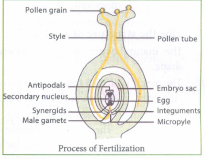
Explain the process of fertilization in plants?
21.
Give the application of torque.
22.
List the difference between RBC and WBC.
23.
Give the applications of Avogadro's hypothesis.
24.
How would you dispose the following wastes?
a. Domestic wastes like vegetable peels
b. Industrial wastes like metallic cans Can the disposal protect the environment? How?
25.
What do you understand by the term phenotype and genotype?
26.
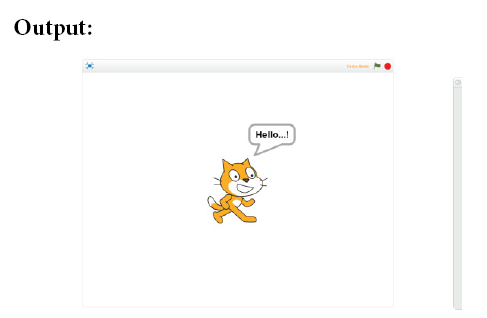
Program for print the word “Hello” with sound
27.
What are synthetic auxins? Give examples.
28.
Differentiate between outbreeding and inbreeding.
29.
Why are the human testes located outside the abdominal cavity? Name the pouch in which they are present .
30.
Differentiate between Voluntary and involuntary actions.
31.
How are arteries and veins structurally different from one another?
32.
Define Ethnobotany and write its importance.
33.
Once a person starts taking drugs or alcohol it is difficult to get rid of the habit. Why?
34.
List out the parasitic adaptations in leech.
35.
Write the reaction for photosynthesis?
36.
Define critical mass.
37.
A strong sound signal is sent from a ship towards the bottom of the sea. It is received back after 1s. What is the depth of sea given that the speed of sound in water 1450 m s–1?
38.
Distinguish between the resistivity and conductivity of a conductor.
39.
Find the final temperature of a copper rod. Whose area of cross section changes from 10 m2 to 11 m2 due to heating. The copper rod is initially kept at 90 K. (Coefficient of superficial expansion is 0.0021 /K)
40.
Two bodies have a mass ratio of 3:4 The force applied on the bigger mass produces an acceleration of 12 ms-2. What could be the acceleration of the other body, if the same force acts on it.
41.
3.5 litres of ethanol is present in 15 litres of aqueous solution of ethanol. Calculate volume percent of ethanol solution.
42.
Explain the factors influencing the rate of a reaction
43.
a) State the reason for addition of caustic alkali to bauxite ore during purification of bauxite.
b) Along with cryolite and alumina, another substance is added to the electrolyte mixture. Name the substance and give one reason for the addition
44.
How is ethanol manufactured from sugarcane?
45.
Derive the relationship between Relative molecular mass and Vapour density.
1.
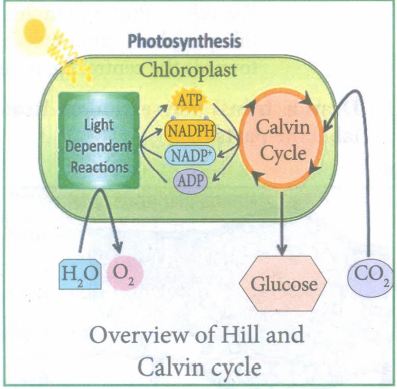
The entire process of photosynthesis takes place inside the chloroplast. The structure of chloroplast is such that the light dependent (Light reaction) and light independent (Dark reaction) take place at different sites in the organelle.
a) Light dependent photosynthesis:
(Hill reaction \ Light reaction)
(i) Discovered by Robin Hill (1939). This reaction takes place in the presence of light energy in thylakoid membranes (grana) of the chloroplasts.
(ii) Photosynthetic pigments absorb the light energy and convert it into chemical energy ATP and NADPH2. These products of light reaction move out from the thylakoid to the stroma of the chloroplast.
b) Light independent reactions:
(Biosynthetic phase):
(i) The second steps (dark reaction or biosynthetic pathway) is carried out in the stroma.
(ii) During this reaction CO2 is reduced into carbohydrates with the help of light generated ATP and NADPH2.
(iii) This is also called as Calvin cycle and is carried out in the absence of light.
(iv) In Calvin cycle the inputs are CO2 from the atmosphere and the ATP and NADPH2 produced from light reaction
2.
(i) The kinetic energy possessed by the wind is due to its high speed, that can be converted into mechanical power by wind turbines.
(ii) The wind energy can be used for
(a) Generating electricity
(b) Run water pumps, flour mills etc.
(c) Rotatory motion of windmill is used to draw water from wells.
Working of wind mills:
(i) Wind mill is a machine that converts the energy of wind into rotational energy by broad blade attached to the rotating axis.
(ii) When the blowing air strikes the blades of the windmill, it exerts force and causes the blades to rotate.
(iii) The rotational movement of the blades operate the generator and the electricity is produced.
(iv) The energy output from each windmill is coupled together to get electricity on a commercial scale.
Advantage of wind energy:
(i) Wind energy is free, eco-friendly, renewable source of energy.
(ii) It does not cause pollution.
(iii) Expenses on periodic maintenance is low when compared to the other power sources
3.
When smoke is inhaled the chemicals get absorbed by the tissues and cause the following harmful effects.
(i) Benzopyrene and polycyclic hydrocarbons present in tobacco smoke is carcinogenic causing lung cancer.
(ii) Causes inflammation of throat and bronchi leading to conditions like bronchitis and pulmonary tuberculosis.
(iii) Inflammation of lung alveoli decrease surface area for gas exchange and cause emphysema.
(iv) Carbon monoxide of tobacco smoke binds to hemoglobin of RBC and decreases its oxygen carrying capacity causing hypoxia in body tissues.
(v) Increased blood pressure caused by smoking leads to increased risk of heart disease.
(vi) Causes increased gastric secretion which leads to gastric and duodenal ulcers.
(vii) Tobacco chewing causes oral cancer (mouth cancer).
4.
Genetically Modified Organisms:
(i) Genetic modification refers to the alteration or manipulation of genes in the organisms using rDNA techniques in order to produce the desired characteristics.
(ii) The DNA fragment inserted is called transgene. Plants or animals expressing a modified endogenous gene or a foreign gene are also known as transgenic organisms.
Advantages:
(i) The transgenic plants are much stable, with improved nutritional quality, resistant to diseases and tolerant to various environment conditions.
(ii) Similarly transgenic animals are used to produce proteins of medicinal importance at low cost and improve livestock quality. eg Golden Rice is a genetically modified Rice which can produce Beta carotene.
5.
(i) Pictures and Audio-Visuals give us more understanding than teaching and writing on black board. So, any visual representation of the concepts would help us to understand better and make teaching simple
(ii) Yes. Visual Communication helps us to easily conceptualize complicated theorems and concepts. When the teacher shows pictures / videos that represent the concept, we would easily relate to its application and firmly understand the concept without any mis-perception
(iii) Pictures, Audio-Visuals, animations provide additional information and helps us to easily correlate the concepts. We could easily remember the visuals than black board writing, and visualize it, so that we do not forget and we could easily recollect at the time of examination.
6.
(i) Dilution: Molasses is first diluted with water to bring down the concentration of sugar to about 8 to 10 percent.
(ii) Addition of yeast: Yeast is added to this solution and the mixture is kept at about 300 K for a few days during this period, the enzymes invertase and zymase present in yeast, bring about the conversion of sucrose into ethanol.
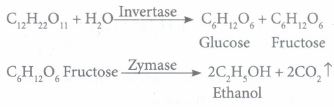
(iii) Distillation of wash: The fermented liquid (i.e. wash), containing 15 to 18 percent alcohol, is now subjected to fractional distillation. The main fraction drawn is an aqueous solution of ethanol which contain 95.5% of ethanol and 4.5% of water. This is called rectified spirit. This mixture is then refluxed over quicklime for about 5 to 6 hours and then allowed to stand for 12 hours. On distillation of this mixture, pure alcohol (100%) is obtained. This is called absolute alcohol.
7.
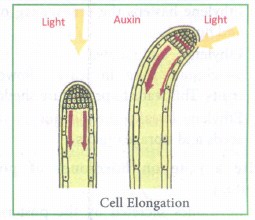
Auxins bring about a variety of physiological effects in different parts of the plant body. Some of them are discussed below:
(i) Auxins promote the elongation of stems and coleoptiles which makes them to grow.
(ii) Auxins induce root formation at low concentration and inhibit it at higher concentration.
(iii) The auxins produced by the apical buds suppress growth of lateral buds. This is called Apical Dominance.
(iv) Seedless fruits without fertilization are induced by the external application of auxins. (Parthenocarpy). Examples: Watermelon, Grapes, Lime etc.
(v) Auxins prevent the formation of abscission layer.
8.
Yes. When there is a change in the environment, the animals respond to the change. They develop adaptive structures. The characters developed by the animals during their life time, in response to the environmental changes are called acquired characters.
(i) Leo lived in the mountain region and it was wild. It developed hunting skills for survival and this made his legs and body strong. So the muscled physical body, strong legs and hunting skills were the acquired characters inherited by Leo.
(ii) According to Lamarck, the. acquired characters are transmitted to the offspring by the process of inheritance.
9.
| Structure | Functions |
| Cerebral cortex | Sensory perception, control of voluntary functions, language, thinking, memory, decision making, creativity. |
| Thalamus | Acts as relay station. |
| Hypothalamus | Temperature control, thirst, hunger, urination, important link between nervous system and endocrine glands. |
| Cerebellum | Maintenance of posture and balance, coordinate voluntary muscle activity. |
| Pons and medulla | Role in sleep-awake cycle, cardiovascular, respiratory and digestive control centers. |
10.
Reversible Reactions: A reversible reaction is a reaction that can be reversed, i.e., the products can be converted back to the reactants. A reversible reaction is represented by a double arrow with their heads in the direction opposite to each other. Thus, a reversible reaction can be kept

Explanation: The compound 'AB' undergoes decomposition to form the products 'A' and 'B'. It is the forward reaction. As soon as the products are formed, they combine together to form 'AB': It is the backward reaction
PCl5(g) ⇌ PCl3(g) + CI2(g)
Irreversible Reactions: The reaction that cannot be reversed is called irreversible reaction. Consider the combustion of coal into carbon dioxide and water.
C(s) + O2(g) ⟶ CO2(g)+ Heat
Coal oxygen Carbon dioxide
In this reaction, solid coal burns with oxygen and gets converted into carbon dioxide gas and water. As the product is a gas, as soon as it is formed it escapes out of the reaction container. It is hard to decompose a gas into a solid. Thus, the backward reaction is not possible in this case. So, it is an irreversible reaction
11.
Medical applications of radioisotopes can be divided into two parts
i) Diagnosis ii) Therapy Radio.
Isotopes are used as tracers to diagnose the nature of blood circulatory disorders, defects of bone metabolism, to locate tumors, etc. Some of the radio isotopes which are used as tracers are: hydrogen, carbon, nitrogen, sulfur, etc.
(i) Radio sodium (Na24) is used for the effective functioning of heart.
(ii) Radio - Iodine (I131) is used to cure the goiter.
(iii) Radio iron is (Fe59) is used to diagnose anemia and also provide treatment for the same.
(iv) Radio phosphorous (P32) is used in the treatment of skin diseases.
(v) Radio cobalt (Co60) and radio gold (Au79) are used in the treatment of skin cancer.
(vi) Radiations are used to sterilize the surgical devices as they can kill the germs and microbes.
12.
(i) If there is an increase in the area of a solid object due to heating, then the expansion is called superficial or areal expansion.
(ii) Superficial expansion is determined in terms of coefficient of superficial expansion. The ratio of increase in area of the body, per degree rise in temperature to its unit area is called coefficient of superficial expansion. Coefficient of superficial expansion is different for different materials. Its SI unit is also per Kelvin.
(iii) The equation relating to the change in area to the change in temperature is given below:
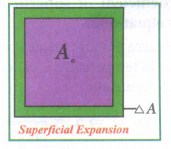
\(\frac { \triangle A }{ { A }_{ 0 } } \) =αA ΔT
ΔA - Change in area
A0 - Original area
ΔT - Change in area
αA - Coefficient of superficial expansion
13.
| Solute | Solvent | Example |
|---|---|---|
| Solid solution | ||
| Solid | Solid | Copper dissolved in gold (Alloys) |
| Liquid | Solid | Mercury with sodium (amalgam) |
| Liquid solution | ||
| Solid | Liquid | Sodium chloride dissolved in water |
| Liquid | Liquid | Ethyl alcohol dissolved in water |
| Gas | Liquid | carbon-di-oxide dissolved in water (Soda water) |
| Gaseous solution | ||
| Liquid | Gas | Water vapour in air (cloud) |
| Gas | Gas | Mixture of Helium-Oxygen gases, |
14.
(i) The object is always placed on the left side of the lens.
(ii) All the distances are measured from the optical centre of the lens.
(iii) The distances measured in the same direction as that of incident light are taken as positive.
(iv) The distances measured against the direction of incident light are taken as negative. (v) The distances measured upward and perpendicular to the principal axis is taken as positive.
(v) The distances measured downward and perpendicular to the principal axis is taken· as negative.
15.
(i) Some animals communicate with each other over long distances and also locate objects by sending sound signals and receiving the echo as reflected from targets.
(ii) The principle of echo is used in obstetric ultrasonography, which is used to create real-time visual images of the developing embryo or fetus in the mother's uterus. This is a safe testing tool, as it does not use any harmful radiations.
(iii) Echo is used to determine the velocity of sound waves in any medium.
16.
Yes. Hirudin is used as an anticoagulant in medical science.
17.
Froth floatation:
(i) Principle: This process depends on the preferential wettability of the ore with oil (pine oil) and the gangue particles by water. Lighter ores, such as sulphide ores, are concentrated by this method. E.g. Zinc blende ZnS
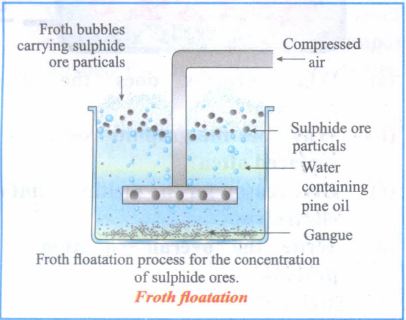
(ii) Method: The crushed ore is taken in a large tank containing oil and water and agitated with a current of compressed air. The ore is wetted by the oil and gets separated from the gangue in the form of froth. Since the 4 ore is lighter, it comes on the surface with the froth and impurities are left behind
18.
(i) Acquired traits are the characters that cannot be passed from one generation to the next generation.
(ii) Characters which are inherited by the offspring from the parents and carried from one generation to another generation are called Inherited traits.
19.
(i) Kalaivani's mother took a small PVC pipe which has water in it and held in a horizontal position. Water came out drop by drop. When she raised one of the ends of the pipe, the water through the other end came out with a greater speed. She said initially when I was holding the pipe in a horizontal position, pressure at the both the ends are same. So water did not come out. The difference in pressure (Pressure difference) between the two ends is zero. But when I raised one of the ends, the top end has high pressure, and the bottom end has low pressure. Due to this pressure difference, water came out with a faster rate. So compare a conductor or a wire to this PVC pipe The wire is connected to a battery, whose one end has higher potential and the other end has lower potential. Due to this difference in potential, electrons from negative terminal (lower potential end) flow towards the positive terminal (higher potential end). Here electron flow is compared with the water flow and the electric potential is compared with the pressure. Kalaivani felt very happy, after hearing her mother's genius explanation.
(ii) When Kalaivani asked how to understand about the concept of resistance from her mother's scientific explanations, her mother continued. If the water pipe is smooth inside, then there is no charge in the speed of flow of water. i.e., zero resistance. But when the pipe has some blocks inside at different points, the water changes its speed of flow at different points, likewise, whenever electrons flow inside the conductor, they may collide with each other, due to which their speed will be resisted (blocked), which forms as electrical resistance. Her explanation made Kalaivani satisfied.
(iii) When two resistors of resistances, R1 & R2 are connected in series to a battery source.
\({ R }_{ s }={ R }_{ 1 }+{ R }_{ 2 }\)
When R1 & R2 are connected in parallel,
\(\frac { 1 }{ { R }_{ p } } +\frac { 1 }{ { R }_{ 1 } } +\frac { 1 }{ { R }_{ 2 } } \Rightarrow \frac { 1 }{ { R }_{ p } } =\frac { { R }_{ 2 }+{ R }_{ 1 } }{ { R }_{ 1 }{ R }_{ 2 } } \)
\({ R }_{ p }=\frac { { R }_{ 1 }{ R }_{ 2 } }{ { R }_{ 1 }+{ R }_{ 2 } } \)
20.
(i) Pollen grains reach the right stigma and begin to germinate.
(ii) Pollen grain forms a small tube-like structure called pollen tube which emerges through the germ pore. The contents of the pollen grain move into the tube.
(iii) Pollen tube grows through the tissues of the stigma and style and finally the ovule through the micropyle.
(iv) Vegetative cell degenerates and the generative cell divides to form two sperms (or male gametes).
(v) Tip of pollen tube bursts and the two sperms enter the embryo sac
(vi) One sperm fuses with the egg (syngamy) and forms a diploid zygote.
(vii) The other sperm fuses with the secondary nucleus (Triple fusion) to form the primary endosperm nucleus which is triploid in nature.
(viii)Since two types of fusion syngamy and triple fusion take place in an embryo sac the process is termed as double fertilization.
(ix) After triple fusion, primary endosperm nucleus develops into an endosperm.
(x) Endosperm provides food to the developing embryo.
(xi) Later the synergids and antipodal cells degenerate.
21.
(i) Gears: A gear is a circular wheel with teeth around its rim. It helps to change the speed of rotation of a wheel by changing the torque and helps to transmit power.
(ii) Seesaw: When the heavier person comes closer to the pivot point (fulcrum) the distance of the line of action of the force decreases. It causes less amount of torque to act on it. This enables the lighter person to lift the heavier person.
(iii) Steering Wheel: A small steering wheel enables you to manoeuore a car easily by transferring a torque to the wheels with less effort.
22.
| S.No |
RBC |
WBC |
|---|---|---|
| i | They are red in colour due to the presence of respiratory pigment hemoglobin. | They are colourless. |
| ii | They are biconcave/disc-shaped. | They are amoeboid in shape. |
| iii | The RBC is not classified into types, all red blood cells are the same. | They are classified into granulocytes and agranulocytes. |
| iv | The mature RBC's lack a nucleus. | They are nucleated. |
| v | They cannot change their shape. | They can change their shape and are capable of amoeboid movement. |
| vi | They are smaller than leucocytes. | They are larger than erythrocytes. |
| vii | They are responsible for the transport of respiratory gases (CO2 and O2). | They help to defend the body against pathogens. |
23.
Applications of Avogadro's hypothesis
(i) It explains Gay-Lussac's law.
(ii) It helps in the determination of atomicity of gases.
(iii) Molecular formula of gases can be derived using Avogadro's law.
(iv) It determines the relation between molecular mass and vapour density.
(v) It helps to determine Gram molar volume of all gases (i.e. 22.4 lit at S.T.P)
24.
a) For domestic wastes- we can have a compost pit. As vegetable waste is dumped in the pit, they rot and become manure.
b) Metallic can - method - Recycle
c) Yes, this disposal method protects the environment because recycling saves energy. It also reduce green house gas emissions which helps to tackle climate change.
25.
(i) External expression of a particular trait is known as phenotype.
(ii) A genotype is the genetic expression of an organism.
26.
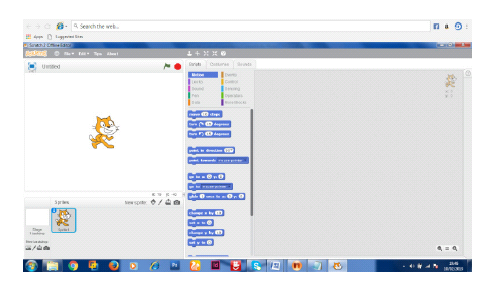
1. Click events in script option
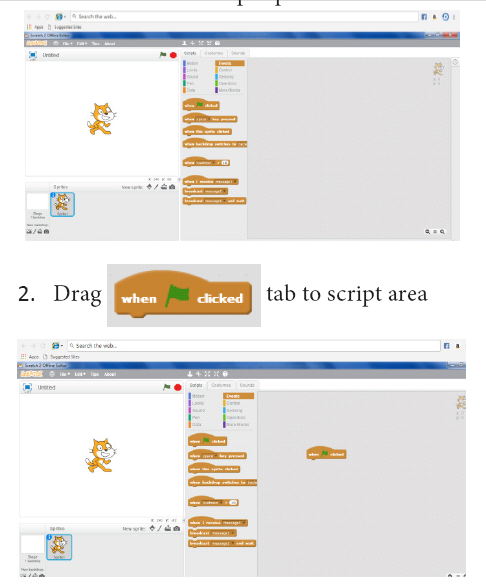
3. Click Looks in script option. Drag “say” to script area.
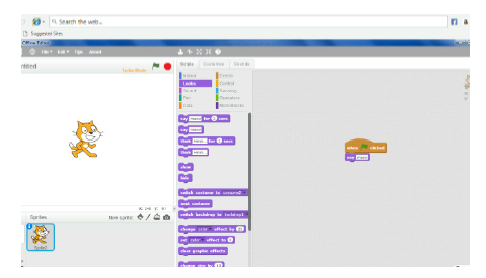
4. Type “Hello “ word in say tab.
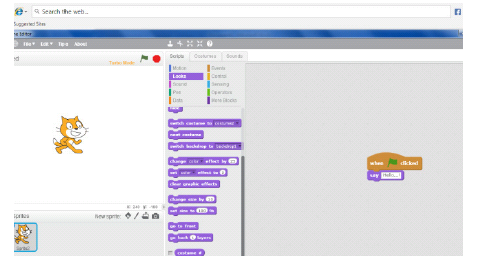
5.Click sounds in script option. Drag play sound to script area. Choose the hello sound from the audio file.
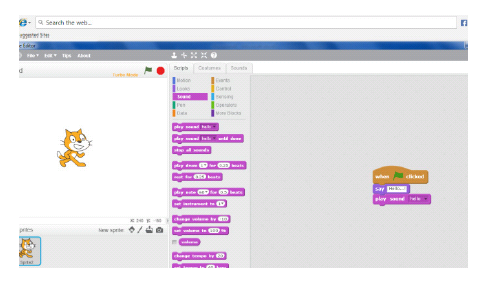
6. From File menu choose the Save option.
7. Click the green flag at the top right corner of the stage window to run the program
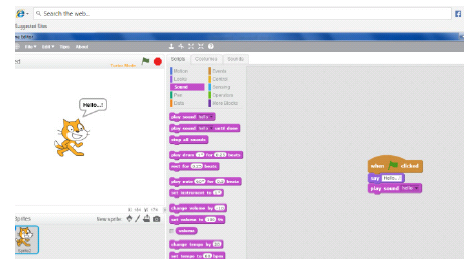
27.
(i) Artificially Synthesized Auxins that have properties like Auxins are called as Synthetic Auxins.
(ii) eg. 2, 4 - D (2,4 Dichlorophenoxy Acetic Acid).
28.
| S.No. |
Outbreeding |
Inbreeding |
|---|---|---|
| i. | Cross between two different species (unrelated) with desirable features of economic value are mated. | Mating of closely related animals within the same breed for about 4 - 6 generations. |
| ii. | It is the breeding of unrelated animals. The offsprings formed are called hybrids. | Superior males and superior females of the same breed are identified and mated in pairs. |
| iii. | The hybrids are stronger and vigorous than their parents. E.g: Mule | It helps in the accumulation of superior genes and elimination of genes which are undesirable. E.g: Hisardale. |
29.
(i) The formation of sperm is in a particular temperature which is less than our body temperature. So it is located in the outside of the body.
(ii) The name of the pouch is scrotum.
30.
| S.No | Voluntary actions | Involuntary actions |
|---|---|---|
| i) | An action which is under conscious control. |
An action which is not under conscious control. |
| ii) | Voluntary action is controlled by the brain. | Involuntary action is controlled by the spinal cord. |
| iii) | All voluntary actions result in a muscular action. | Involuntary actions result in a muscular action (or) secretion from some gland. |
31.
(i) Arteries are thick and elastic vessels that carry blood away from the heart.
(ii) Veins are thin and non-elastic vessels that transport blood to the heart.
32.
(i) Ethnobotany is the study of a region's plants and their practical uses through the traditional knowledge of the local culture of people.
Importance of Ethnobotany :
(i) It provides traditional uses of plant.
(ii) It gives information about certain unknown and known useful plants.
(iii) The ethnomedicinal data will serve as a useful source of information for the chemists, pharmacologists and practitioners of herbal medicine.
(iv) Tribal communities utilize ethnomedicinal plant and prepare medicine to cure many diseases.
33.
(i) Persons who consume these drugs become fully dependent on them, they cannot live without drugs.
(ii) It does by switching on brain circuits that makes one feel wonderful or feel good.
(iii) Physical addiction occurs once a person is unable to stop drinking because of anxiety, shakiness and on the more extreme end, seizures, severe shaking, confusion and hallucinations.
(iv) At a chemical level, it hits multiple areas in the brain and at a psychological level, they are unable to function without it.
34.
Leech is a parasite and sucks the blood of vertebrates and show adaptations.
(i) Suckers are present in the anterior and posterior ends of the body, by which the animal attaches itself to the body of the host.
(ii) The three jaws inside the mouth causes a triradiate or Y shaped wound in the skin of the host.
(iii) Saliva contains a protein called hirudin which prevents the blood clotting. Thus continuous supply of blood is maintained.
(iv) Blood is stored in the crop. It gives nourishment to the leech for several months. Hence, there is no digestive juices and enzyme.
35.

Carbon dioxide + Water ➝ Glucose + Water + Oxygen
36.
(i) The minimum mass of fissile material necessary to sustain chain reaction is called "critical mass".
(ii) It depends on the nature, density and the size of fissile material.
37.
Given:
t = 1s
v = 1450 ms-1
\(d = \frac{v\times t}{2}= \frac {1450 \times 1 }{ 2 } \)
d = 725 m
38.
| S.No |
Resistivity |
Conductivity |
|---|---|---|
| (i) |
It is the resistance of a conductor of unit length and unit area of cross section. |
The reciprocal of electrical resistivity of a material is called electrical conductivity. |
| (ii) | Its unit is ohm meter | Its unit is ohm-1 meter-1 |
| (iii) | Resistivity is less for conductor than for insulators | Conductivity is more for conductors than for insulators. |
| (iv) | ρ = RA / L | σ = 1 / ρ |
39.
Area of copper rod, Ao = 10 m2
Changes of Area of cross section,
Initial temperature \(\Delta \mathrm{A} =11 -10 =1 \mathrm{~m}^{2} \)
\(\mathrm{~T}_{1} =90 \mathrm{~K} \)
\(a_{\mathrm{A}} =0.0021 / \mathrm{K} \)
\(\mathrm{T}_{2} =? \)
\(\frac{\Delta A}{A_{0}} =a_{\mathrm{A}} \Delta \mathrm{T} \)
\(\frac{1 }{10 } =0.0021\left[\mathrm{~T}_{2}-90\right] \)
\(0.1 =0.0021\left[\mathrm{~T}_{2}-90\right]=\frac{0.1}{0.0021}+90=\mathrm{T}_{2} \)
\(\mathrm{~T}_{2} =137.61 \mathrm{~K}\)
So the final temperature of a copper rod is 137.61 K
40.
\(\text {Given } m_{1} : m_{2}=3: 4 \)
\(a_{2} =12 \mathrm{~m} \mathrm{~s}^{-2} \)
\(a_{1} =?\)
Using Newton's second law,
\(\mathrm{F} =\mathrm{m \times a} \)
\(\mathrm{F} =\mathrm{m}_{1} \times a_{1}=3 a_{1} \)
\(\mathrm{~F} =\mathrm{m}_{2} \times a_{2}=4 \times 12=48 \mathrm{~N} \)
\(3 a_{1} =48 \)
\(a_{1} =48 / 3=16 \mathrm{~m} \mathrm{~s}^{-2} \)
\(a_{1} =16 \mathrm{~ms}^{-2}\)
The acceleration produced on the other body is \(16 \mathrm{~m} \mathrm{~s}^{-2}\).
41.
Given, Volume of ethanol = 3.5 lit
Volume of aqueous ethanol solution = 15 lit
Volume percent ethanol solution = ?
Volume percentage = \(\frac {Volume \ of \ the \ solute}{Volume \ of \ the \ solution}\) x 100
= \(\frac{3.5}{15}\times 100=\frac{350}{15}\)
Volume percentage of ethanol solution = 23.33%
42.
Important factors that affect rate of a reaction are:
(i) Nature of the reactants
(ii) Concentration of the reactants
(iii) Temperature
(iv) Catalyst
(v) Pressure
(vi) Surface area of the reactants
(i) Nature of the reactants:
a) The reaction of sodium with hydrochloric acid is faster than that with acetic acid.
b) Because Hydrochloric acid is a stronger acid than acetic acid and thus more reactive.
c) \(2 \mathrm{Na}_{(\mathrm{s})}+2 \mathrm{CH}_{3} \mathrm{COOH}_{\text {(aq) }} \rightarrow 2 \mathrm{CH}_{3} \mathrm{COONa}_{\text {(aq) }}+\mathrm{H}_{2(\mathrm{~g})} \rightarrow (slow)\)
d) 2 Na(S)+ 2HCI(aq) ⟶ 2NaCI(aq)+ H2(g) ⟶ fast
(ii) Concentration of the reactants:
a) The amount of the substance present in a certain volume of the solution is called 'concentration'.
b) More the concentration, more particles per volume exist in it and faster the reaction.
c) Granulated zinc reacts faster with 2 M hydrochloric acid than 1 M hydrochloric acid.
(iii) Temperature:
a) Most of the reactions go faster at higher temperature.
b) Because adding heat to the reactants provides energy to break more bonds and thus speed up the reaction.
c) E.g: Calcium carbonate reacts slowly with hydrochloric acid at room temperature and faster when temperature increases.
(iv) Pressure:
a) Increasing the pressure of reactant gases increases the reaction rate.
b) Because, increasing pressure the reacting particles come closer and collide frequently.
(v) Catalyst:
a) A catalyst is a substance which increases the reaction rate without being consumed in the reaction.
b) E.g: On heating potassium chlorate, it decomposes into potassium chloride and oxygen gas, but at a slower rate.
c) If manganese dioxide is added, it increases the reaction rate.
(vi) Surface area of the reactants:
a) When solid reactants are involved in a reaction, their powdered form reacts more readily.
b) Because, powdering of the reactants increases the surface area and more energy is available on collision of the reactant particles.
c) Thus, the reaction rate is increased.
d) E.g: Powdered calcium carbonate reacts more readily with hydrochloric acid than marble chips.
43.
a) Addition of caustic alkali to bauxite ore:
(i) Bauxite ore is finely ground and heated under pressure with a solution of concentrated caustic soda solution at 150oC to obtain sodium meta aluminate.
(ii) Al2O3 + 2 NaOH → 2 NaAlO2 + H2O
(iii) On diluting sodium meta aluminate with water, a precipitate of aluminium hydroxide is formed.
(iv) NaAlO2 + 2 H2O → Al(OH)3 + NaOH
(v) The precipitate is filtered, washed, dried and ignited at 1000oC to get alumina.
(iv) \(2 \mathrm{Al}(\mathrm{OH})_{3} \stackrel{1000^{\circ} \mathrm{C}}{\longrightarrow} \mathrm{Al}_{2} \mathrm{O}_{3}+3 \mathrm{H}_{2} \mathrm{O}\)
b) (i) Electrolyte : Pure alumina + molten cryolite +fluorspar
(ii) Fluorspar is added to lowers the fusion temperature of electrolyte.
44.
(i) Molasses is a dark coloured syrupy liquid left after the crystallization of sugar from the concentrated sugarcane juice.
(ii) It contains 30 % of sucrose, which cannot be separated by crystallization
(i) Dilution of molasses: Molasses is first diluted with water to bring down the U concentration of sugar to about 8 to 10%.
(ii) Addition of Nitrogen source:
a) Molasses usually contains enough nitrogenous matter to act as food for yeast during the fermentation process.
b) If the nitrogen content of the molasses is poor, ammonium sulphate or ammonium phosphate is added.
(iii) Addition of Yeast:
a) This solution kept in large fermentation tank and yeast is added to and it kept at about 303 K for a few days.
b) During this period, the enzymes invertase and, zymase present in yeast, converts sucrose into ethanol.
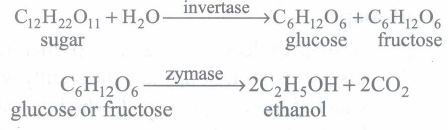
c) The fermented liquid is technically called wash.
(iv) Distillation of wash:
a) This wash containing 15 to 18 % alcohol, is now subjected to fractional distillation.
b) The main fraction drawn in an aqueous solution of ethanol which contains 95.5 % of ethanol and 4.5 % of water.
c) This is called rectified spirit.
d) This mixture is then refluxed over quicklime for about 5 to 6 hour and then allowed to stand for 12 hours.
e) On distillation of mixture, pure alcohol (100%) is obtained.
f) This is called absolute alcohol.
45.
Relative molecular mass:
Relative molecular mass of a gas or vapour is the ratio between the mass of one molecule of gas or vapour to mass of one atom of hydrogen.
Relative molecular mass \(=\frac{\text { Mass of } 1 \text { molecule of a gas (or) vapour at STP }}{\text { Mass of } 1 \text { atom of hydrogen }}\) .......(1)
Vapour density:
It is the ratio of the mass of a certain volume of a gas or vapour, to the mass of an equal volume of hydrogen, measured under the same conditions of temperature and pressure.
Vapour density (V.D) \(=\frac{\text { Mass of a given volume of gas(or) vapour at S.T.P }}{\text { Mass of the same volume of the hydrogen }}\)
According to Avogadro's law [Let the number of molecules in one volume = 'n']
Vapour density (V.D) \(=\frac{\text { Mass of 'n' molecules of a gas (or) vapour at S.T.P }}{\text { Mass of ' } n \text { 'molecules of a hydrogen }}\)
cancelling 'n' vapour density (V.D) \(=\frac{\text { Mass of } 1 \text { molecule of a gas or vapour at S.T.P }}{\text { Mass of } 1 \text { molecule of a hydrogen }}\)
Hydrogen is diatomic molecule, so
Vapour density \(=\frac{\text { Mass of } 1 \text { molecule of a gas or vapour at S.T.P }}{\text { Mass of } 2 \text { atoms of hydrogen }}\)
Vapour density \(=\frac{\text { mass of } 1 \text { molecule of a gas or vapour at S.T.P }}{2 \times \text { mass of 1atom of hydrogen }}\)
2 x Vapour density \(=\frac{\text { mass of } 1 \text { molecule of a gas (or) vapour at S.T.P }}{\text { mass of 1atom of hydrogen }}\)
From eqn (1)
2 x Vapour density = Relative molecular mass

10th Standard Syllabus & Materials
10th Standard
TN 10th English Prose - 2 - The Night the Ghost Got in Important Questions And Answers Study Material - QB365 Set A
NEW10th Standard
TN 10th English Supplementary - 1 - The Tempest Important Questions And Answers Study Material - QB365 Set A
NEW10th Standard
TN 10th English Poem - 1 - Life Important Questions And Answers Study Material - QB365 Set A
NEW10th Standard
TN 10th English Prose - 1 - His First Flight Important Questions And Answers Study Material - QB365 Set A



Tamilnadu Stateboard 10th Standard Subjects
Tamilnadu Stateboard Standards





