
 100% FREE ACCESS
10th Standard Syllabus & Materials
10th Standard
TN 10th English Prose - 4 - The Attic Important Questions And Answers Study Material - QB365 Set A
NEW10th Standard
TN 10th English Supplementary - 3 - The Story of Mulan Important Questions And Answers Study Material - QB365 Set A
NEW10th Standard
TN 10th English Poem - 3 - I am Every Woman Important Questions And Answers Study Material - QB365 Set A
NEW10th Standard
TN 10th English Prose - 3 - Empowered Women Navigating The World Important Questions And Answers Study Material - QB365 Set A
NEW10th Standard
TN 10th English Supplementary - 2 - Zigzag Important Questions And Answers Study Material - QB365 Set A
NEW10th Standard
TN 10th English Poem - 2 - The Grumble Family Important Questions And Answers Study Material - QB365 Set A

Published on: 12/05/2020
10th Standard Science English Medium Book back Important 4 Marks Questions
Download Tamil Nadu 10th Standard Science question papers, model tests, one-mark questions, important questions, and public exam papers in PDF format. Free study materials and answer keys for TN State Board students.
Questions + Answers key
Take MCQ Science Test1.
How would you dispose the following wastes?
a. Domestic wastes like vegetable peels
b. Industrial wastes like metallic cans Can the disposal protect the environment? How?
2.
What are the consequences of deforestation?
3.
What is the importance of rainwater harvesting?
4.
A pure tall plant (TT) is crossed with pure dwarf plant (tt), What would be the F1 and F2 generations? Explain.
5.
What are allosomes?
6.
Why did Mendel select pea plant for his experiments?
7.
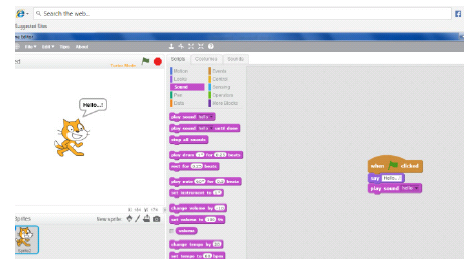
Program for print the word “Hello” with sound
8.
Why are thyroid hormones refered as personality hormone?
9.
What will you do to prevent leaf fall and fruit drop in plants? Support your answer with reason.
10.
What is bolting? How can it be induced artificially?
11.
How are stem cells useful in regenerative process?
12.
Name two maize hybrids rich in amino acid lysine.
13.
Discuss the method of breeding for disease resistance.
14.
Write the events involved in the sexual reproduction of a flowering plant.
a. Discuss the first event and write the types.
b. Mention the advantages and the disadvantages of that event
15.
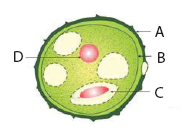
Identify the parts A, B, C and D
16.
How can menstrual hygiene be maintained during menstrual days?
17.
Differentiate between Medullated and non-medullated nerve fibre.
18.
Differentiate between Voluntary and involuntary actions.
19.
Differentiate between systemic circulation and pulmonary circulation.
20.
What would happen to the leaves of a plant that transpires more water than its absorption in the roots?
21.
What is cohesion?
22.
How can you determine the age of the fossils?
23.
Define Ethnobotany and write its importance.
24.
Why is Archaeopteryx considered to be a connecting link?
25.
Name any three foods that are to be avoided and included in the diet of a diabetic patient. Why should it be followed?
26.
How is a cancer cell different from a normal cell?
27.
What are the various routes by which transmission of human immuno deficiency virus takes place?
28.
Why are the rings of cartilages found in trachea of rabbit?
29.
Write the reaction for photosynthesis?
30.
What is photosynthesis and where in a cell does it occur?
31.
Name the three basic tissues system in flowering plants.
32.
Give any two uses of radio isotopes in the field of agriculture?
33.
In Japan, some of the new born children are having congenital diseases. Why?
34.
88Ra226 experiences three \(\alpha\) - decay. Find the number of neutrons in the daughter element.
35.
A man is standing between two vertical walls 680 m apart. He claps his hands and hears two distinct echoes after 0.9 seconds and 1.1 second respectively. What is the speed of sound in the air?
36.
Distinguish between the resistivity and conductivity of a conductor.
37.
State Ohm’s law.
38.
Define electric potential and potential difference.
39.
Mention two cases in which there is no Doppler effect in sound?
40.
Air temperature in the Rajasthan desert can reach 46°C. What is the velocity of sound in air at that temperature? (V0 = 331 m s–1)
41.
Calculate the % of oxygen in Al2(SO4)3. (Atomic mass: Al-27, O-16, S -32).
42.
Calculate the coefficient of cubical expansion of a zinc bar. Whose volume is increased 0.25 m3 from 0.3 m3 due to the change in its temperature of 50 K.
43.
Find the final temperature of a copper rod. Whose area of cross section changes from 10 m2 to 11 m2 due to heating. The copper rod is initially kept at 90 K. (Coefficient of superficial expansion is 0.0021 /K)
44.
A mechanic unscrew a nut by applying a force of 140 N with a spanner of length 40 cm. What should be the length of the spanner if a force of 40 N is applied to unscrew the same nut?
45.
A ball of mass 1 kg moving with a speed of 10 ms-1 rebounds after a perfect elastic collision with the floor. Calculate the change in linear momentum of the ball.
46.
Two bodies have a mass ratio of 3:4 The force applied on the bigger mass produces an acceleration of 12 ms-2. What could be the acceleration of the other body, if the same force acts on it.
47.
In what way hygroscopic substances differ from deliquescent substances.
48.
a) What happens when MgSO4.7H2O is heated? Write the appropriate equation
b) Define solubility
49.
Write notes on
i) saturated solution
ii) unsaturated solution
50.
What is a chemical equilibrium? What are its characteristics?
51.
How does pH play an important role in everyday life?
52.
What are called thermolysis reactions?
53.
Explain smelting process.
54.
The electronic configuration of metal A is 2,8,18,1.
The metal A when exposed to air and moisture forms B a green layered compound. A with con. H2SO4 forms C and D along with water. D is a gaseous compound. Find A,B,C and D.
55.
a) State the reason for addition of caustic alkali to bauxite ore during purification of bauxite.
b) Along with cryolite and alumina, another substance is added to the electrolyte mixture. Name the substance and give one reason for the addition
56.
57.
Give the balanced chemical equation of the following reactions:
(i) Neutralization of NaOH with ethanoic acid.
(ii) Evolution of carbon dioxide by the action of ethanoic acid with NaHCO3.
(iii) Oxidation of ethanol by acidified potassium dichromate.
(iv) Combustion of ethanol.
58.
What is called homologous series? Give any three of its characteristics?
59.
Give the salient features of “Modern atomic theory”.
60.
Calculate the number of moles in
(i) 27g of Al
(ii) 1.51 × 10²³ molecules of NH4Cl
61.
How is the digestive system of rabbit suited for herbivorous mode of feeding?
62.
Leeches do not have an elaborate secretion of digestive juices and enzymes -Why?
1.
a) For domestic wastes- we can have a compost pit. As vegetable waste is dumped in the pit, they rot and become manure.
b) Metallic can - method - Recycle
c) Yes, this disposal method protects the environment because recycling saves energy. It also reduce green house gas emissions which helps to tackle climate change.
2.
Deforestation gives rise to ecological problems like floods, drought, soil erosion, loss of wild life, extinction of species, imbalance of biogeochemical cycles, alternation of climatic conditions and desertification.
3.
(i) Overcome the rapid depletion of ground water levels.
(ii) To meet the increase demand of water.
(iii) Reduce flood and soil erosion.
(iv) Used for drinking purpose.
4.
Parental generation:
i) Pure breeding tall plant and a pure breeding dwarf plant (tt).
F1 generation:
i) Plants raised from the seeds of pure breeding parental cross in F1 generation were tall and monohybrids.
F2 generation:
i) Selfing of the F1 monohybrids resulted in tall and dwarf plants respectively in the ratio of 3:1.
ii) The actual number of tall and dwarf plants obtained by Mendel was 787 tall and 277 dwarf.
iii) External expression of a particular trait is known as phenotype. So the phenotypic ratio is 3:1.
In the F2 generation 3 different types were obtained:
i) Tall Homozygous - TT (Pure) - 1.
ii) Tall Heterozygous - Tt - 2.
iii) Dwarf Homozygous - tt -1.
So the genotypic ratio 1:2:1.
(A genotype is the genetic expression of an organism).
5.
(i) Allosomes are chromosomes which are responsible for determining the sex of an individual.
(ii) They are also called as sex chromosomes or hetero-chromosomes.
6.
(i) Pea plant is naturally self-pollinating and so is very easy to raise pure breeding individuals.
(ii) It has a short life span as it is an annual and so it was possible to follow several generations.
(iii) It is easy to cross-pollinate.
(iv) It has deeply defined contrasting characters.
(v) The flowers are bisexual.
7.

1. Click events in script option
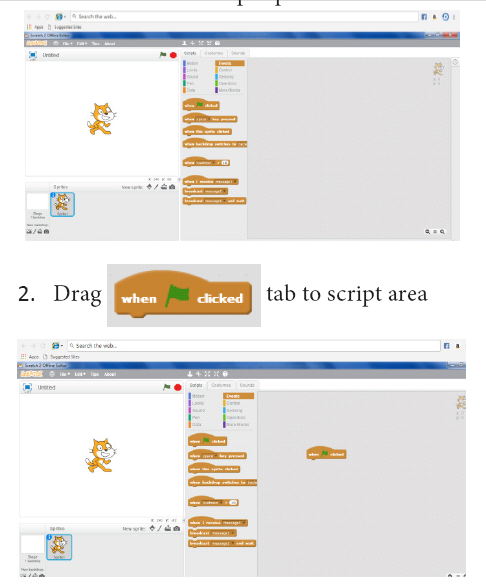
3. Click Looks in script option. Drag “say” to script area.
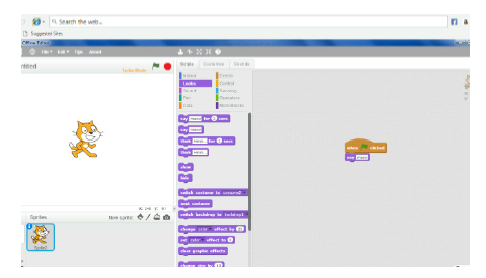
4. Type “Hello “ word in say tab.
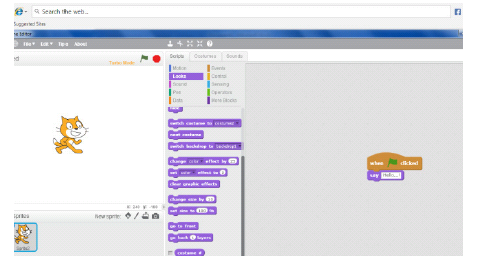
5.Click sounds in script option. Drag play sound to script area. Choose the hello sound from the audio file.

6. From File menu choose the Save option.
7. Click the green flag at the top right corner of the stage window to run the program

8.
i) Thyroid hormone is essential for normal physical, mental and personality development.
ii) Hence it is called as the personality hormone.
9.
Application of auxin on plants will prevent leaf fall and fruit drop in plants because Auxins prevent the formation of abscission layer.
10.
(i) Bolting is production of a flowering stem in plants.
(ii) Treatment of rosette plants with gibberellin induces sudden shoot elongation followed by flowering. This is called bolting.
11.
(i) Sometimes cells, tissues and organs in the body may be permanently damaged or lost due to genetic to disease or injury.
(ii) In such situations stem cells are used for the treatment of diseases which is called stem-cell therapy.
12.
Protina, shakti and Rathna are lysine rich maize hybrids.
13.
| Crop | Variety | Resistance to diseases |
| Wheat | Himgiri | Leaf and stipe rust, hill bunt |
| Cauliflower | Pusa Shubhra, Pusa Snowball K-1 | Black rot |
| Cowpea | Pusa Komal | Bacterial blight |
14.
(a) Pollination:
The transfer of pollen grains from anther to stigma of a flower is called as pollination.
Types of pollination :
(i) Self-pollination
(ii) Cross pollination
Self-pollination (Autogamy)
(i) Self pollination is also known as autogamy.
(ii) The transfer of pollen grain from the anther to the stigma of same flower or another flower borne on the same plant is known as self pollination. e.g.Hibiscus.
(b) Advantages of self-pollination:
(i) Self-pollination is possible in certain bisexual flowers.
(ii) Flowers do not depend on agents for pollination.
(iii) There are no wastages of pollen grains.
Disadvantages of self-pollination:
(i) The seeds are less in number.
(ii) The endosperm is minute. Therefore, the seeds produce weak plants.
(iii) New varieties of plants cannot be produced.
15.
A - Exine
B - Intine
C - Generative cell
D - Vegetative nucleus
16.
Maintaining menstrual hygiene is important for the overall health of women.
The basic menstrual hygiene ways are:
(i) Sanitary pads should be changed regularly, to avoid infections due to microbes from vagina and sweat from genitals.
(ii) Use of warm water to clean genitals helps to get rid of menstrual cramps.
(iii) Wearing loose clothing rather than tight fitting clothes will ensure the airflow around the genitals and prevent sweating.
17.
| S.No | Medullated nerve fibre | Non-medullated nerve fibre |
|---|---|---|
| i) | Medullated Nerve fibre is also known as myelinated or white neuron. Because axon is covered with myelin sheath. | Non-Medullated Nerve fibre is also known as non-myelinated or grey neuron Because axon is not covered myelin sheath. |
| ii) | Myelin sheath is produced by a layer of Schwann cells or neurilemma. | Schwann cells are absent. |
| iii) | Node of Ranvier is present. | Node of Ranvier is absent. |
| iv) | They conduct impulse at a faster speed. | Conduct impulses slower than medullated fibres. |
| v) | These are present in the white matter of brain, spinal cord and in cranial and spinal nerves. |
These are present in autonomic nerves and axons within the CNS as Grey matter. |
18.
| S.No | Voluntary actions | Involuntary actions |
|---|---|---|
| i) | An action which is under conscious control. |
An action which is not under conscious control. |
| ii) | Voluntary action is controlled by the brain. | Involuntary action is controlled by the spinal cord. |
| iii) | All voluntary actions result in a muscular action. | Involuntary actions result in a muscular action (or) secretion from some gland. |
19.
| Systemic circulation | Pulmonary circulation |
| Systemic circulation moves blood between the heart and the rest of the body. | Pulmonary circulation moves blood between the heart and the lungs. |
| It sends oxygenated blood out to cells and returns deoxygenated blood to the heart. | It transports deoxygenated blood to the lungs to absorb oxygen and release carbon dioxide. The oxygenated blood then flows back to the heart. |
20.
(i) Transpiration often results in water deficit which causes injury to the plants by desiccation.
(ii) Excessive rate of transpiration leads to stunted growth of plants.
21.
The force of attraction between molecules of water is called cohesion.
22.
(i) The age of fossils is determined by radioactive elements present in it.
(ii) They may be carbon, uranium, lead or potassium.
(iii) It is used in paleobotany and anthropology for determining the age of human fossils and manuscripts.
23.
(i) Ethnobotany is the study of a region's plants and their practical uses through the traditional knowledge of the local culture of people.
Importance of Ethnobotany :
(i) It provides traditional uses of plant.
(ii) It gives information about certain unknown and known useful plants.
(iii) The ethnomedicinal data will serve as a useful source of information for the chemists, pharmacologists and practitioners of herbal medicine.
(iv) Tribal communities utilize ethnomedicinal plant and prepare medicine to cure many diseases.
24.
(i) Archaeopteryx is considered to be a connecting link between reptiles and birds.
(ii) It had wings with feathers like a bird. It has long tail, clawed digits and conical teeth like a reptile.
25.
(i) For diabetic patients, the food to be avoided are:
a. Refined sugars (sucrose and glucose).
b. Saturated fat intake should be reduced.
These food release sugars rapidly in the blood stream.
(ii) The food to be included in diabetic patients are:
a. Flax seeds containing insoluble fiber, Guavas, Tomatoes and Spinach.
b. Diet comprising whole grains, millets (jowar, bajra, ragi), green leafy vegetables, wheat and unpolished rice should be included in diet regularly. These foods help reduce blood sugar levels.
26.
(i) Cancer is an abnormal and uncontrolled division of cells that invade and destroy surrounding tissues forming a tumor neoplasm (new growth).
(ii) It is a heterogenous group of cells that do not respond to the normal cell division.
(iii) The cancerous cells migrate to distant parts of the body and affect new tissues.
27.
HIV is transmitted generally by
(i) Sexual contact with infected person.
(ii) Use of contaminated needles or syringes especially in case of intravenous drug abusers.
(iii) By transfusion of contaminated/infected blood or blood products.
(iv) From infected mother to her child through the placenta.
28.
Rings of cartilages are found in the tracheal walls of rabbit to help in the free passage of air.
29.

Carbon dioxide + Water ➝ Glucose + Water + Oxygen
30.
(i) Photosynthesis is a process by which autotrophic organisms like green plants, algal and chlorophyll containing bacteria utilize the energy from sunlight using CO2 and H2O to synthesize their own food.
(ii) It occurs in the chloroplasts of the cell.
\(6 \mathrm{CO}_2+12 \mathrm{H}_2 \mathrm{O} \underset{\text { Chlorophyll }}{\stackrel{\text { Light }}{\longrightarrow}} \mathrm{C}_6 \mathrm{H}_{12} \mathrm{O}_6+6 \mathrm{H}_2 \mathrm{O}+6 \mathrm{O}_2 \uparrow\)
31.
The three basic tissue systems is flowering plants are
(i) Dermal or Epidermal tissue system
(ii) Ground tissue system
(iii) Vascular tissue system
32.
(i) To increase the productivity of crops
(ii) Remains fresh beyond their normal life time
33.
(i) The nuclear bomb dropped during World War II emitted gamma radiation.
(ii) Gamma rays caused injury to genes in the reproductive cells.
(iii) This gives rise to mutations which pass on from generation to generation.
34.
When an alpha particle emitted atomic number decreases by two, mass number decreases by four. Now three alpha particles are emitted, atomic number decreases by six, the mass number decreases by twelve,
\({ }_{88} \mathrm{Ra}^{226} \longrightarrow{ }_{82} \mathrm{X}^{214}+3{ }_{2} \mathrm{He}^{4}\)
A = 214, Z = 82
Number of neutrons in the daughter element N = A - Z
N = 214 - 82
N = 132
35.
d = 680 m
t = 1.1 + 0.9 = 2, c = ?
\(d=\frac { ct }{2} \)
c = \(\frac { 2 \times d }{ t } \)
\(c=\frac { 2\times 680 }{ 2 } \)
c = 340 ms-1 which is the speed of sound in air
36.
| S.No |
Resistivity |
Conductivity |
|---|---|---|
| (i) |
It is the resistance of a conductor of unit length and unit area of cross section. |
The reciprocal of electrical resistivity of a material is called electrical conductivity. |
| (ii) | Its unit is ohm meter | Its unit is ohm-1 meter-1 |
| (iii) | Resistivity is less for conductor than for insulators | Conductivity is more for conductors than for insulators. |
| (iv) | ρ = RA / L | σ = 1 / ρ |
37.
According to Ohm's law, at a constant temperature, the steady current 'I' flowing through a conductor is directly proportional to the potential difference 'V' between the two ends of the conductor.
\(I\alpha V \Rightarrow\) V = IR
38.
Electric potential : The electric potential at a point is defined as the amount of work done in moving a unit positive charge from infinity to that point against the electric force.
Electric potential difference : The electric potential difference between two points is defined as the amount of work done in moving a unit positive charge from one point to another point against the electric force.
39.
In the cases given below there will be no Doppler effect.
(i) When source (S) and listener (L) both are at rest.
(ii) When source (S) and listener (L) are moving in mutually perpendicular directions.
(iii) When source (S) and listener (L) move in such a way that distance between them remains constant.
(iv) If the source (S) is situated at the center of the circle along which the listener (L) is moving.
40.
Given
\(\mathrm{t}=46^{\circ} \mathrm{C} \)
\(\mathrm{V}_{0}=331 \mathrm{~ms}^{-1} \)
\(\mathrm{V}_{\mathrm{T}}= ? \)
\(\mathbf{V}_{\mathbf{T}}=\left[\mathrm{V}_{0}+\mathbf{0 . 6 1} \mathrm{T}\right] \)
\(=331+[0.61 \times 46]\)
= 331 + [28.06]
= 359.06 ms-1
The velocity of sound in air at 46oC is 359.06 ms-1
41.
\(\text { Molar mass of } \mathrm{Al}_{2}\left(\mathrm{SO}_{4}\right)_{3}=\mathrm{Al} \times 2+3[\mathrm{~S} \times 1+\mathrm{O} \times 4]\)
\(27 \times 2+3[32 \times 1+16 \times 4]\)
= 54 + 3[32 + 64]
= 54 + 3 [96]
Molar Mass = 54 + 288 = 342
\(\text { Mass } \% \text { of an element }=\frac{\text { mass of that element in the compound }}{\text { molar mass of the compound }} \times100\)
\(\text { Mass } \% \text { oxygen in } \mathrm{Al}_{2}\left(\mathrm{SO}_{4}\right)_{3}=\frac{192}{342} \times 100 \)
\(=0.5614 \times 100=56.14 \% \)
\(\text { Mass } \% \text { of oxygen in } \mathrm{Al}_{2}\left(\mathrm{SO}_{4}\right)_{3} \text { is } 56.14 \%\)
42.
Change in volume \((\Delta V)=0.3-0.25 =0.05\mathrm{~m}^{3}\)
Original volume \(\left(V_{0}\right)=0.3 \mathrm{~m}^{3}\)
Change in Temperature \(\Delta \mathrm{T}=50 \mathrm{~K}\)
\(a_{\mathrm{V}} =? \)
\(\frac{\Delta V}{V_{0}} =a_{\mathrm{V}} \Delta \mathrm{T}\)
\(a_{\mathrm{V}} =\frac{0.05}{0.3 \times 50}=\frac{0.05}{15}=0.0033 \mathrm{~K}^{-1}\)
Co-efficient of cubical expansion of Zinc bar 0.0033
43.
Area of copper rod, Ao = 10 m2
Changes of Area of cross section,
Initial temperature \(\Delta \mathrm{A} =11 -10 =1 \mathrm{~m}^{2} \)
\(\mathrm{~T}_{1} =90 \mathrm{~K} \)
\(a_{\mathrm{A}} =0.0021 / \mathrm{K} \)
\(\mathrm{T}_{2} =? \)
\(\frac{\Delta A}{A_{0}} =a_{\mathrm{A}} \Delta \mathrm{T} \)
\(\frac{1 }{10 } =0.0021\left[\mathrm{~T}_{2}-90\right] \)
\(0.1 =0.0021\left[\mathrm{~T}_{2}-90\right]=\frac{0.1}{0.0021}+90=\mathrm{T}_{2} \)
\(\mathrm{~T}_{2} =137.61 \mathrm{~K}\)
So the final temperature of a copper rod is 137.61 K
44.
\(\text { Given } \quad \mathrm{F}_{1} =140 \mathrm{~N} \)
\(\mathrm{~d}_{1} =40 \mathrm{~cm}=40 \times 10^{-2} \mathrm{~m} \)
\(\mathrm{~F}_{2} =40 \mathrm{~N} \)
\(\mathrm{~d}_{2} =?\)
The moment of force on the nut,
\(=F_{1} \times d_{1}=140 \times 40 \times 10^{-2} \)
\(=56 \ \mathrm{Nm}\)
The same moment of force is required to unscrew the nut,
\(\mathrm{F}_{2} \times \mathrm{~d}_{2} =40 \times d_2\)
In both cases, moment of forces applied are equal,
F1 x d1 = F2 x d2
56 = F2d2
\(56=40 \times \mathrm{d}_{2} \)
\(\mathrm{~d}_{2}=\frac{56}{40}=1.4 \mathrm{~m} \)
\(\mathrm{~d}_{2}=1.4 \mathrm{~m}\)
The spanner with the longer handle requires very less force to unscrew the same nut.
45.
Given \(\mathrm{m}=1 \mathrm{~kg}, \quad \mathrm{v}=10 \mathrm{~m} \mathrm{~s}^{-1}\)
When a ball bounces back with the same speed, the momentum changes from mv to -mv. So, the change in momentum is -2 mv.
Δp = mv - mu
= -mv - mv
\(=-2 \mathrm{mv}=-2 \times 1 \times 10 \) \([Here \ mu = mv \\ mv = -mv]\)
\(\therefore \Delta P=-20 \mathrm{~kg} \mathrm{~m} \mathrm{~s}^{-1}\)
46.
\(\text {Given } m_{1} : m_{2}=3: 4 \)
\(a_{2} =12 \mathrm{~m} \mathrm{~s}^{-2} \)
\(a_{1} =?\)
Using Newton's second law,
\(\mathrm{F} =\mathrm{m \times a} \)
\(\mathrm{F} =\mathrm{m}_{1} \times a_{1}=3 a_{1} \)
\(\mathrm{~F} =\mathrm{m}_{2} \times a_{2}=4 \times 12=48 \mathrm{~N} \)
\(3 a_{1} =48 \)
\(a_{1} =48 / 3=16 \mathrm{~m} \mathrm{~s}^{-2} \)
\(a_{1} =16 \mathrm{~ms}^{-2}\)
The acceleration produced on the other body is \(16 \mathrm{~m} \mathrm{~s}^{-2}\).
47.
|
Deliquescence substances |
Hygroscopic substances |
|---|---|
| When exposed to the atmosphere at ordinary temperature, they absorb moisture and do not dissolve. |
When exposed to the atmospheric air at ordinary temperature, they absorb moisture and dissolve. |
| Hygroscopic substances do not change its physical state on exposure to air. | Deliquescent substances change its physical state on exposure to air. |
| Hygroscopic substances may be amorphous solids or liquids. |
Deliquescent substances are crystalline solids. |
| Hygroscopic substances are used as drying agents. | Deliquescent Substances are not used as drying agent. |
| Example : H2SO4.P2O5 | Example : NaOH, KOH |
48.
a) MgSO4.7H2O is heating process:
(i) Magnesium Sulphate heptahydrate or Epsom salt MgSO4.7H2O water of crystallization is 7.
(ii) When magnesium sulphate heptahydrate crystals are gently heated, it loses seven water molecules, and becomes anhydrous magnesium sulphate.
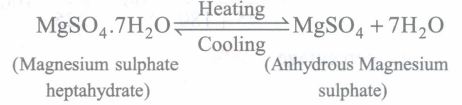
(iii) If you add few drops of water or allow it to cool, the colourless anhydrous salt again turns back into hydrated salt.
b) Solubility:
b) Solubility is defined as the number of grams of a solute that can be dissolved in 100g of a solvent to form its saturated solution at a given temperature and pressure.
Solubility = \(\frac{Mass \ of \ the \ solute}{Mass \ of \ the \ solvent}\) x 100
49.
(i) Saturated solution:
a) A solution in which no more solute can be dissolved in a definite amount of the solvent at a given temperature is called saturated solution.
b) E.g. 36 g of sodium chloride in 100 g of water at 25° C forms saturated solution.
c) Further addition of sodium chloride, leaves it undissolved.
(ii) Unsaturated solution:
a) Unsaturated solution is one that contains less solute than that of the saturated solution at a given temperature.
b) E.g. 10 g or 20 g or 30 g of Sodium chloride in 100 g of water at 25°C forms an unsaturated solution.
50.
(i) Chemical Equilibrium: It is state of a reversible chemical reaction in which no change in the amount of reactants and products takes place.
(ii) At equilibrium, Rate of forward reaction = Rate of backward reaction
Characteristics of equilibrium:
(i) In chemical equilibrium, the rates of forward and backward reactions are equal.
(ii) The observable properties such as pressure, concentration, color, density, viscosity etc., of the system remain unchanged with time.
(iii) The chemical equilibrium is a dynamic equilibrium, because both the forward and backward reactions continue to occur even though it appears static externally.
(iv) In physical equilibrium, the volume of all the phases remain constant.
51.
(i) Our body works within the pH range of 7.0 to 7.8.
(ii) Different body fluids have different pH values.
(iii) Any increase or decrease in this value leads to diseases.
(iv) The ideal pH for blood is 7.4.
pH in our digestive system:
(i) HCl present in our stomach helps in digestion.
(ii) During indigestion our stomach produces more acid and this causes pain and irritation.
(iii) pH of the stomach fluid is approximately 2.0.
pH changes as the cause of tooth decay:
(i) pH of the saliva normally ranges between 6.5 to 7.5.
(ii) White enamel coating (calcium phosphate) is a hard substance in our body.
(iii) When the pH value falls below 5.5, it weathers.
(iv) The basic toothpaste neutralises the excess acid and prevents tooth decay.
pH of soil:
(i) Citrus fruits require slightly alkaline soil, rice requires acidic soil and sugarcane requires neutral soil.
pH of rain water:
(i) The pH of rain water is approximately 7.
(ii) If the atmospheric air is polluted with oxides of non-metals, they get dissolved in the rain water and make its pH less than 7.
(iii) As its pH value is less than 7, then it is called acid rain.
(iv) When this rain water reaches river water, the survival of aquatic life becomes difficult.
52.
(i) In a decomposition reaction, a single compound splits into two or more simpler substances by the help of heat. It is called 'Thermolysis'.
(ii) In this type of reaction, the reactant is decomposed by applying heat.
(iii) For example, It is a class of compound to element/element decomposition. i.e. a compound (HgO) is decomposed into two elements (Hg and Oxygen).

(iv) When calcium carbonate is heated, it breaks down in to calcium oxide and carbon dioxide.
(v) It is a type of compound to compound/compound decomposition.
(vi) In thermal decomposition reaction, heat is supplied to break the bonds.
(vii) Such reactions, in which heat is absorbed, are called 'Endothermic reactions'.
\(\mathrm{CaCO}_{3(\mathrm{~s})} \stackrel{\text { heat }}{\longrightarrow} \mathrm{CaO}_{(\mathrm{s})}+\mathrm{CO}_{2}(\mathrm{~g})\)
53.
Smelting (in a Blast Furnace):
(i) The charge consisting of roasted ore, coke and limestone in the ratio 8:4:1 is smelted in a blast furnace by introducing it through the hopper arrangement at the top.
(ii) There are three important regions in the furnace.
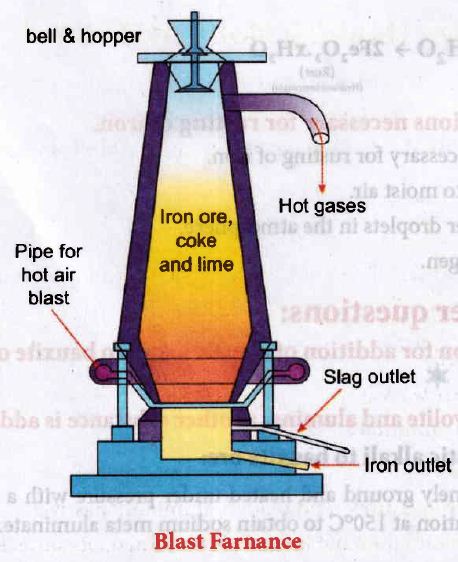
a) The Lower Region (Combustion Zone):
(i) The temperature is at \(1500^{\circ} \mathrm{C}\).
(ii) In this region, coke burns with oxygen to form CO2 when the charge comes in contact with a hot blast of air.
(iii) It is an exothermic reaction since heat is liberated.
\(\mathbf{C}+\mathbf{O}_{2} \underset{\Delta}{\stackrel{1500^{\circ} \mathrm{C}}{\longrightarrow}} \mathrm{CO}_{2}+ Heat\)
b) The Middle Region (Fusion Zone):
(i) The temperature prevails at \(1000^{\circ} \mathrm{C}\).
(ii) In this region, CO2 is reduced to CO.
\(\mathrm{CO}_{2}+\mathrm{C} \underset{\Delta}{\stackrel{1000^{\circ} \mathrm{C}}{\longrightarrow}} 2 \mathrm{CO}-\text { Heat }\)
(iii) Limestone decomposes to calcium oxide and CO2.
\(\mathrm{CaCO}_{3} \underset{\Delta}{\stackrel{1000^{\circ} \mathrm{C}}{\longrightarrow}} \mathrm{CaO}+CO_2-\text { Heat }\)
(iv) These two reactions are endothermic due to absorption of heat.
(v) Calcium oxide combines with silica to form calcium silicate slag.
\(\mathrm{CaO}+\mathrm{SiO}_{2} \longrightarrow \mathrm{CaSiO}_{3}\)
c) The Upper Region (Reduction Zone):
(i) The temperature prevails at \(\mathbf{4 0 0 ^ { \circ } \mathrm { C } \text { . }}\)
(ii) In this region carbon monoxide reduces ferric oxide to form a fairly pure spongy iron.
\(\mathrm{Fe}_{2} \mathrm{O}_{3}+3 \mathrm{CO} \stackrel{400^{\circ} \mathrm{C}}{\longrightarrow} 2 \mathrm{Fe}+3 \mathrm{CO}_{2}\uparrow\)
(iii) The molten iron is collected at the bottom of the furnace after removing the slag.
(iv) The iron thus formed is called pig iron.
(v) It is remelted and cast into different molds.
(vi) This iron is called cast iron.
54.
(i) Copper gets covered with a green layer of basic copper carbonate in the presence of CO2 and moisture.
(ii) \(2 \mathrm{Cu}+\mathrm{O}_{2}+\mathrm{CO}_{2}+\mathrm{H}_{2} \mathrm{O} \rightarrow \mathrm{CuCO}_{3} \cdot \mathrm{Cu}(\mathrm{OH})_{2}\)
(iii) Copper reacts with con. \(\mathrm{H}_{2} \mathrm{SO}_{4}\) to from copper sulphate and SO2.
(iv) \(\mathrm{Cu}+2 \mathrm{H}_{2} \mathrm{SO}_{4} \rightarrow \mathrm{CuSO}_{4}+\mathrm{SO}_{2} \uparrow+2 \mathrm{H}_{2} \mathrm{O}\)
(v) So, A is-Copper (Cu)
\(\mathrm{B}\ is \ -\mathrm{CuCO}_{3} \cdot \mathrm{Cu}(\mathrm{OH})_{2}\) Basic copper carbonate.
\(\mathrm{C}\ is \ -\mathrm{CuSO}_{4}\) (copper sulphate)
\(\mathrm{D}\ is \ -\mathrm{SO}_{2}\) (Sulphur oxide)
55.
a) Addition of caustic alkali to bauxite ore:
(i) Bauxite ore is finely ground and heated under pressure with a solution of concentrated caustic soda solution at 150oC to obtain sodium meta aluminate.
(ii) Al2O3 + 2 NaOH → 2 NaAlO2 + H2O
(iii) On diluting sodium meta aluminate with water, a precipitate of aluminium hydroxide is formed.
(iv) NaAlO2 + 2 H2O → Al(OH)3 + NaOH
(v) The precipitate is filtered, washed, dried and ignited at 1000oC to get alumina.
(iv) \(2 \mathrm{Al}(\mathrm{OH})_{3} \stackrel{1000^{\circ} \mathrm{C}}{\longrightarrow} \mathrm{Al}_{2} \mathrm{O}_{3}+3 \mathrm{H}_{2} \mathrm{O}\)
b) (i) Electrolyte : Pure alumina + molten cryolite +fluorspar
(ii) Fluorspar is added to lowers the fusion temperature of electrolyte.
56.
57.
(i) Ethanoic acid reacts with sodium hydroxide to form sodium ethanoate and water
CH3COOH + NaOH ⟶ CH3COONa + H2O
Ethanoic acid Sodium hydroxide
(ii) Ethanoic acid reacts with sodium bicarbonate and liberates CO2, with brisk effervescence.
CH3COOH + NaHCO3 ⟶ CH3COONa + CO2 ↑ + H2O
Ethanoic acid Sodium hydroxide
(iii) Ethanol is oxidized to ethanoic acid with alkaline KMnO4 or acidified K2Cr2O7

(iv) Ethanol is highly inflammable liquid. It burns with oxygen to form carbon dioxide and water.
.JPG)
58.
Homologous series is a group or a class of organic compounds having same general formula and similar chemical properties in which the successive numbers differ by a -CH2 group.
E.g: Methane - CH4
Ethane - CH3CH3
Propane - CH3CH2CH3
Characteristics:
(i) Each member of the series differs from the preceding or succeeding member by one methylene group (-CH2) and hence by a molecular mass of 14 amu.
(ii) All members of a homologous series contain the same elements and functional group.
(iii) They are represented by a general molecular formula. e.g. Alkanes, CnH2n + 2
(iv) All the members can be prepared by a common method.
59.
(i) An atom is no longer indivisible.
(ii) Atoms of the same element may have different atomic masses (isotopes 17Cl35, 17Cl37)
(iii) Atoms of different elements may have the same atomic masses (isobars 18Ar40, 17Ca40)
(iv) Atoms of one element can be transmuted into atoms of other elements. So atom is no longer indestructible. It is called artificial transmutation.
(v) Atoms may not always combine in a simple whole number ratio [Eg: Glucose C6H12O6, sucrose C12H22O11)
(vi) Atom is the smallest particle that takes part in a chemical reaction.
(vii) The mass of an atom can be converted into energy (E = mc2).
60.
(i) 27 g of AI
Number of moles = \(\frac{Given\ Mass}{Atomic \ Mass}=\frac{27}{27}=1\)
Number of moles of 27 g of Al is 1 mole
(ii) 1.51 x 10²³ molecules of NH4Cl
Number of moles = \(\frac{Number \ of \ molecules}{6.023 \times 10^\text{23}}\)
= \(\frac{1.51 \times10^{23}}{6.023 \times10^{23}}\)
\(\frac{1.51}{6.023}\)
Number of moles of 1.51 x 10²³ molecules of NH4Cl = 0.25 mole
61.
(i) Herbivores have a more specialised digestive system than that of a carnivore because it is more difficult to digest vegetarian than meat.
(ii) Plant material is difficult to digest, particularly plant cellulose.
(iii) The herbivorous animals have a longer intestine than the carnivorous animals giving more time for digestion.
(iv) The teeth is also designed to grind the grass and plant material rather than the sharp teeth of carnivores designed to tear flesh.
62.
(i) Slime glands are present in the body wall. Their secretion keeps the body moist and slippery so that the host can't remove it easily while it sucks blood.
(ii) The availability of the host to the leeches is not regular. Hence, a large amount of blood is stored in the crop whenever it gets food. Digestion is also very slow.
(iii) It may take more than a year for the complete digestion after a full meal.
(iv) In leech the ingested blood is stored in crop chambers. It may take more than a year for the complete digestion and absorption of a full meal. So there is no need for an elaborate secretion of digestion juices and enzymes.

10th Standard Syllabus & Materials
10th Standard
TN 10th English Prose - 2 - The Night the Ghost Got in Important Questions And Answers Study Material - QB365 Set A
NEW10th Standard
TN 10th English Supplementary - 1 - The Tempest Important Questions And Answers Study Material - QB365 Set A
NEW10th Standard
TN 10th English Poem - 1 - Life Important Questions And Answers Study Material - QB365 Set A
NEW10th Standard
TN 10th English Prose - 1 - His First Flight Important Questions And Answers Study Material - QB365 Set A



Tamilnadu Stateboard 10th Standard Subjects
Tamilnadu Stateboard Standards





