
 100% FREE ACCESS
10th Standard Syllabus & Materials
10th Standard
TN 10th English Prose - 4 - The Attic Important Questions And Answers Study Material - QB365 Set A
NEW10th Standard
TN 10th English Supplementary - 3 - The Story of Mulan Important Questions And Answers Study Material - QB365 Set A
NEW10th Standard
TN 10th English Poem - 3 - I am Every Woman Important Questions And Answers Study Material - QB365 Set A
NEW10th Standard
TN 10th English Prose - 3 - Empowered Women Navigating The World Important Questions And Answers Study Material - QB365 Set A
NEW10th Standard
TN 10th English Supplementary - 2 - Zigzag Important Questions And Answers Study Material - QB365 Set A
NEW10th Standard
TN 10th English Poem - 2 - The Grumble Family Important Questions And Answers Study Material - QB365 Set A

Published on: 12/05/2020
10th Standard Science English Medium Book back Important 7 Marks Questions
Download Tamil Nadu 10th Standard Science question papers, model tests, one-mark questions, important questions, and public exam papers in PDF format. Free study materials and answer keys for TN State Board students.
Questions + Answers key
Take MCQ Science Test1.
A door is pushed, at a point whose distance from the hinges is 90 cm, with a force of 40 N. Calculate the moment of the force about the hinges.
2.
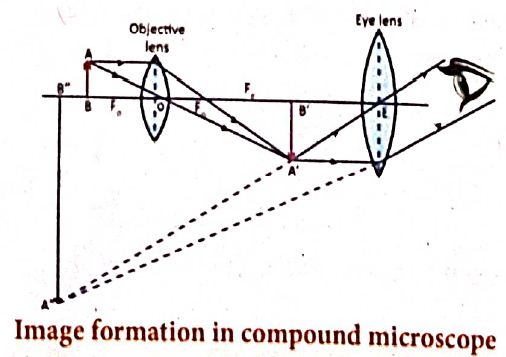
Explain the construction and working of a 'Compound Microscope'.
3.
The sex of the new born child is a matter of chance and neither of the parents may be considered responsible for it. What would be the possible fusion of gametes to determine the sex of the child?
4.
Explain with an example the inheritance of dihybrid cross. How is it different from monohybrid cross?
5.
What are the consequences of soil erosion?
6.
What are the sources of solid wastes? How are solid wastes managed?
7.
Write the physiological effects of gibberellins.
8.
Discuss the importance of biotechnology in the field of medicine.
9.
What are the phases of menstrual cycle? Indicate the changes in the ovary and uterus.
10.
Classify neurons based on its structure.
11.
Illustrate the structure and functions of brain.
12.
Why are leucocytes classified as granulocytes and agranulocytes? Name each cell and mention its functions.
13.
Changes in lifestyle is a risk factor for occurrence of cardiovascular diseases. Can it be modified? If yes, suggest measures for prevention.
14.
What is a nuclear reactor? Explain its essential parts with their functions.
15.
Calculation of mass from mole
Calculate the mass of the following
i) 0.3 mole of aluminium (Atomic mass of Al = 27)
ii) 2.24 litre of SO2 gas at S.T.P
iii) 1.51 × 10²³ molecules of water
iv) 5 × 10²³ molecules of glucose?
16.
What is an echo?
a) State two conditions necessary for hearing an echo.
b) What are the medical applications of echo?
c) How can you calculate the speed of sound using echo?
17.
Explain about domestic electric circuits. (circuit diagram not required)
18.
a) State Joule’s law of heating.
b) An alloy of nickel and chromium is used as the heating element. Why?
c) How does a fuse wire protect electrical appliances?
19.
Describe rocket propulsion.
20.
21.
Calculate the pH of a solution in which the concentration of the hydrogen ions is 1.0 × 10⁻⁸ mol litre–1
22.
Calculate the pH of 1 × 10⁻⁴ molar solution of NaOH.
23.
Identify A, B, C, and D from the following nuclear reactions.
(i) 13AI27 + A \(\longrightarrow \) 15P30 + B
(ii) 12Mg24 + B \(\longrightarrow \) 11Na24 + C
(iii) 92U238 + B \(\longrightarrow \) 93Np239 + D
24.
What is the mass of sodium chloride that would be needed to form a saturated solution in 50 g of water at 30°C. Solubility of sodium chloride is 36 g at 30°C?
25.
1.5 g of solute is dissolved in 15 g of water to form a saturated solution at 298K. Find out the solubility of the solute at the temperature.
26.
In the circuit diagram given below, three resistors R1, R2 and R3 of 5 Ω, 10 Ω and 20 Ω respectively are connected as shown. Calculate:
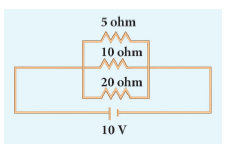
A) Current through each resistor
B) Total current in the circuit
C) Total resistance in the circuit
27.
For a person with hypermetropia, the near point has moved to 1.5m. Calculate the focal length of the correction lens in order to make his eyes normal.
28.
A source producing a sound of frequency 90 Hz is approaching a stationary listener with a speed equal to (1/10) of the speed of sound. What will be the frequency heard by the listener?
29.
An object is placed at a distance 20cm from a convex lens of focal length 10cm. Find the image distance and nature of the image.
30.
Keeping the temperature as constant, a gas is compressed four times of its initial pressure. The volume of gas in the container changing from 20cc (V1 cc) to V2 cc. Find the final volume V2.
31.
Derive the ideal gas equation.
32.
Susan’s father feels very tired and frequently urinates. After clinical diagnosis he was advised to take an injection daily to maintain his blood glucose level. What would be the possible cause for this? Suggest preventive measures.
33.
Polyploids are characterised by gigantism. Justify your answer.
34.
Transpiration is a necessary evil in plants. Explain.
35.
Vinu dissolves 50 g of sugar in 250 ml of hot water, Sarath dissolves 50 g of same sugar in 250 ml of cold water. Who will get faster dissolution of sugar? and Why?
36.
Octopus, cockroach and frog all have eyes. Can we group these animals together to establish a common evolutionary origin. Justify your answer.
37.
Imprints of fossils tell us about evolution-How?
38.
Shylesh has some pet animals at his home. He has few rabbits too, one day while feeding them he observed something different with the teeth. He asked his grandfather, why is it so? What would have been the explanation of his grandfather?
39.
A solid compound ‘A’ decomposes on heating into ‘B’ and a gas ‘C’. On passing the gas ‘C’ through water, it becomes acidic. Identify A, B and C.
40.
a) Identify the bond between H and F in HF molecule.
b) What property forms the basis of identification?
c) How does the property vary in periods and in groups?
41.
Where do the light dependent reaction and the Calvin cycle occur in the chloroplast.
42.
Mass number of a radioactive element is 232 and its atomic number is 90. When this element undergoes certain nuclear reactions, it transforms into an isotope of lead with a mass number 208 and an atomic number 82. Determine the number of alpha and beta decay that can occur.
43.
The molecular formula of an alcohol is C4H10O. The locant number of its –OH group is 2.
(i) Draw its structural formula.
(ii) Give its IUPAC name.
(iii) Is it saturated or unsaturated?
44.
Suppose that a sound wave and a light wave have the same frequency, then which one has a longer wavelength?
a) Sound
b) Light
c) both a and b
d) data not sufficient.
45.
1. Calcium carbonate is decomposed on heating in the following reaction
CaCO3 → CaO + CO2
i. How many moles of Calcium carbonate are involved in this reaction?
ii. Calculate the gram molecular mass of calcium carbonate involved in this reaction.
iii. How many moles of CO2 are there in this equation?
1.
Formula: The moment of a force M = F × d
Given: F = 40 N and d = 90 cm = 0.9 m.
Hence, moment of the force = 40 × 0.9 = 36 N m.
2.
Compound microscope:
A Compound microscope is used to see the tiny objects has better magnification power than simple microscope.
Construction:
(i) A compound microscope consists of two convex lenses.
(ii) The lens with the shorter focal length is placed near the object, and is called as 'objective lens' or 'objective piece'.
(iii) The lens with larger focal length and larger aperture placed near the observer's eye is called as 'eye lens' or 'eye piece'.
(iv) Both the lenses are fixed in a narrow tube with adjustable provision.
Working:
(i) The object (AB) is placed at a distance slightly greater than the focal length of objective lens \(\left(u>f_{0}\right)\).
(ii) A real, inverted and magnified image \(\left(\mathrm{A}^{\prime} \mathrm{B}^{\prime}\right)\) is formed at the other side of the objective lens.
(iii) This image behaves as the object for the eye lens.
(iv) The position of the eye lens is adjusted in such a way, that the image (A' B') falls within the principal focus of the eye piece.
(v) This eye piece forms a virtual, enlarged and erect image (A" B") on the same side of the object.
(vi) Compound microscope has 50 to 200 times more magnification power than simple microscope.
3.
(i) Human beings have 23 pairs of chromosomes out of which 22 pairs are autosomes and one pair (23rd pair) is the sex chromosome.
(ii) The female gametes or the eggs formed are similar in their chromosome type (22+XX).
(ii) Therefore, human females are homogametic.
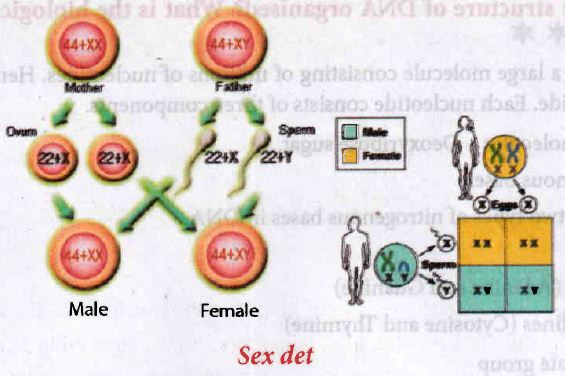
(iv) The male gametes or sperms produced are of two types.
(v) They are produced in equal proportions.
(vi) The sperm bearing (22+X) chromosomes and the sperm bearing (22+Y) chromosomes.
(vii) The human males are called heterogametic.
(v) It is a chance of probability as to which category of sperm fuses with the egg.
(vi) If the egg (X) is fused by the X-bearing sperm an XX individual (female) is produced.
(vii) If the egg (X) is fused by the Y-bearing sperm an XY individual (male) is produced.
(viii) The sperm, produced by the father, determines the sex of the child. The mother is not responsible in determining the sex of the child.
(ix) Now let's see how the chromosomes take part in this formation.
(x) Fertilization of the egg (22+X) with a sperm (22+X) will produce a female child (44+XX) while fertilization of the egg (22+X) with a sperm (22+Y) will give rise to a male child (44+XY).
4.
(i) Dihybrid cross involves the inheritance of two pairs of contrasting characteristics (or contrasting traits) at the same time.
(ii) The two pairs of contrasting characteristics chosen by Mendel were shape and colour of seeds: round-yellow seeds and wrinkled-green seeds.
(iii) Mendel crossed pea plants having round - yellow seeds with pea plants having wrinkled green seeds.
Mendel made the following observations:
(i) Mendel first crossed pure breeding pea plants having round-yellow seeds with pure breeding pea plants having wrinkled green seeds and found that only round yellow seeds were produced in the first generation (F1).
(ii) No wrinkled-green seeds were obtained in the F1 generation.
(iii) From this it was concluded that round shape and yellow colour of the seeds were dominant traits over the wrinkled shape and green color of the seeds.
(iv) When the hybrids of F1 generation pea plants having round-yellow seeds were cross-breed by self pollination, then four types of seeds having different combinations of shape and colour were obtained in second generation or F2 generation.
(v) They were round-yellow, round-green, wrinkled yellow and wrinkled-green seeds.
(vi) The ratio of each phenotype (or appearance) of seeds in the F2 generation is 9:3:3:1. This is known as the Dihybrid ratio.
(vii) From the above results it can be concluded that the factors for each character or trait remain independent and maintain their identity in the gametes.
(viii) The factors are independent to each other and pass to the offsprings (through gametes).
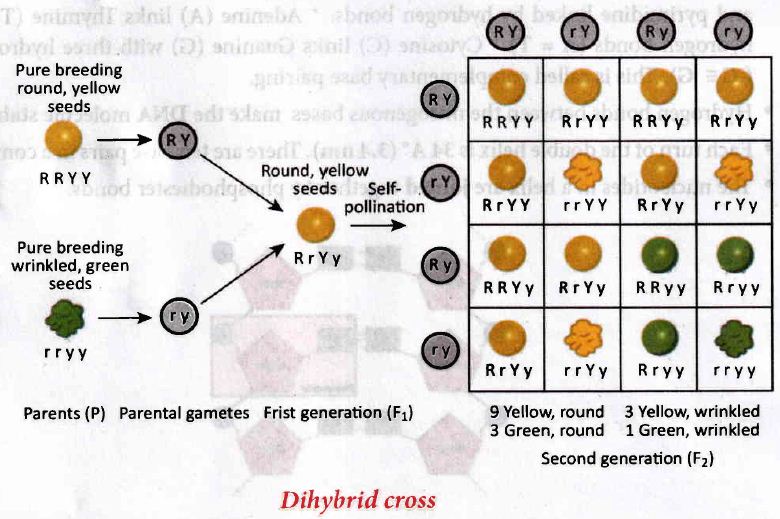
Results of a Dihybrid Cross:
(i) Mendel got the following results from his dihybrid cross.
Four Types of Plants:
(i) A dihybrid cross produced four types of F2 offsprings in the ratio of 9 with two dominant traits, 3 with one dominant trait and one recessive trait, 3 with another dominant trait and
another recessive trait and 1 with two recessive traits.
New Combination:
(i) Two new combinations of traits with round green and wrinkled yellow had appeared in the dihybrid cross (F2 generation).
| Monohybrid Cross | Dihybrid Cross |
| Cross involving inheritance of only one pair of contrasting character. |
Cross involves the inheritance of two pair of contrasting character. |
| E.g. Stem length | E.g. seed shape and seed colour |
5.
i) The top layers of soil contain humus and mineral salts, which are vital for the growth of plants.
ii) Removal of upper layer of soil by wind and water is called soil erosion.
iii) Soil erosion causes a significant loss of humus, nutrients and decrease the fertility of soil.
iv) The direct and primary effect of soil erosion is soil loss and nutrient leaching resulting in reduction of land productivity.
v) Annual floods causes damages to crops, property and lives.
vi) Deforested rain forest soil becomes dry and nutrient-deficient as there is no longer vegetation to hold water and nutrients in place.
vii) Heavy rains further erode soil and saturate waterways with excess nutrients, disrupting the food chains of tropical ecosystems.
viii) Eroded sediments can even change the course of rivers, which suffer from huge deposits of silt from deforestation.
ix) Desertification is another possible consequence of erosion.
6.
Sources of solid waste:
a) Municipal wastes
b) Hospital wastes
c) Industrial wastes
d) e - wastes
Solid waste management:
Solid-waste management involves the collection, treatment and proper disposing of solid material that is discarded from the household and industrial activities.
Methods of solid wastes disposal:
i) Segregation:
It is the separation of different type of waste materials like biodegradable and non biodegradable wastes.
ii) Sanitary landfill:
a) Solid wastes are dumped into Iow lying areas.
b) The layers are compacted by trucks to allow settlement.
c) The waste materials get stabilized in about 2 - 12 months.
d) The organic matter undergoes decomposition.
iii) Incineration:
It is the burning of non-biodegradable solid wastes (medical wastes) in properly constructed furnace at high temperature.
iv) Composting:
Biodegradable matter of solid wastes is digested by microbial action or earthworms and converted into humus.
7.
(i) Application of gibberellins on plants stimulate extraordinary elongation of internode. E.g: Corn and Pea.
(ii) Treatment of rosette plants with gibberellin induces sudden shoot elongation followed by flowering. This is called bolting.
(iii) Gibberellins promote the production of male flowers in monoecious plants (Cucurbits).
(iv) Gibberellins break dormancy of Potato tubers.
(v) Gibberellins are efficient than auxins in inducing the formation of seedless fruit - Parthenocarpic fruits (Development of fruits without fertilization) E.g: Tomato.
8.
(i) Insulin used in the treatment of diabetes.
(ii) Human growth hormone used for treating children with growth deficiencies.
(iii) Blood clotting factors are developed to treat haemophilia.
(iv) Tissue plasminogen activator is used to dissolve blood clots and prevent heart attack.
(v) Development of vaccines against various diseases like Hepatitis B and rabies.
9.
The reproductive period is marked by characteristic events repeated almost every month in physiologically normal woman (28 days with minor variation) in the form of a menstrual flow
The menstrual cycle consists of 4 phases:
(i) Menstrual or Destructive phase
(ii) Follicular or Proliferative Phase
(iii) Ovulatory Phase
(iv) Luteal or Secretory Phase
|
Phase |
Days |
Changes in Ovary |
Changes in Uterus |
Hormonal Changes |
|---|---|---|---|---|
| Menstrual phase | 4-5 days | Development of primary follicles | Breakdown of uterine endometrial lining leads to bleeding | Decrease in progesterone and oestrogen |
| Follicular phase | 6th -13thday | Primary follicles grow to become a fully mature Graafian follicle | Endometrium regenerates through proliferation | FSH and oestrogen increase |
| Ovulatory phase | 14th day | The Graafian follicle ruptures, and releases the ovum( egg) | Increase in endometrial thickness | LH peak |
| Luteal phase | 15th-28th day | Emptied Graafian follicle develops into corpus luteum | Endometrium is prepared for implantation if fertilization of egg takes place. If fertilization does not occur corpus luteum degenerates, uterine wall ruptures, bleeding starts and unfertilized egg is expelled | LH and FSH decrease Corpus luteum produces progesterone and its level increases followed by a decline if menstrual bleeding occurs. |
10.
The neurons may be of different types based on their structure and functions.
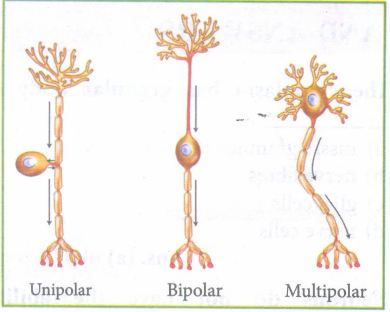
Structurally the neurons may be of the following types:
(i) Unipolar neurons
(ii) Bipolar neurons
(iii) Multipolar neurons
(i) Unipolar neurons:
i) Only one nerve process arises from the cyton which acts as both axon and dendron.
ii) Unipolar neurons found in early embryos but not in adults.
(ii) Bipolar neurons:
i) The cyton gives rise to two nerve processes of which one acts as an axon while another as a dendron.
ii) Bipolar neurons found in retina of eye and olfactory epithelium of nasal chambers.
(iii) Multipolar neurons:
i) The cyton gives rise to many dendrons and an axon.
ii) Multipolar neurons found in cerebral cortex of brain.
11.
A human brain is formed of three main parts:
(a) forebrain
(b) midbrain and
(c) hindbrain.
(1) Forebrain:
A. Cerebrum(cortex)
B. Diencephalon
i) Thalamus ii) Hypothalamus
(2) Midbrain
(3) Hindbrain:
A. Cerebellum
B. Pons
C. Medulla Oblongata
| Part of brain | Structure | Description | Functions |
| Forebrain | Cerebrum (cortex) |
(i) It is the largest portion forming nearly two-third of the brain. (ii) It is divided into 2 halves (Right and Left hemispheres) interconnected by Corpus collosum. (iii) The outer portion is called cortex (grey matter) and inner portion is called medulla (white matter) (iv) The cortex is extremely folder forming elevations (gyri) and abd depressions (sulci) in between. (v) Each cerebral hemisphere is divided into frontal lobe, parietal lobe, temporal lobe and occipital lobe. |
(i) Sensory perception (ii) Control of voluntary functions (iii) Language (iv) Thinking (intelligence) (v) Memory (vi) Decision making (vii) Creativity |
| Thalamus | It is present in cerebral medulla is a major conducting centre for sensory and motor signalling. | Acts as a relay centre | |
| Hypothalamus | (i) It lies at the base of the thalamus (ii) It is an important link between nervous system and endocrine glands |
(i) Controls involuntary functions (ii) Temperature control (iii) Thirst, hunger control (iv) Urinationi (v) Controls the secretion of hormones from anterior pituitary gland |
|
| Midbrain | Corpora quadrigemina |
(i) It is located between thalamus and hindbrain (ii) It is made of four rounded bodies |
Controls visual and auditory (hearing) reflexes |
| Hindbrain | Cerebellum | It is seçond largest part of the brain formed of two large sized hemispheres and middle vermis |
(i) Coordinates voluntary movements (ii) Maintains body balance |
| Pons | (i) 'Pons' a latin word, meaning bridge (ii) It is a bridge of nerve fibre that connects the lobes of cerebellum. |
(i) Relays signals between the cerebellum, spinal cord, midbrain and cerebrum (ii) Controls respiration and sleep cycle. |
|
| Medulla Oblongata | It is the posterior most part of the brain that connects spinal cord and various parts of brain. |
(i) Has cardiac centre, respiratory centres, vasomotor centres and digestive centre (ii) Also regulates vomiting and salivation |
12.
WBC's are colourless and nucleated cells. Granulocytes contain granules in their cytoplasm. Agranulocytes do not contain granules in their cytoplasm, So they are classified as Granulocytes and Agranulocytes.
Granulocytes: Granulocytes contain granules in their cytoplasm. They are of three types.
(i) Neutrophils:
i) They are large in size and have a 2-7 lobed nucleus.
ii) These corpuscles form 60% - 65% of the total leucocytes.
iii) Their number are increased during infection and inflammation.
(ii) Eosinophils:
i) Eosinophils has a bilobed nucleus and constitute 2% - 3% of the total leucocytes.
ii) Their number increases during conditions of allergy and parasitic infections.
iii) It brings about detoxification of toxins.
(iii) Basophils:
i) Basophils have lobed nucleus.
ii) They form 0.5% - 1.0 % of the total leucocytes.
iii) They release chemicals during the process of inflammation.
(iv) Agranulocytes:
i) Granules are found in the cytoplasm of these cells.
ii) The Agranulocytes are of two types:
(i) Lymphocytes:
i) These are about 20 - 25% of the total leucocytes.
ii) They produce antibodies during bacterial and viral infections.
(ii) Monocytes:
i) They are the largest of the leucocytes and are amoeboid in shape.
ii) These cells form 5 - 6% of the total leucocytes.
iii) They are phagocytic and can engulf bacteria.
13.
Yes. Lifestyle can be modified so as the risk factors of cardio vascular diseases can be avoided. Thereby we can avoid heart diseases.
The following measures can be advocated to change life style:
Diet management:
(i) Reduction in the intake of calories, low saturated fat and cholesterol rich food, low carbohydrates and common salt are some of the dietary modifications.
(ii) Diet rich in polyunsaturated fatty acids (PUFA) is essential.
(iii) Increase in the intake of fiber diet, fruits and vegetables, protein, minerals and vitamin are required.
Physical activity:
(i) Regular exercise, walking and yoga are essential for body weight maintenance.
(ii) There should be some physical activity in between long sitting hours.
Addictive substance avoidance:
Alcohol consumption and smoking are to be avoided.
14.
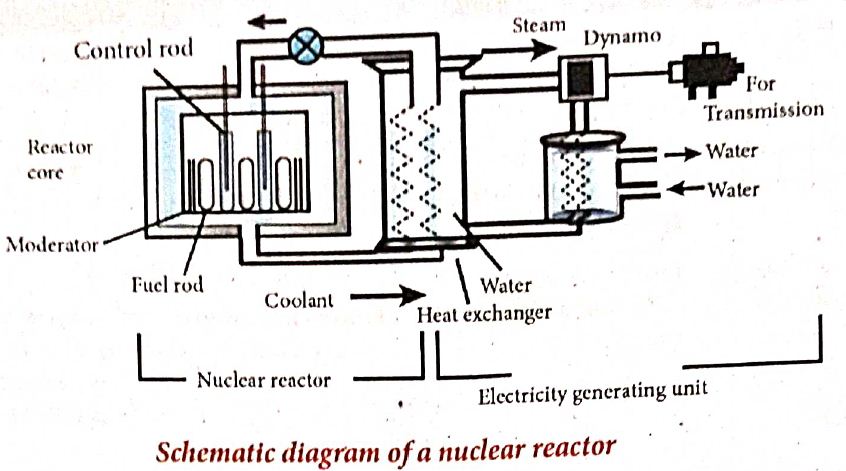
A Nuclear reactor is a device in which the nuclear fission reaction takes place in a self-sustained and controlled manner to produce electricity.
(i) Fuel:
a) A fissile material is used as fuel.
b) The commonly used fuel material is uranium
(ii) Moderator:
a) A moderator is used to slow down the high-energy neutrons to get slow neutrons.
b) Graphite and heavy water are the commonly used moderators.
(iii) Control rod:
a) Control rods are used to control the number of neutrons in order to have a sustained chain reaction.
b) Mostly boron or cadmium rods are used as control rods.
(iv) Coolant:
a)A coolant is used to remove the heat produced in the reactor core to produce steam.
b) This steam is used to run a turbine to produce electricity.
c) Water, air and helium are some of the coolants.
(v) Protection wall:
A thick concrete lead wall is built around the nuclear reactor in order to prevent the harmful radiations from escaping into the environment.
15.
1) 0.3 mole of aluminium (Atomic mass of Al = 27)
\(\text { Number of moles }=\frac{\text { Mass of } \mathrm{Al}}{\text { Atomic mass of } \mathrm{Al}}\)
Mass = No. of moles × atomic mass
So, mass of Al = 0.3 × 27
= 8.1 g
2) 2.24 litre of SO2 gas at S.T.P
Molecular mass of SO2 = 32 + (16 × 2)
= 32 + 32 = 64
\(\text { Number of moles of } \mathrm{SO}_2=\frac{\begin{array}{c} \text { Given volume of } \mathrm{SO}_2 \text { at S.T.P } \end{array}}{\begin{array}{c} \text { Molar volume } \mathrm{SO}_2 \text { at S.T.P } \end{array}}\)
Number of moles of SO2 = \(\frac{2.24}{22.4}\)
= 0.1 mole
\(\text { Number of moles }=\frac{\text { Mass }}{\text { Molecular mass }}\)
Mass = No. of moles × molecular mass
Mass = 0.1 × 64
Mass of SO2 = 6.4 g
iii) 1.51 × 10²³ molecules of water
Molecular mass of H2O = 18
\(\text { Number of moles }=\frac{\begin{array}{c} \text { Number of molecules of }\text { water } \end{array}}{\text { Avogadro's number }}\)
= 1.51 × 10²³ / 6.023 × 1023
= 1 / 4
= 0.25 mole
\(\text { Number of moles }=\frac{\text { Mass }}{\text { Molecular mass }}\)
0.25 = mass / 18
Mass = 0.25 × 18
Mass = 4.5 g
iv) 5 × 10²³ molecules of glucose
Molecular mass of glucose = 180
\(\text { Mass of glucose }=\frac{\begin{array}{c} \text { Molecular mass } \times \text { number of particles } \end{array}}{\text { Avogadro's number }}\)
= (180 × 5 × 1023) / 6.023 × 1023
= 149.43 g
16.
Echo:
(i) An echo is the sound reproduced due to the reflection of the original sound from various rigid surfaces such as walls, ceilings, surfaces of mountains, etc.
a) Conditions necessary for hearing echo:
(i) The persistence of hearing for human ears is 0.1 second.
(ii) This means that you can hear two sound waves clearly, if the time interval between the two sounds is at least 0.1 s.
(iii) Thus, the minimum time gap between the original sound and an echo must be 0.1 s.
(iv) The above criterion can be satisfied only when the distance between the source of sound and the reflecting surface would satisfy the following equation:
\(\text { Velocity } =\frac{\text { distance travelled by sound }}{\text { time taken }} \)
\(v =\frac{2 d}{t} \)
\(d =\frac{v t}{2}\)
since, t = 0.1 second, then \(\mathrm{d}=\frac{331}{0.20}=\frac{\mathrm{v}}{20}\)
(v) Thus the minimum distance required to hear an echo is 1 / 20th part of the magnitude of the velocity of sound in air.
(vi) If you consider the velocity of sound as 344 ms-1, the minimum distance required to hear an echo is 17.2 m.
b) Applications of echo:
(i) The principle of echo is used in obstetric ultrasonography, which is used to create real-time visual images of the developing embryo or fetus in the mother's uterus.
(ii) This is a safe testing tool, as it does not use any harmful radiations.
c) Calculation of speed of sound:
(i) The sound pulse emitted by the source travels a total distance of 2d while travelling from the source to the wall and then back to the receiver.
(ii) The time taken for this has been observed to be 't'. Hence, the speed of sound wave is given by
\(\text { Speed of Sound }=\frac{\text { distance travelled }}{\text { time taken }}=\frac{2 \mathrm{d}}{\mathrm{t}}\)
17.
i) The electricity produced in power stations is distributed to all the domestic and industrial consumers through overhead and underground cables.
ii) In our homes, electricity is distributed through the domestic electric circuits wired by the electricians.
iii) The first stage of the domestic circuit is to bring the power supply to the main-box from a distribution panel, such as a transformer.
Main Box Contains:
a) Fuse Box:
i) The fuse box contains either a fuse wire or a miniature circuit breaker (MCB).
ii) The function of the fuse wire or a MCB is to protect the house hold electrical appliances from overloading due to excess current.
iii) An MCB is a switching device, which can be activated automatically as well as manually. It has a spring attached to the switch, which is attracted by an electromagnet when an excess current passes through the circuit.
iv) It has a spring attached to the switch, which is attracted by an electromagnet when an excess current passes through the circuit.
v) Hence, the circuit is broken and the protection of the appliance is ensured.
b) Meter:
i) The meter is used to record the consumption of electrical energy.
Insulated Wire:
i) The electricity is brought to houses by two insulated wires.
ii) Out of these two wires, one wire has a red insulation and is called the "live wire'.
iii) The other wire has a black insulation and is called the 'neutral wire'.
iv) Both, the live wire and the neutral wire enter into a box where the main fuse is connected with the live wire.
v) After the electricity meter, these wires enter into the main switch, which is used to discontinue the electricity supply whenever required.
vi) After the main switch, these wires are connected to live wires of two separate circuits.
5A rating circuit:
i) Out of these two circuits, one circuit is of a 5 A rating, which is used to run the electric appliances with a lower power rating, such as tube lights, bulbs and fans.
15 A rating circuit:
i) The other circuit is of a 15 A rating, which is used to run electric appliances with a high power rating, such as air-conditioners, refrigerators, electric iron and heaters.
ii) It should be noted that all the circuits in a house are connected in parallel, so that the disconnection of one circuit does not affect the other circuit.
iii) One more advantage of the parallel connection of circuits is that each electric appliance gets an equal voltage.
iv) The electricity supplied to your house is actually an alternating current having an electric potential of 220 V.
18.
a) Joule's law of heating:
a) Joule's law of heating states that the heat produced in any resistor is:
(i) Directly proportional to the square of the current passing through the resistor.
(ii) Directly proportional to the resistance of the resistor.
(iii) Directly proportional to the time for which the current is passing through the resistor.
b) Alloy of nickel and chromium have the following properties:
(i) It has high resistivity,
(ii) It has a high melting point,
(iii) It is not easily oxidized.
c) The fuse wire is connected in series, in an electric circuit. When a large current passes through the circuit, the fuse wire melts due to Joule's heating effect and hence the circuit gets disconnected. Therefore, the circuit and the electric appliances are saved from any damage. The fuse wire is made up of a material whose melting point is relatively low.
19.
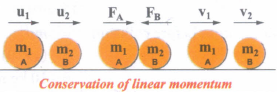
(i) Propulsion of rockets is based on law of conservation of linear momentum as well as Newton's III law of motion.
(ii) Rockets are filled with a fuel (either liquid or solid) in the propellant tank.
(iii) When the rocket is fired, this fuel is burnt and a hot gas is ejected with high speed from the back nozzle producing a huge momentum.
(iv) To balance this momentum, an equal and opposite reaction force is produced combustion chamber which makes the rocket project forward.
(v) While in motion, the mass of the rocket gradually decreases, until the fuel is completely burnt out.
(vi) Since there is no net external force acting on it, the linear momentum of the system is conserved.
(vii) The mass of the rocket decreases with altitude, which results in the gradual increase in velocity of the rocket.
(viii) At one stage, it reaches a velocity, which is sufficient to just escape from the gravitational pull of the Earth. This velocity is called escape velocity.
20.
21.
Here, although the solution is extremely dilute, the concentration given is not of an acid or a base but that of H+ ions. Hence, the pH can be calculated from the relation:
pH = –log10[H+]
given [H+] = 1.0 × 10⁻⁸ mol litre–1
pH = –log1010–8 = –(–8 × log1010)
= –(–8 × 1) = 8
22.
NaOH is a strong base and dissociates in its solution as:
NaOH(aq) → Na+(aq) + OH–(aq)
One mole of NaOH would give one mole of OH– ions. Therefore,
[OH–] = 1 × 10⁻⁴ mol litre–1
pOH = –log10[OH–] = –log10 × [10–4]
= –(–4 × log1010)= –(–4) = 4
Since, pH + pOH = 14
pH = 14 – pOH = 14 – 4
= 10
23.
(i) 13AI27 + 2He4 \(\longrightarrow \) 15P30 + 0n1
(ii) 12Mg24 + 0n1 \(\longrightarrow \) 11Na24 + 1H1
(iii) 92U238 + 0n1 \(\longrightarrow \) 93Np239 + -1e0
A is alpha particle, B is neutron, C is proton, and D is electron.
24.
At 30°C, 36 g of sodium chloride is dissolved in 100 g of water.
\(\therefore\) Mass of sodium chloride that would be need for 100 g of water = 36 g
\(\therefore\) Mass of sodium chloride dissolved in 50 g of water = \(\frac {36 \times 50}{100}\)
=18 g
25.
Mass of the solute = 1.5 g
Mass of the solvent = 15 g
Solubility of the solute = \(\frac{\text { Mass of the solute }}{\text { Mass of the solvent }} \times 100\)
Solubility of the solute = \(\frac{1.5}{15}\times 100\)
= 10 g
26.
A) Since the resistors are connected in parallel, the potential difference across each resistor is same (i.e. V=10V)
Therefore, the current through R1 is,
\({ I }_{ 1 }=\frac { V }{ { R }_{ 1 } } =\frac { 10 }{ 5 } =2A\)
Current through \({ R }_{ 2 }={ I }_{ 2 }=\frac { V }{ { R }_{ 2 } } =\frac { 10 }{ 10 } =1A\)
Current through \({ R }_{ 3 }={ I }_{ 3 }=\frac { V }{ { R }_{ 3 } } =\frac { 10 }{ 20 } =0.5A\)
B) Total current in the circuit, I = I1 + I2 + I3
= 2 + 1 + 0.5 = 3.5 A
C) Total resistance in the circuit \(\frac { 1 }{ { R }_{ P } } =\frac { 1 }{ { R }_{ 1 } } +\frac { 1 }{ { R }_{ 2 } } +\frac { 1 }{ { R }_{ 3 } } \)
\(=\frac { 1 }{ 5 } +\frac { 1 }{ 10 } +\frac { 1 }{ 20 } \)
\(=\frac { 4+2+1 }{ 20 } \)
\(\frac { 1 }{ { R }_{ P } } =\frac { 7 }{ 20 } \)
Hence, \({ R }_{ P }=\frac { 20 }{ 7 } =2.857\Omega \)
27.
Given that, d = 1.5m; D = 25cm = 0.25m (For a normal eye).
From equation (2.8), the focal length of the correction lens is
\(f=\cfrac { d\times D }{ d-D } =\cfrac { 1.5\times 0.25 }{ 1.5-0.25 } =\cfrac { 0.375 }{ 1.25 } =0.3m\)
28.
When the source is moving towards the stationary listener, the expression for apparent frequency is
\(n'=\left( \frac { v }{ v-{ v }_{ s } } \right) n\)
= \(\left( \frac { v }{ v-\left( \frac { 1 }{ 10 } \right) v } \right) n=\left( \frac { 10 }{ 9 } \right) n\)
= \(\left( \frac { 10 }{ 9 } \right) \times 90=100\) Hz
n'=100 Hz
29.
Given:
\(\mathrm{f}=10 \mathrm{~cm}, \mathrm{u}=-20 \mathrm{~cm}, \mathrm{v}=? \)
\(\frac{1}{f}=\frac{1}{v}-\frac{1}{u} \Rightarrow \frac{1}{v} =\frac{1}{f}+\frac{1}{u} \)
\(\frac{1}{v} =\frac{1}{10}+\frac{1}{-20}=\frac{1}{10}-\frac{1}{20} \)
\(\frac{1}{v} =\frac{2-1}{20}=\frac{1}{20} \)
\(\mathbf{v} =20 \mathrm{~cm} \)
Image distance = 20 cm
Nature of image:
Nature of the image is real, enlarged and inverted image.
30.
Data:
Initial pressure (P1)= P
Final Pressure (P2) = 4P
Initial volume (V1) = 20cc = 20cm3
Final volume (V2) = ?
Using Boyle's Law, PV = constant
P1V1 = P2V2
\({ V }_{ 2 }=\frac { { P }_{ 1 } }{ { P }_{ 2 } } \times { v }_{ 1 }\)
\(=\frac { P }{ 4P } \times 20{ cm }^{ 3 }\)
V2 = 5 cm3
31.
(i) The ideal gas equation is an equation, which relates to all the properties of an ideal gas.
(ii) An ideal gas obeys Boyle's law and Charles's law and Avogadro's law.
(iii) According to Boyle's law,
PV = constant ... (1)
(iv) According to Charles's law,
V/T = constant ... (2)
(v) According to Avogadro's law,
V/n = constant ... (3)
(vi) After combining equations (1), (2), and (3), we can get the following equation.
PV/nT = constant ... (4)
The above relation is called the combined gas law
(vii) If you consider a gas which contains μ moles of the gas, the number of atoms contained will be equal to μ times the Avogadro number, NA. i.e.,
\(n=\mu N_A\) ...... (5)
(viii) Using equation (5), equation (4) can be written as
\(PV/\mu N_AT\) = constant
(ix) The value of constant in the above equation is taken to be kB, which is called as Boltzmann's constant. Its value is (1.381 x10⁻²³JK-1). Hence, we have the following equation:
\(PV/\mu N_AT=K_B\)
\(PV=\mu N_AK_BT\)
(xi) Here, \(\mu N_AK_B=R\), which is termed as universal gas constant whose value is 8.31 J mol-1 K-1.
PV = RT ...... (6)
Ideal gas equation is also called as equation of state because it gives the relation between the state variables and it is used to describe the state of any gas.
32.
(i) Polyuria occurs in people diagnosed with Diabetes mellitus, if blood glucose levels have risen too high.
(ii) Regular exercise, along with a good diet, can reduce the risk of diabetes.
33.
Polyploldys are characterised by gigantism
An organism having more than two sets of chromosomes is called polyploid. It causes increase in size. Polys = Many + aploos = One fold + eidos = Form (E.g) Watermelon
34.
(i) During transpiration, water is lost from leaves.
(ii) Still transpiration is essential for the movement of water and minerals from the root to the healthy parts of the plant.
(iii) But excess transpiration may result in drying up of the leaves or wilting and loss of soil water.
(iv) Hence it is termed as a necessary evil.
35.
(i) Vinu will get faster dissolution of sugar.
(ii) Temperature is one of the factors.
(iii) It will affect the solubility of a solute in a liquid.
(iv) Solvent increases with increase in temperature.
36.
(i) Octopus, cockroach and frog all have eyes.
(ii) Octopus-belongs to mollusc which have simple eye without lens.
(iii) Cockroach are invertebrate have compound eyes.
(iv) Frog which is vertebrate, have highly specialised lens.
(v) However, all of them perform the same function that is vision.
(vi) Thus a common evolutionary origin can be established on the basis of eye.
37.
(i) Fossils are remains or impressions of organisms that lived in the remote past.
(ii) Fossil provide the evidence that the present animal have originated from previously existing ones through the process of continuous evolution.
38.
(i) Canines are absent.
(ii) Hence, a gap is seen between the incisors and premolars.
(iii) This is called diastema.
(iv) It helps in mastication and chewing of food in herbivorous animals.
39.
(i) On passing ' C ' through water it becomes acidic.
(ii) Therefore the gas ' C ' must be a non-metal oxide \(\left(\mathrm{CO}_{2}\right)\).
(iii) So a solid compound must be a calcium carbonate.
(iv) It decomposes into calcium oxide and carbon dioxide. (C)
\(\mathrm{CaCO}_{3(\mathrm{~g})} \rightarrow \mathrm{CaO}_{(\mathrm{S})}+\mathrm{CO}_{2(\mathrm{~g})} \uparrow\\ \quad \mathrm{A} \quad \quad \quad \quad \mathrm{B} \quad \quad \quad \quad \mathrm{C}\)
| A | CaCo3 | Calcium carbonate |
| B | CaO | Calcium oxide |
| C | CO2 | Carbon di oxide |
40.
(a) Ionic bond.
(b) Electronegativity property.
(c) (i) Along the period, from left to right in the periodic table, the electronegativity increases, because of the increase in the nuclear charge which in turn attracts the electrons more strongly.
(ii) On moving down a group, the electronegativity of the element decreases because of the increased number of valence shells.
41.
The light-dependent reactions occur in the thylakoids (grana) and the light independent reactions (Calvin cycle) occur in the stroma.
42.
In alpha decay atomic number decreases by two and mass number decreases by four. So
232 - 208 = 24
Mass number decreased by 24. So 6 alpha particle would come out.
\({ }_{90} \mathrm{X}^{232} \rightarrow{ }_{78} \mathrm{Y}^{208}+6{ }_{2} \mathrm{He}^{4}\)
In beta decay atomic number increases by one
78 + 4 = 82
So, 4 beta particle would come out.
\({ }_{78} \mathrm{Y}^{208} \rightarrow{ }_{82} \mathrm{Z}^{208}+4_{-1} \mathrm{e}^{\mathrm{o}}\)
So, six alpha particle and four beta particles would come out.
43.
(i) 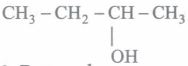
(ii) IUPAC name - Butane-2-ol (or) 2-Butanol.
(iii) The compound is saturated, because these compounds are do not decolourize with bromine water.
44.
b) Light
The light wave has a longer wave length. Because, it has much greater speed.
45.
i) 1 mole of calcium carbonate are involved
ii) Gram molecular mass of \(\mathrm{CaCO}_{3} \rightarrow \mathrm{Ca} \times 1+\mathrm{C} \times 1+\mathrm{O} \times 3\)
40 x 1 + 12 x 1 + 16 x 3
40 + 12 + 48 = 100 g
Gram molecular mass of CaCO3 is 100 g / mol.
iii) 1 mole of CO2 are there in above equation.

10th Standard Syllabus & Materials
10th Standard
TN 10th English Prose - 2 - The Night the Ghost Got in Important Questions And Answers Study Material - QB365 Set A
NEW10th Standard
TN 10th English Supplementary - 1 - The Tempest Important Questions And Answers Study Material - QB365 Set A
NEW10th Standard
TN 10th English Poem - 1 - Life Important Questions And Answers Study Material - QB365 Set A
NEW10th Standard
TN 10th English Prose - 1 - His First Flight Important Questions And Answers Study Material - QB365 Set A



Tamilnadu Stateboard 10th Standard Subjects
Tamilnadu Stateboard Standards





