
 100% FREE ACCESS
10th Standard Syllabus & Materials
10th Standard
TN 10th English Prose - 4 - The Attic Important Questions And Answers Study Material - QB365 Set A
NEW10th Standard
TN 10th English Supplementary - 3 - The Story of Mulan Important Questions And Answers Study Material - QB365 Set A
NEW10th Standard
TN 10th English Poem - 3 - I am Every Woman Important Questions And Answers Study Material - QB365 Set A
NEW10th Standard
TN 10th English Prose - 3 - Empowered Women Navigating The World Important Questions And Answers Study Material - QB365 Set A
NEW10th Standard
TN 10th English Supplementary - 2 - Zigzag Important Questions And Answers Study Material - QB365 Set A
NEW10th Standard
TN 10th English Poem - 2 - The Grumble Family Important Questions And Answers Study Material - QB365 Set A

Published on: 12/05/2020
10th Standard Science English Medium Creative Important 4 Marks Questions
Download Tamil Nadu 10th Standard Science question papers, model tests, one-mark questions, important questions, and public exam papers in PDF format. Free study materials and answer keys for TN State Board students.
Questions + Answers key
Take MCQ Science Test1.
Can Human beings survive with anaerobic respiration - Justify.
2.
Why is a dicot leaf described as dorsiventral?
3.
Fermentation is a process applicable of Bakery and Breweries. What is the scientific explanation for this?
4.
A family has 3 three cars and can afford to buy fuel. They prefer to go out independently. Is it right to suggest car pooling for such people. Justify.
5.
Explain the waste water treatment process.
6.
Write a note an wind energy.
7.
Ramu studies in a school and his friends are discussing about drugs. They force him to use drugs and threaten to avoid him / harm him if he refuses. What should Ramu do?
8.
Write a note on Obesity.
9.
Explain the hazards and effects of Tobacco.
10.
A farmer has lot of banana trees in his form. He wishes to go in for selection to improve the crop. Which method can he adopt in banana?
11.
Plants seeds got from other countries are tested in plant quarantine. Reason out.
12.
Write a note an selection.
13.
In a biology period, the teacher drew the heart of rabbit on the board and explained its structure and functions. After the class, your friend told you that he finds it difficult to understand the concept and felt he wanted a detailed explanation.
(i) In what way the teaching can be made easily understandable?
(ii) Do you think using technologies like Visual Communication help students to understand the difficult concepts in a simple way?
(iii) By what means the Visual Communication improve the learning ability?
14.
Explain in detail the uses and main parts of the 'SCRATCH' animation software.
15.
How to identify saturated and unsaturated compounds?
16.
How will you classify hydrocarbons?
17.
Write the characteristics of organic compounds.
18.
Name the pituitary hormones, and on the target tissues? How does it exert its action.
19.
Describe the role of pancreas in maintenance of blood sugar level.
20.
Write a note on Thyroid Dysfunctions.
21.
X is the oldest fossil bird. The animal X became extinct a long time ago. But the study of fossils of X tells us that it had features like birds and some like reptiles.
(i) Identify 'X'?
(ii) Name one feature in which 'X' resembled birds.
(iii) Name one feature in which 'X' resembled reptiles.
22.
Explain Use and Disuse theory.
23.
Write a note on evidences from Morphology and Anatomy in favour of Evolution.
24.
'A' contains a cerebrospinal fluid filled cavity known as 'B'. How many nerves are produced from A.
(i) What is A?
(ii) What is 'B'?
25.
List the function of cerebrospinal fluid.
26.
Explain the classification based on the direction of the reaction.
27.
What are the precautions to be taken by people working in radiation labs?
28.
Distinguish between Nuclear fission and nuclear fusion.
29.
Explain the principle & structure of atom bomb.
30.
State and explain Boyle's law.
31.
With an illustration, explain the method of Calculation for cubical expansion of an object.
32.
With an illustration, explain the method of Calculation for areal expansion of an object.
33.
With an illustration, explain the method of Calculation for linear expansion of an object.
34.
Define and describe thermal expansion.
35.
Write some solubility substances in water at 25°C.
36.
Explain Solid solution, Liquid solution and Gaseous solution.
37.
Explain the refraction of light through a glass prism.
38.
Explain the types of Telescope.
39.
Explain the construction of Simple Microscope and derive its magnification power.
40.
Explain the working of the eye.
41.
Explain the Sign Conventions of lenses.
42.
Write the sign convention for lenses.
43.
Explain Raman Scattering.
44.
State the laws of refraction.
45.
Write the applications of Doppler effect.
46.
What are the various possibilities of relative motion between source and listener?
47.
Write the applications of echo.
48.
Is hirudin used in medical science.
49.
Man is a mammal and has incisors and canine. Rabbits are mammals but lack canines. Explain.
50.
Redraw and label the diagram. Then answer the following questions.
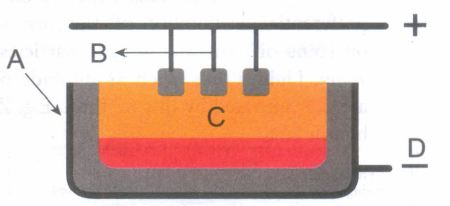
(a) What process does the diagram represent?
(b) Why does the graphite rod need to be replaced often?
(c) Give reason for the melting point of the electrolyte.
(d) Write the overall equation of this process.
51.
How is zinc blende concentrated? Explain it with a neat diagram
52.
Distinguish ore from a mineral.
53.
Mala had a huge scar on her cheek after she met with fire accident during her college days. She is worried if her baby would inherit the scar she had acquired. She clarified with her doctor, she need not worry about it, as her scar is an acquired trait.
(i) What are acquired traits?
(ii) How is it different from inherited traits?
54.
Write a note on DNA replication.
55.
How are chromosomes classified based on the position of centromere?
56.
Kalaivani was watching at a metal pipe, one end of which is connected to a tank at the top of her building and the other end to the tap, which is near the ground level. She was admiring how the water flows from top to the bottom through the pipe. She went and asked her mother, who was an engineer.
(i) Also Kalaivani asked her mother that can she able to compare this with any other scientific concepts?
(ii) How would her mother have compared the resistance in a water pipe as well as in a conductor.
(iii) Give the expression for resistors connected in series and parallel.
57.
Arun and Ram were good friends. But Ram slowly started loosing interest in studies as they grew up. The teacher found out that Ram had three siblings and their parents could not give him good food or personal care. What value does this episode give us.
58.
Government has brought in lot of measures to focus on health of a pregnant woman. Answer the following questions based on the same
(a) Name the tissue responsible for transfer of nutrients from mother to the offspring during pregnancy.
(b) Suggest two measures to maintain a woman's health during pregnancy.
59.
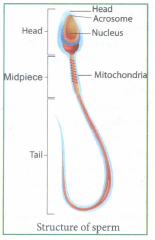
Describe the structure of human sperm.
60.
Discuss the apparent weight of a man in lift?
61.
Derive the Relation between g and G?
62.
Give examples for Newton's third law.
63.
Give the application of torque.
64.
What are the concepts prepared by Galileo?
65.
List the difference between RBC and WBC.
66.
Write a note an ABO blood grouping.
67.
Write any five electrical components used in electrical circuit and draw its symbol.
68.
Water boils in an electric kettle in 15 mins after switching on. If the length of the heating wire is decreased to \(\frac{1}{3}\) of its initial value, then in how much time will the same amount of water boil with the same supply voltage?
69.
How will you determine the atomicity of gases using Avogadro's hypothesis?
70.
Give the applications of Avogadro's hypothesis.
71.
Describe the heart of rabbit.
72.
Rani fell from her bike and had a head injury. She was hospitalized and discharged later. What do you think she could have done to save herself from this accident.
1.
(i) In anaerobic respiration the amount of energy produced is very less.
(ii) Aerobic respiration is seen is humans wherein the number of ATP molecules produced from a glucose molecule is more than an aerobic respiration.
2.
(i) The dorsal and ventral surfaces of a dicot leaf can be clearly distinguished
(ii) The dorsal surface is darker is appearance and the ventral surface is lighter.
(iii) This is due to distribution of palisade parenchyma below the upper epidermis which as rich in chloroplasts.
(iv) Hence the dicot left is described as dorsiventral.
3.
(i) Anaerobic respiration is referred to as fermentation. Microbes like yeast are used in these processes.
(ii) They respire anaerobically by which the substrate (sugar) is converted to alcohol and carbon dioxide.
(iii) Carbon dioxide is used by bakeries. Alcohol is used by breweries.
4.
Car pooling is an initiative being advocated to the public because more people can make use of a vehicle. It has multiple uses like Judicious use of fuel, reducing traffic congestion and so on. Further it is also economic for the users. Thus car pooling is a eco friendly initiative which can save resources for the future generation. It is not linked to the economic status of an individual.
5.
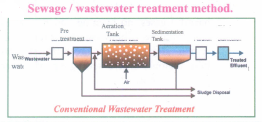
The conventional water treatment:
i) Pre-screening
ii) Aeration
iii) Sludge Management and Water Reuse.
(i) Pre-screening: Screening of waste water to remove soil and solid particulates.
(ii) Aeration: Screened wastewater is pumped to an aeration tank. Microbial contaminants are removed by the biological degradation that occurs in the presence of air.
(iii) Sedimentation process: The solid particles in suspension form are allowed to settle under the effect of gravity. The particles that settle out from the suspension is known as sludge.
(iv) Sludge removal: The sludge generated by the degradation process is transferred periodically from the tank for safe disposal.
(v) Disinfection: Chlorination and Ultra Violet (UV) radiation of treated water to remove any microorganism contamination.
(vi) Water recycling: The water will then be supplied for domestic or industrial purposes.
6.
(i) The kinetic energy possessed by the wind is due to its high speed, that can be converted into mechanical power by wind turbines.
(ii) The wind energy can be used for
(a) Generating electricity
(b) Run water pumps, flour mills etc.
(c) Rotatory motion of windmill is used to draw water from wells.
Working of wind mills:
(i) Wind mill is a machine that converts the energy of wind into rotational energy by broad blade attached to the rotating axis.
(ii) When the blowing air strikes the blades of the windmill, it exerts force and causes the blades to rotate.
(iii) The rotational movement of the blades operate the generator and the electricity is produced.
(iv) The energy output from each windmill is coupled together to get electricity on a commercial scale.
Advantage of wind energy:
(i) Wind energy is free, eco-friendly, renewable source of energy.
(ii) It does not cause pollution.
(iii) Expenses on periodic maintenance is low when compared to the other power sources
7.
Ramu must discuss the issue with his parents or teachers. He must take support from elders in not being a part of this group so that he can take care of his physical and mental health and not fall a prey to bad habits. Friendship does not mean being a support to the wrong actions of our friends.
8.
(i) Obesity is the state in which there is an accumulation of excess body fat with an abnormal increase in body weight.
(ii) Obesity occurs if intake of calories is more than the expenditure of energy.
(iii) Overweight and obesity are conditions where the body weight is greater than the mean standard weight for age and height of an individual.
(iv) Body Mass Index (BMI) is an estimate of body fat and health risk. BMI = Weight (kg) / Height (m)2
Causes and risk factors :
(i) Obesity is due to genetic factors, physical inactivity, eating habits (overeating) and endocrine factors.
(ii) Obesity is a positive risk factor in development of hypertension, diabetes, gall bladder disease, coronary heart disease, and arthritis.
Prevention and Control of Obesity :
(i) Diet Management: Low calorie, normal protein, vitamins and mineral, restricted carbohydrate and fat, high fiber diet can prevent overweight.
(ii) Physical exercise: A low calorie diet accompanied by moderate exercise will be effective in causing weight loss. Meditation, yoga and physical activity can also reduce stress related to overeating.
9.
When smoke is inhaled the chemicals get absorbed by the tissues and cause the following harmful effects.
(i) Benzopyrene and polycyclic hydrocarbons present in tobacco smoke is carcinogenic causing lung cancer.
(ii) Causes inflammation of throat and bronchi leading to conditions like bronchitis and pulmonary tuberculosis.
(iii) Inflammation of lung alveoli decrease surface area for gas exchange and cause emphysema.
(iv) Carbon monoxide of tobacco smoke binds to hemoglobin of RBC and decreases its oxygen carrying capacity causing hypoxia in body tissues.
(v) Increased blood pressure caused by smoking leads to increased risk of heart disease.
(vi) Causes increased gastric secretion which leads to gastric and duodenal ulcers.
(vii) Tobacco chewing causes oral cancer (mouth cancer).
10.
He can adopt clonal selection since banana reproduces asexually from the underground stem.
11.
Plant materials brought into a country must be free from pathogens. It may lead to outbreak of new disease or introduction of a new pathogen into the environment. Thus plant materials (seeds / saplings) are tested in plant quarantine.
12.
Selection is one of the oldest methods of plant breeding in which individual plants or groups of plants are sorted out from a mixed population based on the morphological characters.
Methods of selection:
There are three methods of selection. They are
a) Mass selection
b) Pure line selection
c) Clonal selection
a) Mass selection:
(i) Seeds of best plants showing desired characters are collected from a mixed population.
(ii) The collected seeds are allowed to raise the second generation. This process is carried out for seven or eight generations.
(iii) At the end, they will be multiplied and distributed to the farmers for cultivation. Eg: Groundnut varieties like TMV-2 and AK-10.
b) Pureline selection :
(i) Pureline is "the progeny of a single individual obtained by self breeding":
(ii) This is also called as individual plant selection. In pureline selection large numbers of plants are selected from a self pollinated crop and harvested individually.
(iii) Individual plant progenies from them are evaluated separately. The best one is released as a pureline variety.
(iv) Progeny is similar both genotypically and phenotypically.
c) Clonal selection:
(i) A group of plants produced from a single plant through vegetative or asexual reproduction are called clones.
(ii) All the plants of a clone are similar both in genotype and phenotype.
(iii) Selection of desirable clones from the mixed population of vegetatively propagated crop is called clonal selection.
13.
(i) Pictures and Audio-Visuals give us more understanding than teaching and writing on black board. So, any visual representation of the concepts would help us to understand better and make teaching simple
(ii) Yes. Visual Communication helps us to easily conceptualize complicated theorems and concepts. When the teacher shows pictures / videos that represent the concept, we would easily relate to its application and firmly understand the concept without any mis-perception
(iii) Pictures, Audio-Visuals, animations provide additional information and helps us to easily correlate the concepts. We could easily remember the visuals than black board writing, and visualize it, so that we do not forget and we could easily recollect at the time of examination.
14.
'Scratch' is a software used to create animations, cartoons and games easily. Scratch, on the other hand, is a Visual Programming Language. It was developed in the Massachusetts Institute of Technology (MIT) Media Lab to make programming easier and more fun to learn.
Scratch Environment Editor:
(i) The Scratch editor has three main parts: They are Stage, Sprite and Script editor.
(ii) Stage: Stage is the background appearing when we open the scratch window. The background will most often be white. You can change the background colour as you like.
(iii) Sprite: The characters on the background of a Scratch window are known as Sprite. Usually a cat appears as a sprite when the Scratch window is opened. The software provides facilities to make alternations in sprite.
(iv) Script editor / Costume editor: Where you edit your programs or your sprite's pictures.
The script editor has three main parts :
(a) Script area: Where you build scripts.
(b) Block menu: Where you choose the category of blocks (programming statements) to use.
(c) Block palette: Where you choose the block to use.
15.
(i) Take the given sample solution in a test tube.
(ii) Add a few drops of bromine water and observe any characteristic change in colour
(iii) If the given compound is unsaturated it will decolorise bromine water. Saturated compounds do not decolorise bromine
16.
Hydrocarbons are classified into three classes such as:
(i) Alkanes
(ii) Alkenes
(iii) Alkynes
(i) Alkanes: These are hydrocarbons which contain only single bonds. They are represented by the general formula CnH2n + 2 (where n = 1,2,3, ).
Ex: Methane (CH4).
(ii) Alkenes: The hydrocarbons which contain one or more C=C bonds are called alkenes. These are unsaturated compounds. They are represented by the general formula CnH2n.
(iii) Alkynes: The hydrocarbons containing carbon to carbon triple bond are called alkynes. They have the general formula CnH2n-2.
Ex: Acetylene (C2H2)
17.
(i) Organic compounds have high molecular weight and complex structure
(ii) They are mostly insoluble in water and soluble in organic solvents such as ether, carbon tetrachloride, toluene, etc.
(iii) They are highly flammable.
(iv) Organic compounds are less reactive compared to inorganic compounds.
(v) Organic compounds form covalent bonds.
(vi) They have lower melting point and boiling point.
(vii) They exhibit the phenomenon of isomerism.
(viii) They are volatile in nature.
(ix) They can be prepared in the laboratory.
18.
| Pituitary hormones | Tissue | Action |
| Growth hormone | All tissues | Growth of cartilage, bones, muscles and enlargement of all tissues. |
| Thyroid Stimulating Hormone |
Thyroid gland | Controls growth of the thyroid gland, co-ordinates its activities and hormone secretion. |
| Adrenocortico tropic Hormone |
Adrenal gland - cortex layer |
Stimulates adrenal cortex the produce its hormones and influences protein synthesis also |
| Gonadotropins a. Follicular stimulating hormone |
Testis - Germinal epithelium Ovary - Follicles |
In male it stimulates germinal epithelium of testis to produce sperms. In female, it initiates growth of ovarian follicles. |
| b. Luteinizing hormone | Testis (Male) Ovary (Female) |
Promotes the Leydig cells to secrete male sex hormone testosterone. Causes ovulation |
| c. Prolactin | Mammary glands | Initiates development of mammary glands during pregnancy and stimulates milk production after child birth. |
| Posterior lobe - hormones a. Vasopressin |
Kidney tubules | Increases reabsorption of water and reduces water loss through urine. |
| b. Oxytocin | Uterus | Helps in contraction of smooth muscles of uterus at the time of child birth and milk ejection from mammary gland. |
19.
The endocrine portion of pancreas is made up of Islets of Langerhans.
Structure of Pancreas:
The Islets of Langerhans consists of two types of cells namely alpha cells and beta cells. The alpha cells secrete glucagon and beta cells secrete insulin.
Functions of Pancreatic hormones:
A balance between insulin and glucagon production is necessary to maintain blood glucose concentration.
Insulin :
(i) Insulin helps in the conversion of glucose into glycogen which is stored in liver and skeletal muscles.
(ii) It promotes the transport of glucose into the cells.
(iii) It decreases the concentration of glucose in blood.
Glucagon:
(i) Glucagon helps in the breakdown of glycogen to glucose in the liver.
(ii) It increases blood glucose levels.
Diabetes mellitus :
The deficiency of insulin causes Diabetes mellitus. It is characterised by
(i) Increase in blood sugar level (Hyperglycemia)
(ii) Excretion of excess glucose in the urine (Glycosuria).
(iii) Frequent urination (Polyuria).
(iv) Increased thirst (Polydipsia).
(v) Increase in appetite (Polyphagia).
20.
When the thyroid gland fails to secrete the normal level of hormones, the condition is called thyroid dysfunction. It leads to the following conditions.
Hypothyroidism: It is caused due to the decreased secretion of the thyroid hormones. The abnormal conditions are simple goitre, cretinism and myxoedema.
Goitre:
(i) It is caused due to the inadequate supply of iodine in our diet.
(ii) This is commonly prevalent in Himalayan regions due to low level of iodine content in the soil.
(iii) It leads to the enlargement of thyroid gland which protrudes as a marked swelling in the neck and is called as goitre.
Cretinism:
(i) It is caused due to decreased secretion of the thyroid hormones in children.
(ii) The conditions are stunted growth, mental defect, lack of skeletal development and deformed bones. They are called as cretins
Myxoedema:
(i) It is caused by deficiency of thyroid hormones in adults.
(ii) They are mentally sluggish, increase in body weight, puffiness of the face and hand, oedematous appearance.
Hyperthyroidism:
(i) It is caused due to the excess secretion of the thyroid hormones which leads to Grave's disease (Exopthalmic goitre).
(ii) The symptoms are protrusion of the eyeballs (Exopthalmia), increased metabolic rate, high body temperature, profuse sweating, loss of body weight and nervousness.
21.
(i) Arachaeopteryx.
(ii) It had wings with feathers like a bird.
(iii) It had conical teeth like a reptile.
22.
Use and disuse theory
(i) Lamarck's Use and Disuse theory states that if an organ is used constantly, the organ develops well and gets strengthened.
(ii) When an organ is not used for a long time, it gradually degenerates.
(iii) The ancestors of Giraffe were provided with short neck and short forelimbs.
(iv) Due to shortage of grass, they were forced to feed on leaves from trees. The continuous stretching of their neck and forelimbs resulted in the development of long neck and long forelimbs which is an example for constant use of an organ.
(v) The degenerated wing of Kiwi is an example for organ of disuse.
23.
The comparative study of Morphology and Anatomy of animals, reveal that they possess common set of characteristics.
(a) Homologous organs:
(i) The homologous organs are those which have inherited from common ancestors with similar developmental pattern in embryos.
(ii) E.g: The fore limbs of mammals are homologous structures. A Human hand, a front leg of a Cat, flipper of a Whale and a Bat's wing look dissimilar and adapted for different functions. Their mode of development and basic structure of bone are similar.
(b) Analogous organs:
(i) The analogous organs look similar and perform similar functions but they have different origin and developmental pattern.
(ii) The function of the wings of a Bat, the wings of a bird and wings of an insect are similar, but their basic structures are different.
(c) Vestigial organs:
(i) The degenerated and non-functional organs of animals are called Vestigial organs. The same organs are found to be well-developed and functional, in some of the related forms.
(ii) E.g: Some of the Vestigial organs in man are Vermiform appendix, Nictitating membrane, Caudal Vertebra, Coccyx etc.
(d) Atavism:
(i) The reappearance of ancestral characters in some individuals is called Atavism.
(ii) E.g: Presence of rudimentary tail in new born babies, presence of thick hair on the Human body.
24.
(i) Spinal cord.
(ii) Central canal.
31 pairs of nerves are produced from spinal cord.
25.
The brain is suspended in a special fluid environment called cerebrospinal fluid.
Functions:
(i) It acts as shock absorbing fluid and protects the brain from damage when it is subjected to sudden jerk.
(ii) The CSF supplies nutrients to the brain.
(iii) It collects and removes wastes from the brain.
(iv) It is also responsible for maintaining a constant pressure inside the cranium.
26.
Reversible Reactions: A reversible reaction is a reaction that can be reversed, i.e., the products can be converted back to the reactants. A reversible reaction is represented by a double arrow with their heads in the direction opposite to each other. Thus, a reversible reaction can be kept

Explanation: The compound 'AB' undergoes decomposition to form the products 'A' and 'B'. It is the forward reaction. As soon as the products are formed, they combine together to form 'AB': It is the backward reaction
PCl5(g) ⇌ PCl3(g) + CI2(g)
Irreversible Reactions: The reaction that cannot be reversed is called irreversible reaction. Consider the combustion of coal into carbon dioxide and water.
C(s) + O2(g) ⟶ CO2(g)+ Heat
Coal oxygen Carbon dioxide
In this reaction, solid coal burns with oxygen and gets converted into carbon dioxide gas and water. As the product is a gas, as soon as it is formed it escapes out of the reaction container. It is hard to decompose a gas into a solid. Thus, the backward reaction is not possible in this case. So, it is an irreversible reaction
27.
(i) Radioactive materials should be kept in thick walled lead container.
(ii) Lead coated aprons and lead gloves should be used while working with hazardous radioactive materials.
(iii) We should avoid eating while handling radioactive materials.
(iv) The radioactive materials should be handled only by tongs or by a remote control process.
(v) Dosimeters should be worn by the users to check the level of radiation.
28.
| S. No |
Nuclear fission |
Nuclear fusion |
|---|---|---|
| i | The process of breaking (splitting) up of a heavy nucleus into two smaller nuclei is called "nuclear fission". | Nuclear fusion is the combination of two lighter nuclei to form a heavier nucleus. |
| ii | Can be performed at room temperature. | Extreme high temperature and pressure is needed. |
| iii | Alpha, beta and gamma radiations are emitted. | Alpha ray, Positron, and neutrinos are emitted. |
| iv | Fission leads to the emission of gamma radiation. This triggers mutation in the human genes and causes genetic transform diseases. | Only light and heat energy is emitted. No harmful radiation and will not cause any genetic transform diseases. |
| v | Deflected by both the fields; but the direction of deflection is opposite to alpha rays. (in accordance with Fleming's left hand rule). | They are not deflected by both fields. |
29.
(i) Atom bomb is based on the principle of uncontrolled chain reaction.
(ii) In an uncontrolled chain reaction, the number of neutrons and the number of fission reactions multiply almost in a geometrical progression.
(iii) This releases a huge amount of energy in a very small time interval and leads to explosion.
Structure:
(i) An atom bomb consists of a piece of fissile material whose mass is sub critical.
(ii) This piece has a cylindrical void. It has a cylindrical fissile material which can fit into this void and its mass is also sub critical.
(iii) When the bomb has to be exploded, this cylinder is injected into the void using a conventional explosive.
(iv) Now, the two pieces of fissile material add up to form super critical mass which leads to an explosion.
(v) During this explosion tremendous amount of energy in the form of heat, light and radiation is released.
(vi) A very high temperature and pressure are experienced in fraction of second along with hazardous radiation like ૪ rays which adversely affect the living creatures.
30.
Statement of Boyle's law:
When the temperature of a gas is kept constant, the volume of a fixed mass of gas is inversely proportional to its pressure.
∴ P α 1/V
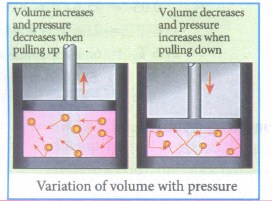
In other words, for an invariable mass of a perfect gas, at constant temperature, the product of pressure and volume is a constant.
Pressure x Volume = constant
PV = constant
31.
Cubical expansion:
(i) If there is an increase in the volume of a solid body due to heating, then the expansion is called cubical or volumetric expansion.
(ii) As in the cases of linear and areal expansion, cubical expansion is also expressed in terms of coefficient of cubical expansion. The ratio of increase in volume of the body per degree rise in temperature to its unit volume is called coefficient of cubical expansion. This is also measured in K-1.
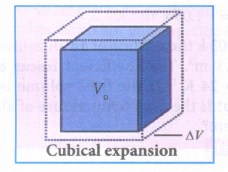
(iii) The equation relating to the change in volume to the change in temperature is given below:
\(\frac { \triangle V }{ { V }_{ 0 } } \) = αv ΔT
ΔV - Change in volume
V0 - Original volume
ΔT - Change in temperature
αv - Coefficient of cubical expansion.
32.
(i) If there is an increase in the area of a solid object due to heating, then the expansion is called superficial or areal expansion.
(ii) Superficial expansion is determined in terms of coefficient of superficial expansion. The ratio of increase in area of the body, per degree rise in temperature to its unit area is called coefficient of superficial expansion. Coefficient of superficial expansion is different for different materials. Its SI unit is also per Kelvin.
(iii) The equation relating to the change in area to the change in temperature is given below:
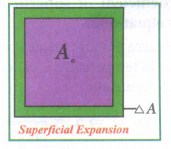
\(\frac { \triangle A }{ { A }_{ 0 } } \) =αA ΔT
ΔA - Change in area
A0 - Original area
ΔT - Change in area
αA - Coefficient of superficial expansion
33.
Linear expansion:
(i) When a body is heated or cooled, the length of the body changes due to change in its temperature. This expansion is said to be a linear or longitudinal expansion.
(ii) The ration of increase in length of a body per degree celsius rise in temperature to its unit length is called the coefficient of linear expansion. Its SI unit is per Kelvin. The value of coefficient of linear expansion is different for different materials.
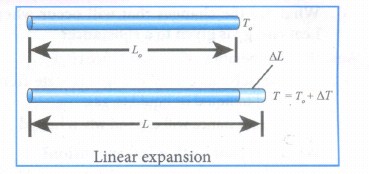
(iii) The equation relating the change in length to the change in temperature of a body is given below:
\(\frac { \triangle L }{ { L }_{ 0 } } \) =αL ΔT
ΔL - Change in length
L0 - Original length
ΔT - Change in temperature
αL - Coefficient of linear expansion.
34.
(i) When heat energy is supplied to a body, there can be an increase in the dimension of the object. This change in the dimension due to rise in temperature is called thermal expansion of the object.
(ii) The expansion of liquids (eg. mercury) can be seen when a thermometer is placed in warm water. All forms of matter (solid, liquid and gas) undergo expansion on heating.
(iii) When a solid is heated, the atoms gain energy and vibrate more vigorously. This results in the expansion of the solid.
(iv) The different types of expansion of solid are
i) Linear expansion
ii) Superficial expansion
iii) Cubical expansion
(v) When heated, the atoms in a liquid or gas gain energy and are forced further apart. The extent of expansion varies from substance to substance. For a given rise in temperature, a liquid will have more expansion than a solid and a gaseous substance has the highest expansion when compared with the other two.
35.
| Name of the solute | Formula of the solute | Solubility g/100 g water |
|---|---|---|
| Calcium carbonate | CaCO3(s) | 0.0013 |
| Sodium chloride | NaCI (s) | 36 |
| Ammonia | NH3(g) | 48 |
| Sodium hydroxide | NaOH(s) | 80 |
| Glucose | C6H12O6(s) | 91 |
| Sodium bromide | NaBr(s) | 95 |
| Sodium iodide | NaI(s) | 184 |
36.
| Solute | Solvent | Example |
|---|---|---|
| Solid solution | ||
| Solid | Solid | Copper dissolved in gold (Alloys) |
| Liquid | Solid | Mercury with sodium (amalgam) |
| Liquid solution | ||
| Solid | Liquid | Sodium chloride dissolved in water |
| Liquid | Liquid | Ethyl alcohol dissolved in water |
| Gas | Liquid | carbon-di-oxide dissolved in water (Soda water) |
| Gaseous solution | ||
| Liquid | Gas | Water vapour in air (cloud) |
| Gas | Gas | Mixture of Helium-Oxygen gases, |
37.
(i) When a beam of white light or composite light is refracted through any transparent media such as glass or water, it is split into its component colours.
(ii) This phenomenon is called as 'dispersion of light'.
(iii) The band of colours is termed as spectrum. This spectrum consists of following colours: Violet, Indigo, Blue, Green, Yellow, Orange, and Red. These colours are represented by the acronym "VIBGYOR".
(iv ) When white light is refracted by a transparent medium. Different coloured lights are bent through different angles. That is the angle of refraction is different for different colours.
(v) Angle of refraction is the smallest for red and the highest for violet.
(vi) From Snell's law, we know that the angle of refraction is determined in terms of the refractive index of the medium.
(vii) Hence, the refractive index of the medium is different for different coloured lights.
38.
According to optical property, it is classified into two types.
(i) Refracting telescope
(ii Reflecting telescope
(i) Refracting telescope: Lenses are used in this kind of telescopes. Galilean telescope, Keplerian telescope, Achromatic refractors, Apochromatic refractors are some Refracting telescope.
(ii) Reflecting telescope: Parabolic mirrors are used in these kind telescopes. Gregorian, Newtonian, Cassegrain telescope, Ritchey- Chretien telescope are some Reflecting telescopes. According to the things which are observed, Astronomical Telescope and Terrestrial Telescopes are the two major types of telescope.
39.
(i) Simple Microscope: Simple microscope is a convex lens of short focal length. It is held near the eye to get enlarged image of small objects.
(ii) Let an object (AB) of height 'h' is placed at a point within the principal focus (u < f) of the convex lens and the observer's eye placed just behind the lens.
(iii) As per this position the convex lens CJ produces an erect, virtual and enlarged image (A'B'). The image formed is in the same side of the object and the distance equal to the least distance of distinct vision (D) (D = 25 cm for normal human eye).
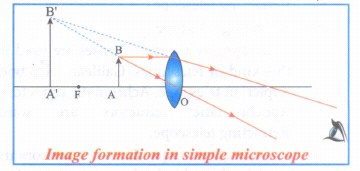
(iv) Magnification power (M): Ratio of the height of the image produced by the microscope h2) to the original height of the object (h1) is called magnification.
M=\(\frac { A'B' }{ AB } \)
Magnification M =\(\frac { height\ of\ the\ image }{ height\ of\ the\ object } \)
=\(\frac { { h }_{ 2 } }{ { h }_{ 1 } } \)
Magnification can also be defined as the ratio of distance of image (v) to the distance of object (u)
Magnification M =\(\frac { Distance\ of\ the\ image }{ Distance\ of\ the\ object } \)
=\(\frac { v }{ u } \)
Since, the image is virtual and erect; the Magnification (M) is taken as positive In simple Microscope,
when the image is formed at the near point
M=1+\(\frac { D }{ f } \)
when the image is formed at infinity
M=\(\frac { D }{ f } \).
40.
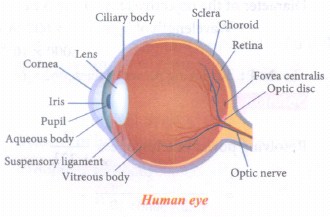
(i) The transparent layer cornea bends the light rays through pupil located at the centre part of the Iris.
(ii) The adjusted light passes through the eye lens. Eye lens is convex in nature. So, the light rays from the objects are converged and a real and inverted image is formed on retina.
(iii) Then, retina passes the received real and inverted image to the brain through optical nerves. Finally, the brain senses it as erect image.
41.
(i) The object is always placed on the left side of the lens.
(ii) All the distances are measured from the optical centre of the lens.
(iii) The distances measured in the same direction as that of incident light are taken as positive.
(iv) The distances measured against the direction of incident light are taken as negative. (v) The distances measured upward and perpendicular to the principal axis is taken as positive.
(v) The distances measured downward and perpendicular to the principal axis is taken· as negative.
42.
| S.No. | Convex Lens | Concave Lens |
| i | Focal length | + for convex lens - for concave lens |
| ii | Distance of object | - if the object is to the left object of the lens + if the object is to the right of the lens |
| iii | Distance of image | + if the image is formed on the right of the lens (real image) - if the image is formed one the left of the lens (virtual image) |
| iv | Magnification | + for erect images - for inverted images |
43.
(i) When a parallel beam of monochromatic (single coloured ) light passes through a gas or liquid or transparent solid, a part of light rays are scattered. This scattering is called Raman scattering (inelastic scattering).
(ii) Raman Scattering is defined as "The interaction of light ray with the particles of pure liquids or transparent solids, which leads to a change in wavelength or frequency".
(iii) The scattered light contains some additional frequencies (or wavelengths) other than that of incident frequency (or wavelength). This is known as Raman scattering or Raman Effect.
(iv) The modified lines are called 'Raman lines' and the unmodified lines are called as 'Rayleigh lines'. The lines having frequencies lower than the incident frequency is called stokes lines and the lines having frequencies higher than the incident frequency are called Anti-stokes lines.
44.
(i) First law of refraction : The incident ray of light, the refracted ray of light and the normal to the refracting surface all lie in the same plane.
(ii) Second law of refraction : The ratio of the sine of the angle of incidence and sine of the angle of refraction is equal to the ratio of refractive indices of the two media. This law is also known as Snell's law.
\(\frac{\operatorname{sin i}}{\sin x}=\frac{\mu_2}{\mu_1} .\).
45.
a) To measure the speed of an automobile:
(i) An electromagnetic wave is emitted by a source attached to a police car. The wave is reflected by a moving vehicle, which acts as a moving source.
(ii) There is a shift in the frequency of the reflected wave.
(iii) From the frequency shift, the speed of the car can be determined. This helps to track the over speeding vehicles.
b) Tracking a satellite:
(i) The frequency of radio waves emitted by a satellite decreases as the satellite passes away from the earth.
(ii) By measuring the change in the frequency of radio waves, the location of satellites is studied.
c) RADAR (Radio Detection And Ranging):
(i) In RADAR, radio waves are sent, and the reflected waves are detected by the receiver of the RADAR station.
(ii) From the frequency change, the speed and location of aeroplanes and aircrafts are tracked.
(d) SONAR: In SONAR, by measuring the Q change in the frequency between the sent signal and received signal, the speed of marine animals and submarines can be determined.
46.
(i) The listener moves towards or away from a stationary source.
(ii) The source moves towards or away from a stationary listener.
(iii) Both source and listener move towards or away from each other.
(iv) The medium moves when both source and listener are at rest
47.
(i) Some animals communicate with each other over long distances and also locate objects by sending sound signals and receiving the echo as reflected from targets.
(ii) The principle of echo is used in obstetric ultrasonography, which is used to create real-time visual images of the developing embryo or fetus in the mother's uterus. This is a safe testing tool, as it does not use any harmful radiations.
(iii) Echo is used to determine the velocity of sound waves in any medium.
48.
Yes. Hirudin is used as an anticoagulant in medical science.
49.
Man is omnivorous in his food habit. He eats plant and animal food. Therefore he has well CI developed incisors and canines. Rabbits are herbivorous in mode of nutrition. They need sharp incisors only. Canines or tearing teeth are hence absent in rabbits.
50.
A - Steel shell
B - Graphite rods - anode
C - Electrolyte
D - Graphite lining - cathode iron tank
(a) Hall's process.
(b) As oxygen is liberated at the mode (graphite rod) and combines to form CO2, It easily corrodes it. Hence, the graphite rod needs to the replaced often.
(c) It lowers the melting point of the electrolyte.
(d) 2Al2O3 ⟶ 4Al + 3O2 ↑
51.
Froth floatation:
(i) Principle: This process depends on the preferential wettability of the ore with oil (pine oil) and the gangue particles by water. Lighter ores, such as sulphide ores, are concentrated by this method. E.g. Zinc blende ZnS
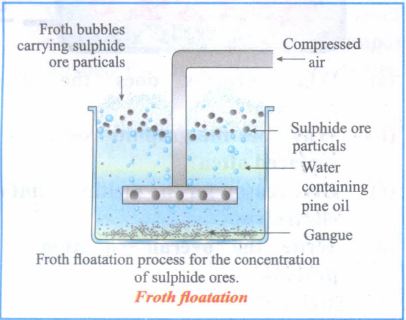
(ii) Method: The crushed ore is taken in a large tank containing oil and water and agitated with a current of compressed air. The ore is wetted by the oil and gets separated from the gangue in the form of froth. Since the 4 ore is lighter, it comes on the surface with the froth and impurities are left behind
52.
| S. No | Ore | Mineral |
|---|---|---|
| i) | A mineral from which a metal can be economically extracted. | A mineral may be a single compound or complex mixture of various compounds of metals found in the earth. |
| ii) | All ores are minerals. | All minerals are not ores. |
| iii) | Eg. Bauxite is an ore of aluminium. | Clay is a mineral. |
53.
(i) Acquired traits are the characters that cannot be passed from one generation to the next generation.
(ii) Characters which are inherited by the offspring from the parents and carried from one generation to another generation are called Inherited traits.
54.
(i) DNA molecule produces exact copies of its own structure during replication process.
(ii) The two strands of a DNA molecule have complementary base pairs. The nucleotides of each strand provide the information needed to produce its new strand.
Origin of replication: The specific points on the DNA, where the replication begins. It is the site of origin of replication. The two strands open and separate at this point forming the replication fork.
Unwinding of DNA molecule:
(i) The enzyme called helicase, bind to the origin of replication site.
(ii) They separate the two strands of the DNA. The enzyme called topoisomerase seperates the double helix above the replication fork and removes the twists formed during the unwinding process.
(iii) Each of the separated DNA strands function as template.
Formation of RNA primer: An RNA primer is a short segment of RNA nucleotides. The primer is synthesized by the DNA template close to the origin of replication.
Synthesis of new complimentary strand from the parent strand :
(i) After the formation of RNA primer, nucleotides are added with the help of an enzyme DNA polymerase and new complimentary strand of DNA is formed from each of the parent strand. The synthesis is unidirectional.
(ii) In one strand the daughter strand is synthesized as a continuous strand which is called leading strand.
(iii) In the order stand, short segment of DNA are synthesized. This strand is called lagging strand.
(iv) The short segments of DNA are called Okazaki fragments. The fragments are joined together by the enzyme DNA ligase.
(v) The replication stops when the replication fork of the two sides meet at a site called terminus which is situated opposite to origin of replication site
55.
Based on the position of centromere, the chromosomes are classified as Telocentric, Acrocentric, Submetacentric andMetacentric.
(i) Telocentric - The centromere is found on the proximal end. They are rod shaped chromosomes.
(ii) Acrocentric - The centromere is found at the one end with a short arm and long arm. They are also rod - shaped chromosomes.
(iii) Submetacentric - The centromere is found near the centre of the chromosome. Thus forming two unequal arms. They are J
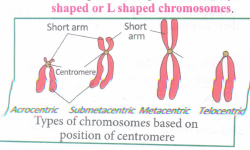
(iv) Metacentric - The centromere occurs in the centre of the chromosome and form two equal arms. They are V shaped chromosomes.
56.
(i) Kalaivani's mother took a small PVC pipe which has water in it and held in a horizontal position. Water came out drop by drop. When she raised one of the ends of the pipe, the water through the other end came out with a greater speed. She said initially when I was holding the pipe in a horizontal position, pressure at the both the ends are same. So water did not come out. The difference in pressure (Pressure difference) between the two ends is zero. But when I raised one of the ends, the top end has high pressure, and the bottom end has low pressure. Due to this pressure difference, water came out with a faster rate. So compare a conductor or a wire to this PVC pipe The wire is connected to a battery, whose one end has higher potential and the other end has lower potential. Due to this difference in potential, electrons from negative terminal (lower potential end) flow towards the positive terminal (higher potential end). Here electron flow is compared with the water flow and the electric potential is compared with the pressure. Kalaivani felt very happy, after hearing her mother's genius explanation.
(ii) When Kalaivani asked how to understand about the concept of resistance from her mother's scientific explanations, her mother continued. If the water pipe is smooth inside, then there is no charge in the speed of flow of water. i.e., zero resistance. But when the pipe has some blocks inside at different points, the water changes its speed of flow at different points, likewise, whenever electrons flow inside the conductor, they may collide with each other, due to which their speed will be resisted (blocked), which forms as electrical resistance. Her explanation made Kalaivani satisfied.
(iii) When two resistors of resistances, R1 & R2 are connected in series to a battery source.
\({ R }_{ s }={ R }_{ 1 }+{ R }_{ 2 }\)
When R1 & R2 are connected in parallel,
\(\frac { 1 }{ { R }_{ p } } +\frac { 1 }{ { R }_{ 1 } } +\frac { 1 }{ { R }_{ 2 } } \Rightarrow \frac { 1 }{ { R }_{ p } } =\frac { { R }_{ 2 }+{ R }_{ 1 } }{ { R }_{ 1 }{ R }_{ 2 } } \)
\({ R }_{ p }=\frac { { R }_{ 1 }{ R }_{ 2 } }{ { R }_{ 1 }+{ R }_{ 2 } } \)
57.
A small family is a happy family. If there are one or two children in a family, the parents can afford to give them good education, food, personal care and other facilities required for them to grow into healthy and happy individuals. Thus it is important for parents to plan a small family which will also build a healthy nation.
58.
(a) Placenta.
(b) A pregnant woman should eat a balanced diet and take lot of fresh fruits and vegetables.
(i) She should be stress free.
(ii) She should not take any medicines without the advice of a doctor
59.
(i) The spermatozoan consists of head, a middle piece and tail.
(ii) The sperm head is elongated and formed by the condensation of nucleus.
(iii) The anterior portion has a cap like structure called acrosome.
(iv) It contains hyaluronidase, an enzyme that helps the sperm to enter the ovum during fertilization.
(v) A short neck connects the head and middle piece which comprises the centrioles.
(vi) The middle piece contains the mitochondria which provides energy for the movement of tail.
(vii) It brings about sperm motility which is essential for fertilization.
60.
| Case 1: Lift is moving upward with an acceleration a |
Case 2: Lift is moving downward with an acceleration a |
Case 3: Lift is at rest | Case 4: Lift is falling down freely |
| R-W =Fnet= ma R=W + ma R=mg + ma R=m (g+a) R>W |
W -R=Fnet =ma R=W -ma R=mg-ma R = m (g-a) R < W |
Here acceleration is zero (a= 0) R=W R=mg R=W |
R = m(g-a) Here acceleration is equals to g (a = g) R= m(g-g) R=0 R=0 |
| Apparent weight is greater than the actual weight |
Apparent weight is lesser than the actual weight |
Apparent weight is equals to actual weight. |
Apparent weight is equals to zero |
61.
(i) Let M be the mass of the Earth and m be the mass of the object.
(ii) The entire mass of the earth is assumed to be concentrated at its centre. The radius of the earth is R (= 6378 km = 6400 km approximately).
(iii) By Newton's law of gravitation, the force acting on the object is given by
F = G M m / R2 ............. (A)
(iv) According to Newton's second law, the force acting on the object is given by the product of its mass and acceleration. Here acceleration of the is under action of gravity hence a =g.
F=ma =mg
F = weight = mg
Comparing equations (A) and (B), we get
g= GM/ R2
Acceleration due to gravity
g=\(\frac { GM }{ { R }^{ 2 } } \).
62.
(i) When birds fly they push the air downwards by their wings (Action).
(ii) The air pushes the bird upwards (Reaction).
(iii) When a person swims he pushes the water using hands backwards (Action), the water pushes the swimmer in forward direction (Reaction).
(iv) Rockets expel gas at high velocity (Action). The downward moving gas pushes the rocket in upward direction (Reaction).
(v) When we fire a bullet, the gun recoils back, Bullet is moving forward (action). The gun equalise this forward action by moving backward (reaction).
63.
(i) Gears: A gear is a circular wheel with teeth around its rim. It helps to change the speed of rotation of a wheel by changing the torque and helps to transmit power.
(ii) Seesaw: When the heavier person comes closer to the pivot point (fulcrum) the distance of the line of action of the force decreases. It causes less amount of torque to act on it. This enables the lighter person to lift the heavier person.
(iii) Steering Wheel: A small steering wheel enables you to manoeuore a car easily by transferring a torque to the wheels with less effort.
64.
(i) The natural state of all earthly objects is either the state of rest or the state of uniform motion.
(ii) An object in motion will continue to be in the same state of motion as long as no external force is applied.
(iii) When force is applied on objects, they resist any change in their state. This property of objects is called "inertia".
(iv) When dropped from a height in vacuum, objects of different size, shape and mass fall at the same rate arid reach the ground at the same time.
65.
| S.No |
RBC |
WBC |
|---|---|---|
| i | They are red in colour due to the presence of respiratory pigment hemoglobin. | They are colourless. |
| ii | They are biconcave/disc-shaped. | They are amoeboid in shape. |
| iii | The RBC is not classified into types, all red blood cells are the same. | They are classified into granulocytes and agranulocytes. |
| iv | The mature RBC's lack a nucleus. | They are nucleated. |
| v | They cannot change their shape. | They can change their shape and are capable of amoeboid movement. |
| vi | They are smaller than leucocytes. | They are larger than erythrocytes. |
| vii | They are responsible for the transport of respiratory gases (CO2 and O2). | They help to defend the body against pathogens. |
66.
Blood Groups
(i) The concept of blood grouping was discovered by Karl Landsteiner. He identified blood groups A, B and O. AB blood group was recognized by Decastello and Steini.
(ii) Human blood contains certain specific substances called agglutinogens or antigens (Ag) and agglutinins or antibodies (Ab). Antigens are found on the membrane surface of RBC. Antibodies are present in blood plasma. Based on the presence or absence of antigen and antibodies human blood group is classified into four groups called A, B, AB, and O. An individual has one of the four blood groups.
(iii) 'A' group individuals: Antigen 'A' is present on the surface of RBC and antibody b (anti-b) is present in the plasma.
(iv) 'B' group individuals: Antigen 'B' is present on the surface of RBC and antibody an (anti-a) is present in the plasma.
(v) 'AB' group individuals: Antigens A and B are present on the surface of RBC and antibodies are absent in the plasma.
(vi) 'O' group individuals: No antigen A or B are absent on the surface of RBC. However, the plasma contains both antibodies 'a' and 'b' (anti a and b).
Blood donation :
(i) In blood transfusion one must consider the antigen and antibody compatibility (matching) between the donor and the person receiving blood (recipient). When an individual receives a mismatched blood group from the donor agglutination (clumping) of blood occurs in the body which leads to death.
67.
| Component | Use Of The Component | Symbol Used | |
| i) | A resistor of resistance R | Used to fix the magnitude of the current through the circuit | 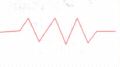 |
| ii) | Variable resistor or Rheostat | Used to select the magnitude of the current through the circuit. | 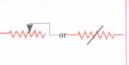 |
| iii) | Ammeter | Used to measure the current. | 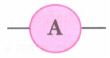 |
| iv) | Voltmeter | Used to measure the potential difference. | 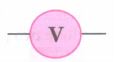 |
| v) | Galvano meter | Used to indicate the direction of current. | 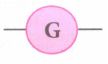 |
68.
Supply Voltage is same
Amount of heat produced is also same
Time taken to heat water t = 15 min.
\(H=\frac { { V }^{ 2 } }{ R } .t\quad [H={ I }^{ 2 }Rt\Rightarrow (V=IR)\therefore I=\frac { V }{ R } ]\)
\(\therefore \frac { { R }_{ 1 } }{ { R }_{ 2 } } =\frac { { t }_{ 1 } }{ { t }_{ 2 } } \quad ...(1)\)
\(R\alpha l\quad \quad \quad [R=\rho \frac { l }{ A } ]\)
\(\frac { { R }_{ 1 } }{ { R }_{ 2 } } =\frac { { l }_{ 1 } }{ { l }_{ 2 } } \quad \quad \quad ...(2)\)
From (i) and (2)
\(\frac { { l }_{ 1 } }{ { l }_{ 2 } } =\frac { { t }_{ 1 } }{ { t }_{ 2 } } =\frac { 15 }{ { t }_{ 2 } } \quad \quad ....(iii)\)
\({ l }_{ 2 }=\frac { 1 }{ 3 } { l }_{ 1 }\Rightarrow \frac { { l }_{ 1 } }{ { l }_{ 2 } } =3\)
Sub in (iii) \(3=\frac { 15 }{ { t }_{ 2 } } \)
\(\therefore { t }_{ 2 }=\frac { 15 }{ 3 } =5min\)
Time taken to heat \(\frac{1}{3}\) length of the wire = 5 min
69.
The atomicity of an element can be derived using Avogadro's hypothesis. Let us consider the following equation
| H2(g) | + | CI2(g) | ➝ | 2HCI(g) |
| 1 volume | + | 1 volume | ➝ | 2 volumes (By Gay-Lussac's Law) |
According to Avogadro's law, 1 volume of any gas occupy 'n' number of molecules.
| n molecules |
+ n molecules |
➝ 2n molecules |
if n = 1 then
| 1 molecule | + | 1 molecule | ⟶ | 2 molecules. |
| \(\frac{1}{2}\) molecule | + | \(\frac{1}{2}\) molecule | ➝ | 1 molecule |
(i) 1 molecule of hydrogen chloride gas is made up of \(\frac{1}{2}\) molecule of hydrogen and \(\frac{1}{2}\) molecule of chlorine
(ii) But 1 molecule of hydrogen chloride contains one atom of hydrogen and I atom of chlorine
(iii) Hence \(\frac{1}{2}\) molecule of hydrogen = 1 atom of hydrogen
(iv) Or 1 molecule of hydrogen = 2 atoms of hydrogen
(v) So the atomicity of hydrogen is 2, and molecular formula is H2
Similarly,
\(\frac{1}{2}\) molecule of chlorine = 1 atom of chlorine 1molecule of chlorine = 2 atoms of chlorine So the atomicity of chlorine is 2, and its molecular formula is Cl2
70.
Applications of Avogadro's hypothesis
(i) It explains Gay-Lussac's law.
(ii) It helps in the determination of atomicity of gases.
(iii) Molecular formula of gases can be derived using Avogadro's law.
(iv) It determines the relation between molecular mass and vapour density.
(v) It helps to determine Gram molar volume of all gases (i.e. 22.4 lit at S.T.P)
71.
(i) The heart is pear shaped and lies in the thoracic cavity in between the lungs. It is enclosed by pericardium, a double layered membrane.
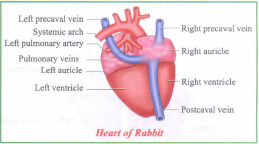
(ii) The heart is four chambered with two auricles and two ventricles. The right and left auricles are separated by interauricular septum, similarly right and left ventricles are separated by interventricular septum.
(iii) The right auricle opens into the right ventricle by right auriculoventricular aperture, guarded by a tricuspid valve.
(iv) The left auricle opens into the left ventricle by left auriculoventricular aperture guarded by a bicuspid valve or mitral valve.
(v) The opening of the pulmonary artery and aorta are guarded by three semilunar valves.
(vi) The right auricle receives deoxygenated blood through two precaval (superior vena cava) and one postcaval (inferior vena cava) veins from all parts of the body.
(vii) The left auricle receives oxygenated blood from the pulmonary veins from the lungs.
(viii) From the right ventricle arises pulmonary trunk which carries the deoxygenated blood to the lungs and from the left ventricle arises the systemic arch (aorta) which supplies oxygenated blood to all parts of the body.
72.
Rani did not wear a helmet. Some people wear a helmet but don't fasten the strap. When they fall down from the bike, the helmet falls off and they are injured. Thus a helmet worn properly can save lives.

10th Standard Syllabus & Materials
10th Standard
TN 10th English Prose - 2 - The Night the Ghost Got in Important Questions And Answers Study Material - QB365 Set A
NEW10th Standard
TN 10th English Supplementary - 1 - The Tempest Important Questions And Answers Study Material - QB365 Set A
NEW10th Standard
TN 10th English Poem - 1 - Life Important Questions And Answers Study Material - QB365 Set A
NEW10th Standard
TN 10th English Prose - 1 - His First Flight Important Questions And Answers Study Material - QB365 Set A



Tamilnadu Stateboard 10th Standard Subjects
Tamilnadu Stateboard Standards





