
 100% FREE ACCESS
10th Standard Syllabus & Materials
10th Standard
TN 10th English Prose - 4 - The Attic Important Questions And Answers Study Material - QB365 Set A
NEW10th Standard
TN 10th English Supplementary - 3 - The Story of Mulan Important Questions And Answers Study Material - QB365 Set A
NEW10th Standard
TN 10th English Poem - 3 - I am Every Woman Important Questions And Answers Study Material - QB365 Set A
NEW10th Standard
TN 10th English Prose - 3 - Empowered Women Navigating The World Important Questions And Answers Study Material - QB365 Set A
NEW10th Standard
TN 10th English Supplementary - 2 - Zigzag Important Questions And Answers Study Material - QB365 Set A
NEW10th Standard
TN 10th English Poem - 2 - The Grumble Family Important Questions And Answers Study Material - QB365 Set A

Published on: 04/10/2022
QB365 provides a detailed and simple solution for every Possible Creative Questions in Class 10th Science Subject -Electricity, English Medium. It will help Students to get more practice questions, Students can Practice these question papers in addition to score best marks.
Download Tamil Nadu 10th Standard Science question papers, model tests, one-mark questions, important questions, and public exam papers in PDF format. Free study materials and answer keys for TN State Board students.
Questions + Answers key
Take MCQ Science Test1.
Derive the equation of Joule's law of heating.
2.
Find the total resistance of parallel connection of series resistors?
3.
Find the effective resistance of series connection of parallel resistors.
4.
Define parallel & series connection.
5.
Write electrical use of the components in electrical circuit.
6.
Should the resistance of an ammeter be low or high? Give reason.
7.
Draw a closed circuit diagram consisting of resistor, ammeter, voltmeter cell and a point key
8.
Give the formula for the following
(i) Ohm's law
(ii) Joules law
(iii) Effective resistance for resistance in series
(iv) Power
(v) Specific resistance
9.
Out of 100 W and 40 W bulbs, which has high electrical resistance when in use.
10.
Write the difference between electric energy and electric power.
11.
Write the difference between conductor and insulator.
12.
Write the difference between ammeter and voltmeter.
13.
What happens to resistance of the conductor
(i) when temperature is increased
(ii) length is doubled
(iii) area of cross section is increases
14.
Why copper were is used as connecting wires in the circuit?
15.
What is the difference between open and closed circuits?
1.
(i) T be the current flowing through a resistor of resistance 'R' and 'V' be the potential difference across the resistor. The charge flowing through the circuit for a time interval 't' is 'Q':
(ii) The work done in moving the charge Q across the ends of the resistor with a potential difference of V is VQ. This energy spent by the source gets dissipated in the resistor as heat. Thus, the heat produced in the resistor is:
H = W = VQ
(iii) You know that the relation between the charge and current is Q = I t. Using this, you get
H = V I t ------------------------ (A)
From Ohm's Law, V = I R. Hence, you have
H = I2 R t ------------------------ (B)
This is known as Joule's law of heating.
2.
A connection of a set of series resistors connected in a parallel circuit, is a parallel-series circuit. Let R1 and R2 be connected in series to give an effective resistance of Rs1. Similarly, let R3 and R4 be connected in series to give an effective resistance of Rs2. Then, both of these serial segments are connected in parallel (Figure).
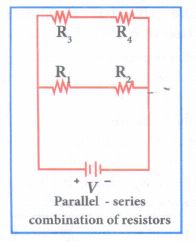
Using the equation Rs = R1 + R2
Rs1 =R1 + R2'
RS2 = R3 + R4
Finally, using equation \(\left( \frac { 1 }{ { R }_{ p } } =\frac { 1 }{ { R }_{ 1 } } +\frac { 1 }{ { R }_{ 2 } } \right) \), the net effective resistance is given by \(\frac { 1 }{ { R }_{ total } } =\frac { 1 }{ { R }_{ S1 } } +\frac { 1 }{ { R }_{ S2 } } \)
3.
The connection of a set of parallel resistors that are connected in series, is a series - parallel circuit
Let R1 and R2 be connected in parallel to give an effective resistance of Rp1. Similarly, let R3 and R4 be connected in parallel to give an effective resistance of Rp2. Then, both of these parallel segments are connected in series (Figure).
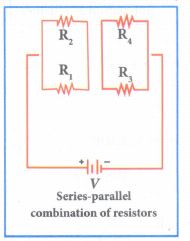
For parallel connection, the effective resistance is \(\frac { 1 }{ { R }_{ p } } =\frac { 1 }{ { R }_{ 1 } } +\frac { 1 }{ { R }_{ 2 } } \)
Using equation
\(\frac { 1 }{ { R }_{ p1 } } =\frac { 1 }{ { R }_{ 1 } } +\frac { 1 }{ { R }_{ 2 } } \)
\(\frac { 1 }{ { R }_{ p2 } } =\frac { 1 }{ { R }_{ 3 } } +\frac { 1 }{ { R }_{ 4 } } \)
Rp1 & Rp2 are connected in series Finally, using equation Rs = R1 + R2 the net effective resistance is given by
\({ R }_{ total }={ R }_{ p1 }+{ R }_{ p2 }\)
4.
(i) A series circuit connects the components one after the other to form a 'single loop'. A series circuit has only one loop through which current can pass.
(ii) A parallel circuit has two or more loops through which current can pass. If the circuit is disconnected in one of the loops, the current can still pass through the other loop(s).
5.
(i) Resistor is used to fix the magnitude of the current through the circuit
(ii) Rheostat is used to fix the magnitude of the current through the circuit
(iii) Ammeter is used to measure the current.
(iv) Voltmeter is used to measure the potential difference.
6.
Resistance of an ammeter should be low because almost all the current in the circuit is allowed to pass through ammeter.
7.
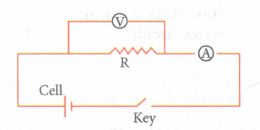
8.
(i) V = IR
(ii) H = I2Rt
(iii) Rs = R1 + R2
(iv) P = VI
(v) \(\rho=R\frac{A}{L}\)
9.
40W. for the same applied voltage, power \(\alpha \frac{1}{resistance}\) If the power is less, higher will be its resistance.
10.
| Electric power | Electric energy | |
| i) | Rate of consumption of electric energy | The work done by the source in maintaining the flow of electric current |
| ii) | P = \(\frac{W}{t}\) | E = P x t |
| iii) | SI unit is watt | SI unit is joule |
11.
| S. No | Conductor | Insulator |
| i) | Materials which | Materials which do not allow current |
| ii) | Resistivity is less | Resistivity is high |
12.
| S. No | Ammeter | Voltmeter |
| i) | It measures current | It measures potential difference |
| ii) | It is connected in series | It is connected in |
13.
(i) When temp is increased, resistance is increased
(ii) When length is doubled, resistance is increased
(iii) When area of cross section is increased, resistance is increased.
14.
Copper wire is used as connecting wires because copper has very low resistivity.
15.
| S. No | Open circuit | Closed circuit |
| i) | Key is open | Key is closed |
| ii) | No current flows through it | Current flows through it |

10th Standard Syllabus & Materials
10th Standard
TN 10th English Prose - 2 - The Night the Ghost Got in Important Questions And Answers Study Material - QB365 Set A
NEW10th Standard
TN 10th English Supplementary - 1 - The Tempest Important Questions And Answers Study Material - QB365 Set A
NEW10th Standard
TN 10th English Poem - 1 - Life Important Questions And Answers Study Material - QB365 Set A
NEW10th Standard
TN 10th English Prose - 1 - His First Flight Important Questions And Answers Study Material - QB365 Set A



Tamilnadu Stateboard 10th Standard Subjects
Tamilnadu Stateboard Standards





