
 100% FREE ACCESS
10th Standard Syllabus & Materials
10th Standard
TN 10th English Prose - 4 - The Attic Important Questions And Answers Study Material - QB365 Set A
NEW10th Standard
TN 10th English Supplementary - 3 - The Story of Mulan Important Questions And Answers Study Material - QB365 Set A
NEW10th Standard
TN 10th English Poem - 3 - I am Every Woman Important Questions And Answers Study Material - QB365 Set A
NEW10th Standard
TN 10th English Prose - 3 - Empowered Women Navigating The World Important Questions And Answers Study Material - QB365 Set A
NEW10th Standard
TN 10th English Supplementary - 2 - Zigzag Important Questions And Answers Study Material - QB365 Set A
NEW10th Standard
TN 10th English Poem - 2 - The Grumble Family Important Questions And Answers Study Material - QB365 Set A

Published on: 04/10/2022
QB365 provides a detailed and simple solution for every Possible Creative Questions in Class 10th Science Subject -Electricity, English Medium. It will help Students to get more practice questions, Students can Practice these question papers in addition to score best marks.
Download Tamil Nadu 10th Standard Science question papers, model tests, one-mark questions, important questions, and public exam papers in PDF format. Free study materials and answer keys for TN State Board students.
Questions + Answers key
Take MCQ Science Test1.
Explain Electrical Resistivity.
2.
Explain the Ohm’s Law.
3.
Explain Electrical potential difference.
4.
Tabulate the Symbols of some components of a circuit.
5.
The Resistivities of some substances are given below:
| Material | Resistivity (Ωm) |
| A | 1.6 x 10⁻⁸ |
| B | 6.4 x 10⁻⁸ |
| C | 10 x 10-8 |
| D | 96 x 10-8 |
| E | 100 x 10-6 |
Answer the following questions in relation to them given justification for each:
(i) Which material is best for making connecting cords?
(ii) Which material do you suggest to be used in heater elements?
(iii) You have two wires of same length and same thickness. One is made of material A and another of material D. If the resistance of wire made of A is 2Ω, what is the resistance of the other wire?
6.
V-I graphs for the two wires A and B are shown in the figure. If we connect both the wires one by one to the same battery, which of the two will produce more heat per unit time? Give justification for your answer.
7.
Three V-I graphs are drawn individually for two resistors and their series combination. Out of A, B, C which one represents the graph for series combination of the other two. Give reason for y or answer.
8.
The electric power consumed by a device may be calculated by using either of the two expressions : P = I2 R or P = V2/R. The first expression indicates that the power is directly proportional to R, whereas the second expression indicates inverse proportionally. How can the seemingly different dependence of P on R in these expression be explained?
9.
An electrician puts a fuse of rating 5 A in that part of domestic electrical circuit in which an electrical heater of rating 1.5 kW, 220V is operating. What is likely to happen in this case and why? What change, if any needs to be made?
10.
Two metallic wires A and B of same material are connected in parallel. Wire A has length 1 and radius r and wire B has length 2l and radius 2r. Compute the ratio of the total resistance of parallel combination and the resistance of wire A.
11.
Two metallic wires A and B are connected in series. Wire A has length l and radius r, while wire B has length 2l and radius 2r. Find the ratio of the total resistance of series combination and the resistance of wire A, if both the wires are of same material.
12.
The following table gives the resistivity of three samples:
| Sample: | A | B | C |
| Resistivity: | 1.6 x 10⁻⁸Ωm | 5.1 x 10⁻⁸Ωm | 10.6 x 10⁻⁸Ωm |
Which of them is suitable for heating elements of electrical appliances and why?
13.
Electrical resistivities of some substances at 200 C are given below:
| Silver | 1.60 x 10⁻⁸Ω- m |
| Copper | 1.62 x 10⁻⁸Ω-m |
| Tungsten | 5.20 x 10⁻⁸Ω - m |
| Iron | 10.0 x 10⁻⁸Ω-m |
| Mercury | 94.0 x 10⁻⁸Ω-m |
| Nichrome | 10.0 x 10⁻⁸Ω-m |
Answer the following question in relation to them:
(i) Among silver and copper, which one is a better conductor? Why?
(ii) Which material would you advise to be used in electrical heating devices? Why?
14.
The electrical resistivity of few materials is given below in ohm-meter.
| Material | Resistivity (in ohm-metre) |
| A | 6.84 x 10⁻⁸ |
| B | 1.60 x 10⁻⁸ |
| C | 2.30 x 10¹⁷ |
| D | 1.00 x 10⁻⁶ |
| E | 2.50 x 10¹² |
| F | 4.40 x 10⁻⁸ |
Which of these materials can be used for making element of heating device?
15.
Following table gives the resistivity of three samples in (Ωm)
| Sample | A | B | C |
| Resistivity in Ω-m | 1.6 x 10⁻⁸ | 7.5 x 10⁻⁷ | 44 x 10-6 |
Which of them is a good conductor? And which of them is an insulation? Explain why?
1.
i) The resistance of any conductor ‘R’ is directly proportional to the length of the conductor ‘L’ and is inversely proportional to its area of cross section ‘A’
ii) R\(\alpha\) L, R\(\alpha\) 1/A,
Hence, R\(\alpha\) L/A
Therefore, R = \(\rho \) L/A
Where, \(\rho \) (rho) is a constant, called as electrical resistivity or specific resistance of the material of the conductor.
From equation (1), \(\rho \) =RA/L
If L= 1m, A= 1m2 then, from the above equation), \(\rho \) =R
iii) Hence, the electrical resistivity of a material is defined as the resistance of a conductor of unit length and unit area of cross section. Its unit is ohm metre.
iv) Electrical resistivity of a conductor is a measure of the resisting power of a specified material to the passage of an electric current. It is a constant for a given material.
2.
A German physicist, Georg Simon Ohm established the relation between the potential difference and current, which is known as Ohm’s Law.
According to Ohm’s law, at a constant temperature, the steady current ‘I’ flowing through a conductor is directly proportional to the potential difference ‘V’ between the two ends of the conductor.
I \(\alpha\) V. Hence, I/V = constant.
The value of this proportionality constant is found to be 1/R
Therefore, I = (I /R) V
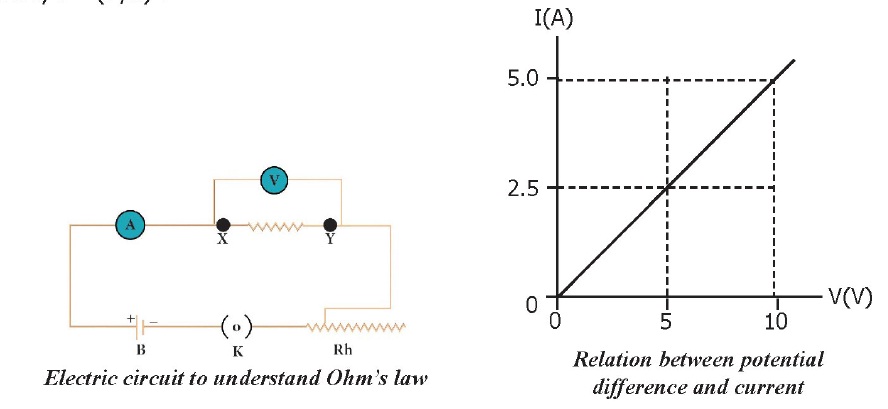
V = IR Here, R is a constant for a given material (say Nichrome) at a given temperature and is known as the resistance of the material. Since, the potential difference V is proportional to the current I, the graph between V and I is a straight line for a conductor.
3.
i) The electric potential difference between two points is defined as the amount of work done in moving a unit positive charge from one point to another point against the electric force.

ii) Electrical potential moved a charge Q from a point A to another point B. Let ‘W’ be the work done to move the charge from A to B. Then, the potential difference between the points A and B is given by the following expression.
iii) Potential Difference (V) = Work done (w)/ Charge (Q).
iv) Potential difference is also equal to the difference in the electric potential of these two points. If VA and VB represent the electric potential at the points A and B respectively, then, the potential difference between the points A and B is given by:
V= VA- VB (If VA is more than VB)
V = VB- VA (If VB is more than VA).
4.
| Component | Use of the component | Symbol used |
| Resistor | Used to fix the magnitude of the current through a circuit | 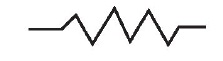 |
| Variable resistor or Rheostat | Used to select the magnitude of the current through a circuit. | 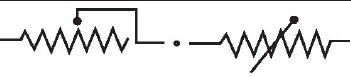 |
| Ammeter | Used to measure the current. | 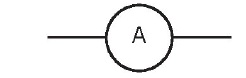 |
| Voltmeter | Used to measure the potential difference. | 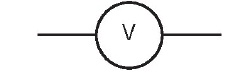 |
| Galvanometer | Used to indicate the direction of current |  |
| A diode | A diode has various uses, 7 which you will study in higher classes | 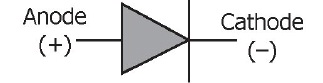 |
| Light Emitting Diode (LED) | LED has various uses which you will study in higher classes. | 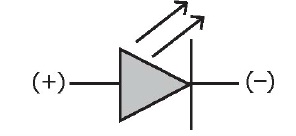 |
| Ground connection | Used to provide protection to the electrical components. It also serves as a reference point to measure the electric potential | 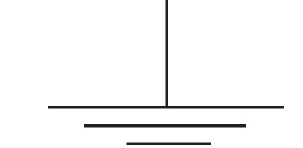 |
5.
(i) Material A is best for making connecting cords as its resistivity is the lowest one.
(ii) For heater elements, material of high resistivity is used.
Therefore, the material E is to be used in heater elements.
(iii) \(R=\frac { \rho l }{ A } \)Therefore, \(\frac { { R }_{ 1 } }{ { R }_{ 2 } } =\frac { { \rho }_{ 1 } }{ { \rho }_{ 2 } } \) (as I and A are same for both wires).
\(\frac { { R }_{ 2 } }{ { R }_{ 1 } } =\frac { { \rho }_{ 2 } }{ { \rho }_{ 1 } } =\frac { { 98\times 10 }^{ -8 } }{ 1.6\times { 10 }^{ -8 } } =61.25\)
6.
Heat produced per unit time = V^2/R
Now slope of V-I graph = R (resistance of wire).
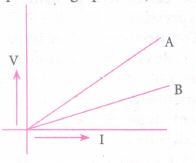
Since slope of V-I graph for wire A is greater than the slope of V-I graph for wire B, therefore, resistance of wire A is greater than the resistance of wire B, Hence, more heat will be produced per unit time in wire B than in wire A.
7.
Slope of V-I graph = resistance of a resistor. When two resistors are connected in series, volts the resistance of this combination (R = R1 + R2) is more than the resistance of both the resistors.
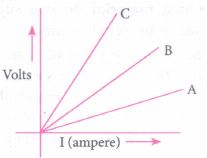
Since, slope of C is greater than the slopes of A and B. Therefore, C represents the graph for series combination of the other two.
8.
P = I2 R is used when current flowing in every component of the circuit is constant. This is the - case of series combination of the devices in the circuit.
P = V2/R is used when potential difference (V) across every component of the circuit is constant. This expression is used in case of parallel combination in the circuit. In series combination, R is greater than the value of R in parallel combination.
9.
The fuse will melt and the circuit breaks if electric current more than the rating of fuse (i.e., 5 A) flows in the circuit. Electric current flowing in the circuit,
\(I=\frac { P }{ V } =\frac { 1.5\times 1000W }{ 220V } =6.82A\)
Since, current flowing in the circuit (6.82 A) is more than the rating of fuse (5 A), therefore, the fuse will melt and the electrical heater does not work. To operate the heater, fuse of rating 10 A is to be put in the circuit.
10.
Resistance of wire A, \({ R }_{ 1 }=\frac { \rho l }{ A } =\frac { \rho l }{ { \pi r }^{ 2 } } \)
Resistance of wire B, \({ R }_{ 2 }=\frac { \rho l' }{ A' } \)
\(=\frac { \rho \times 2l }{ \pi { (2r) }^{ 2 } } =\frac { \rho l }{ 2\pi { r }^{ 2 } } \)
Total resistance of the series combination, \(\frac { 1 }{ R } =\frac { 1 }{ { R }_{ 1 } } +\frac { 1 }{ { R }_{ 2 } } \)
or \(\frac { 1 }{ R } =\frac { \pi { r }^{ 2 } }{ \rho l } +\frac { 2\pi { r }^{ 2 } }{ \rho l } \)
\(=\frac { 3\pi { r }^{ 2 } }{ \rho l } \)
\(R=\frac { \rho l }{ 3\pi { r }^{ 2 } } \)
\(\therefore \frac { R }{ { R }_{ 1 } } =\frac { \rho l }{ 3\pi { r }^{ 2 } } \times \frac { \pi { r }^{ 2 } }{ \rho l } \)
\(=\frac { 1 }{ 3 } \)
11.
Resistance of wire A, \({ R }_{ 1 }=\frac { \rho l }{ A } =\frac { \rho l }{ { \pi r }^{ 2 } } \)
Resistance of wire B, \({ R }_{ 2 }=\frac { \rho l' }{ A' } \)
\(=\frac { \rho \times 2l }{ \pi { (2r) }^{ 2 } } =\frac { \rho l }{ 2\pi { r }^{ 2 } } \)
Total resistance of the series combination, R = R1 + R2
or \(R=\frac { \rho l }{ { \pi r }^{ 2 } } +\frac { \rho l }{ { 2\pi r }^{ 2 } } \)
\(\\ =\frac { 3\rho l }{ { 2\pi r }^{ 2 } } \)
\(\therefore \frac { R }{ { R }_{ 1 } } =\frac { 3\rho l }{ { 2\pi r }^{ 2 } } \times \frac { { \pi r }^{ 2 } }{ \rho l } \)
\(=\frac { 3 }{ 2 } \)
12.
For making the heating elements of electrical appliances, alloy is used instead of a pure metal This is because alloy does not burn even at higher temperature. The resistivity of sample C is of the order of an alloy, so sample C is suitable for heating elements of electrical appliances.
13.
(i) A material whose electrical resistivity is low is a good conductor of electricity. Since the electrical resistivity of silver is less than that of the copper, so silver is a better conductor than the copper.
(ii) For making the elements of heating devices, alloy is used instead of a pure metal This is because the resistivity of an alloy is more than that of a metal and alloy does not burn (or oxidise) even at higher temperature. Out of the given substances, nichrome is an alloy, so nichrome is used in electrical heating devices.
14.
For making element of a heating device, we use alloy instead of pure metals. The resistivity of material D lies in the range of resistivities of alloys. Therefore, material D can be used for making element of a heating device.
15.
A material having low resistivity is a good conductor. Since, resistivity of sample A is the least among all other materials, so sample A is good conductor. A material having high value of resistivity is an insulator. Therefore, sample C is an insulator.

10th Standard Syllabus & Materials
10th Standard
TN 10th English Prose - 2 - The Night the Ghost Got in Important Questions And Answers Study Material - QB365 Set A
NEW10th Standard
TN 10th English Supplementary - 1 - The Tempest Important Questions And Answers Study Material - QB365 Set A
NEW10th Standard
TN 10th English Poem - 1 - Life Important Questions And Answers Study Material - QB365 Set A
NEW10th Standard
TN 10th English Prose - 1 - His First Flight Important Questions And Answers Study Material - QB365 Set A



Tamilnadu Stateboard 10th Standard Subjects
Tamilnadu Stateboard Standards





