
 100% FREE ACCESS
10th Standard Syllabus & Materials
10th Standard
TN 10th English Prose - 4 - The Attic Important Questions And Answers Study Material - QB365 Set A
NEW10th Standard
TN 10th English Supplementary - 3 - The Story of Mulan Important Questions And Answers Study Material - QB365 Set A
NEW10th Standard
TN 10th English Poem - 3 - I am Every Woman Important Questions And Answers Study Material - QB365 Set A
NEW10th Standard
TN 10th English Prose - 3 - Empowered Women Navigating The World Important Questions And Answers Study Material - QB365 Set A
NEW10th Standard
TN 10th English Supplementary - 2 - Zigzag Important Questions And Answers Study Material - QB365 Set A
NEW10th Standard
TN 10th English Poem - 2 - The Grumble Family Important Questions And Answers Study Material - QB365 Set A

Published on: 04/10/2022
QB365 provides a detailed and simple solution for every Possible Creative Questions in Class 10th Science Subject -Laws of Motion, English Medium. It will help Students to get more practice questions, Students can Practice these question papers in addition to score best marks.
Download Tamil Nadu 10th Standard Science question papers, model tests, one-mark questions, important questions, and public exam papers in PDF format. Free study materials and answer keys for TN State Board students.
Questions + Answers key
Take MCQ Science Test1.
Deduce the relation between g and G.
2.
Write a detailed note on moment of the force.
3.
Write any three applications of torque.
4.
Give a detailed account on Galileo's concepts about force, motion and inertia of bodies.
5.
Discuss the apparent weight of a man in lift?
6.
Derive the Relation between g and G?
7.
Give examples for Newton's third law.
8.
Give the application of torque.
9.
What are the concepts prepared by Galileo?
1.
(i) When a body is at rest on the surface of the Earth, it is acted upon by the gravitational force of the Earth.
(ii) Let us compute the magnitude of this force in two ways.
(iii) Let, M be the mass of the Earth and m be the mass of the body.
(iv) The entire mass of the Earth is assumed to be concentrated at its centre.
(v) The radius of the Earth is R = 6378 km (= 6400 km approximately).
(vi) By Newton's law of gravitation, the force acting on the body is given by
\(\mathrm{F}=\frac{\mathrm{GMm}}{\mathrm{R}^{2}}\) ..........(i)
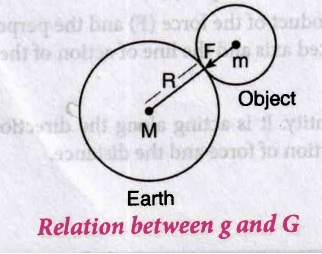
(vii) Here, the radius of the body considered is negligible when compared with the Earth's radius.
(viii) Now the same force can be obtained from Newton's second law of motion.
(ix) According to this law, the force acting on the body is given by the product of its mass and acceleration (called as weight).
(x) Here, acceleration of the body is under the action of gravity hence a = g
F = ma = mg
F = weight = mg ..........(2)
Comparing equation (1) and (2) we get,
\(\mathrm{mg}=\frac{\mathrm{GMm}}{\mathrm{R}^{2}}\)
Acceleration due to gravity
\(\mathbf{g}=\frac{\mathbf{G M}}{\mathbf{R}^{2}}\)
2.
(i) The rotating or turning effect of a force about a fixed point or fixed axis is called moment of the force about that point or torque (\(\tau\)).
(ii) It is measured by the product of the force (F) and the perpendicular distance (d) between the fixed point or the fixed axis and the line of action of the force.
\(\tau=\mathrm{F} \times \mathrm{d}\)
(iii) Torque is a vector quantity. It is acting along the direction, perpendicular to the plane containing the line of action of force and the distance.
(iv) Its SI unit is Nm.
Couple:
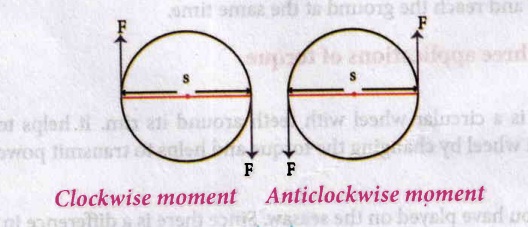
(i) Two equal and unlike parallel forces applied simultaneously at two distinct points constitute a couple.
(ii) The line of action of the two forces does not coincide.
(iii) It does not produce any translatory motion since the resultant is zero.
(iv) But, a couple results in of the rotation of the body.
(v) Rotating effect of a couple is known as moment of a couple.
Examples: Turning a tap, winding or unwinding a screw, spinning of a top, etc.
(vi) Moment of a couple is measured by the product of any one of the forces and the perpendicular distance between the line of action of two forces.
(vii) The turning effect of a couple is measured by the magnitude of its moment.
(viii) Moment of a couple = Force x perpendicular distance between the line of action of forces
M = F x S
(ix) The unit of moment of a couple is newton metre (N m) in SI system and dyne cm in CGS system.
(x) By convention, the direction of moment of a force or couple is taken as positive if it is rotated in the anti-clockwise direction and negative if it is rotate in the clockwise direction.
3.
Gears:
A gear is a circular wheel with teeth around its rim. It helps to change the speed of rotation of a wheel by changing the torque and helps to transmit power.
Seesaw:
(i) Most of you have played on the seesaw. Since there is a difference in the weight of the persons sitting on it, the heavier person lifts the lighter person.
(ii) When the heavier Person comes closer to the pivot point (fulcrum) the distance of the line of action of the force decreases.
(iii) It causes less amount of torque to act on it. This enables the lighter person to lift the heavier Person.
Steering Wheel:
A small steering wheel enables you to turn a car easily by transferring a torque to the wheels with less effort.
4.
Galileo proposed the following concepts about force, motion and inertia of bodies:
(i) The natural state of all earthly bodies is either the state of rest or the state of uniform motion.
(ii) A body in motion will continue to be in the same state of motion as long as no external force is applied.
(iii) When a force is applied on bodies, they resist any change in their state. This property of bodies is called 'inertia'.
(iv) When dropped from a height in vacuum, bodies of different size, shape and mass fall at the same rate and reach the ground at the same time.
5.
| Case 1: Lift is moving upward with an acceleration a |
Case 2: Lift is moving downward with an acceleration a |
Case 3: Lift is at rest | Case 4: Lift is falling down freely |
| R-W =Fnet= ma R=W + ma R=mg + ma R=m (g+a) R>W |
W -R=Fnet =ma R=W -ma R=mg-ma R = m (g-a) R < W |
Here acceleration is zero (a= 0) R=W R=mg R=W |
R = m(g-a) Here acceleration is equals to g (a = g) R= m(g-g) R=0 R=0 |
| Apparent weight is greater than the actual weight |
Apparent weight is lesser than the actual weight |
Apparent weight is equals to actual weight. |
Apparent weight is equals to zero |
6.
(i) Let M be the mass of the Earth and m be the mass of the object.
(ii) The entire mass of the earth is assumed to be concentrated at its centre. The radius of the earth is R (= 6378 km = 6400 km approximately).
(iii) By Newton's law of gravitation, the force acting on the object is given by
F = G M m / R2 ............. (A)
(iv) According to Newton's second law, the force acting on the object is given by the product of its mass and acceleration. Here acceleration of the is under action of gravity hence a =g.
F=ma =mg
F = weight = mg
Comparing equations (A) and (B), we get
g= GM/ R2
Acceleration due to gravity
g=\(\frac { GM }{ { R }^{ 2 } } \).
7.
(i) When birds fly they push the air downwards by their wings (Action).
(ii) The air pushes the bird upwards (Reaction).
(iii) When a person swims he pushes the water using hands backwards (Action), the water pushes the swimmer in forward direction (Reaction).
(iv) Rockets expel gas at high velocity (Action). The downward moving gas pushes the rocket in upward direction (Reaction).
(v) When we fire a bullet, the gun recoils back, Bullet is moving forward (action). The gun equalise this forward action by moving backward (reaction).
8.
(i) Gears: A gear is a circular wheel with teeth around its rim. It helps to change the speed of rotation of a wheel by changing the torque and helps to transmit power.
(ii) Seesaw: When the heavier person comes closer to the pivot point (fulcrum) the distance of the line of action of the force decreases. It causes less amount of torque to act on it. This enables the lighter person to lift the heavier person.
(iii) Steering Wheel: A small steering wheel enables you to manoeuore a car easily by transferring a torque to the wheels with less effort.
9.
(i) The natural state of all earthly objects is either the state of rest or the state of uniform motion.
(ii) An object in motion will continue to be in the same state of motion as long as no external force is applied.
(iii) When force is applied on objects, they resist any change in their state. This property of objects is called "inertia".
(iv) When dropped from a height in vacuum, objects of different size, shape and mass fall at the same rate arid reach the ground at the same time.

10th Standard Syllabus & Materials
10th Standard
TN 10th English Prose - 2 - The Night the Ghost Got in Important Questions And Answers Study Material - QB365 Set A
NEW10th Standard
TN 10th English Supplementary - 1 - The Tempest Important Questions And Answers Study Material - QB365 Set A
NEW10th Standard
TN 10th English Poem - 1 - Life Important Questions And Answers Study Material - QB365 Set A
NEW10th Standard
TN 10th English Prose - 1 - His First Flight Important Questions And Answers Study Material - QB365 Set A



Tamilnadu Stateboard 10th Standard Subjects
Tamilnadu Stateboard Standards





