
 100% FREE ACCESS
10th Standard Syllabus & Materials
10th Standard
TN 10th English Prose - 4 - The Attic Important Questions And Answers Study Material - QB365 Set A
NEW10th Standard
TN 10th English Supplementary - 3 - The Story of Mulan Important Questions And Answers Study Material - QB365 Set A
NEW10th Standard
TN 10th English Poem - 3 - I am Every Woman Important Questions And Answers Study Material - QB365 Set A
NEW10th Standard
TN 10th English Prose - 3 - Empowered Women Navigating The World Important Questions And Answers Study Material - QB365 Set A
NEW10th Standard
TN 10th English Supplementary - 2 - Zigzag Important Questions And Answers Study Material - QB365 Set A
NEW10th Standard
TN 10th English Poem - 2 - The Grumble Family Important Questions And Answers Study Material - QB365 Set A

Published on: 04/10/2022
QB365 provides a detailed and simple solution for every Possible Book Back Questions in Class 10th Science Subject -Laws of Motion, English Medium. It will help Students to get more practice questions, Students can Practice these question papers in addition to score best marks.
Download Tamil Nadu 10th Standard Science question papers, model tests, one-mark questions, important questions, and public exam papers in PDF format. Free study materials and answer keys for TN State Board students.
Questions + Answers key
Take MCQ Science Test1.
Give the applications of universal law gravitation.
2.
State the universal law of gravitation and derive its mathematical expression.
3.
Describe rocket propulsion.
4.
5.
Deduce the equation of a force using Newton’s second law of motion.
6.
State Newton’s laws of motion?
7.
What are the types of inertia? Give an example for each type.
8.
“Wearing helmet and fastening the seat belt is highly recommended for safe journey” Justify your answer using Newton’s laws of motion.
9.
A heavy truck and bike are moving with the same kinetic energy. If the mass of the truck is four times that of the bike, then calculate the ratio of their momenta. (Ratio of momenta = 2:1)
10.
Two blocks of masses 8 kg and 2 kg respectively lie on a smooth horizontal surface in contact with one other. They are pushed by a horizontally applied force of 15 N. Calculate the force exerted on the 2 kg mass.
1.
i) Dimensions of the heavenly bodies can be measured using the gravitation . Mass of the Earth, radius of the Earth, acceleration due to gravity, etc. can be calculated with a higher accuracy.
ii) It helps in discovering new stars and planets.
iii) One of the irregularities in the motion of stars is called 'Wobble' lead to the disturbance in the motion of a planet nearby. In this condition the mass of the star can be calculated using the law of gravitation.
iv) Helps to explain germination of roots is due to the property of geotropism which is the property of a root responding to the gravity.
v) Helps to predict the path of the astronomical bodies.
2.
Statement:
Universal law of gravitation states that, 'every particle of matter in this universe attracts every other particle with a force. This force is directly proportional to the product of their masses and inversely proportional to the square of the distance between centers of these masses. The direction of the force acts along the line joining the masses'.
Deviation: Force between the masses is always attractive and it does not depend on the medium where they are placed.
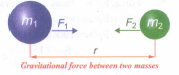
Let m1 and m2 be the masses of two bodies A and B placed at r meter apart in space
Force \(\mathrm{F} \propto \mathrm{m}_{1} \times \mathrm{m}_{2}\)
\(\mathrm{F} \propto 1 / r^{2}\)
On combining the above two expressions,
\(\mathrm{F} \propto \frac{\mathrm{m}_{1} \times \mathrm{m}_{2}}{\mathrm{r}^{2}} \)
\(F=\frac{G m_{1} m_{2}}{r^{2}}\)
Where G is the universal gravitational constant.
Its value in SI unit is \(6.674 \times 10^{-11} \mathrm{~N} \mathrm{~m}^{2} \mathrm{~kg}^{-2}\).
3.
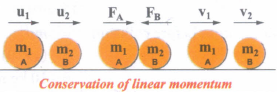
(i) Propulsion of rockets is based on law of conservation of linear momentum as well as Newton's III law of motion.
(ii) Rockets are filled with a fuel (either liquid or solid) in the propellant tank.
(iii) When the rocket is fired, this fuel is burnt and a hot gas is ejected with high speed from the back nozzle producing a huge momentum.
(iv) To balance this momentum, an equal and opposite reaction force is produced combustion chamber which makes the rocket project forward.
(v) While in motion, the mass of the rocket gradually decreases, until the fuel is completely burnt out.
(vi) Since there is no net external force acting on it, the linear momentum of the system is conserved.
(vii) The mass of the rocket decreases with altitude, which results in the gradual increase in velocity of the rocket.
(viii) At one stage, it reaches a velocity, which is sufficient to just escape from the gravitational pull of the Earth. This velocity is called escape velocity.
4.
5.
(i) According to Newton's second law, "the force acting on a body is directly proportional to the rate of change of linear momentum of the body and the change in momentum takes place in the direction of the force".
(ii) This law helps us to measure the amount of force. So it is called as law of force'
(iii) Let, "m" be the mass of a moving body, moving along a straight line with an initial speed 'u'.
(iv) After a time interval of 't', the velocity of the body changes to 'v' due to the impact of an unbalanced external force F.
Initial momentum of the body, \( P_{i}=m u \)
Final momentum of the body, \( P_{f}=m v \)
Change in momentum, \( \Delta \mathrm{p}=\mathrm{P}_{\mathrm{f}}-\mathrm{P}_{\mathrm{i}} \)
\(=m v-m u \)
By Newton's second law of motion,
\(\text {Force, } \ F \propto\) rate of change of momentum
\(\mathrm{F} \propto \) change in momentum / time
\(\mathrm{F} \propto \frac{\mathrm{mv}-\mathrm{mu}}{\mathrm{t}}\)
\(\mathrm{F}=\frac{\mathrm{km}(\mathrm{v}-\mathrm{u})}{\mathrm{t}}\)
Here, k is the proportionality constant.
k = 1 in all system of units. Hence,
\(F=\cfrac { m(v-u) }{ t } \)
Since acceleration = change in velocity / time, a = (v-u) / t. Hence, we have
F = m x a
Force = mass x acceleration
6.
(i) Newton's First law: Newton's first law states that, everybody continues to be in its state of rest or the state of uniform motion along a straight line unless it is acted upon by some external force.
(ii) Newton's second law of motion: Newton's second law states that, the force acting on an object is directly proportional to the rate of change of linear momentum of the object and the change in momentum takes place in the direction of force.
(iii) Newton's third law of motion: Newton's third law states that, for every action there is an equal and opposite reaction. They always act on two different bodies.
7.
Definition:
The inherent property of a body to resist any change in its state of rest or the state of uniform motion, unless it is influenced upon by an external unbalanced force, is known as inertia.
Types of Inertia:
(i) Inertia of rest
(ii) Inertia of motion
(iii) Inertia of direction
(i) Inertia of rest: The resistance of a body to change its state of rest is called inertia of rest.
Example: When you vigorously shake the branches of a tree, some of the leaves and fruits are detached and they fall down (Inertia of rest).
(ii) Inertia of motion: The resistance of a body to change its state of motion is called inertia of motion.
Example: An athlete runs some distance before jumping. Because, this will help him jump longer and higher (Inertia of motion).
(iii) Inertia of direction: The resistance of a body to change its direction of motion is called inertia of direction.
Example: When we make a sharp turn while driving a car we tend to lean sideways 'inertia of direction'.
8.
(i) The Newton second law tells us that applying a force on an object produces an acceleration proportional to the object's mass.
(ii) When you're wearing your seat belt, it supplies the force to decelerate you in the event of a crash so that you don't hit the wind shield.
(iii) According to Newton's first law an object in motion continues in motion with the same speed and in same direction, unless acted upon by a force.
(iv) If the motor cycle were to abruptly stop, then the rider in motion would continue in motion.
(v) The rider would likely be propelled from the motor cycle, the rider becomes a projectile.
(vi) If the person is not wearing the helmet, the injury would be severe.
(vii) Thus "wearing helmet and fastening the seat belt is highly recommended for safe journey".
9.
Given: K1 = K2 = K, m1 = 4m2
The kinetic energy of the truck \(=\frac{1}{2} m_{1} v_{1}^{2} \Rightarrow v_1= \sqrt\frac{2 k}{m_{1}}\)
The kinetic energy of the bike \(=\frac{1}{2} \mathrm{~m}_{2} \mathrm{v}_{2}^{2}\Rightarrow v_2= \sqrt\frac{2 k}{m_{2}}\)
∴ Momentum p = mv
∴ Momentum of the two bodies are given by,
\(P_1=\sqrt{2m_1K,}\)
\(P_2=\sqrt{2m_2K,}\)
\(\therefore \frac{P_1}{P_2} =\sqrt{\frac{2 m_1K}{2m_{2}K}}=\sqrt{\frac{m_1}{m_{2}}}=\sqrt{\frac{4m_2}{m_{2}}}=\frac{\sqrt { 4}}{\sqrt 1}= \frac{2}{1}\)
Ratio of momenta = 2: 1
10.
Given: Let m1 = 8 kg, m2 =2 kg. F = 15 N
Consider both the masses as a unit system as they will move with common acceleration,
\({\mathrm{F}}_{1}=\mathrm{M_1}a\)
\(F_2=m_2a\)
\(F=F_1+F_2\)
\(=\left(\mathrm{m}_{1} +\mathrm{~m}_{2}\right){a}\)
\(15=(8+2) {a} \)
\(15=10 a \)
\(a=15 / 10=1.5 \mathrm{~ms}^{-2}\)
a = 1.5 ms-2
Let \(\mathrm{F}_{2}\) be the force exerted on 2 kg mass, then
\({\mathrm{F}_{2}}=\mathrm{m_2} {a} \)
\({\mathrm{F}_{2}}=2 \times 1.5=3 \mathrm{~N}\)
So, the force exerted on 2 kg mass is 3 N.

10th Standard Syllabus & Materials
10th Standard
TN 10th English Prose - 2 - The Night the Ghost Got in Important Questions And Answers Study Material - QB365 Set A
NEW10th Standard
TN 10th English Supplementary - 1 - The Tempest Important Questions And Answers Study Material - QB365 Set A
NEW10th Standard
TN 10th English Poem - 1 - Life Important Questions And Answers Study Material - QB365 Set A
NEW10th Standard
TN 10th English Prose - 1 - His First Flight Important Questions And Answers Study Material - QB365 Set A



Tamilnadu Stateboard 10th Standard Subjects
Tamilnadu Stateboard Standards





