
 100% FREE ACCESS
10th Standard Syllabus & Materials
10th Standard
TN 10th English Prose - 4 - The Attic Important Questions And Answers Study Material - QB365 Set A
NEW10th Standard
TN 10th English Supplementary - 3 - The Story of Mulan Important Questions And Answers Study Material - QB365 Set A
NEW10th Standard
TN 10th English Poem - 3 - I am Every Woman Important Questions And Answers Study Material - QB365 Set A
NEW10th Standard
TN 10th English Prose - 3 - Empowered Women Navigating The World Important Questions And Answers Study Material - QB365 Set A
NEW10th Standard
TN 10th English Supplementary - 2 - Zigzag Important Questions And Answers Study Material - QB365 Set A
NEW10th Standard
TN 10th English Poem - 2 - The Grumble Family Important Questions And Answers Study Material - QB365 Set A

Published on: 13/05/2020
10th Standard Science English Medium Model Question Paper Part - II
Download Tamil Nadu 10th Standard Science question papers, model tests, one-mark questions, important questions, and public exam papers in PDF format. Free study materials and answer keys for TN State Board students.
Questions + Answers key
Take MCQ Science Test1.
What is Paleobotany?
2.
What is Sprite?
3.
Mention the diseases caused by tobacco smoke.
4.
What is mean by binary solution?
5.
Why is the teeth of rabbit called heterodont?
6.
What is the minimum distance needed for an echo?
7.
Give any two examples for heterodiatomic molecules.
8.
Why a spanner with a long handle is preferred to tighten screws in heavy vehicles?
9.
A plant hormone was first discovered in Japan when rice plants were suffering from Bakanae disease caused by Gibberella fujikoroi. Based on this information answer the following questions:
a) Identify the hormone involved in this process.
b) Which property of this hormone causes the disease?
c) Give two functions of this hormone.
10.
Vinu dissolves 50 g of sugar in 250 ml of hot water, Sarath dissolves 50 g of same sugar in 250 ml of cold water. Who will get faster dissolution of sugar? and Why?
11.
A solid compound ‘A’ decomposes on heating into ‘B’ and a gas ‘C’. On passing the gas ‘C’ through water, it becomes acidic. Identify A, B and C.
12.
Name the acid that renders aluminium passive. Why?
13.
A heavy truck and bike are moving with the same kinetic energy. If the mass of the truck is four times that of the bike, then calculate the ratio of their momenta. (Ratio of momenta = 2:1)
14.
The inner mitochondrial membrane gives rise to finger like projections called ____________
oxysomes
matrix
cristae
stalk
15.
_____ is the longest cell of the human body.
Neuron
Neuroglia
Nerve fibres
Cyton
16.
17.
Radio __________ is used in the treatment of skin diseases
iron
phosphorous
sodium
iodine
18.
Which among the following are the ores of aluminium?
(i) Bauxite
(ii) Cryolite
(iii) Corundum.
Both (i) and (ii)
Only
Only (iii)
(i), (ii) and (iii)
19.
20.
All files are stored in the _____________
Folder
box
Pai
scanner
21.
The term Ethnobotany was coined by
Khorana
J.W. Harshberger
Ronald Ross
Hugo de Vries
22.
The body of leech has
23 segments
33 segments
38 segments
30 segments
23.
Which of the following is the universal solvent?
Acetone
Benzene
Water
Alcohol
24.
1 mole of any substance contains __________ molecules
6.023 × 10²³
6.023 × 10⁻²³
3.0115 × 10²³
12.046 × 10²³
25.
Where should an object be placed so that a real and inverted image of same size is obtained by a convex lens
f
2f
infinity
between f and 2f
26.
What is diabetes? Explain the types.
27.
Explain the principle & structure of atom bomb.
28.
Explain the Sign Conventions of lenses.
29.
Write a note on DNA replication.
30.
Program for print the word “Hello” with sound
31.
Differentiate between outbreeding and inbreeding.
32.
What is cohesion?
33.
Why is Archaeopteryx considered to be a connecting link?
34.
Find the final temperature of a copper rod. Whose area of cross section changes from 10 m2 to 11 m2 due to heating. The copper rod is initially kept at 90 K. (Coefficient of superficial expansion is 0.0021 /K)
35.
Raman went to a garden. He saw that the stem of the Banyan tree becomes thicker every year whereas such a change is not seen in a coconut tree. Can you give a explanation for this.
36.
An electrician puts a fuse of rating 5 A in that part of domestic electrical circuit in which an electrical heater of rating 1.5 kW, 220V is operating. What is likely to happen in this case and why? What change, if any needs to be made?
37.
Describe mutation breeding with an example.
38.
What is called homologous series? Give any three of its characteristics?
1.
Paleobotany is derived from Greek words paleon that means "old" and botany the study of plants. It is the branch of Paleontology that deals with recovery and identification or plant remains of geological past.
2.
The characters on the background of a Scratch window are known as Sprite. Usually a cat appears as a sprite when the Scratch window is opened. The software provides facilities to make alternations in sprite.
3.
Lung cancer, bronchitis and pulmonary tuberculosis, emphysema, Hypoxia, increased blood pressure, gastric and duodenal ulcers.
4.
(i) A solution must at least be consisting of two components ( a solute and a solvent ).
(ii) Such solution which are made of one solute and one solvent (two components) are called binary solution.
(iii) e.g: On addition copper sulphate crystals to water.
5.
There are different types of teeth in rabbit. Hence, called as heterodont denitition.
6.
The minimum distance required to hear an echo is 1/20th part of the magnitude of the velocity of sound in air.
i.e. \(\frac{1}{20} \times 344 = 16.7m\)
7.
Hydrogen chloride (HCl), Hydrogen iodide (HI) are two examples for heterodiatomic molecules.
8.
(i) A spanner has a long handle to produce a larger moment of force by a small force applied normally at the end of its handle.
(ii) Moment of force = \(\overrightarrow{\mathbf{F}} \times \overrightarrow{\mathrm{d}}\)
9.
a) Gibberellin
b) The active substance was identified as Gibberellic acid, which caused this disease.
c) i) Application of gibberellins on plants stimulate extraordinary elongation of internode. e.g. Corn and Pea.
ii) Treatment of rosette plants with gibberellin induces sudden shoot elongation followed by flowering. This is called bolting.
10.
(i) Vinu will get faster dissolution of sugar.
(ii) Temperature is one of the factors.
(iii) It will affect the solubility of a solute in a liquid.
(iv) Solvent increases with increase in temperature.
11.
(i) On passing ' C ' through water it becomes acidic.
(ii) Therefore the gas ' C ' must be a non-metal oxide \(\left(\mathrm{CO}_{2}\right)\).
(iii) So a solid compound must be a calcium carbonate.
(iv) It decomposes into calcium oxide and carbon dioxide. (C)
\(\mathrm{CaCO}_{3(\mathrm{~g})} \rightarrow \mathrm{CaO}_{(\mathrm{S})}+\mathrm{CO}_{2(\mathrm{~g})} \uparrow\\ \quad \mathrm{A} \quad \quad \quad \quad \mathrm{B} \quad \quad \quad \quad \mathrm{C}\)
| A | CaCo3 | Calcium carbonate |
| B | CaO | Calcium oxide |
| C | CO2 | Carbon di oxide |
12.
(i) Dilute or concentrated nitric acid renders aluminum passive.
(ii) It does not attack aluminium but it forms oxide film on its surface.
13.
Given: K1 = K2 = K, m1 = 4m2
The kinetic energy of the truck \(=\frac{1}{2} m_{1} v_{1}^{2} \Rightarrow v_1= \sqrt\frac{2 k}{m_{1}}\)
The kinetic energy of the bike \(=\frac{1}{2} \mathrm{~m}_{2} \mathrm{v}_{2}^{2}\Rightarrow v_2= \sqrt\frac{2 k}{m_{2}}\)
∴ Momentum p = mv
∴ Momentum of the two bodies are given by,
\(P_1=\sqrt{2m_1K,}\)
\(P_2=\sqrt{2m_2K,}\)
\(\therefore \frac{P_1}{P_2} =\sqrt{\frac{2 m_1K}{2m_{2}K}}=\sqrt{\frac{m_1}{m_{2}}}=\sqrt{\frac{4m_2}{m_{2}}}=\frac{\sqrt { 4}}{\sqrt 1}= \frac{2}{1}\)
Ratio of momenta = 2: 1
14.
(c)
cristae
15.
(a)
Neuron
16.
(a)
17.
(b)
phosphorous
18.
(d)
(i), (ii) and (iii)
19.
(c)
20.
(a)
Folder
21.
(b)
J.W. Harshberger
22.
(b)
33 segments
23.
(c)
Water
24.
(a)
6.023 × 10²³
25.
(b)
2f
26.
Diabetes Mellitus is a chronic metabolic disorder. It is characterized by increased blood glucose level due to insufficient, deficient or failure of insulin secretion. This is the most common pancreatic endocrine disorder.
Type I Insulin dependent diabetes mellitus (IDDM):
(i) IDDM accounts for 10 to 20% of the known diabetics.
(ii) The condition also occurs in children (Juvenile onset diabetes) and young adults, the onset is usually sudden and can be life threatening.
(iii) This is caused by the destruction of cells of the pancreas.
(iv) It is characterized by abnormally elevated blood glucose levels (hyperglycemia) resulting from inadequate insulin secretion.
Causes: Genetic inheritance and environmental factors (infections due to virus, acute stress) are the cause for this condition.
Type II Non-Insulin Dependent Diabetes Mellitus (NIDDM):
(i) This is also called as adult onset diabetes and accounting for 80 to 90% of the diabetic population.
(ii) It develops slowly, usually milder and more stable.
(iii) Insulin production by the pancreas is normal but its action is impaired. (iv) The target cells do not respond to insulin.
(v) It does not allow the movement of glucose into cells.
Causes: The causes are multifactorial which include increasing age obesity, sedentary lifestyle, overeating and physically inactive.
27.
(i) Atom bomb is based on the principle of uncontrolled chain reaction.
(ii) In an uncontrolled chain reaction, the number of neutrons and the number of fission reactions multiply almost in a geometrical progression.
(iii) This releases a huge amount of energy in a very small time interval and leads to explosion.
Structure:
(i) An atom bomb consists of a piece of fissile material whose mass is sub critical.
(ii) This piece has a cylindrical void. It has a cylindrical fissile material which can fit into this void and its mass is also sub critical.
(iii) When the bomb has to be exploded, this cylinder is injected into the void using a conventional explosive.
(iv) Now, the two pieces of fissile material add up to form super critical mass which leads to an explosion.
(v) During this explosion tremendous amount of energy in the form of heat, light and radiation is released.
(vi) A very high temperature and pressure are experienced in fraction of second along with hazardous radiation like ૪ rays which adversely affect the living creatures.
28.
(i) The object is always placed on the left side of the lens.
(ii) All the distances are measured from the optical centre of the lens.
(iii) The distances measured in the same direction as that of incident light are taken as positive.
(iv) The distances measured against the direction of incident light are taken as negative. (v) The distances measured upward and perpendicular to the principal axis is taken as positive.
(v) The distances measured downward and perpendicular to the principal axis is taken· as negative.
29.
(i) DNA molecule produces exact copies of its own structure during replication process.
(ii) The two strands of a DNA molecule have complementary base pairs. The nucleotides of each strand provide the information needed to produce its new strand.
Origin of replication: The specific points on the DNA, where the replication begins. It is the site of origin of replication. The two strands open and separate at this point forming the replication fork.
Unwinding of DNA molecule:
(i) The enzyme called helicase, bind to the origin of replication site.
(ii) They separate the two strands of the DNA. The enzyme called topoisomerase seperates the double helix above the replication fork and removes the twists formed during the unwinding process.
(iii) Each of the separated DNA strands function as template.
Formation of RNA primer: An RNA primer is a short segment of RNA nucleotides. The primer is synthesized by the DNA template close to the origin of replication.
Synthesis of new complimentary strand from the parent strand :
(i) After the formation of RNA primer, nucleotides are added with the help of an enzyme DNA polymerase and new complimentary strand of DNA is formed from each of the parent strand. The synthesis is unidirectional.
(ii) In one strand the daughter strand is synthesized as a continuous strand which is called leading strand.
(iii) In the order stand, short segment of DNA are synthesized. This strand is called lagging strand.
(iv) The short segments of DNA are called Okazaki fragments. The fragments are joined together by the enzyme DNA ligase.
(v) The replication stops when the replication fork of the two sides meet at a site called terminus which is situated opposite to origin of replication site
30.

1. Click events in script option

3. Click Looks in script option. Drag “say” to script area.
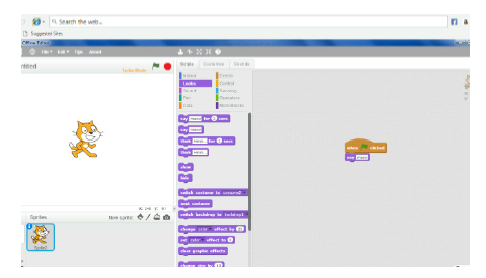
4. Type “Hello “ word in say tab.
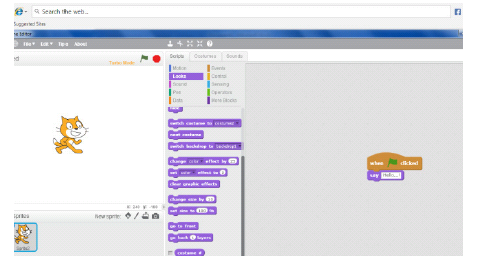
5.Click sounds in script option. Drag play sound to script area. Choose the hello sound from the audio file.
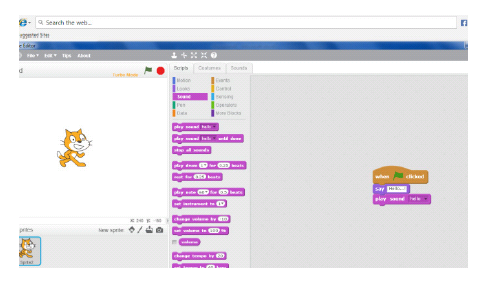
6. From File menu choose the Save option.
7. Click the green flag at the top right corner of the stage window to run the program
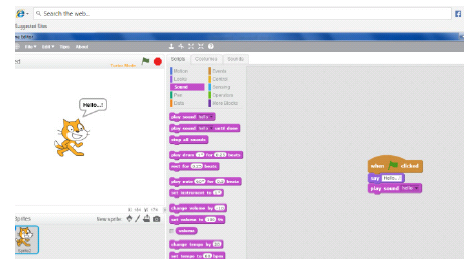

31.
| S.No. |
Outbreeding |
Inbreeding |
|---|---|---|
| i. | Cross between two different species (unrelated) with desirable features of economic value are mated. | Mating of closely related animals within the same breed for about 4 - 6 generations. |
| ii. | It is the breeding of unrelated animals. The offsprings formed are called hybrids. | Superior males and superior females of the same breed are identified and mated in pairs. |
| iii. | The hybrids are stronger and vigorous than their parents. E.g: Mule | It helps in the accumulation of superior genes and elimination of genes which are undesirable. E.g: Hisardale. |
32.
The force of attraction between molecules of water is called cohesion.
33.
(i) Archaeopteryx is considered to be a connecting link between reptiles and birds.
(ii) It had wings with feathers like a bird. It has long tail, clawed digits and conical teeth like a reptile.
34.
Area of copper rod, Ao = 10 m2
Changes of Area of cross section,
Initial temperature \(\Delta \mathrm{A} =11 -10 =1 \mathrm{~m}^{2} \)
\(\mathrm{~T}_{1} =90 \mathrm{~K} \)
\(a_{\mathrm{A}} =0.0021 / \mathrm{K} \)
\(\mathrm{T}_{2} =? \)
\(\frac{\Delta A}{A_{0}} =a_{\mathrm{A}} \Delta \mathrm{T} \)
\(\frac{1 }{10 } =0.0021\left[\mathrm{~T}_{2}-90\right] \)
\(0.1 =0.0021\left[\mathrm{~T}_{2}-90\right]=\frac{0.1}{0.0021}+90=\mathrm{T}_{2} \)
\(\mathrm{~T}_{2} =137.61 \mathrm{~K}\)
So the final temperature of a copper rod is 137.61 K
35.
(i) Banyan tree is a dicot. In Dicots cambium is present in the vascular bundle and secondary growth is seen throughout the life of the plant. Hence the stem becomes thicker due to additional formation of xylem and phloem every year.
(ii) Coconut is a monocot. Secondary growth is absent in monocots. Hence the stem does not increase in thickness every year.
36.
The fuse will melt and the circuit breaks if electric current more than the rating of fuse (i.e., 5 A) flows in the circuit. Electric current flowing in the circuit,
\(I=\frac { P }{ V } =\frac { 1.5\times 1000W }{ 220V } =6.82A\)
Since, current flowing in the circuit (6.82 A) is more than the rating of fuse (5 A), therefore, the fuse will melt and the electrical heater does not work. To operate the heater, fuse of rating 10 A is to be put in the circuit.
37.
Mutation:
(i) Mutation is defined as the sudden heritable change in the nucleotide sequence of DNA in an organism.
(ii) It is a Process by which genetic variations are created which in turn brings about changes in the organism.
(iii) The organism which undergoes mutation is called a mutant.
(iv) The factors which induce mutations are known as mutagens or mutagenic agents.
(v) Mutagens are two types namely physical mutagens and chemical mutagens.
(i) Physical mutagens:
Radiations like X-rays, α, β and γ-rays, UV rays, temperature, etc. which induce mutations are called physical mutagens.
(ii) Chemical mutagens:
(i) Chemical substances that induce mutations are called chemical mutagens.
(ii) Eg: Mustard gas and nitrous acid. The utilization of induced mutation in crop improvement is called mutation breeding. Achievements of mutation breeding:
Achievements of mutation breeding:
(i) Sharbati Sonora wheat produced from Sonora-64 by using gamma rays.
(ii) Atomica 2 rice with saline tolerance and pest resistance.
(iii) Groundnuts with thick shells.
38.
Homologous series is a group or a class of organic compounds having same general formula and similar chemical properties in which the successive numbers differ by a -CH2 group.
E.g: Methane - CH4
Ethane - CH3CH3
Propane - CH3CH2CH3
Characteristics:
(i) Each member of the series differs from the preceding or succeeding member by one methylene group (-CH2) and hence by a molecular mass of 14 amu.
(ii) All members of a homologous series contain the same elements and functional group.
(iii) They are represented by a general molecular formula. e.g. Alkanes, CnH2n + 2
(iv) All the members can be prepared by a common method.

10th Standard Syllabus & Materials
10th Standard
TN 10th English Prose - 2 - The Night the Ghost Got in Important Questions And Answers Study Material - QB365 Set A
NEW10th Standard
TN 10th English Supplementary - 1 - The Tempest Important Questions And Answers Study Material - QB365 Set A
NEW10th Standard
TN 10th English Poem - 1 - Life Important Questions And Answers Study Material - QB365 Set A
NEW10th Standard
TN 10th English Prose - 1 - His First Flight Important Questions And Answers Study Material - QB365 Set A



Tamilnadu Stateboard 10th Standard Subjects
Tamilnadu Stateboard Standards





