
 100% FREE ACCESS
10th Standard Syllabus & Materials
10th Standard
TN 10th English Prose - 4 - The Attic Important Questions And Answers Study Material - QB365 Set A
NEW10th Standard
TN 10th English Supplementary - 3 - The Story of Mulan Important Questions And Answers Study Material - QB365 Set A
NEW10th Standard
TN 10th English Poem - 3 - I am Every Woman Important Questions And Answers Study Material - QB365 Set A
NEW10th Standard
TN 10th English Prose - 3 - Empowered Women Navigating The World Important Questions And Answers Study Material - QB365 Set A
NEW10th Standard
TN 10th English Supplementary - 2 - Zigzag Important Questions And Answers Study Material - QB365 Set A
NEW10th Standard
TN 10th English Poem - 2 - The Grumble Family Important Questions And Answers Study Material - QB365 Set A

Published on: 13/05/2020
10th Standard Science English Medium Model Question Paper Part - III
Download Tamil Nadu 10th Standard Science question papers, model tests, one-mark questions, important questions, and public exam papers in PDF format. Free study materials and answer keys for TN State Board students.
Questions + Answers key
Take MCQ Science Test1.
Draw the ultrastructure of a chloroplast and label the parts.
2.
What is Sprite?
3.
What is adult onset diabetes?
4.
5.
Why is the teeth of rabbit called heterodont?
6.
What is the audible range of frequency?
7.
What is Molar volume of a gas?
8.
State Newton’s second law.
9.
A plant hormone was first discovered in Japan when rice plants were suffering from Bakanae disease caused by Gibberella fujikoroi. Based on this information answer the following questions:
a) Identify the hormone involved in this process.
b) Which property of this hormone causes the disease?
c) Give two functions of this hormone.
10.
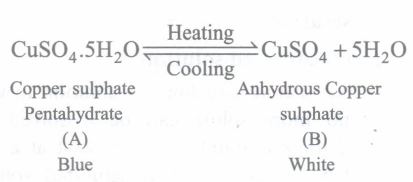
'A' is a blue coloured crystalline salt. On heating it loses blue colour and to give 'B'. When water is added, 'B' gives back to 'A'. Identify A and B, write the equation.
11.
A solid compound ‘A’ decomposes on heating into ‘B’ and a gas ‘C’. On passing the gas ‘C’ through water, it becomes acidic. Identify A, B and C.
12.
a) Identify the bond between H and F in HF molecule.
b) What property forms the basis of identification?
c) How does the property vary in periods and in groups?
13.
“Wearing helmet and fastening the seat belt is highly recommended for safe journey” Justify your answer using Newton’s laws of motion.
14.
The axons may be covered by a protective sheath called ______
Myelin
Nodes of ranvier
Schwann cells
Nissl's granules
15.
Linear expansion is the change in _____ when object is heated or cooled.
length
area
volume
density
16.
૪ rays are ________ in charge.
positive
negative
neutral
none
17.
The process of extracting the ore from the earth's crust is ____________
Metallurgy
Mining
Smelting
Leaching
18.
A & B are two objects with masses 100 kg & 75 kg respectively, then _______
both will have same inertia
B will have more inertia
A will have more inertia
both will have less inertia
19.
20.
Paleontologists deal with
Embryological evidences
Fossil evidences
Vestigial organ evidences
All the above
21.
22.
A solution in which no more solute can be dissolved in a definite amount of solvent at a given temperature is called ___________
Saturated solution
Un saturated solution
Super saturated solution
Dilute solution
23.
The gram molecular mass of oxygen molecule is
16 g
18 g
32 g
17 g
24.
Which of the following lens would you prefer to use while reading small letters found in a dictionary?
A convex lens of focal length 5 cm
A concave lens of focal length 5 cm
A convex lens of focal length 10 cm
A concave lens of focal length 10 cm
25.
Ramu studies in a school and his friends are discussing about drugs. They force him to use drugs and threaten to avoid him / harm him if he refuses. What should Ramu do?
26.
What are the precautions to be taken by people working in radiation labs?
27.
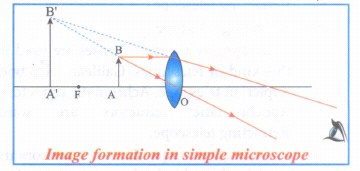
Explain the construction of Simple Microscope and derive its magnification power.
28.
Mala had a huge scar on her cheek after she met with fire accident during her college days. She is worried if her baby would inherit the scar she had acquired. She clarified with her doctor, she need not worry about it, as her scar is an acquired trait.
(i) What are acquired traits?
(ii) How is it different from inherited traits?
29.
Program for print the word “Hello” with sound
30.
Name two maize hybrids rich in amino acid lysine.
31.
What is the importance of valves in the heart?
32.
The degenerated wing of a kiwi is an acquired character. Why is it an acquired character?
33.
Find the final temperature of a copper rod. Whose area of cross section changes from 10 m2 to 11 m2 due to heating. The copper rod is initially kept at 90 K. (Coefficient of superficial expansion is 0.0021 /K)
34.
'Our teeth and an elephant's tusks are homologous organs'. Justify this statement. What do the analogous organs indicate?
35.
An electrician puts a fuse of rating 5 A in that part of domestic electrical circuit in which an electrical heater of rating 1.5 kW, 220V is operating. What is likely to happen in this case and why? What change, if any needs to be made?
36.
Describe mutation breeding with an example.
37.
Give the balanced chemical equation of the following reactions:
(i) Neutralization of NaOH with ethanoic acid.
(ii) Evolution of carbon dioxide by the action of ethanoic acid with NaHCO3.
(iii) Oxidation of ethanol by acidified potassium dichromate.
(iv) Combustion of ethanol.
1.
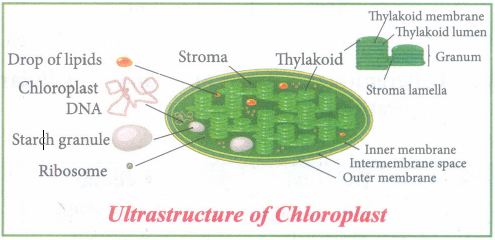
2.
The characters on the background of a Scratch window are known as Sprite. Usually a cat appears as a sprite when the Scratch window is opened. The software provides facilities to make alternations in sprite.
3.
Type-2 Non-Insulin Dependent diabetes mellitus.
4.
5.
There are different types of teeth in rabbit. Hence, called as heterodont denitition.
6.
(i) The audible range of frequency is 20 Hz to 20,000 Hz.
(ii) These are generated by vibrating bodies such as vocal cords, stretched strings, etc.
7.
(i) One mole (6.023 x 10²³ of entities) of any gas occupies 22.4 litre or 22400 ml at S.T.P.
(ii) This volume is called as molar volume of gas.
8.
(i) "According to Newton's second law, the force acting on a body is directly proportional to the rate of change of linear momentum of the body and the change in momentum takes place in the direction of the force".
(ii) Force = mass x acceleration
(iii) F = m x a
9.
a) Gibberellin
b) The active substance was identified as Gibberellic acid, which caused this disease.
c) i) Application of gibberellins on plants stimulate extraordinary elongation of internode. e.g. Corn and Pea.
ii) Treatment of rosette plants with gibberellin induces sudden shoot elongation followed by flowering. This is called bolting.
10.
(i) 'A' is copper sulphate pentahydrate (CuSO4.5H2O).
(ii) 'B' is Anhydrous copper sulphate (CuSO4)
11.
(i) On passing ' C ' through water it becomes acidic.
(ii) Therefore the gas ' C ' must be a non-metal oxide \(\left(\mathrm{CO}_{2}\right)\).
(iii) So a solid compound must be a calcium carbonate.
(iv) It decomposes into calcium oxide and carbon dioxide. (C)
\(\mathrm{CaCO}_{3(\mathrm{~g})} \rightarrow \mathrm{CaO}_{(\mathrm{S})}+\mathrm{CO}_{2(\mathrm{~g})} \uparrow\\ \quad \mathrm{A} \quad \quad \quad \quad \mathrm{B} \quad \quad \quad \quad \mathrm{C}\)
| A | CaCo3 | Calcium carbonate |
| B | CaO | Calcium oxide |
| C | CO2 | Carbon di oxide |
12.
(a) Ionic bond.
(b) Electronegativity property.
(c) (i) Along the period, from left to right in the periodic table, the electronegativity increases, because of the increase in the nuclear charge which in turn attracts the electrons more strongly.
(ii) On moving down a group, the electronegativity of the element decreases because of the increased number of valence shells.
13.
(i) The Newton second law tells us that applying a force on an object produces an acceleration proportional to the object's mass.
(ii) When you're wearing your seat belt, it supplies the force to decelerate you in the event of a crash so that you don't hit the wind shield.
(iii) According to Newton's first law an object in motion continues in motion with the same speed and in same direction, unless acted upon by a force.
(iv) If the motor cycle were to abruptly stop, then the rider in motion would continue in motion.
(v) The rider would likely be propelled from the motor cycle, the rider becomes a projectile.
(vi) If the person is not wearing the helmet, the injury would be severe.
(vii) Thus "wearing helmet and fastening the seat belt is highly recommended for safe journey".
14.
(a)
Myelin
15.
(a)
length
16.
(c)
neutral
17.
(b)
Mining
18.
(c)
A will have more inertia
19.
(a)
20.
(b)
Fossil evidences
21.
(d)
22.
(a)
Saturated solution
23.
(c)
32 g
24.
(a)
A convex lens of focal length 5 cm
25.
Ramu must discuss the issue with his parents or teachers. He must take support from elders in not being a part of this group so that he can take care of his physical and mental health and not fall a prey to bad habits. Friendship does not mean being a support to the wrong actions of our friends.
26.
(i) Radioactive materials should be kept in thick walled lead container.
(ii) Lead coated aprons and lead gloves should be used while working with hazardous radioactive materials.
(iii) We should avoid eating while handling radioactive materials.
(iv) The radioactive materials should be handled only by tongs or by a remote control process.
(v) Dosimeters should be worn by the users to check the level of radiation.
27.
(i) Simple Microscope: Simple microscope is a convex lens of short focal length. It is held near the eye to get enlarged image of small objects.
(ii) Let an object (AB) of height 'h' is placed at a point within the principal focus (u < f) of the convex lens and the observer's eye placed just behind the lens.
(iii) As per this position the convex lens CJ produces an erect, virtual and enlarged image (A'B'). The image formed is in the same side of the object and the distance equal to the least distance of distinct vision (D) (D = 25 cm for normal human eye).
(iv) Magnification power (M): Ratio of the height of the image produced by the microscope h2) to the original height of the object (h1) is called magnification.
M=\(\frac { A'B' }{ AB } \)
Magnification M =\(\frac { height\ of\ the\ image }{ height\ of\ the\ object } \)
=\(\frac { { h }_{ 2 } }{ { h }_{ 1 } } \)
Magnification can also be defined as the ratio of distance of image (v) to the distance of object (u)
Magnification M =\(\frac { Distance\ of\ the\ image }{ Distance\ of\ the\ object } \)
=\(\frac { v }{ u } \)
Since, the image is virtual and erect; the Magnification (M) is taken as positive In simple Microscope,
when the image is formed at the near point
M=1+\(\frac { D }{ f } \)
when the image is formed at infinity
M=\(\frac { D }{ f } \).
28.
(i) Acquired traits are the characters that cannot be passed from one generation to the next generation.
(ii) Characters which are inherited by the offspring from the parents and carried from one generation to another generation are called Inherited traits.
29.

1. Click events in script option
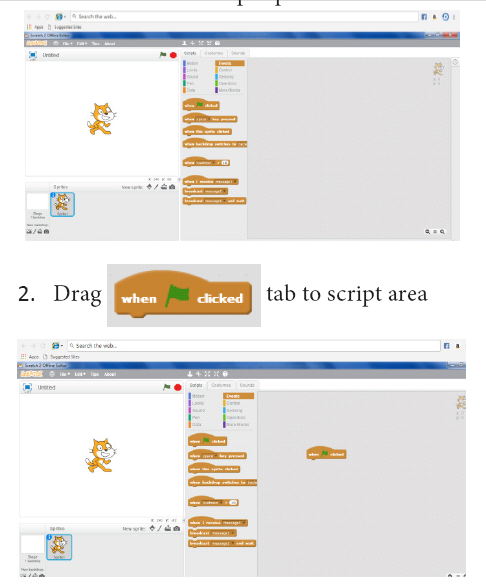
3. Click Looks in script option. Drag “say” to script area.

4. Type “Hello “ word in say tab.
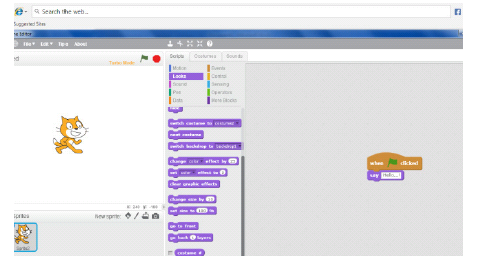
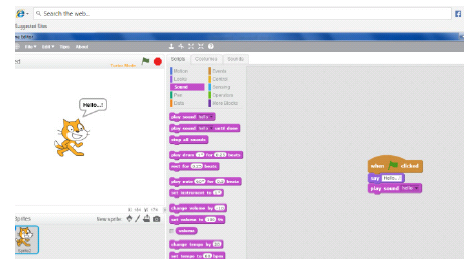
5.Click sounds in script option. Drag play sound to script area. Choose the hello sound from the audio file.

6. From File menu choose the Save option.
7. Click the green flag at the top right corner of the stage window to run the program

30.
Protina, shakti and Rathna are lysine rich maize hybrids.
31.
Valves are the muscular flaps that regulate the flow of blood in a single direction and prevent back flow of blood.
32.
(i) Kiwi is a flightless bird. The degenerated wing in Kiwi is an example for organ of disuse.
(ii) When there is a change in the environment, the animals respond to the change.
(iii) They develop adaptive structures (acquired characters).
33.
Area of copper rod, Ao = 10 m2
Changes of Area of cross section,
Initial temperature \(\Delta \mathrm{A} =11 -10 =1 \mathrm{~m}^{2} \)
\(\mathrm{~T}_{1} =90 \mathrm{~K} \)
\(a_{\mathrm{A}} =0.0021 / \mathrm{K} \)
\(\mathrm{T}_{2} =? \)
\(\frac{\Delta A}{A_{0}} =a_{\mathrm{A}} \Delta \mathrm{T} \)
\(\frac{1 }{10 } =0.0021\left[\mathrm{~T}_{2}-90\right] \)
\(0.1 =0.0021\left[\mathrm{~T}_{2}-90\right]=\frac{0.1}{0.0021}+90=\mathrm{T}_{2} \)
\(\mathrm{~T}_{2} =137.61 \mathrm{~K}\)
So the final temperature of a copper rod is 137.61 K
34.
(i) Our teeth and an elephant's tusks are homologous organs as both of them have the same basic structure, but different functions (we chew with our teeth, whereas elephants use their tusks to hold things).
(ii) Analogous organs indicate that even organisms having different structures can adapt by modifying these structures to perform similar functions for their survival under the given environmental conditions.
35.
The fuse will melt and the circuit breaks if electric current more than the rating of fuse (i.e., 5 A) flows in the circuit. Electric current flowing in the circuit,
\(I=\frac { P }{ V } =\frac { 1.5\times 1000W }{ 220V } =6.82A\)
Since, current flowing in the circuit (6.82 A) is more than the rating of fuse (5 A), therefore, the fuse will melt and the electrical heater does not work. To operate the heater, fuse of rating 10 A is to be put in the circuit.
36.
Mutation:
(i) Mutation is defined as the sudden heritable change in the nucleotide sequence of DNA in an organism.
(ii) It is a Process by which genetic variations are created which in turn brings about changes in the organism.
(iii) The organism which undergoes mutation is called a mutant.
(iv) The factors which induce mutations are known as mutagens or mutagenic agents.
(v) Mutagens are two types namely physical mutagens and chemical mutagens.
(i) Physical mutagens:
Radiations like X-rays, α, β and γ-rays, UV rays, temperature, etc. which induce mutations are called physical mutagens.
(ii) Chemical mutagens:
(i) Chemical substances that induce mutations are called chemical mutagens.
(ii) Eg: Mustard gas and nitrous acid. The utilization of induced mutation in crop improvement is called mutation breeding. Achievements of mutation breeding:
Achievements of mutation breeding:
(i) Sharbati Sonora wheat produced from Sonora-64 by using gamma rays.
(ii) Atomica 2 rice with saline tolerance and pest resistance.
(iii) Groundnuts with thick shells.
37.
(i) Ethanoic acid reacts with sodium hydroxide to form sodium ethanoate and water
CH3COOH + NaOH ⟶ CH3COONa + H2O
Ethanoic acid Sodium hydroxide
(ii) Ethanoic acid reacts with sodium bicarbonate and liberates CO2, with brisk effervescence.
CH3COOH + NaHCO3 ⟶ CH3COONa + CO2 ↑ + H2O
Ethanoic acid Sodium hydroxide
(iii) Ethanol is oxidized to ethanoic acid with alkaline KMnO4 or acidified K2Cr2O7

(iv) Ethanol is highly inflammable liquid. It burns with oxygen to form carbon dioxide and water.
.JPG)

10th Standard Syllabus & Materials
10th Standard
TN 10th English Prose - 2 - The Night the Ghost Got in Important Questions And Answers Study Material - QB365 Set A
NEW10th Standard
TN 10th English Supplementary - 1 - The Tempest Important Questions And Answers Study Material - QB365 Set A
NEW10th Standard
TN 10th English Poem - 1 - Life Important Questions And Answers Study Material - QB365 Set A
NEW10th Standard
TN 10th English Prose - 1 - His First Flight Important Questions And Answers Study Material - QB365 Set A



Tamilnadu Stateboard 10th Standard Subjects
Tamilnadu Stateboard Standards





