
 100% FREE ACCESS
10th Standard Syllabus & Materials
10th Standard
TN 10th English Prose - 4 - The Attic Important Questions And Answers Study Material - QB365 Set A
NEW10th Standard
TN 10th English Supplementary - 3 - The Story of Mulan Important Questions And Answers Study Material - QB365 Set A
NEW10th Standard
TN 10th English Poem - 3 - I am Every Woman Important Questions And Answers Study Material - QB365 Set A
NEW10th Standard
TN 10th English Prose - 3 - Empowered Women Navigating The World Important Questions And Answers Study Material - QB365 Set A
NEW10th Standard
TN 10th English Supplementary - 2 - Zigzag Important Questions And Answers Study Material - QB365 Set A
NEW10th Standard
TN 10th English Poem - 2 - The Grumble Family Important Questions And Answers Study Material - QB365 Set A

Published on: 13/05/2020
10th Standard Science English Medium Model Question Paper Part - IV
Download Tamil Nadu 10th Standard Science question papers, model tests, one-mark questions, important questions, and public exam papers in PDF format. Free study materials and answer keys for TN State Board students.
Questions + Answers key
Take MCQ Science Test1.
Name the internal factors affecting photosynthesis.
2.
What is Astrobiology? Explain the criteria.
3.
Write the difference between conductor and insulator.
4.
What is Scratch?
5.
How does insulin deficiency occur?
6.
What is aqueous and non-aqueous solution? Give an example.
7.
How does leech suck blood from the host?
8.
Name three animals, which can hear ultrasonic vibrations.
9.
Write the different types of isotopes of oxygen and its percentage abundance.
10.
State the principle of moments.
11.
Biofortification may help in removing hidden hunger. How?
12.
How is ethanol manufactured from sugarcane?
13.
Give the applications of universe law gravitation.
14.
______ is located between thalamus and hindbrain.
Forebrain
Midbrain
Cerebral lobes
Hypothalamus
15.
All the substances will undergo the following changes like _____ when heated.
increase in temperature
expansion of substance
change of state
all the above
16.
The main source of stellar energy is
(i) fission reactors
(ii) fusion reaction
(iii) chemical reaction
(iv) thermonuclear reactions
(i) is correct
(i) & (ii) are correct
(i) & (iv) are correct
(ii) & (iv) are correct
17.
The chemical symbol of Iron is _________________
I
Ir
FE
Fe
18.
Study of moving bodies under the action of forces ______
Statics
Kinematics
Dynamics
Mechanics
19.
All files are stored in the _____________
Folder
box
Pai
scanner
20.
Paleontologists deal with
Embryological evidences
Fossil evidences
Vestigial organ evidences
All the above
21.
22.
A solution in which no more solute can be dissolved in a definite amount of solvent at a given temperature is called ___________
Saturated solution
Un saturated solution
Super saturated solution
Dilute solution
23.
The volume occupied by 4.4 g of CO2 at S.T.P
22.4 liter
2.24 liter
0.24 liter
0.1 liter
24.
Power of a lens is –4D, then its focal length is
4m
–40m
–0.25 m
–2.5 m
25.
Explain the hazards and effects of Tobacco.
26.
What are the precautions to be taken by people working in radiation labs?
27.
State the laws of refraction.
28.
Write a note on mutation.
29.
Program for print the word “Hello” with sound
30.
Differentiate between outbreeding and inbreeding.
31.
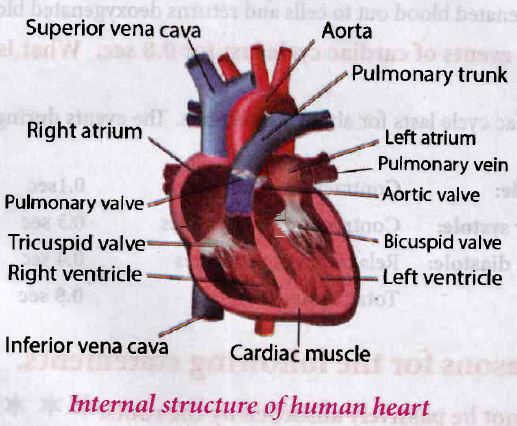
Describe the structure and working of the human heart.
32.
Define Ethnobotany and write its importance.
33.
Find the final temperature of a copper rod. Whose area of cross section changes from 10 m2 to 11 m2 due to heating. The copper rod is initially kept at 90 K. (Coefficient of superficial expansion is 0.0021 /K)
34.
Sanjay is sitting in the exam hall. Before the start of the exam, he sweats a lot, with increased rate of heart beat. Why does this condition occur?
35.
Will the cool drinks give more fizz at top of the hills or at the foot? Explain.
36.
A solid compound ‘A’ decomposes on heating into ‘B’ and a gas ‘C’. On passing the gas ‘C’ through water, it becomes acidic. Identify A, B and C.
37.
Name the acid that renders aluminium passive. Why?
1.
(i) Pigments.
(ii) Leaf age.
(iii) Accumulation of carbohydrates.
(iv) Hormones.
2.
(i) Astrobiology / Exobiology is the science which looks for the presence of extra terrestrial life in the Universe.
(ii) It deals with the origin, evolution and distribution of life in the Universe and to investigate the possibility of life in other world.
(iii) The major concept is the habitable zone. The theory explains that any planets can support the existence of life, if it fulfills two important criteria, that is :
(a) It must have a right mass to retain an atmosphere.
(b) It must have an orbit at just the right distance from its Star (Sun) that it allows liquid water to exist. Thus, the distance need to be neither too hot or not too cold and is often referred as Goldilock Zone for life.
(iv) In our solar system 'Earth' is the only planet in the Goldilock zone. Since, this zone varies at times as the star evolves, we know that Mars have also been habitable. The life on Mars are likely to be the creatures, we find in extreme environments on earth.
3.
| S. No | Conductor | Insulator |
| i) | Materials which | Materials which do not allow current |
| ii) | Resistivity is less | Resistivity is high |
4.
Scratch is a software used to create animations, cartoons and games easily. Scratch, on the other hand, is a visual programming language. It is developed in the Massachusetts Institute of Technology (MIT). Media Lab to make programming easier and more fun to learn.
5.
Insulin deficiency occurs due to destruction of \(\beta \)-cells of the pancreas.
6.
(i) Aqueous solution:
a) The solution in which water acts as a solvent is called aqueous solution.
b) Example: common salt in water, Copper Sulphate in water.
(ii) Non - Aqueous solution:
a) The solution in which any liquid, other than water, acts as a solvent is called non-aqueous solution.
b) Example: Sulphur dissolved in carbon disulphide, Iodine dissolved in carbon tetrachloride
7.
The Ieech makes a triradiate or 'Y' shaped incision in the skin of the host by the jaws protruded through the mouth and sucks the blood by muscular pharynx.
8.
Dolphins, dogs, bats can hear the ultrasonic vibrations.
9.
Isotopes of oxygen and its percentage abundance
| Isotope | % abundance |
|---|---|
| 8O16 | 99.757 % |
| 8O17 | 0.038 % |
| 8O18 | 0.205 % |
10.
(i) When a number of like or unlike parallel forces act on a rigid body and the body is in equilibrium, then the algebraic sum of the moments in the clockwise direction is equal to the algebraic sum of the moments in the anti-clockwise direction.
(ii) Moment in clockwise direction = Moment in anticlockwise direction.
(iii) F1 x d1 = F2 x d2.
11.
(i) Biofortification is the scientific process of developing crop plants enriched with high levels of desirable nutrients like vitamins, proteins and minerals.
(ii) Production of Bio fortification crops help in removing hidden hunger.
Examples:
(i) Protina, Shakti and Rathna are lysine rich maize hybrids (developed in India).
(ii) Atlas 66, a protein rich wheat variety.
(iii) Iron rich fortified rice variety.
(iv) Vitamin A enriched carrots, pumpkin and spinach.
(v) So in this way, Biofortification may help in removing hidden hunger.
12.
(i) Molasses is a dark coloured syrupy liquid left after the crystallization of sugar from the concentrated sugarcane juice.
(ii) It contains 30 % of sucrose, which cannot be separated by crystallization
(i) Dilution of molasses: Molasses is first diluted with water to bring down the U concentration of sugar to about 8 to 10%.
(ii) Addition of Nitrogen source:
a) Molasses usually contains enough nitrogenous matter to act as food for yeast during the fermentation process.
b) If the nitrogen content of the molasses is poor, ammonium sulphate or ammonium phosphate is added.
(iii) Addition of Yeast:
a) This solution kept in large fermentation tank and yeast is added to and it kept at about 303 K for a few days.
b) During this period, the enzymes invertase and, zymase present in yeast, converts sucrose into ethanol.
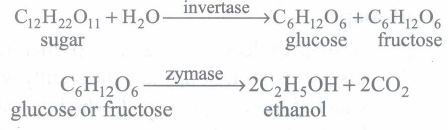
c) The fermented liquid is technically called wash.
(iv) Distillation of wash:
a) This wash containing 15 to 18 % alcohol, is now subjected to fractional distillation.
b) The main fraction drawn in an aqueous solution of ethanol which contains 95.5 % of ethanol and 4.5 % of water.
c) This is called rectified spirit.
d) This mixture is then refluxed over quicklime for about 5 to 6 hour and then allowed to stand for 12 hours.
e) On distillation of mixture, pure alcohol (100%) is obtained.
f) This is called absolute alcohol.
13.
Application of Newton's law of gravitation
(i) Dimensions of the heavenly objects can be measured using gravitation law. Mass of the earth, radius of the earth, acceleration due to gravity etc. can be calculated with a higher accuracy.
(ii) Helps in discovering new stars and planets. Mass of the double stars can be calculated.
(iii) One of the irregularities in the motion of stars is called "Wobble" which leads to the disturbance in the motion of planet nearby. In this condition mass of the star can be calculated using law of gravitation.
(iv) Helps to explain germination of roots due to the property of geotropism, which is the property of root responding to the gravity.
(v) Helps to predict the path of the astronomical bodies.
14.
(b)
Midbrain
15.
(d)
all the above
16.
(d)
(ii) & (iv) are correct
17.
(d)
Fe
18.
(c)
Dynamics
19.
(a)
Folder
20.
(b)
Fossil evidences
21.
(d)
22.
(a)
Saturated solution
23.
(b)
2.24 liter
24.
(c)
–0.25 m
25.
When smoke is inhaled the chemicals get absorbed by the tissues and cause the following harmful effects.
(i) Benzopyrene and polycyclic hydrocarbons present in tobacco smoke is carcinogenic causing lung cancer.
(ii) Causes inflammation of throat and bronchi leading to conditions like bronchitis and pulmonary tuberculosis.
(iii) Inflammation of lung alveoli decrease surface area for gas exchange and cause emphysema.
(iv) Carbon monoxide of tobacco smoke binds to hemoglobin of RBC and decreases its oxygen carrying capacity causing hypoxia in body tissues.
(v) Increased blood pressure caused by smoking leads to increased risk of heart disease.
(vi) Causes increased gastric secretion which leads to gastric and duodenal ulcers.
(vii) Tobacco chewing causes oral cancer (mouth cancer).
26.
(i) Radioactive materials should be kept in thick walled lead container.
(ii) Lead coated aprons and lead gloves should be used while working with hazardous radioactive materials.
(iii) We should avoid eating while handling radioactive materials.
(iv) The radioactive materials should be handled only by tongs or by a remote control process.
(v) Dosimeters should be worn by the users to check the level of radiation.
27.
(i) First law of refraction : The incident ray of light, the refracted ray of light and the normal to the refracting surface all lie in the same plane.
(ii) Second law of refraction : The ratio of the sine of the angle of incidence and sine of the angle of refraction is equal to the ratio of refractive indices of the two media. This law is also known as Snell's law.
\(\frac{\operatorname{sin i}}{\sin x}=\frac{\mu_2}{\mu_1} .\).
28.
(i) The term mutation was introduced by Hugo De Vries in 1901 when he observed phenotypic changes in the evening Primrose plant, Oenothera lamarckiana.
(ii) Mutation is an inheritable sudden change in the genetic material (DNA) of an organism.
(iii) Mutations are classified into two main types, namely chromosomal mutation and gene mutation. Chromosomal mutation: The sudden change in the structure or number of chromosomes is called chromosomal mutation. This may result in
Changes in the structure of chromosomes:
Structural changes in the chromosomes usually occurs due to errors in cell division. Changes in the number and arrangement of genes takes place as a result of deletion, duplication, inversion and translocation in chromosomes. Changes in the number of chromosomes: They involve addition or deletion in the number of chromosomes present in a cell. This is called ploidy. There are 2 types of ploidy:
Euploidy in plants and animals:
(a) Euploidy: It is the condition in which the individual bears more than the usual number of diploid (2n) chromosomes. If an individual has three haploid sets of chromosomes, the condition is called triploidy (3n). If it has four haploid sets of chromosomes. It is called Tetraploidy. Tetraploid plants are advantageous as they often result in increased fruit and flower size.
(b) Aneuploidy: It is the loss or gain of one or more chromosomes in a set. It is of 3 types:
(i) Monosomy (2n-1),
(ii) Trisomy (2n+1)
(iii) Nullisomy (2n-2). In man, Down's syndrome is one of the commonly known aneuploid condition.
Gene or point mutation:
(i) Gene mutation is the changes occurring in nucleotide sequence of a gene.
(ii) It involves substitution, deletion, insertion or inversion of a single or more than one nitrogenous base.
(iii) Gene alteration results in abnormal protein formation in an organism.
29.

1. Click events in script option

3. Click Looks in script option. Drag “say” to script area.
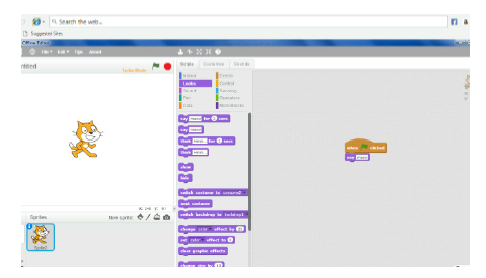
4. Type “Hello “ word in say tab.
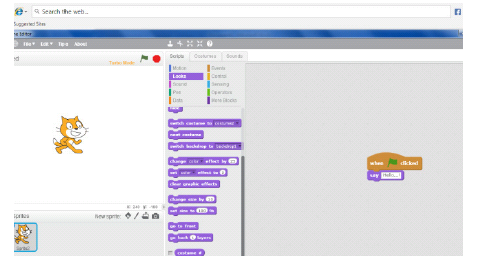
5.Click sounds in script option. Drag play sound to script area. Choose the hello sound from the audio file.

6. From File menu choose the Save option.
7. Click the green flag at the top right corner of the stage window to run the program
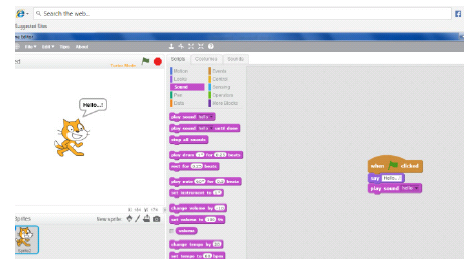

30.
| S.No. |
Outbreeding |
Inbreeding |
|---|---|---|
| i. | Cross between two different species (unrelated) with desirable features of economic value are mated. | Mating of closely related animals within the same breed for about 4 - 6 generations. |
| ii. | It is the breeding of unrelated animals. The offsprings formed are called hybrids. | Superior males and superior females of the same breed are identified and mated in pairs. |
| iii. | The hybrids are stronger and vigorous than their parents. E.g: Mule | It helps in the accumulation of superior genes and elimination of genes which are undesirable. E.g: Hisardale. |
31.
Structure of heart:
(i) Heart is a muscular pumping organ that pumps out blood into the blood vessels.
(ii) It is enclosed in a double walled sac called pericardium.
(iii) The two upper thin walled chambers are called auricles and the two thick walled chambers are called ventricles.
(iv) The chambers are separated by septum
(v) Heart contains pericardial fluid.
Working of heart:
(i) Contraction of heart is called systole and relaxation is called diastole.
(ii) When the auricles are filled with blood they are in diastole. The tricuspid and bicuspid valves remain closed. This is called atrial diastole.
(iii) When the auricles are full they contract. This leads to the opening of tricuspid and bicuspid valves. Blood from the auricles are pushed to the ventricles. This is called atrial systole.
(iv) Now the valves are closed. The ventricles contract. The deoxygenated blood from the right ventricle enters the pulmonary artery and the oxygenated blood from the left ventricle enters the aorta. This is called ventricular systole.
(v) These three events constitute the cardiac cycle.
32.
(i) Ethnobotany is the study of a region's plants and their practical uses through the traditional knowledge of the local culture of people.
Importance of Ethnobotany :
(i) It provides traditional uses of plant.
(ii) It gives information about certain unknown and known useful plants.
(iii) The ethnomedicinal data will serve as a useful source of information for the chemists, pharmacologists and practitioners of herbal medicine.
(iv) Tribal communities utilize ethnomedicinal plant and prepare medicine to cure many diseases.
33.
Area of copper rod, Ao = 10 m2
Changes of Area of cross section,
Initial temperature \(\Delta \mathrm{A} =11 -10 =1 \mathrm{~m}^{2} \)
\(\mathrm{~T}_{1} =90 \mathrm{~K} \)
\(a_{\mathrm{A}} =0.0021 / \mathrm{K} \)
\(\mathrm{T}_{2} =? \)
\(\frac{\Delta A}{A_{0}} =a_{\mathrm{A}} \Delta \mathrm{T} \)
\(\frac{1 }{10 } =0.0021\left[\mathrm{~T}_{2}-90\right] \)
\(0.1 =0.0021\left[\mathrm{~T}_{2}-90\right]=\frac{0.1}{0.0021}+90=\mathrm{T}_{2} \)
\(\mathrm{~T}_{2} =137.61 \mathrm{~K}\)
So the final temperature of a copper rod is 137.61 K
34.
Adrenaline is known to cause physical symptoms that accompany test anxiety such as increased heart rate, sweating, and rapid breathing.
35.
(i) Cool drinks give more fizz at the foot of mountain because the atmospheric pressure is less at the top of the mountain.
(ii) So the pressure affects the fizz of the cool drink.
36.
(i) On passing ' C ' through water it becomes acidic.
(ii) Therefore the gas ' C ' must be a non-metal oxide \(\left(\mathrm{CO}_{2}\right)\).
(iii) So a solid compound must be a calcium carbonate.
(iv) It decomposes into calcium oxide and carbon dioxide. (C)
\(\mathrm{CaCO}_{3(\mathrm{~g})} \rightarrow \mathrm{CaO}_{(\mathrm{S})}+\mathrm{CO}_{2(\mathrm{~g})} \uparrow\\ \quad \mathrm{A} \quad \quad \quad \quad \mathrm{B} \quad \quad \quad \quad \mathrm{C}\)
| A | CaCo3 | Calcium carbonate |
| B | CaO | Calcium oxide |
| C | CO2 | Carbon di oxide |
37.
(i) Dilute or concentrated nitric acid renders aluminum passive.
(ii) It does not attack aluminium but it forms oxide film on its surface.

10th Standard Syllabus & Materials
10th Standard
TN 10th English Prose - 2 - The Night the Ghost Got in Important Questions And Answers Study Material - QB365 Set A
NEW10th Standard
TN 10th English Supplementary - 1 - The Tempest Important Questions And Answers Study Material - QB365 Set A
NEW10th Standard
TN 10th English Poem - 1 - Life Important Questions And Answers Study Material - QB365 Set A
NEW10th Standard
TN 10th English Prose - 1 - His First Flight Important Questions And Answers Study Material - QB365 Set A



Tamilnadu Stateboard 10th Standard Subjects
Tamilnadu Stateboard Standards





