
 100% FREE ACCESS
10th Standard Syllabus & Materials
10th Standard
TN 10th English Prose - 4 - The Attic Important Questions And Answers Study Material - QB365 Set A
NEW10th Standard
TN 10th English Supplementary - 3 - The Story of Mulan Important Questions And Answers Study Material - QB365 Set A
NEW10th Standard
TN 10th English Poem - 3 - I am Every Woman Important Questions And Answers Study Material - QB365 Set A
NEW10th Standard
TN 10th English Prose - 3 - Empowered Women Navigating The World Important Questions And Answers Study Material - QB365 Set A
NEW10th Standard
TN 10th English Supplementary - 2 - Zigzag Important Questions And Answers Study Material - QB365 Set A
NEW10th Standard
TN 10th English Poem - 2 - The Grumble Family Important Questions And Answers Study Material - QB365 Set A

Published on: 13/05/2020
10th Standard Science English Medium Model Question Paper Part - V
Download Tamil Nadu 10th Standard Science question papers, model tests, one-mark questions, important questions, and public exam papers in PDF format. Free study materials and answer keys for TN State Board students.
Questions + Answers key
Take MCQ Science Test1.
Explain Chemical evolution of life.
2.
What is Sprite?
3.
What are psychotropic drugs?
4.
What is aqueous and non-aqueous solution? Give an example.
5.
Give the common name of the Hirudinaria granulosa
6.
What is a longitudinal wave?
7.
Define: Relative atomic mass.
8.
Differentiate mass and weight.
9.
Vinu dissolves 50 g of sugar in 250 ml of hot water, Sarath dissolves 50 g of same sugar in 250 ml of cold water. Who will get faster dissolution of sugar? and Why?
10.
Can a nickel spatula be used to stir copper sulphate solution? Justify your answer.
11.
a) Identify the bond between H and F in HF molecule.
b) What property forms the basis of identification?
c) How does the property vary in periods and in groups?
12.
Two blocks of masses 8 kg and 2 kg respectively lie on a smooth horizontal surface in contact with one other. They are pushed by a horizontally applied force of 15 N. Calculate the force exerted on the 2 kg mass.
13.
The inner mitochondrial membrane gives rise to finger like projections called ____________
oxysomes
matrix
cristae
stalk
14.
______ acts as a insulator.
myelin sheath(b)
synaptic junction
nodes of ranvier
glial cells
15.
SI unit of temperature is
Celsius
Fahrenheit
Kelvin
None
16.
Penetration power is the greatest in_______ rays
alpha
beta
gamma
helium
17.
Electronegativity values of Na and CI are 0.9 and 3.0 respectively predict the nature of bonding.
Ionic
Covalent
Coordinate
Metallic
18.
The gravitational force of earth acting on a body of mass 1 kg is ___________
8.9 N
9.8 N
980 N
1 N
19.
All files are stored in the _____________
Folder
box
Pai
scanner
20.
Biogenetic law states that ___________
Ontogeny and phylogeny go together
Ontogeny recapitulates phylogeny
Phylogeny recapitulates ontogeny
There is no relationship between phylogeny and ontogeny
21.
The body of leech has
23 segments
33 segments
38 segments
30 segments
22.
The number of components in a binary solution is _____________
2
3
4
5
23.
Mass of 1 mole of Nitrogen atom is
28 amu
14 amu
28 g
14 g
24.
A convex lens forms a real, diminished point sized image at focus. Then the position of the object is at
focus
infinity
at 2f
between f and 2f
25.
Explain the hazards and effects of Tobacco.
26.
Explain the principle & structure of atom bomb.
27.
Explain the Sign Conventions of lenses.
28.
Mala had a huge scar on her cheek after she met with fire accident during her college days. She is worried if her baby would inherit the scar she had acquired. She clarified with her doctor, she need not worry about it, as her scar is an acquired trait.
(i) What are acquired traits?
(ii) How is it different from inherited traits?
29.
Program for print the word “Hello” with sound
30.
Distinguish between
a. somatic gene therapy and germ line gene therapy
b. undifferentiated cells and differentiated cells.
31.
Who discovered Rh factor? Why was it named so?
32.
Define Ethnobotany and write its importance.
33.
Calculate the coefficient of cubical expansion of a zinc bar. Whose volume is increased 0.25 m3 from 0.3 m3 due to the change in its temperature of 50 K.
34.
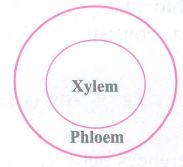
(a) What do you infer from this diagram? Identify it.
(b) Classify the type.
(c) Give an example
35.
V-I graphs for the two wires A and B are shown in the figure. If we connect both the wires one by one to the same battery, which of the two will produce more heat per unit time? Give justification for your answer.
36.
Where are estrogens produced? What is the role of estrogens in the human body?
37.
Biofortification may help in removing hidden hunger. How?
38.
What is called homologous series? Give any three of its characteristics?
1.
(i) This idea was developed by Oparin (1922) and Haldane (1929). They proposed that with the conditions prevailing on earth, life arose by a series of sequential chemical reactions.
(ii) The first form of life could have come from pre-existing non-living inorganic molecules which gave rise to formation of diverse organic molecules which are transformed into colloid system to produce life.
(iii) The modern concept on chemical evolution regarding origin of life was accepted.
2.
The characters on the background of a Scratch window are known as Sprite. Usually a cat appears as a sprite when the Scratch window is opened. The software provides facilities to make alternations in sprite.
3.
Psychotropic drugs acts on the brain and alters the behaviour, consciousness, power of thinking and perception.
4.
(i) Aqueous solution:
a) The solution in which water acts as a solvent is called aqueous solution.
b) Example: common salt in water, Copper Sulphate in water.
(ii) Non - Aqueous solution:
a) The solution in which any liquid, other than water, acts as a solvent is called non-aqueous solution.
b) Example: Sulphur dissolved in carbon disulphide, Iodine dissolved in carbon tetrachloride
5.
The Indian cattle leech.
6.
If the particles of the medium vibrate along the direction of propagation of the wave, then the waves are said to be longitudinal.
7.
(i) Relative atomic mass of an element is the ratio between the average mass of its isotopes to \(\frac{1}{12^{\text {th }}}\) part of the mass of a carbon-12 atom.
(ii) It is denoted as Ar.
(iii) It is otherwise called "Standard atomic weight".
8.
| S. No | Mass | Weight |
|---|---|---|
| (i) | Fundamental quantity. | Derived quantity. |
| (ii) | It is the amount of matter containing in a body. | It is the gravitational pull acting on the body. |
| (iii) | Its unit is kilogram (kg). | Its unit is newton (N). |
| (iv) | Remains the same. | Varies from one place to another place. |
| (v) | It is a scalar quantity. | It is a vector quantity. |
9.
(i) Vinu will get faster dissolution of sugar.
(ii) Temperature is one of the factors.
(iii) It will affect the solubility of a solute in a liquid.
(iv) Solvent increases with increase in temperature.
10.
(i) No, because Nickel is more reactive than Copper.
(ii) So Nickel easily reacts and displaces copper from copper sulphate solution.
(iii) \(\mathrm{Ni}_{(\mathrm{s})}+\mathrm{CuSO_4}_{(\mathrm{aq})} \rightarrow \mathrm{NiSO_4}_{(\mathrm{aq})}+\mathrm{Cu}_{(\mathrm{S})}\)
11.
(a) Ionic bond.
(b) Electronegativity property.
(c) (i) Along the period, from left to right in the periodic table, the electronegativity increases, because of the increase in the nuclear charge which in turn attracts the electrons more strongly.
(ii) On moving down a group, the electronegativity of the element decreases because of the increased number of valence shells.
12.
Given: Let m1 = 8 kg, m2 =2 kg. F = 15 N
Consider both the masses as a unit system as they will move with common acceleration,
\({\mathrm{F}}_{1}=\mathrm{M_1}a\)
\(F_2=m_2a\)
\(F=F_1+F_2\)
\(=\left(\mathrm{m}_{1} +\mathrm{~m}_{2}\right){a}\)
\(15=(8+2) {a} \)
\(15=10 a \)
\(a=15 / 10=1.5 \mathrm{~ms}^{-2}\)
a = 1.5 ms-2
Let \(\mathrm{F}_{2}\) be the force exerted on 2 kg mass, then
\({\mathrm{F}_{2}}=\mathrm{m_2} {a} \)
\({\mathrm{F}_{2}}=2 \times 1.5=3 \mathrm{~N}\)
So, the force exerted on 2 kg mass is 3 N.
13.
(c)
cristae
14.
(a)
myelin sheath(b)
15.
(c)
Kelvin
16.
(c)
gamma
17.
(a)
Ionic
18.
(b)
9.8 N
19.
(a)
Folder
20.
(b)
Ontogeny recapitulates phylogeny
21.
(b)
33 segments
22.
(a)
2
23.
(d)
14 g
24.
(b)
infinity
25.
When smoke is inhaled the chemicals get absorbed by the tissues and cause the following harmful effects.
(i) Benzopyrene and polycyclic hydrocarbons present in tobacco smoke is carcinogenic causing lung cancer.
(ii) Causes inflammation of throat and bronchi leading to conditions like bronchitis and pulmonary tuberculosis.
(iii) Inflammation of lung alveoli decrease surface area for gas exchange and cause emphysema.
(iv) Carbon monoxide of tobacco smoke binds to hemoglobin of RBC and decreases its oxygen carrying capacity causing hypoxia in body tissues.
(v) Increased blood pressure caused by smoking leads to increased risk of heart disease.
(vi) Causes increased gastric secretion which leads to gastric and duodenal ulcers.
(vii) Tobacco chewing causes oral cancer (mouth cancer).
26.
(i) Atom bomb is based on the principle of uncontrolled chain reaction.
(ii) In an uncontrolled chain reaction, the number of neutrons and the number of fission reactions multiply almost in a geometrical progression.
(iii) This releases a huge amount of energy in a very small time interval and leads to explosion.
Structure:
(i) An atom bomb consists of a piece of fissile material whose mass is sub critical.
(ii) This piece has a cylindrical void. It has a cylindrical fissile material which can fit into this void and its mass is also sub critical.
(iii) When the bomb has to be exploded, this cylinder is injected into the void using a conventional explosive.
(iv) Now, the two pieces of fissile material add up to form super critical mass which leads to an explosion.
(v) During this explosion tremendous amount of energy in the form of heat, light and radiation is released.
(vi) A very high temperature and pressure are experienced in fraction of second along with hazardous radiation like ૪ rays which adversely affect the living creatures.
27.
(i) The object is always placed on the left side of the lens.
(ii) All the distances are measured from the optical centre of the lens.
(iii) The distances measured in the same direction as that of incident light are taken as positive.
(iv) The distances measured against the direction of incident light are taken as negative. (v) The distances measured upward and perpendicular to the principal axis is taken as positive.
(v) The distances measured downward and perpendicular to the principal axis is taken· as negative.
28.
(i) Acquired traits are the characters that cannot be passed from one generation to the next generation.
(ii) Characters which are inherited by the offspring from the parents and carried from one generation to another generation are called Inherited traits.
29.
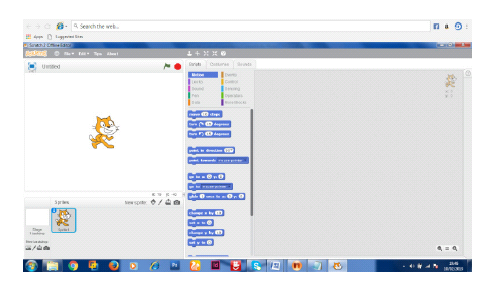
1. Click events in script option
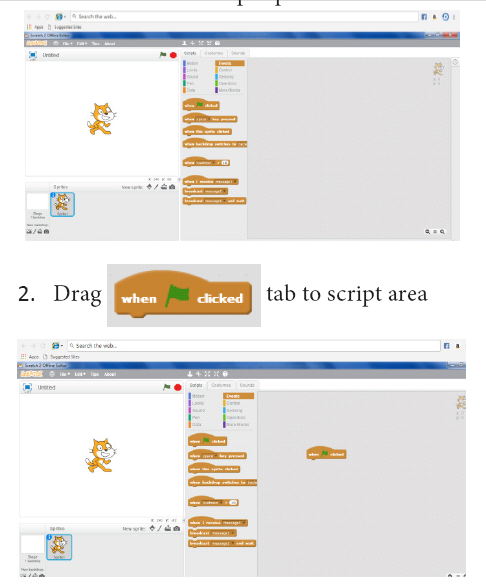
3. Click Looks in script option. Drag “say” to script area.
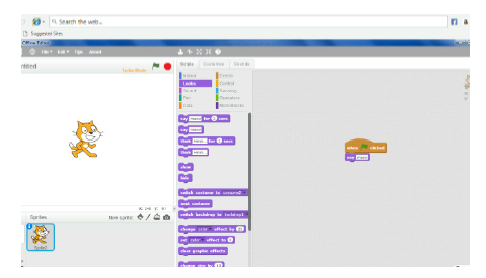
4. Type “Hello “ word in say tab.
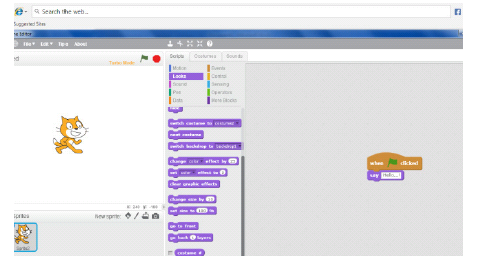
5.Click sounds in script option. Drag play sound to script area. Choose the hello sound from the audio file.
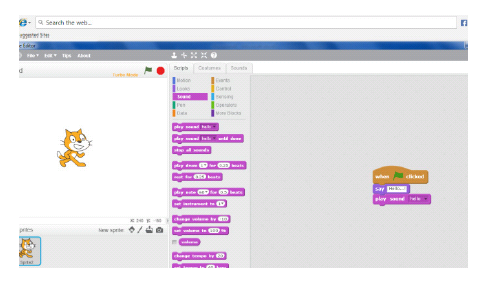
6. From File menu choose the Save option.
7. Click the green flag at the top right corner of the stage window to run the program
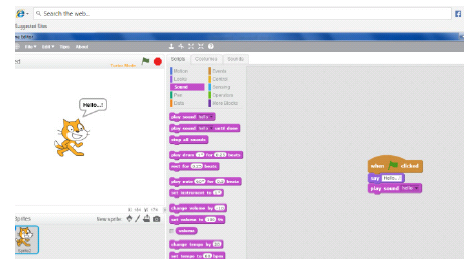
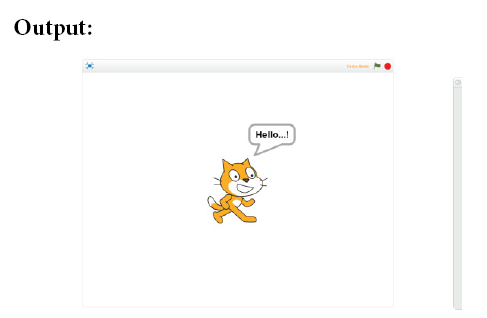
30.
a. Somatic gene therapy and germ line gene therapy
| S.No. |
Somatic gene therapy |
Germline gene therapy |
|---|---|---|
| (i) | Somatic gene therapy is the replacement of defective gene in somatic cells. | Germ line gene therapy is replacement of defective gene in germ cell. |
b. Undifferentiated cells and differentiated cells:
| S.No. |
Undifferentiated Cells |
Differentiated cells |
|---|---|---|
| (i) | Undifferentiated cells continuously proliferate throughout the life time of the organism. E.g: Umbilical cord |
Differentiated cells some are unable to proliferate. E.g: Pancreatic cells to secrete insulin. |
31.
(i) Rh factor was discovered by Landsteiner and Wiener in 1940. It was named so because it was first discovered in Rhesus monkey.
32.
(i) Ethnobotany is the study of a region's plants and their practical uses through the traditional knowledge of the local culture of people.
Importance of Ethnobotany :
(i) It provides traditional uses of plant.
(ii) It gives information about certain unknown and known useful plants.
(iii) The ethnomedicinal data will serve as a useful source of information for the chemists, pharmacologists and practitioners of herbal medicine.
(iv) Tribal communities utilize ethnomedicinal plant and prepare medicine to cure many diseases.
33.
Change in volume \((\Delta V)=0.3-0.25 =0.05\mathrm{~m}^{3}\)
Original volume \(\left(V_{0}\right)=0.3 \mathrm{~m}^{3}\)
Change in Temperature \(\Delta \mathrm{T}=50 \mathrm{~K}\)
\(a_{\mathrm{V}} =? \)
\(\frac{\Delta V}{V_{0}} =a_{\mathrm{V}} \Delta \mathrm{T}\)
\(a_{\mathrm{V}} =\frac{0.05}{0.3 \times 50}=\frac{0.05}{15}=0.0033 \mathrm{~K}^{-1}\)
Co-efficient of cubical expansion of Zinc bar 0.0033
34.
a) It is a vascular bundle.
b) It is a concentric bundle in which phloem completely surrounds the xylem such a type is described as amphicribral.
c) This is seen in ferns.
35.
Heat produced per unit time = V^2/R
Now slope of V-I graph = R (resistance of wire).
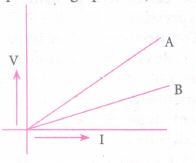
Since slope of V-I graph for wire A is greater than the slope of V-I graph for wire B, therefore, resistance of wire A is greater than the resistance of wire B, Hence, more heat will be produced per unit time in wire B than in wire A.
36.
Estrogen is produced by the Graafian follicles of the ovary,
Role of Estrogens in the human body:
(i) It brings about the changes that occur during puberty.
(ii) It initiates the process of oogenesis.
(iii) It stimulates the maturation of ovarian follicles in the ovary.
(iv) It promotes the development of secondary sexual characters (breast development, high pitched voice etc).
37.
(i) Biofortification is the scientific process of developing crop plants enriched with high levels of desirable nutrients like vitamins, proteins and minerals.
(ii) Production of Bio fortification crops help in removing hidden hunger.
Examples:
(i) Protina, Shakti and Rathna are lysine rich maize hybrids (developed in India).
(ii) Atlas 66, a protein rich wheat variety.
(iii) Iron rich fortified rice variety.
(iv) Vitamin A enriched carrots, pumpkin and spinach.
(v) So in this way, Biofortification may help in removing hidden hunger.
38.
Homologous series is a group or a class of organic compounds having same general formula and similar chemical properties in which the successive numbers differ by a -CH2 group.
E.g: Methane - CH4
Ethane - CH3CH3
Propane - CH3CH2CH3
Characteristics:
(i) Each member of the series differs from the preceding or succeeding member by one methylene group (-CH2) and hence by a molecular mass of 14 amu.
(ii) All members of a homologous series contain the same elements and functional group.
(iii) They are represented by a general molecular formula. e.g. Alkanes, CnH2n + 2
(iv) All the members can be prepared by a common method.

10th Standard Syllabus & Materials
10th Standard
TN 10th English Prose - 2 - The Night the Ghost Got in Important Questions And Answers Study Material - QB365 Set A
NEW10th Standard
TN 10th English Supplementary - 1 - The Tempest Important Questions And Answers Study Material - QB365 Set A
NEW10th Standard
TN 10th English Poem - 1 - Life Important Questions And Answers Study Material - QB365 Set A
NEW10th Standard
TN 10th English Prose - 1 - His First Flight Important Questions And Answers Study Material - QB365 Set A



Tamilnadu Stateboard 10th Standard Subjects
Tamilnadu Stateboard Standards





