
 100% FREE ACCESS
10th Standard Syllabus & Materials
10th Standard
TN 10th English Prose - 4 - The Attic Important Questions And Answers Study Material - QB365 Set A
NEW10th Standard
TN 10th English Supplementary - 3 - The Story of Mulan Important Questions And Answers Study Material - QB365 Set A
NEW10th Standard
TN 10th English Poem - 3 - I am Every Woman Important Questions And Answers Study Material - QB365 Set A
NEW10th Standard
TN 10th English Prose - 3 - Empowered Women Navigating The World Important Questions And Answers Study Material - QB365 Set A
NEW10th Standard
TN 10th English Supplementary - 2 - Zigzag Important Questions And Answers Study Material - QB365 Set A
NEW10th Standard
TN 10th English Poem - 2 - The Grumble Family Important Questions And Answers Study Material - QB365 Set A

Published on: 04/10/2022
QB365 provides a detailed and simple solution for every Possible Creative Questions in Class 10th Science Subject -Optics, English Medium. It will help Students to get more practice questions, Students can Practice these question papers in addition to score best marks.
Download Tamil Nadu 10th Standard Science question papers, model tests, one-mark questions, important questions, and public exam papers in PDF format. Free study materials and answer keys for TN State Board students.
Questions + Answers key
Take MCQ Science Test1.
What is the function of Cornea?
2.
What is Lens? What are types of lenses?
3.
Why is a normal eye not able to see clearly the objects placed closer than 25 cm?
4.
The colour of the sun is reddish during the sun rise and sunset. Explain why?
5.
What is 'Presbyopia'?
6.
What is near point and far point of a human eye?
7.
What are the other types of microscope and write is uses.
8.
How do we see distant and closer objects?
9.
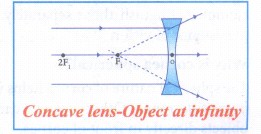
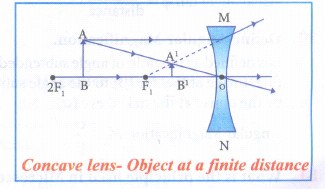
Draw images formation due to refraction through a concave lens.
10.
Write the application of convex lenses.
11.
Explain the types of lens.
12.
When does Mie scattering take place? Write the causes.
13.
Name and explain the types of scattering?
14.
How is a rainbow formed?
15.
What are the conclusions obtained from laws of refraction?
1.
(i) This is the thin and transparent layer on the front surface of the eyeball. It is the main refracting surface.
(ii) When light enters through the cornea, it refracts or bends the light on to the lens.
2.
(i) A lens is an optically transparent medium bounded by two spherical refracting surfaces or one plane and one spherical surface.
(ii) Lens is basically classified into two types. They are: (i) Convex Lens (ii) Concave Lens.
3.
(i) The rays coming from the objects which are at a distance less than 25 cm are not properly a focused on retina therefore ciliary muscles cannot be contracted beyond this limit.
(ii) The focal length of the eye cannot be reduced below 25 cm.
4.
(i) At sunrise and sunset, the light rays from the sun have to travel a larger distance in the atmosphere than at noon.
(ii) Hence, most of the blue lights are scattered away and only the red light which gets least scattered reaches us.
(iii) Therefore, the colour of the sun is red at sunrise and sunset.
5.
(i) Due to ageing, ciliary muscles becoming weak and the eye-lens becoming rigid (inflexible), the eye loses its power of accommodation.
(ii) Because of this, an aged person cannot see the nearby objects clearly. So, it is also called as 'old age hypermetropia'.
6.
(i) Near point : The minimum distance required to see the objects distinctly without strain is called least distance of distinct vision. It is 25 cm for normal human eye.
(ii) Far point: The maximum distance up to which the eye can see objects clearly is called as far point of the eye. It is infinity for normal eye.
7.
The other types and uses of microscopes are
(i) Travelling microscope: It is for measuring very small length with high degree of an accuracy at the order of 0.01 mm.
(ii) Electron Microscope: It is much higher magnifications and has a greater resolving power to see much smaller objects in finer detail.
(iii) Transmission Electron Microscope: It is capable of resolving to better than nanometre (10-9m). It is also capable of 3-Dimensional tomography.
8.
(i) To see distant objects, the ciliary muscle relaxes and makes the eye lens thinner. This increases the focal length of eye lens.
(ii) Hence, the distant object can be clearly seen. When we look at a closer object, the focal length of the eye lens is decreased by the contraction of ciliary muscle.
(iii) Thus, the image of the closer object is clearly formed on the retina.
9.
(i) Object at Infinity: When an object is placed at infinity, a virtual image is formed at the focus. The size of the image is much smaller than that of the object.
(ii) Object anywhere on the principal axis at a finite distance: When an object is placed at a finite distance from the lens, a virtual image is formed between pole and focus of the convex lens. The size of the image is smaller than that of the object.
10.
(i) Convex lenses are used as camera lenses.
(ii) Convex lenses are used as magnifying lenses.
(iii) Convex lenses are used in making microscope, telescope and slide projectors.
(iv) Convex lenses are used to correct the defect of vision called hypermetropia.
11.
(i) Convex or bi-convex lens : It is a lens bounded by two spherical surfaces such that it is thicker at the centre than at the edges. It is a converging lens. So, a beam of light passing through it is converged to a point. So, a convex lens is also called as converging lens.
(ii) Concave or bi-concave Lens : It is a lens bounded by two spherical surfaces such that it is thinner at the centre than at the edges. It is a diverging lens. So, a parallel beam of light passing through it is diverged or spread out. So, a concave lens is also called as diverging lens.
12.
(i) Mie scattering takes place when the diameter of the scatterer is similar to or larger than the wavelength of the incident light. It is also an elastic scattering. The amount of scattering is independent of wave length.
(ii) Mie scattering is caused by pollen, dust, smoke, water droplets, and other particles in the lower portion of the atmosphere.
13.
Based on initial and final energy of the light beam, scattering can be classified as, (i) Elastic scattering, (ii) Inelastic scattering.
(i) Elastic scattering : If the energy of the incident beam of light and the scattered beam of light are same, then it is called as 'elastic scattering'
(ii) Inelastic scattering : If the energy of the incident beam of light and the scattered beam of light are not same, then it is called as 'inelastic scattering:
14.
(i) Tiny water droplets are formed in the atmosphere due to rainfall. The rainbow is formed when sun light falling on these tiny water droplets undergoes dispersion.
(ii) When the sun light is incident on them, it is first refracted and dispersed at the front surface. When the refracted light falls on the back surface of the water droplet, it undergoes total internal reflection.
(iii) This reflected beam of coloured lights are refracted at the front surface of the water droplet. Thus, the rainbows can always be seen opposite to the sun.
15.
(i) The speed of light in a medium is low if the refractive index of the medium is high and vice versa.
(ii) When light travels from a denser medium into a rarer medium, the refracted ray is bent away from the normal drawn to the interface.
(iii) When light travels from a rarer medium into a denser medium, the refracted ray is bent towards the normal drawn to the interface.

10th Standard Syllabus & Materials
10th Standard
TN 10th English Prose - 2 - The Night the Ghost Got in Important Questions And Answers Study Material - QB365 Set A
NEW10th Standard
TN 10th English Supplementary - 1 - The Tempest Important Questions And Answers Study Material - QB365 Set A
NEW10th Standard
TN 10th English Poem - 1 - Life Important Questions And Answers Study Material - QB365 Set A
NEW10th Standard
TN 10th English Prose - 1 - His First Flight Important Questions And Answers Study Material - QB365 Set A



Tamilnadu Stateboard 10th Standard Subjects
Tamilnadu Stateboard Standards





