
 100% FREE ACCESS
10th Standard Syllabus & Materials
10th Standard
TN 10th English Prose - 4 - The Attic Important Questions And Answers Study Material - QB365 Set A
NEW10th Standard
TN 10th English Supplementary - 3 - The Story of Mulan Important Questions And Answers Study Material - QB365 Set A
NEW10th Standard
TN 10th English Poem - 3 - I am Every Woman Important Questions And Answers Study Material - QB365 Set A
NEW10th Standard
TN 10th English Prose - 3 - Empowered Women Navigating The World Important Questions And Answers Study Material - QB365 Set A
NEW10th Standard
TN 10th English Supplementary - 2 - Zigzag Important Questions And Answers Study Material - QB365 Set A
NEW10th Standard
TN 10th English Poem - 2 - The Grumble Family Important Questions And Answers Study Material - QB365 Set A

Published on: 04/10/2022
QB365 provides a detailed and simple solution for every Possible Book Back Questions in Class 10th Science Subject -Optics, English Medium. It will help Students to get more practice questions, Students can Practice these question papers in addition to score best marks.
Download Tamil Nadu 10th Standard Science question papers, model tests, one-mark questions, important questions, and public exam papers in PDF format. Free study materials and answer keys for TN State Board students.
Questions + Answers key
Take MCQ Science Test1.
An object of height 3cm is placed at 10cm from a concave lens of focal length 15cm. Find the size of the image.
2.
An object is placed at a distance 20cm from a convex lens of focal length 10cm. Find the image distance and nature of the image.
3.
The eyes of the nocturnal birds like owl are having a large cornea and a large pupil. How does it help them?
4.
While doing an experiment for the determination of focal length of a convex lens, Raja Suddenly dropped the lens. It got broken into two halves along the axis. If he continues his experiment with the same lens,
(a) can he get the image?
(b) Is there any change in the focal length?
5.
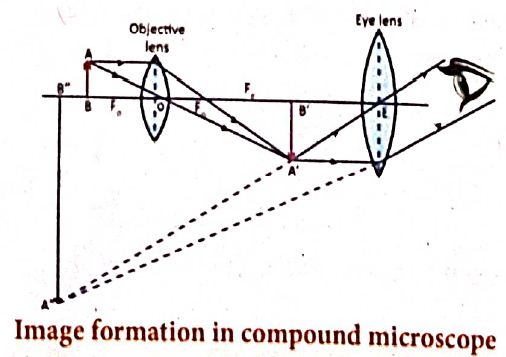
Explain the construction and working of a 'Compound Microscope'.
6.
Differentiate the eye defects: Myopia and Hypermetropia.
7.
Explain the rules for obtaining images formed by a convex lens with the help of ray diagram.
8.
List any five properties of light.
1.
Given:
\(\mathrm{f}=-15 \mathrm{~cm}, \mathrm{u}=-10 \mathrm{~cm}, \mathrm{v}=?, \mathrm{~h}=3 \mathrm{~cm} \)
\(\frac{1}{f} =\frac{1}{v}-\frac{1}{u} \Rightarrow \frac{1}{v}-\frac{1}{u} =\frac{1}{f} \)
\(\frac{1}{v} =\frac{1}{f}+\frac{1}{u} \)
.JPG)
\(\frac{1}{v}=\frac{-5}{30}=-\frac{1}{6} \)
\(v=-6 \mathrm{~cm} \)
Size of the image:
Magnification \(=\frac{+v}{u} \quad\left(m=\frac{h^{\prime}}{h}\right) \)
\(\frac{h^{\prime}}{h} =\frac{-v}{u} \)
\(\frac{h^{\prime}}{3} =\frac{-6}{-10}=0.6 \)
\(h^{\prime} =0.6 \times 3=1.8 \mathrm{~cm}\)
Size of the image =1.8 cm
2.
Given:
\(\mathrm{f}=10 \mathrm{~cm}, \mathrm{u}=-20 \mathrm{~cm}, \mathrm{v}=? \)
\(\frac{1}{f}=\frac{1}{v}-\frac{1}{u} \Rightarrow \frac{1}{v} =\frac{1}{f}+\frac{1}{u} \)
\(\frac{1}{v} =\frac{1}{10}+\frac{1}{-20}=\frac{1}{10}-\frac{1}{20} \)
\(\frac{1}{v} =\frac{2-1}{20}=\frac{1}{20} \)
\(\mathbf{v} =20 \mathrm{~cm} \)
Image distance = 20 cm
Nature of image:
Nature of the image is real, enlarged and inverted image.
3.
The eyes of the nocturnal birds like owl have a large cornea and a large pupil. These features increase their field of vision and also shows an increase in retinal surface and help them to collect more ambient light during night.
4.
a) Yes, he got the image. But the image is not clear.
b) There is no change in the focal length. Because, no change in radius of curvature.
5.
Compound microscope:
A Compound microscope is used to see the tiny objects has better magnification power than simple microscope.
Construction:
(i) A compound microscope consists of two convex lenses.
(ii) The lens with the shorter focal length is placed near the object, and is called as 'objective lens' or 'objective piece'.
(iii) The lens with larger focal length and larger aperture placed near the observer's eye is called as 'eye lens' or 'eye piece'.
(iv) Both the lenses are fixed in a narrow tube with adjustable provision.
Working:
(i) The object (AB) is placed at a distance slightly greater than the focal length of objective lens \(\left(u>f_{0}\right)\).
(ii) A real, inverted and magnified image \(\left(\mathrm{A}^{\prime} \mathrm{B}^{\prime}\right)\) is formed at the other side of the objective lens.
(iii) This image behaves as the object for the eye lens.
(iv) The position of the eye lens is adjusted in such a way, that the image (A' B') falls within the principal focus of the eye piece.
(v) This eye piece forms a virtual, enlarged and erect image (A" B") on the same side of the object.
(vi) Compound microscope has 50 to 200 times more magnification power than simple microscope.
6.
| S. No |
Myopia |
Hypermetropia |
|---|---|---|
| (i) | It is also known as Short sightedness. | It is also known as Long sightedness. |
| (ii) | It occurs due to the lengthening of eye ball. | It occurs due to the shortening of eye ball. |
| (iii) | With this defect near by objects can be seen clearly, but distant objects cannot be seen clearly. | With this defect nearby objects cannot be seen clearly but distant objects can be seen clearly. |
| (iv) | The focal length of eye lens is reduced. | The focal length of eye lens is increased. |
| (v) | The far point will not be infinity for such eyes and the far points have come closer. | The near point will not be at 25 cm for such eyes and the near point have moved farther. |
| (vi) | The image of distant objects are formed before the retina. |
The image of nearby objects are formed behind the retina. |
| (vii) | The defect can be corrected using concave lens. | The defect can be corrected using convex lens. |
7.
Rules for obtaining images:
(i) When an object is placed in front of a lens, the light rays from the object fall on the lens.
(ii) The position, size and nature of the image formed can be understood only if we know certain basic rules.
Rule-1: When a ray of light strikes the convex lens obliquely at its optical centre, it continues to follow its path without any deviation.
.JPG)
Rule-2: When rays parallel to the principal axis strikes a convex or concave lens, the rays are refracted converged to (convex lens) or appear to diverge from the principal focus.
.JPG)
Rule-3: When a ray passing through (convex lens) or directed towards (concave lens) the principal focus strikes a convex or concave lens, the refracted ray will be parallel to the principal axis.
.JPG)
8.
(i) Light is a form of energy.
(ii) Light always travels along a straight line.
(iii) Light does not need any medium for its propagation. It can even travel through vacuum.
(iv) The speed of light in vacuum or air is, c = 3 x 10⁸ m/s
(v) Since, light is in the form of waves, it is characterized by a wavelength (λ) and a frequency (v), which are related by the following equation: c = v λ (c - velocity of light).

10th Standard Syllabus & Materials
10th Standard
TN 10th English Prose - 2 - The Night the Ghost Got in Important Questions And Answers Study Material - QB365 Set A
NEW10th Standard
TN 10th English Supplementary - 1 - The Tempest Important Questions And Answers Study Material - QB365 Set A
NEW10th Standard
TN 10th English Poem - 1 - Life Important Questions And Answers Study Material - QB365 Set A
NEW10th Standard
TN 10th English Prose - 1 - His First Flight Important Questions And Answers Study Material - QB365 Set A



Tamilnadu Stateboard 10th Standard Subjects
Tamilnadu Stateboard Standards





