
 100% FREE ACCESS
10th Standard Syllabus & Materials
10th Standard
TN 10th English Prose - 4 - The Attic Important Questions And Answers Study Material - QB365 Set A
NEW10th Standard
TN 10th English Supplementary - 3 - The Story of Mulan Important Questions And Answers Study Material - QB365 Set A
NEW10th Standard
TN 10th English Poem - 3 - I am Every Woman Important Questions And Answers Study Material - QB365 Set A
NEW10th Standard
TN 10th English Prose - 3 - Empowered Women Navigating The World Important Questions And Answers Study Material - QB365 Set A
NEW10th Standard
TN 10th English Supplementary - 2 - Zigzag Important Questions And Answers Study Material - QB365 Set A
NEW10th Standard
TN 10th English Poem - 2 - The Grumble Family Important Questions And Answers Study Material - QB365 Set A

Published on: 12/05/2020
10th Standard Science English Medium Public Exam Model Question Paper July 2020
Download Tamil Nadu 10th Standard Science question papers, model tests, one-mark questions, important questions, and public exam papers in PDF format. Free study materials and answer keys for TN State Board students.
Questions + Answers key
Take MCQ Science Test1.
What are bulliform cells?
2.
Give some examples of vestigial organs in man.
3.
Give the formula for the following
(i) Ohm's law
(ii) Joules law
(iii) Effective resistance for resistance in series
(iv) Power
(v) Specific resistance
4.
Write a short note on editor and its types.
5.
What are psychotropic drugs?
6.
What is aqueous and non-aqueous solution? Give an example.
7.
Write the dental formula of rabbit.
8.
What is the minimum distance needed for an echo?
9.
Give any two examples for heterodiatomic molecules.
10.
Why a spanner with a long handle is preferred to tighten screws in heavy vehicles?
11.
How is ethanol manufactured from sugarcane?
12.
State Newton’s laws of motion?
13.
Each neuron can transmit ______ nerve impulses per second.
10
1000
10,000
1,00,000
14.
The formula for conversion of temperature from Kelvin to Celsius is
C = K + 73
C = K - 273
C = K + 460
C = K - 460
15.
16.
Electronegativity values of Na and CI are 0.9 and 3.0 respectively predict the nature of bonding.
Ionic
Covalent
Coordinate
Metallic
17.
18.
Which is used to build scripts?
Script area
Block palette
stage
sprite
19.
Paleontologists deal with
Embryological evidences
Fossil evidences
Vestigial organ evidences
All the above
20.
The animals which give birth to young ones are
Oviparous
Viviparous
Ovoviviparous
All the above
21.
Solubility of NaCl in 100 ml water is 36 g. If 25 g of salt is dissolved in 100 ml of water how much more salt is required for saturation _____________
12g
11g
16g
20g
22.
The volume occupied by 4.4 g of CO2 at S.T.P
22.4 liter
2.24 liter
0.24 liter
0.1 liter
23.
24.
Ramu studies in a school and his friends are discussing about drugs. They force him to use drugs and threaten to avoid him / harm him if he refuses. What should Ramu do?
25.
Distinguish between Nuclear fission and nuclear fusion.
26.
Write the sign convention for lenses.
27.
Write a note on mutation.
28.
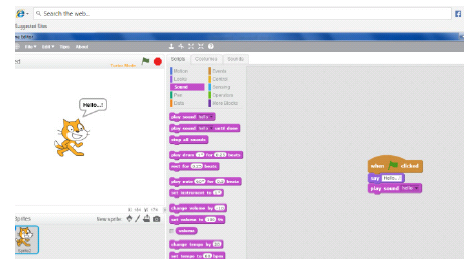
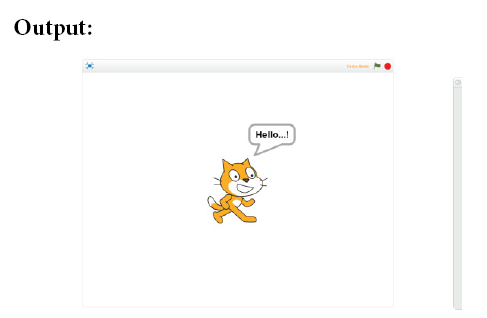
Program for print the word “Hello” with sound
29.
Differentiate between outbreeding and inbreeding.
30.
The complete events of cardiac cycle last for 0.8 sec. What is the timing for each event?
31.
How can you determine the age of the fossils?
32.
Calculate the coefficient of cubical expansion of a zinc bar. Whose volume is increased 0.25 m3 from 0.3 m3 due to the change in its temperature of 50 K.
33.
A plant hormone was first discovered in Japan when rice plants were suffering from Bakanae disease caused by Gibberella fujikoroi. Based on this information answer the following questions:
a) Identify the hormone involved in this process.
b) Which property of this hormone causes the disease?
c) Give two functions of this hormone.
34.
A breeder wishes to incorporate desirable characters into the crop plants. Prepare a list of characters he will incorporate.
35.
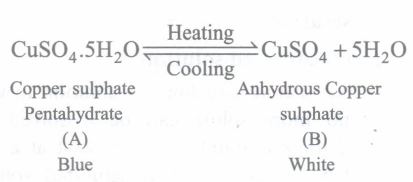
'A' is a blue coloured crystalline salt. On heating it loses blue colour and to give 'B'. When water is added, 'B' gives back to 'A'. Identify A and B, write the equation.
36.
A solid compound ‘A’ decomposes on heating into ‘B’ and a gas ‘C’. On passing the gas ‘C’ through water, it becomes acidic. Identify A, B and C.
37.
Metal A belongs to period 3 and group 13. A in red hot condition reacts with steam to form B. A with strong alkali forms C. Find A, B and C with reactions.
1.
In monocot leaf some cells of upper epidermis are large and thin walled. They are known as bulliform cells.
2.
Vermiform appendix, Nictitating membrane, Caudal Vertebra and Coccyx.
3.
(i) V = IR
(ii) H = I2Rt
(iii) Rs = R1 + R2
(iv) P = VI
(v) \(\rho=R\frac{A}{L}\)
4.
The script editor where you edit programs or your sprites pictures. The script editor has three main parts.
i) Script area
ii) Block menu
iii) Block palette.
5.
Psychotropic drugs acts on the brain and alters the behaviour, consciousness, power of thinking and perception.
6.
(i) Aqueous solution:
a) The solution in which water acts as a solvent is called aqueous solution.
b) Example: common salt in water, Copper Sulphate in water.
(ii) Non - Aqueous solution:
a) The solution in which any liquid, other than water, acts as a solvent is called non-aqueous solution.
b) Example: Sulphur dissolved in carbon disulphide, Iodine dissolved in carbon tetrachloride
7.
\(\text{Dental formula is }\left( 1\cfrac { 2 }{ 1 } ,C\cfrac { 0 }{ 0 } ,PM\cfrac { 3 }{ 2 } ,H\cfrac { 3 }{ 3 } \right)\text{in rabbit which is written as }\frac{2033}{1023} \)
8.
The minimum distance required to hear an echo is 1/20th part of the magnitude of the velocity of sound in air.
i.e. \(\frac{1}{20} \times 344 = 16.7m\)
9.
Hydrogen chloride (HCl), Hydrogen iodide (HI) are two examples for heterodiatomic molecules.
10.
(i) A spanner has a long handle to produce a larger moment of force by a small force applied normally at the end of its handle.
(ii) Moment of force = \(\overrightarrow{\mathbf{F}} \times \overrightarrow{\mathrm{d}}\)
11.
(i) Molasses is a dark coloured syrupy liquid left after the crystallization of sugar from the concentrated sugarcane juice.
(ii) It contains 30 % of sucrose, which cannot be separated by crystallization
(i) Dilution of molasses: Molasses is first diluted with water to bring down the U concentration of sugar to about 8 to 10%.
(ii) Addition of Nitrogen source:
a) Molasses usually contains enough nitrogenous matter to act as food for yeast during the fermentation process.
b) If the nitrogen content of the molasses is poor, ammonium sulphate or ammonium phosphate is added.
(iii) Addition of Yeast:
a) This solution kept in large fermentation tank and yeast is added to and it kept at about 303 K for a few days.
b) During this period, the enzymes invertase and, zymase present in yeast, converts sucrose into ethanol.
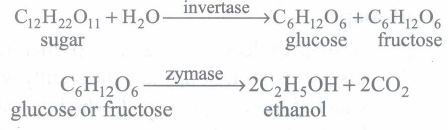
c) The fermented liquid is technically called wash.
(iv) Distillation of wash:
a) This wash containing 15 to 18 % alcohol, is now subjected to fractional distillation.
b) The main fraction drawn in an aqueous solution of ethanol which contains 95.5 % of ethanol and 4.5 % of water.
c) This is called rectified spirit.
d) This mixture is then refluxed over quicklime for about 5 to 6 hour and then allowed to stand for 12 hours.
e) On distillation of mixture, pure alcohol (100%) is obtained.
f) This is called absolute alcohol.
12.
(i) Newton's First law: Newton's first law states that, everybody continues to be in its state of rest or the state of uniform motion along a straight line unless it is acted upon by some external force.
(ii) Newton's second law of motion: Newton's second law states that, the force acting on an object is directly proportional to the rate of change of linear momentum of the object and the change in momentum takes place in the direction of force.
(iii) Newton's third law of motion: Newton's third law states that, for every action there is an equal and opposite reaction. They always act on two different bodies.
13.
(b)
1000
14.
(b)
C = K - 273
15.
(d)
16.
(a)
Ionic
17.
(c)
18.
(a)
Script area
19.
(b)
Fossil evidences
20.
(b)
Viviparous
21.
(b)
11g
22.
(b)
2.24 liter
23.
(d)
24.
Ramu must discuss the issue with his parents or teachers. He must take support from elders in not being a part of this group so that he can take care of his physical and mental health and not fall a prey to bad habits. Friendship does not mean being a support to the wrong actions of our friends.
25.
| S. No |
Nuclear fission |
Nuclear fusion |
|---|---|---|
| i | The process of breaking (splitting) up of a heavy nucleus into two smaller nuclei is called "nuclear fission". | Nuclear fusion is the combination of two lighter nuclei to form a heavier nucleus. |
| ii | Can be performed at room temperature. | Extreme high temperature and pressure is needed. |
| iii | Alpha, beta and gamma radiations are emitted. | Alpha ray, Positron, and neutrinos are emitted. |
| iv | Fission leads to the emission of gamma radiation. This triggers mutation in the human genes and causes genetic transform diseases. | Only light and heat energy is emitted. No harmful radiation and will not cause any genetic transform diseases. |
| v | Deflected by both the fields; but the direction of deflection is opposite to alpha rays. (in accordance with Fleming's left hand rule). | They are not deflected by both fields. |
26.
| S.No. | Convex Lens | Concave Lens |
| i | Focal length | + for convex lens - for concave lens |
| ii | Distance of object | - if the object is to the left object of the lens + if the object is to the right of the lens |
| iii | Distance of image | + if the image is formed on the right of the lens (real image) - if the image is formed one the left of the lens (virtual image) |
| iv | Magnification | + for erect images - for inverted images |
27.
(i) The term mutation was introduced by Hugo De Vries in 1901 when he observed phenotypic changes in the evening Primrose plant, Oenothera lamarckiana.
(ii) Mutation is an inheritable sudden change in the genetic material (DNA) of an organism.
(iii) Mutations are classified into two main types, namely chromosomal mutation and gene mutation. Chromosomal mutation: The sudden change in the structure or number of chromosomes is called chromosomal mutation. This may result in
Changes in the structure of chromosomes:
Structural changes in the chromosomes usually occurs due to errors in cell division. Changes in the number and arrangement of genes takes place as a result of deletion, duplication, inversion and translocation in chromosomes. Changes in the number of chromosomes: They involve addition or deletion in the number of chromosomes present in a cell. This is called ploidy. There are 2 types of ploidy:
Euploidy in plants and animals:
(a) Euploidy: It is the condition in which the individual bears more than the usual number of diploid (2n) chromosomes. If an individual has three haploid sets of chromosomes, the condition is called triploidy (3n). If it has four haploid sets of chromosomes. It is called Tetraploidy. Tetraploid plants are advantageous as they often result in increased fruit and flower size.
(b) Aneuploidy: It is the loss or gain of one or more chromosomes in a set. It is of 3 types:
(i) Monosomy (2n-1),
(ii) Trisomy (2n+1)
(iii) Nullisomy (2n-2). In man, Down's syndrome is one of the commonly known aneuploid condition.
Gene or point mutation:
(i) Gene mutation is the changes occurring in nucleotide sequence of a gene.
(ii) It involves substitution, deletion, insertion or inversion of a single or more than one nitrogenous base.
(iii) Gene alteration results in abnormal protein formation in an organism.
28.

1. Click events in script option

3. Click Looks in script option. Drag “say” to script area.

4. Type “Hello “ word in say tab.

5.Click sounds in script option. Drag play sound to script area. Choose the hello sound from the audio file.

6. From File menu choose the Save option.
7. Click the green flag at the top right corner of the stage window to run the program
29.
| S.No. |
Outbreeding |
Inbreeding |
|---|---|---|
| i. | Cross between two different species (unrelated) with desirable features of economic value are mated. | Mating of closely related animals within the same breed for about 4 - 6 generations. |
| ii. | It is the breeding of unrelated animals. The offsprings formed are called hybrids. | Superior males and superior females of the same breed are identified and mated in pairs. |
| iii. | The hybrids are stronger and vigorous than their parents. E.g: Mule | It helps in the accumulation of superior genes and elimination of genes which are undesirable. E.g: Hisardale. |
30.
Each cardiac cycle lasts for about 0.8 seconds. The events during a single cardiac cycle involves,
a) Atrial systole - 0.1 sec
(Contraction of auricles)
b) Ventricular systole - 0.3 sec
( Contraction of ventricles)
c) Ventricular diastole - 0.4 sec
(Relaxation of ventricles)
Total time - 0.8 sec
31.
(i) The age of fossils is determined by radioactive elements present in it.
(ii) They may be carbon, uranium, lead or potassium.
(iii) It is used in paleobotany and anthropology for determining the age of human fossils and manuscripts.
32.
Change in volume \((\Delta V)=0.3-0.25 =0.05\mathrm{~m}^{3}\)
Original volume \(\left(V_{0}\right)=0.3 \mathrm{~m}^{3}\)
Change in Temperature \(\Delta \mathrm{T}=50 \mathrm{~K}\)
\(a_{\mathrm{V}} =? \)
\(\frac{\Delta V}{V_{0}} =a_{\mathrm{V}} \Delta \mathrm{T}\)
\(a_{\mathrm{V}} =\frac{0.05}{0.3 \times 50}=\frac{0.05}{15}=0.0033 \mathrm{~K}^{-1}\)
Co-efficient of cubical expansion of Zinc bar 0.0033
33.
a) Gibberellin
b) The active substance was identified as Gibberellic acid, which caused this disease.
c) i) Application of gibberellins on plants stimulate extraordinary elongation of internode. e.g. Corn and Pea.
ii) Treatment of rosette plants with gibberellin induces sudden shoot elongation followed by flowering. This is called bolting.
34.
A breeder will incorporate the following characters:
(i) Tallness and profuse branching are desirable characters for fodder crops.
(ii) Dwarfness is desirable in cereals, so that less nutrients are consumed by these crops.
35.
(i) 'A' is copper sulphate pentahydrate (CuSO4.5H2O).
(ii) 'B' is Anhydrous copper sulphate (CuSO4)
36.
(i) On passing ' C ' through water it becomes acidic.
(ii) Therefore the gas ' C ' must be a non-metal oxide \(\left(\mathrm{CO}_{2}\right)\).
(iii) So a solid compound must be a calcium carbonate.
(iv) It decomposes into calcium oxide and carbon dioxide. (C)
\(\mathrm{CaCO}_{3(\mathrm{~g})} \rightarrow \mathrm{CaO}_{(\mathrm{S})}+\mathrm{CO}_{2(\mathrm{~g})} \uparrow\\ \quad \mathrm{A} \quad \quad \quad \quad \mathrm{B} \quad \quad \quad \quad \mathrm{C}\)
| A | CaCo3 | Calcium carbonate |
| B | CaO | Calcium oxide |
| C | CO2 | Carbon di oxide |
37.
i) Metal A belongs to periods 3 and group 13 is Aluminium.
ii) When steam is passed over red hot aluminium, Aluminium oxide and Hydrogen is produced.
iii) when Aluminium react with strong caustic alkalis forming aluminates
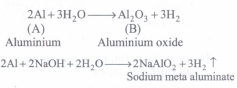
| A | Al | Aluminium |
| B | Al2O3 | Aluminium oxide |
| C | NaAlO2 | Sodium meta aluminate |

10th Standard Syllabus & Materials
10th Standard
TN 10th English Prose - 2 - The Night the Ghost Got in Important Questions And Answers Study Material - QB365 Set A
NEW10th Standard
TN 10th English Supplementary - 1 - The Tempest Important Questions And Answers Study Material - QB365 Set A
NEW10th Standard
TN 10th English Poem - 1 - Life Important Questions And Answers Study Material - QB365 Set A
NEW10th Standard
TN 10th English Prose - 1 - His First Flight Important Questions And Answers Study Material - QB365 Set A



Tamilnadu Stateboard 10th Standard Subjects
Tamilnadu Stateboard Standards





