
 100% FREE ACCESS
10th Standard Syllabus & Materials
10th Standard
TN 10th English Prose - 4 - The Attic Important Questions And Answers Study Material - QB365 Set A
NEW10th Standard
TN 10th English Supplementary - 3 - The Story of Mulan Important Questions And Answers Study Material - QB365 Set A
NEW10th Standard
TN 10th English Poem - 3 - I am Every Woman Important Questions And Answers Study Material - QB365 Set A
NEW10th Standard
TN 10th English Prose - 3 - Empowered Women Navigating The World Important Questions And Answers Study Material - QB365 Set A
NEW10th Standard
TN 10th English Supplementary - 2 - Zigzag Important Questions And Answers Study Material - QB365 Set A
NEW10th Standard
TN 10th English Poem - 2 - The Grumble Family Important Questions And Answers Study Material - QB365 Set A

Published on: 15/10/2019
Environmental Management
Download Tamil Nadu 10th Standard Science question papers, model tests, one-mark questions, important questions, and public exam papers in PDF format. Free study materials and answer keys for TN State Board students.
Questions + Answers key
Take MCQ Science Test1.
A family has 3 three cars and can afford to buy fuel. They prefer to go out independently. Is it right to suggest car pooling for such people. Justify.
2.
Explain the waste water treatment process.
3.
Write a note an wind energy.
4.
Write a note an solar cells.
5.
Write a note on biogas.
6.
How does rainwater harvesting structures recharge ground water?
7.
Although coal and petroleum are produced by degradation of biomass, yet we need to conserve them. Why?
8.
Why is the management of forest and wildlife resource considered as a challenging task?
9.
What are the consequences of soil erosion?
10.
1.
Car pooling is an initiative being advocated to the public because more people can make use of a vehicle. It has multiple uses like Judicious use of fuel, reducing traffic congestion and so on. Further it is also economic for the users. Thus car pooling is a eco friendly initiative which can save resources for the future generation. It is not linked to the economic status of an individual.
2.
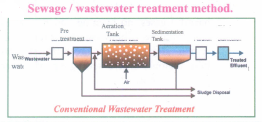
The conventional water treatment:
i) Pre-screening
ii) Aeration
iii) Sludge Management and Water Reuse.
(i) Pre-screening: Screening of waste water to remove soil and solid particulates.
(ii) Aeration: Screened wastewater is pumped to an aeration tank. Microbial contaminants are removed by the biological degradation that occurs in the presence of air.
(iii) Sedimentation process: The solid particles in suspension form are allowed to settle under the effect of gravity. The particles that settle out from the suspension is known as sludge.
(iv) Sludge removal: The sludge generated by the degradation process is transferred periodically from the tank for safe disposal.
(v) Disinfection: Chlorination and Ultra Violet (UV) radiation of treated water to remove any microorganism contamination.
(vi) Water recycling: The water will then be supplied for domestic or industrial purposes.
3.
(i) The kinetic energy possessed by the wind is due to its high speed, that can be converted into mechanical power by wind turbines.
(ii) The wind energy can be used for
(a) Generating electricity
(b) Run water pumps, flour mills etc.
(c) Rotatory motion of windmill is used to draw water from wells.
Working of wind mills:
(i) Wind mill is a machine that converts the energy of wind into rotational energy by broad blade attached to the rotating axis.
(ii) When the blowing air strikes the blades of the windmill, it exerts force and causes the blades to rotate.
(iii) The rotational movement of the blades operate the generator and the electricity is produced.
(iv) The energy output from each windmill is coupled together to get electricity on a commercial scale.
Advantage of wind energy:
(i) Wind energy is free, eco-friendly, renewable source of energy.
(ii) It does not cause pollution.
(iii) Expenses on periodic maintenance is low when compared to the other power sources
4.
The various devices used for harvesting sun's energy are called solar energy devices.
Solar cells:
(i) Solar cells (Photovoltaic devices) is made up of silicon that converts sunlight directly into electricity.
(ii) Solar cell produces electricity without polluting the environment.
(iii) Since it uses no fuel other than sunlight, no harmful gases, no burning and no wastes are produced. These can be installed in remote and inaccessible areas (forests and hilly regions) where setting up of power plant is expensive
Uses of Solar cells:
(i) It can be used for street lighting, traffic signals, water pumping, battery charging system etc.
(ii) It is used in artificial satellites and space probes.
(iii) It provides radio and TV transmission to remote areas
(iv) It is used in calculators, electronic toys and watches.
5.
Biogas is the mixture of methane (nearly 75 %), hydrogen sulphide, carbon dioxide and hydrogen. It is produced by the decomposition of animal wastes (cow dung) and plant wastes in the absence of oxygen. It is also commonly called as 'Gobar gas' since the starting material used is cow dung called as gobar.
Uses of biogas:
(i) It is used as fuel for cooking.
(ii) It is used to run motors and pump sets.
(iii) It is used to generate electricity.
Advantages of biogas:
(i) It burns without smoke and therefore causes less pollution.
(ii) An excellent way to get rid of organic wastes like bio-waste and sewage material.
(iii) Left over slurry is good manure rich in nitrogen and phosphorus
(iv) It is safe and convenient to use.
(v) It can reduce the amount of greenhouse gases emitted.
6.
Methods of rainwater harvesting:
(i) Roof top rainwater harvesting:
a) Roof tops are excellent rain catchers.
b) The rain water that falls on the roof of the houses, apartments, commercial buildings etc. is collected and stored in the surface tank and can be used for domestic purpose.
(ii) Recharge pit:
a) In this method, the rain water is first collected from the roof tops or open spaces and is directed into the percolation pits through pipes for filtration.
b) After filtration the rainwater enters the recharge pit or ground wells.
7.
(i) Coal and petroleum are natural resource, formed from the degradation of biomass buried deep under the earth millions of years ago.
(ii) The formation of these fossil fuels is a very slow process and takes very long period and for renewal. So we need to conserve them.
8.
(i) Management of forest and wild life resource is considered as a challenging task.
(ii) Now-a-days people are continuously cutting down trees and it causes deforestation and it results in lack of oxygen.
(iii) People kill animals for making cloth designs and thus harm wildlife.
9.
i) The top layers of soil contain humus and mineral salts, which are vital for the growth of plants.
ii) Removal of upper layer of soil by wind and water is called soil erosion.
iii) Soil erosion causes a significant loss of humus, nutrients and decrease the fertility of soil.
iv) The direct and primary effect of soil erosion is soil loss and nutrient leaching resulting in reduction of land productivity.
v) Annual floods causes damages to crops, property and lives.
vi) Deforested rain forest soil becomes dry and nutrient-deficient as there is no longer vegetation to hold water and nutrients in place.
vii) Heavy rains further erode soil and saturate waterways with excess nutrients, disrupting the food chains of tropical ecosystems.
viii) Eroded sediments can even change the course of rivers, which suffer from huge deposits of silt from deforestation.
ix) Desertification is another possible consequence of erosion.
10.

10th Standard Syllabus & Materials
10th Standard
TN 10th English Prose - 2 - The Night the Ghost Got in Important Questions And Answers Study Material - QB365 Set A
NEW10th Standard
TN 10th English Supplementary - 1 - The Tempest Important Questions And Answers Study Material - QB365 Set A
NEW10th Standard
TN 10th English Poem - 1 - Life Important Questions And Answers Study Material - QB365 Set A
NEW10th Standard
TN 10th English Prose - 1 - His First Flight Important Questions And Answers Study Material - QB365 Set A



Tamilnadu Stateboard 10th Standard Subjects
Tamilnadu Stateboard Standards





