 100% FREE ACCESS
10th Standard Syllabus & Materials
10th Standard
TN 10th English Prose - 4 - The Attic Important Questions And Answers Study Material - QB365 Set A
NEW10th Standard
TN 10th English Supplementary - 3 - The Story of Mulan Important Questions And Answers Study Material - QB365 Set A
NEW10th Standard
TN 10th English Poem - 3 - I am Every Woman Important Questions And Answers Study Material - QB365 Set A
NEW10th Standard
TN 10th English Prose - 3 - Empowered Women Navigating The World Important Questions And Answers Study Material - QB365 Set A
NEW10th Standard
TN 10th English Supplementary - 2 - Zigzag Important Questions And Answers Study Material - QB365 Set A
NEW10th Standard
TN 10th English Poem - 2 - The Grumble Family Important Questions And Answers Study Material - QB365 Set A

Published on: 11/09/2019
Heredity
Download Tamil Nadu 10th Standard Science question papers, model tests, one-mark questions, important questions, and public exam papers in PDF format. Free study materials and answer keys for TN State Board students.
Questions + Answers key
Take MCQ Science Test1.
The loss of one or more chromosome in a ploidy is called_____________.
Tetraploidy
Aneuploidy
Euploidy
Polyploidy
2.
Okasaki fragments are joined together by ___________________.
Helicase
DNA polymerase
RNA primer
DNA ligase
3.
According to Mendel alleles have the following character
Pair of genes
Responsible for character
Production of gametes
Recessive factors
4.
DNA consists of two ____________ chains.
5.
The pairs of contrasting character (traits) of Mendel are called_________.
6.
Dihybrid ratio
7.
Down’s syndrome
8.
Diploid condition
9.
Autosomes
10.
Name the bond which binds the nucleotides in a DNA.
11.
What is the name given to the segments of DNA, which are responsible for the inheritance of a particular character?
12.
Name the conditions when both the alleles are identical.
13.
14.
What are allosomes?
15.
How is the structure of DNA organised? What is the biological significance of DNA?
1.
(b)
Aneuploidy
2.
(d)
DNA ligase
3.
(b)
Responsible for character
4.
()
polynucleotide
5.
()
Alleles
6.
9:3:3:1
7.
Trisomy 21
8.
2n
9.
22 pairs of chromosome
10.
Hydrogen bond which binds the nucleotides in a DNA.
11.
The name of the segment of DNA is gene.
12.
The both alleles are identical in homozygous condition.
13.
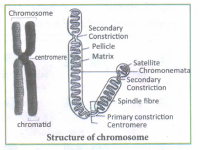
14.
(i) Allosomes are chromosomes which are responsible for determining the sex of an individual.
(ii) They are also called as sex chromosomes or hetero-chromosomes.
15.
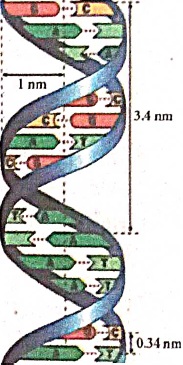
DNA is a large molecule consisting of millions of nucleotides. Hence, it is also called a polynucleotide. Each nucleotide consists of three components.
(i) A sugar molecules - Deoxyribose sugar.
(ii) A nitrogenous base.
There are two types of nitrogenous bases in DNA.
They are
(a) Purines (Adenine and Guanine)
(b) Pyrimidines (Cytosine and Thymine)
(iii) A phosphate group
Nucleoside and Nucleotide:
Nucleoside = Nitrogen base + Sugar
Nucleotide = Nucleoside + Phosphate
The nucleotides are formed according to the purines and pyrimidines present in them.
Watson and Crick model of DNA:
(i) DNA molecule consists of two polynucleotide chains.
(ii) These chains form a double helix structure with two strands which run anti-parallel to one another.
(iii) Nitrogenous bases in the centre are linked to sugar-phosphate units which form the backbone of the DNA.
(iv) Pairing between the nitrogenous bases is very specific and is always between purine and pyrimidine linked by hydrogen bonds.
a) Adenine (A) links Thymine (T) with two hydrogen bonds (A = T)
b) Cytosine (C) links Guanine (G) with three hydrogen bonds( C ≡ G) This is called complementary base pairing.
(v) Hydrogen bonds between the nitrogenous bases make the DNA molecule stable.
(vi) Each turn of the double helix is 34 Ao (3.4 nm). There are ten base pairs in a complete turn.
(vii) The nucleotides in a helix are joined together by phosphodiester bonds.
Significance of DNA:
(i) DNA is responsible for the transmission of hereditary information from one generation to next generation.
(ii) It contains information required for the formation of proteins.
(iii) It controls the developmental process and life activities of an organism.
10th Standard Syllabus & Materials
10th Standard
TN 10th English Prose - 2 - The Night the Ghost Got in Important Questions And Answers Study Material - QB365 Set A
NEW10th Standard
TN 10th English Supplementary - 1 - The Tempest Important Questions And Answers Study Material - QB365 Set A
NEW10th Standard
TN 10th English Poem - 1 - Life Important Questions And Answers Study Material - QB365 Set A
NEW10th Standard
TN 10th English Prose - 1 - His First Flight Important Questions And Answers Study Material - QB365 Set A

Tamilnadu Stateboard 10th Standard Subjects
Tamilnadu Stateboard Standards