
 100% FREE ACCESS
10th Standard Syllabus & Materials
10th Standard
TN 10th English Prose - 4 - The Attic Important Questions And Answers Study Material - QB365 Set A
NEW10th Standard
TN 10th English Supplementary - 3 - The Story of Mulan Important Questions And Answers Study Material - QB365 Set A
NEW10th Standard
TN 10th English Poem - 3 - I am Every Woman Important Questions And Answers Study Material - QB365 Set A
NEW10th Standard
TN 10th English Prose - 3 - Empowered Women Navigating The World Important Questions And Answers Study Material - QB365 Set A
NEW10th Standard
TN 10th English Supplementary - 2 - Zigzag Important Questions And Answers Study Material - QB365 Set A
NEW10th Standard
TN 10th English Poem - 2 - The Grumble Family Important Questions And Answers Study Material - QB365 Set A

Published on: 31/10/2019
Heredity
Download Tamil Nadu 10th Standard Science question papers, model tests, one-mark questions, important questions, and public exam papers in PDF format. Free study materials and answer keys for TN State Board students.
Questions + Answers key
Take MCQ Science Test1.
________is a gene mutation
Deletion
Duplication
Translocation
Ploidy
2.
L shaped chromosomes are described as_______
acrocentric
metacentric
submetacentric
telocentric
3.
The haploid condition in a human cell refers to________ chromosomes
44
23
46
22
4.
Okasaki fragments are joined together by ___________________.
Helicase
DNA polymerase
RNA primer
DNA ligase
5.
The _____________ units form the backbone of the DNA.
5 Carbon sugar
Phosphate
Nitrogenous bases
Sugar phosphate
6.
7.
The region of the chromosome where the spindle fibres get attached during cell division
Chromomere
Centrosome
Centromere
Chromonema
8.
9 : 3 : 3 : 1 ratio is due to
Segregation
Crossing over
Independent assortment
Recessiveness
9.
__________stated base pair rule.
10.
The number of chromosomes present in a human cell is_________
11.
An inheritable change in the amount or the structure of a gene or a chromosome is called _______________.
12.
DNA consists of two ____________ chains.
13.
The thin thread like structures found in the nucleus of each cell are called _________.
14.
Helicase
15.
Topo isomerase
16.
Mendel
17.
Dihybrid ratio
18.
Allosome
19.
Write a note on mutation.
20.
21.
What are allosomes?
22.
Why did Mendel select pea plant for his experiments?
23.
How is the structure of DNA organised? What is the biological significance of DNA?
24.
Explain with an example the inheritance of dihybrid cross. How is it different from monohybrid cross?
25.
Differentiate diploid and haploid condition.
26.
State the Law of Independent Assortment
27.
Write a note on euploidy.
28.
What is nucleolar organizer?
29.
Mention the types of gene or point mutation
30.
Define a gene
1.
(a)
Deletion
2.
(c)
submetacentric
3.
(b)
23
4.
(d)
DNA ligase
5.
(d)
Sugar phosphate
6.
(b)
7.
(c)
Centromere
8.
(c)
Independent assortment
9.
()
Chargaff
10.
()
46
11.
()
mutation
12.
()
polynucleotide
13.
()
Chromosomes
14.
Replication site
15.
Replication fork
16.
Basic principles of Heredity
17.
9:3:3:1
18.
23rd pair of chromosomes
19.
(i) The term mutation was introduced by Hugo De Vries in 1901 when he observed phenotypic changes in the evening Primrose plant, Oenothera lamarckiana.
(ii) Mutation is an inheritable sudden change in the genetic material (DNA) of an organism.
(iii) Mutations are classified into two main types, namely chromosomal mutation and gene mutation. Chromosomal mutation: The sudden change in the structure or number of chromosomes is called chromosomal mutation. This may result in
Changes in the structure of chromosomes:
Structural changes in the chromosomes usually occurs due to errors in cell division. Changes in the number and arrangement of genes takes place as a result of deletion, duplication, inversion and translocation in chromosomes. Changes in the number of chromosomes: They involve addition or deletion in the number of chromosomes present in a cell. This is called ploidy. There are 2 types of ploidy:
Euploidy in plants and animals:
(a) Euploidy: It is the condition in which the individual bears more than the usual number of diploid (2n) chromosomes. If an individual has three haploid sets of chromosomes, the condition is called triploidy (3n). If it has four haploid sets of chromosomes. It is called Tetraploidy. Tetraploid plants are advantageous as they often result in increased fruit and flower size.
(b) Aneuploidy: It is the loss or gain of one or more chromosomes in a set. It is of 3 types:
(i) Monosomy (2n-1),
(ii) Trisomy (2n+1)
(iii) Nullisomy (2n-2). In man, Down's syndrome is one of the commonly known aneuploid condition.
Gene or point mutation:
(i) Gene mutation is the changes occurring in nucleotide sequence of a gene.
(ii) It involves substitution, deletion, insertion or inversion of a single or more than one nitrogenous base.
(iii) Gene alteration results in abnormal protein formation in an organism.
20.
21.
(i) Allosomes are chromosomes which are responsible for determining the sex of an individual.
(ii) They are also called as sex chromosomes or hetero-chromosomes.
22.
(i) Pea plant is naturally self-pollinating and so is very easy to raise pure breeding individuals.
(ii) It has a short life span as it is an annual and so it was possible to follow several generations.
(iii) It is easy to cross-pollinate.
(iv) It has deeply defined contrasting characters.
(v) The flowers are bisexual.
23.
DNA is a large molecule consisting of millions of nucleotides. Hence, it is also called a polynucleotide. Each nucleotide consists of three components.
(i) A sugar molecules - Deoxyribose sugar.
(ii) A nitrogenous base.
There are two types of nitrogenous bases in DNA.
They are
(a) Purines (Adenine and Guanine)
(b) Pyrimidines (Cytosine and Thymine)
(iii) A phosphate group
Nucleoside and Nucleotide:
Nucleoside = Nitrogen base + Sugar
Nucleotide = Nucleoside + Phosphate
The nucleotides are formed according to the purines and pyrimidines present in them.
Watson and Crick model of DNA:
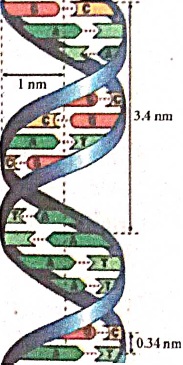
(i) DNA molecule consists of two polynucleotide chains.
(ii) These chains form a double helix structure with two strands which run anti-parallel to one another.
(iii) Nitrogenous bases in the centre are linked to sugar-phosphate units which form the backbone of the DNA.
(iv) Pairing between the nitrogenous bases is very specific and is always between purine and pyrimidine linked by hydrogen bonds.
a) Adenine (A) links Thymine (T) with two hydrogen bonds (A = T)
b) Cytosine (C) links Guanine (G) with three hydrogen bonds( C ≡ G) This is called complementary base pairing.
(v) Hydrogen bonds between the nitrogenous bases make the DNA molecule stable.
(vi) Each turn of the double helix is 34 Ao (3.4 nm). There are ten base pairs in a complete turn.
(vii) The nucleotides in a helix are joined together by phosphodiester bonds.
Significance of DNA:
(i) DNA is responsible for the transmission of hereditary information from one generation to next generation.
(ii) It contains information required for the formation of proteins.
(iii) It controls the developmental process and life activities of an organism.
24.
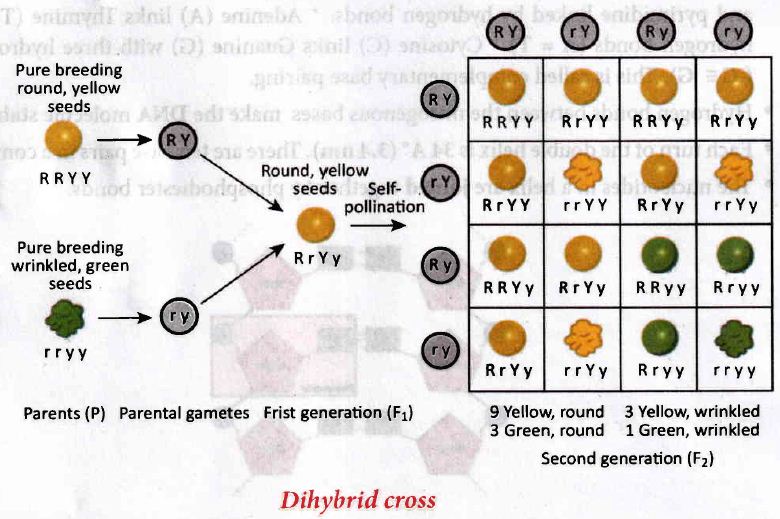
(i) Dihybrid cross involves the inheritance of two pairs of contrasting characteristics (or contrasting traits) at the same time.
(ii) The two pairs of contrasting characteristics chosen by Mendel were shape and colour of seeds: round-yellow seeds and wrinkled-green seeds.
(iii) Mendel crossed pea plants having round - yellow seeds with pea plants having wrinkled green seeds.
Mendel made the following observations:
(i) Mendel first crossed pure breeding pea plants having round-yellow seeds with pure breeding pea plants having wrinkled green seeds and found that only round yellow seeds were produced in the first generation (F1).
(ii) No wrinkled-green seeds were obtained in the F1 generation.
(iii) From this it was concluded that round shape and yellow colour of the seeds were dominant traits over the wrinkled shape and green color of the seeds.
(iv) When the hybrids of F1 generation pea plants having round-yellow seeds were cross-breed by self pollination, then four types of seeds having different combinations of shape and colour were obtained in second generation or F2 generation.
(v) They were round-yellow, round-green, wrinkled yellow and wrinkled-green seeds.
(vi) The ratio of each phenotype (or appearance) of seeds in the F2 generation is 9:3:3:1. This is known as the Dihybrid ratio.
(vii) From the above results it can be concluded that the factors for each character or trait remain independent and maintain their identity in the gametes.
(viii) The factors are independent to each other and pass to the offsprings (through gametes).
Results of a Dihybrid Cross:
(i) Mendel got the following results from his dihybrid cross.
Four Types of Plants:
(i) A dihybrid cross produced four types of F2 offsprings in the ratio of 9 with two dominant traits, 3 with one dominant trait and one recessive trait, 3 with another dominant trait and
another recessive trait and 1 with two recessive traits.
New Combination:
(i) Two new combinations of traits with round green and wrinkled yellow had appeared in the dihybrid cross (F2 generation).
| Monohybrid Cross | Dihybrid Cross |
| Cross involving inheritance of only one pair of contrasting character. |
Cross involves the inheritance of two pair of contrasting character. |
| E.g. Stem length | E.g. seed shape and seed colour |
25.
(i) In the body cells of sexually reproducing organisms, the chromosomes generally occur in pairs. This condition is called diploid (2n).
(ii) The gametes produced by the organisms contain a single set of chromosomes. Hence, the gametes are said to be haploid (n).
26.
Law of independent assortment states: "In case of inheritance of two or more pairs of characters simultaneously, the factors or genes of one pair assort out independently of the other pair
27.
(i) Addition or deletion in the number of chromosomes in a cell. This is called ploidy. It is of two types Euploidy and Aneuploidy.
(ii) Euploidy is the condition in which the individual bears more than the usual number of diploid (2n) chromosomes. If an individual has three haploid sets of chromosomes, the condition is called triploidy (3n). Triploid plants and animals are typically sterile. If it has four haploid sets of chromosomes, the condition is called tetraploidy (4n). Tetraploid plants are advantageous as they often result in addition or deletion in the number of chromosomes in a cell. This is called ploidy. It is of two types Euploidy and Aneuploidy. Euploidy is the condition in which the individual bears more than the usual number of diploid (2n) chromosomes. If an individual has three haploid sets of chromosomes, the condition is called triploidy (3n). Triploid plants and animals are typically sterile. If it has four haploid sets of chromosomes, the condition is called tetraploidy (4n). Tetraploid plants are advantageous as they often result in increased fruit and flower size reased fruit and flower size.
28.
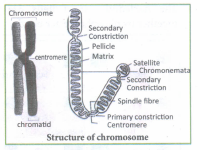
(i) Some chromosomes possess secondary constriction at any point of the chromosome.
(ii) They are known as the nuclear zone or nucleolar organizer (formation of nucleolus in the nucleus).
29.
Substitution, Deletion, Insertion and Inversion
30.
Genes are segments of DNA, which are responsible for the inheritance of a particular phenotypic character.

10th Standard Syllabus & Materials
10th Standard
TN 10th English Prose - 2 - The Night the Ghost Got in Important Questions And Answers Study Material - QB365 Set A
NEW10th Standard
TN 10th English Supplementary - 1 - The Tempest Important Questions And Answers Study Material - QB365 Set A
NEW10th Standard
TN 10th English Poem - 1 - Life Important Questions And Answers Study Material - QB365 Set A
NEW10th Standard
TN 10th English Prose - 1 - His First Flight Important Questions And Answers Study Material - QB365 Set A



Tamilnadu Stateboard 10th Standard Subjects
Tamilnadu Stateboard Standards





