
 100% FREE ACCESS
10th Standard Syllabus & Materials
10th Standard
TN 10th English Prose - 4 - The Attic Important Questions And Answers Study Material - QB365 Set A
NEW10th Standard
TN 10th English Supplementary - 3 - The Story of Mulan Important Questions And Answers Study Material - QB365 Set A
NEW10th Standard
TN 10th English Poem - 3 - I am Every Woman Important Questions And Answers Study Material - QB365 Set A
NEW10th Standard
TN 10th English Prose - 3 - Empowered Women Navigating The World Important Questions And Answers Study Material - QB365 Set A
NEW10th Standard
TN 10th English Supplementary - 2 - Zigzag Important Questions And Answers Study Material - QB365 Set A
NEW10th Standard
TN 10th English Poem - 2 - The Grumble Family Important Questions And Answers Study Material - QB365 Set A

Published on: 25/08/2019
MODEL QUARTERLY EXAMINATION QUESTION PAPER SEPTEMBER 2019 - 10 th Science
Download Tamil Nadu 10th Standard Science question papers, model tests, one-mark questions, important questions, and public exam papers in PDF format. Free study materials and answer keys for TN State Board students.
Questions + Answers key
Take MCQ Science Test1.
To increase the sugar production in sugarcanes they are sprayed with _______
Auxin
Cytokinin
Gibberellins
Ethylene
2.
Syngamy results in the formation of____________
Zoospores
Conidia
Zygote
Chlamydospores
3.
Nerve cells do not possess
neurilemma
sarcolemma
axon
dendrites
4.
Which one of the following shows correct composition of blood?
Plasma - Blood + Lymphocyte
Serum - Blood + Fibrinogen
Lymph - Plasma + RBC + WBC
Blood - Plasma + RBC + WBC + Platelets
5.
Mammals are ______________ animals.
Cold blooded
Warm blooded
Poikilothermic
All the above
6.
Which of the following is hygroscopic in nature?
ferric chloride
copper sulphate pentahydrate
silica gel
none of the above
7.
Which of the following have inert gases 2 electrons in the outermost shell.
He
Ne
Ar
Kr
8.
Which is formed during anaerobic respiration
Carbohydrate
Ethyl alcohol
Acetyl CoA
Pyruvate
9.
Which of the following represents 1 amu?
Mass of a C – 12 atom
Mass of a hydrogen atom
1/12th of the mass of a C – 12 atom
Mass of O – 16 atom
10.
The value of universal gas constant
3.81 J mol–1 K–1
8.03 J mol–1 K–1
1.38 J mol–1 K–1
8.31 J mol–1 K–1
11.
Which of the following lens would you prefer to use while reading small letters found in a dictionary?
A convex lens of focal length 5 cm
A concave lens of focal length 5 cm
A convex lens of focal length 10 cm
A concave lens of focal length 10 cm
12.
The unit of ‘g’ is m s-2. It can be also expressed as ______.
cms-1
Nkg-1
Nm2kg-1
cm2s-2
13.
How will you determine the atomicity of gases using Avogadro's hypothesis?
14.
What are chemical messengers?
15.
Differentiate between Medullated and non-medullated nerve fibre.
16.
Who discovered Rh factor? Why was it named so?
17.
State two conditions necessary for rusting of iron.
18.
Calculate the % of oxygen in Al2(SO4)3. (Atomic mass: Al-27, O-16, S -32).
19.
Find the final temperature of a copper rod. Whose area of cross section changes from 10 m2 to 11 m2 due to heating. The copper rod is initially kept at 90 K. (Coefficient of superficial expansion is 0.0021 /K)
20.
Two bodies have a mass ratio of 3:4 The force applied on the bigger mass produces an acceleration of 12 ms-2. What could be the acceleration of the other body, if the same force acts on it.
21.
List any five properties of light.
22.
Illustrate the structure and functions of brain.
23.
a) What happens when MgSO4.7H2O is heated? Write the appropriate equation
b) Define solubility
24.
The electronic configuration of metal A is 2,8,18,1.
The metal A when exposed to air and moisture forms B a green layered compound. A with con. H2SO4 forms C and D along with water. D is a gaseous compound. Find A,B,C and D.
25.
Deduce the equation of a force using Newton’s second law of motion.
26.
Weight of a person inside the lift while at rest is 50 N. What is the weight he feels when lift moves up with an acceleration of 9.8 ms-2.
27.
Which hormone induces parthenocarpy in tomatoes?
28.
When is World Menstrual Hygiene Day observed?
29.
What is the shape of RBC in human blood?
30.
Define the term: Solution.
31.
Name the phenomenon by which carbohydrates are oxidized to release ethyl alcohol.
32.
Give any two examples for heterodiatomic molecules.
33.
What is co-efficient of apparent expansion?
34.
Define dispersion of light.
35.
In angiosperms the pollen germinates to produce pollen tube that carries two gametes. What is the purpose of carrying two gametes when single gamete can fertilize the egg?
36.
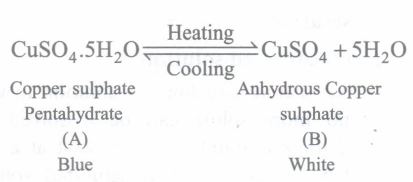
'A' is a blue coloured crystalline salt. On heating it loses blue colour and to give 'B'. When water is added, 'B' gives back to 'A'. Identify A and B, write the equation.
37.
1. Calcium carbonate is decomposed on heating in the following reaction
CaCO3 → CaO + CO2
i. How many moles of Calcium carbonate are involved in this reaction?
ii. Calculate the gram molecular mass of calcium carbonate involved in this reaction.
iii. How many moles of CO2 are there in this equation?
38.
Leeches do not have an elaborate secretion of digestive juices and enzymes -Why?
1.
(c)
Gibberellins
2.
(c)
Zygote
3.
(b)
sarcolemma
4.
(d)
Blood - Plasma + RBC + WBC + Platelets
5.
(b)
Warm blooded
6.
(c)
silica gel
7.
(a)
He
8.
(b)
Ethyl alcohol
9.
(c)
1/12th of the mass of a C – 12 atom
10.
(d)
8.31 J mol–1 K–1
11.
(a)
A convex lens of focal length 5 cm
12.
(b)
Nkg-1
13.
The atomicity of an element can be derived using Avogadro's hypothesis. Let us consider the following equation
| H2(g) | + | CI2(g) | ➝ | 2HCI(g) |
| 1 volume | + | 1 volume | ➝ | 2 volumes (By Gay-Lussac's Law) |
According to Avogadro's law, 1 volume of any gas occupy 'n' number of molecules.
| n molecules |
+ n molecules |
➝ 2n molecules |
if n = 1 then
| 1 molecule | + | 1 molecule | ⟶ | 2 molecules. |
| \(\frac{1}{2}\) molecule | + | \(\frac{1}{2}\) molecule | ➝ | 1 molecule |
(i) 1 molecule of hydrogen chloride gas is made up of \(\frac{1}{2}\) molecule of hydrogen and \(\frac{1}{2}\) molecule of chlorine
(ii) But 1 molecule of hydrogen chloride contains one atom of hydrogen and I atom of chlorine
(iii) Hence \(\frac{1}{2}\) molecule of hydrogen = 1 atom of hydrogen
(iv) Or 1 molecule of hydrogen = 2 atoms of hydrogen
(v) So the atomicity of hydrogen is 2, and molecular formula is H2
Similarly,
\(\frac{1}{2}\) molecule of chlorine = 1 atom of chlorine 1molecule of chlorine = 2 atoms of chlorine So the atomicity of chlorine is 2, and its molecular formula is Cl2
14.
(i) A chemical messenger is any compound that serves to transmit a message.
(ii) Hormones act as chemical messengers which are produced by specialized glands.
15.
| S.No | Medullated nerve fibre | Non-medullated nerve fibre |
|---|---|---|
| i) | Medullated Nerve fibre is also known as myelinated or white neuron. Because axon is covered with myelin sheath. | Non-Medullated Nerve fibre is also known as non-myelinated or grey neuron Because axon is not covered myelin sheath. |
| ii) | Myelin sheath is produced by a layer of Schwann cells or neurilemma. | Schwann cells are absent. |
| iii) | Node of Ranvier is present. | Node of Ranvier is absent. |
| iv) | They conduct impulse at a faster speed. | Conduct impulses slower than medullated fibres. |
| v) | These are present in the white matter of brain, spinal cord and in cranial and spinal nerves. |
These are present in autonomic nerves and axons within the CNS as Grey matter. |
16.
(i) Rh factor was discovered by Landsteiner and Wiener in 1940. It was named so because it was first discovered in Rhesus monkey.
17.
Conditions necessary for rusting of iron:
(i) Iron is exposed to moist air.
(ii) Presence of water droplets in the atmosphere.
(iii) Presence of Oxygen.
18.
\(\text { Molar mass of } \mathrm{Al}_{2}\left(\mathrm{SO}_{4}\right)_{3}=\mathrm{Al} \times 2+3[\mathrm{~S} \times 1+\mathrm{O} \times 4]\)
\(27 \times 2+3[32 \times 1+16 \times 4]\)
= 54 + 3[32 + 64]
= 54 + 3 [96]
Molar Mass = 54 + 288 = 342
\(\text { Mass } \% \text { of an element }=\frac{\text { mass of that element in the compound }}{\text { molar mass of the compound }} \times100\)
\(\text { Mass } \% \text { oxygen in } \mathrm{Al}_{2}\left(\mathrm{SO}_{4}\right)_{3}=\frac{192}{342} \times 100 \)
\(=0.5614 \times 100=56.14 \% \)
\(\text { Mass } \% \text { of oxygen in } \mathrm{Al}_{2}\left(\mathrm{SO}_{4}\right)_{3} \text { is } 56.14 \%\)
19.
Area of copper rod, Ao = 10 m2
Changes of Area of cross section,
Initial temperature \(\Delta \mathrm{A} =11 -10 =1 \mathrm{~m}^{2} \)
\(\mathrm{~T}_{1} =90 \mathrm{~K} \)
\(a_{\mathrm{A}} =0.0021 / \mathrm{K} \)
\(\mathrm{T}_{2} =? \)
\(\frac{\Delta A}{A_{0}} =a_{\mathrm{A}} \Delta \mathrm{T} \)
\(\frac{1 }{10 } =0.0021\left[\mathrm{~T}_{2}-90\right] \)
\(0.1 =0.0021\left[\mathrm{~T}_{2}-90\right]=\frac{0.1}{0.0021}+90=\mathrm{T}_{2} \)
\(\mathrm{~T}_{2} =137.61 \mathrm{~K}\)
So the final temperature of a copper rod is 137.61 K
20.
\(\text {Given } m_{1} : m_{2}=3: 4 \)
\(a_{2} =12 \mathrm{~m} \mathrm{~s}^{-2} \)
\(a_{1} =?\)
Using Newton's second law,
\(\mathrm{F} =\mathrm{m \times a} \)
\(\mathrm{F} =\mathrm{m}_{1} \times a_{1}=3 a_{1} \)
\(\mathrm{~F} =\mathrm{m}_{2} \times a_{2}=4 \times 12=48 \mathrm{~N} \)
\(3 a_{1} =48 \)
\(a_{1} =48 / 3=16 \mathrm{~m} \mathrm{~s}^{-2} \)
\(a_{1} =16 \mathrm{~ms}^{-2}\)
The acceleration produced on the other body is \(16 \mathrm{~m} \mathrm{~s}^{-2}\).
21.
(i) Light is a form of energy.
(ii) Light always travels along a straight line.
(iii) Light does not need any medium for its propagation. It can even travel through vacuum.
(iv) The speed of light in vacuum or air is, c = 3 x 10⁸ m/s
(v) Since, light is in the form of waves, it is characterized by a wavelength (λ) and a frequency (v), which are related by the following equation: c = v λ (c - velocity of light).
22.
A human brain is formed of three main parts:
(a) forebrain
(b) midbrain and
(c) hindbrain.
(1) Forebrain:
A. Cerebrum(cortex)
B. Diencephalon
i) Thalamus ii) Hypothalamus
(2) Midbrain
(3) Hindbrain:
A. Cerebellum
B. Pons
C. Medulla Oblongata
| Part of brain | Structure | Description | Functions |
| Forebrain | Cerebrum (cortex) |
(i) It is the largest portion forming nearly two-third of the brain. (ii) It is divided into 2 halves (Right and Left hemispheres) interconnected by Corpus collosum. (iii) The outer portion is called cortex (grey matter) and inner portion is called medulla (white matter) (iv) The cortex is extremely folder forming elevations (gyri) and abd depressions (sulci) in between. (v) Each cerebral hemisphere is divided into frontal lobe, parietal lobe, temporal lobe and occipital lobe. |
(i) Sensory perception (ii) Control of voluntary functions (iii) Language (iv) Thinking (intelligence) (v) Memory (vi) Decision making (vii) Creativity |
| Thalamus | It is present in cerebral medulla is a major conducting centre for sensory and motor signalling. | Acts as a relay centre | |
| Hypothalamus | (i) It lies at the base of the thalamus (ii) It is an important link between nervous system and endocrine glands |
(i) Controls involuntary functions (ii) Temperature control (iii) Thirst, hunger control (iv) Urinationi (v) Controls the secretion of hormones from anterior pituitary gland |
|
| Midbrain | Corpora quadrigemina |
(i) It is located between thalamus and hindbrain (ii) It is made of four rounded bodies |
Controls visual and auditory (hearing) reflexes |
| Hindbrain | Cerebellum | It is seçond largest part of the brain formed of two large sized hemispheres and middle vermis |
(i) Coordinates voluntary movements (ii) Maintains body balance |
| Pons | (i) 'Pons' a latin word, meaning bridge (ii) It is a bridge of nerve fibre that connects the lobes of cerebellum. |
(i) Relays signals between the cerebellum, spinal cord, midbrain and cerebrum (ii) Controls respiration and sleep cycle. |
|
| Medulla Oblongata | It is the posterior most part of the brain that connects spinal cord and various parts of brain. |
(i) Has cardiac centre, respiratory centres, vasomotor centres and digestive centre (ii) Also regulates vomiting and salivation |
23.
a) MgSO4.7H2O is heating process:
(i) Magnesium Sulphate heptahydrate or Epsom salt MgSO4.7H2O water of crystallization is 7.
(ii) When magnesium sulphate heptahydrate crystals are gently heated, it loses seven water molecules, and becomes anhydrous magnesium sulphate.
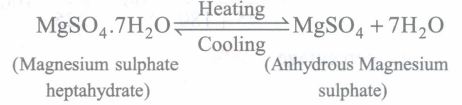
(iii) If you add few drops of water or allow it to cool, the colourless anhydrous salt again turns back into hydrated salt.
b) Solubility:
b) Solubility is defined as the number of grams of a solute that can be dissolved in 100g of a solvent to form its saturated solution at a given temperature and pressure.
Solubility = \(\frac{Mass \ of \ the \ solute}{Mass \ of \ the \ solvent}\) x 100
24.
(i) Copper gets covered with a green layer of basic copper carbonate in the presence of CO2 and moisture.
(ii) \(2 \mathrm{Cu}+\mathrm{O}_{2}+\mathrm{CO}_{2}+\mathrm{H}_{2} \mathrm{O} \rightarrow \mathrm{CuCO}_{3} \cdot \mathrm{Cu}(\mathrm{OH})_{2}\)
(iii) Copper reacts with con. \(\mathrm{H}_{2} \mathrm{SO}_{4}\) to from copper sulphate and SO2.
(iv) \(\mathrm{Cu}+2 \mathrm{H}_{2} \mathrm{SO}_{4} \rightarrow \mathrm{CuSO}_{4}+\mathrm{SO}_{2} \uparrow+2 \mathrm{H}_{2} \mathrm{O}\)
(v) So, A is-Copper (Cu)
\(\mathrm{B}\ is \ -\mathrm{CuCO}_{3} \cdot \mathrm{Cu}(\mathrm{OH})_{2}\) Basic copper carbonate.
\(\mathrm{C}\ is \ -\mathrm{CuSO}_{4}\) (copper sulphate)
\(\mathrm{D}\ is \ -\mathrm{SO}_{2}\) (Sulphur oxide)
25.
(i) According to Newton's second law, "the force acting on a body is directly proportional to the rate of change of linear momentum of the body and the change in momentum takes place in the direction of the force".
(ii) This law helps us to measure the amount of force. So it is called as law of force'
(iii) Let, "m" be the mass of a moving body, moving along a straight line with an initial speed 'u'.
(iv) After a time interval of 't', the velocity of the body changes to 'v' due to the impact of an unbalanced external force F.
Initial momentum of the body, \( P_{i}=m u \)
Final momentum of the body, \( P_{f}=m v \)
Change in momentum, \( \Delta \mathrm{p}=\mathrm{P}_{\mathrm{f}}-\mathrm{P}_{\mathrm{i}} \)
\(=m v-m u \)
By Newton's second law of motion,
\(\text {Force, } \ F \propto\) rate of change of momentum
\(\mathrm{F} \propto \) change in momentum / time
\(\mathrm{F} \propto \frac{\mathrm{mv}-\mathrm{mu}}{\mathrm{t}}\)
\(\mathrm{F}=\frac{\mathrm{km}(\mathrm{v}-\mathrm{u})}{\mathrm{t}}\)
Here, k is the proportionality constant.
k = 1 in all system of units. Hence,
\(F=\cfrac { m(v-u) }{ t } \)
Since acceleration = change in velocity / time, a = (v-u) / t. Hence, we have
F = m x a
Force = mass x acceleration
26.
R = m (g + a) (R ⟶ Apparent weight)
mg = 50 N
ma = 50 N
R = mg + ma = 50 + 50
R = 100 N
Here Apparent weight (R) is greater than the actual weight mg (=W).
27.
Gibberellin induces parthenocarpy in tomatoes.
28.
Every year May 28 is observed as menstrual hygiene day.
29.
RBCs are biconcave and disc - shaped.
30.
(i) A solution is a homogeneous mixture of two or more substances.
E g: Sea water.
(ii) In a solution, the component present in lesser amount by weight is called a solute.
(iii) The component present in a larger amount by weight is called a solvent.
(iv) Solute + Solvent → Solution
31.
Anaerobic respiration is a process by which carbohydrates are converted into ethyl alcohol.
32.
Hydrogen chloride (HCl), Hydrogen iodide (HI) are two examples for heterodiatomic molecules.
33.
(i) Co-efficient of apparent expansion is defined as the ratio of the apparent rise in the volume of the liquid per degree rise in temperature to its unit volume.
(ii) Its SI unit is K-1.
34.
When a beam of white light or composite light is refracted through any transparent media such as glass or water, it is split into its component colours. This phenomenon is called as dispersion of light.
35.
(i) Vegetative cell degenerates and the generative cell divides to form two sperms (or male gametes)
(ii) Tip of pollen tube bursts and the two sperms enter the embryo sac.
(iii) One sperm fuses with the egg (syngamy) and forms a diploid zygote.
(iv) The other sperm fuses with the secondary nucleus (Triple fusion) to form the primary endosperm nucleus which is triploid in nature.
(v) Since two types of fusion syngamy and triple fusion take place in an embryo sac the process is termed as double fertilization.
(vi) After triple fusion, primary endosperm nucleus develops into an endosperm.
(v) Endosperm provides food to the developing embryo.
(vi) The purpose of carrying two gametes is one is to form zygote another is to form endosperm to provide food to the developing embryo.
36.
(i) 'A' is copper sulphate pentahydrate (CuSO4.5H2O).
(ii) 'B' is Anhydrous copper sulphate (CuSO4)
37.
i) 1 mole of calcium carbonate are involved
ii) Gram molecular mass of \(\mathrm{CaCO}_{3} \rightarrow \mathrm{Ca} \times 1+\mathrm{C} \times 1+\mathrm{O} \times 3\)
40 x 1 + 12 x 1 + 16 x 3
40 + 12 + 48 = 100 g
Gram molecular mass of CaCO3 is 100 g / mol.
iii) 1 mole of CO2 are there in above equation.
38.
(i) Slime glands are present in the body wall. Their secretion keeps the body moist and slippery so that the host can't remove it easily while it sucks blood.
(ii) The availability of the host to the leeches is not regular. Hence, a large amount of blood is stored in the crop whenever it gets food. Digestion is also very slow.
(iii) It may take more than a year for the complete digestion after a full meal.
(iv) In leech the ingested blood is stored in crop chambers. It may take more than a year for the complete digestion and absorption of a full meal. So there is no need for an elaborate secretion of digestion juices and enzymes.

10th Standard Syllabus & Materials
10th Standard
TN 10th English Prose - 2 - The Night the Ghost Got in Important Questions And Answers Study Material - QB365 Set A
NEW10th Standard
TN 10th English Supplementary - 1 - The Tempest Important Questions And Answers Study Material - QB365 Set A
NEW10th Standard
TN 10th English Poem - 1 - Life Important Questions And Answers Study Material - QB365 Set A
NEW10th Standard
TN 10th English Prose - 1 - His First Flight Important Questions And Answers Study Material - QB365 Set A



Tamilnadu Stateboard 10th Standard Subjects
Tamilnadu Stateboard Standards





