
 100% FREE ACCESS
10th Standard Syllabus & Materials
10th Standard
TN 10th English Prose - 4 - The Attic Important Questions And Answers Study Material - QB365 Set A
NEW10th Standard
TN 10th English Supplementary - 3 - The Story of Mulan Important Questions And Answers Study Material - QB365 Set A
NEW10th Standard
TN 10th English Poem - 3 - I am Every Woman Important Questions And Answers Study Material - QB365 Set A
NEW10th Standard
TN 10th English Prose - 3 - Empowered Women Navigating The World Important Questions And Answers Study Material - QB365 Set A
NEW10th Standard
TN 10th English Supplementary - 2 - Zigzag Important Questions And Answers Study Material - QB365 Set A
NEW10th Standard
TN 10th English Poem - 2 - The Grumble Family Important Questions And Answers Study Material - QB365 Set A

Published on: 10/10/2019
Structural Organisation of Animals
Download Tamil Nadu 10th Standard Science question papers, model tests, one-mark questions, important questions, and public exam papers in PDF format. Free study materials and answer keys for TN State Board students.
Questions + Answers key
Take MCQ Science Test1.
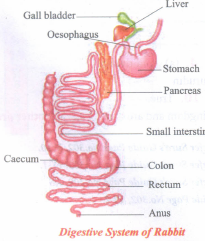
Explain the Digestive System of Rabbit.
2.
List out the parasitic adaptations in leech.
3.
Why are the rings of cartilages found in trachea of rabbit?
4.
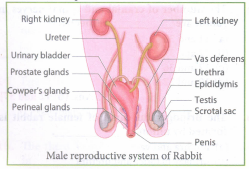
Explain the male reproductive system of rabbit with a labelled diagram.
5.
6.
How is the circulatory system designed in leech to compensate the heart structure?
7.
Shylesh has some pet animals at his home. He has few rabbits too, one day while feeding them he observed something different with the teeth. He asked his grandfather, why is it so? What would have been the explanation of his grandfather?
8.
Arjun is studying in tenth standard. He was down with fever and went to meet the doctor. As he went to the clinic he saw a patient undergoing treatment for severe leech bite. Being curious, Arjun asked the doctor why leech bite was not felt as soon as it attaches to the skin ? What would have been the reply given by the doctor?
9.
How is the digestive system of rabbit suited for herbivorous mode of feeding?
10.
Leeches do not have an elaborate secretion of digestive juices and enzymes -Why?
1.
i) The digestive system includes the alimentary canal and the associated digestive glands.
ii) The alimentary canal consists of mouth, buccal cavity, pharynx, oesophagus, stomach, small intestine, caecum, large intestine and anus.
iii) Mouth leads to the buccal cavity.
iv) Through the pharynx it reaches oesopbagus.
v) Oesophagus opens into the stomach followed by smallintestine.
vi) Caecum ispresent in between the snnall intestine and large intestine.
vii) Caecunm contains bacteria that helps in the digestion of cellulose.
viii) Large intestine has colon and rectum.
ix) It finally opens in to the anus.
x) The digestive glands are salivary glands, gastric glands, liver, pancreas and intestinal glands. The secretion of digestive glands help in digestion of food in the alimentary canal.
2.
Leech is a parasite and sucks the blood of vertebrates and show adaptations.
(i) Suckers are present in the anterior and posterior ends of the body, by which the animal attaches itself to the body of the host.
(ii) The three jaws inside the mouth causes a triradiate or Y shaped wound in the skin of the host.
(iii) Saliva contains a protein called hirudin which prevents the blood clotting. Thus continuous supply of blood is maintained.
(iv) Blood is stored in the crop. It gives nourishment to the leech for several months. Hence, there is no digestive juices and enzyme.
3.
Rings of cartilages are found in the tracheal walls of rabbit to help in the free passage of air.
4.
Male Reproductive system
(i) Male reproductive system of rabbit consists of a pair of testes which are ovoid in shape.
(ii) Testes are enclosed by scrotal sacs in the abdominal cavity
(iii) Each testis consists of numerous fine tubules called seminiferous tubules
(iv) This network of tubules lead into a coiled tubule called epididymis, which lead into the sperm duct called vas deferens.
(v) Below the urinary bladder is the urethra. Vas deferens joins the urethra.
(vi) Urethra runs backward and passes into the penis.
(vii) There are three accessory glands namely prostate gland, cowper's gland and perineal gland. Their secretions are involved in reproduction.
5.
6.
(i) Circulation is brought about by haemocoelic system.
(ii) There are no true blood vessels.
(iii) The blood vessels are replaced by channels called haemocoelic channels or canals filled with blood-like fluid. The coelomic fluid contains hemoglobin
(iv) There are four longitudinal channels. One lies above the alimentary canal (dorsal), one below the alimentary canal (ventral) and two on either side of the alimentary canal (lateral), which serve as the heart and have inner valves.
7.
(i) Canines are absent.
(ii) Hence, a gap is seen between the incisors and premolars.
(iii) This is called diastema.
(iv) It helps in mastication and chewing of food in herbivorous animals.
8.
The leech, while making incision on the skin it also injects an anaesthetic substance that prevents the host from feeling the bite.
9.
(i) Herbivores have a more specialised digestive system than that of a carnivore because it is more difficult to digest vegetarian than meat.
(ii) Plant material is difficult to digest, particularly plant cellulose.
(iii) The herbivorous animals have a longer intestine than the carnivorous animals giving more time for digestion.
(iv) The teeth is also designed to grind the grass and plant material rather than the sharp teeth of carnivores designed to tear flesh.
10.
(i) Slime glands are present in the body wall. Their secretion keeps the body moist and slippery so that the host can't remove it easily while it sucks blood.
(ii) The availability of the host to the leeches is not regular. Hence, a large amount of blood is stored in the crop whenever it gets food. Digestion is also very slow.
(iii) It may take more than a year for the complete digestion after a full meal.
(iv) In leech the ingested blood is stored in crop chambers. It may take more than a year for the complete digestion and absorption of a full meal. So there is no need for an elaborate secretion of digestion juices and enzymes.

10th Standard Syllabus & Materials
10th Standard
TN 10th English Prose - 2 - The Night the Ghost Got in Important Questions And Answers Study Material - QB365 Set A
NEW10th Standard
TN 10th English Supplementary - 1 - The Tempest Important Questions And Answers Study Material - QB365 Set A
NEW10th Standard
TN 10th English Poem - 1 - Life Important Questions And Answers Study Material - QB365 Set A
NEW10th Standard
TN 10th English Prose - 1 - His First Flight Important Questions And Answers Study Material - QB365 Set A



Tamilnadu Stateboard 10th Standard Subjects
Tamilnadu Stateboard Standards





