
 100% FREE ACCESS
10th Standard Syllabus & Materials
10th Standard
TN 10th English Prose - 4 - The Attic Important Questions And Answers Study Material - QB365 Set A
NEW10th Standard
TN 10th English Supplementary - 3 - The Story of Mulan Important Questions And Answers Study Material - QB365 Set A
NEW10th Standard
TN 10th English Poem - 3 - I am Every Woman Important Questions And Answers Study Material - QB365 Set A
NEW10th Standard
TN 10th English Prose - 3 - Empowered Women Navigating The World Important Questions And Answers Study Material - QB365 Set A
NEW10th Standard
TN 10th English Supplementary - 2 - Zigzag Important Questions And Answers Study Material - QB365 Set A
NEW10th Standard
TN 10th English Poem - 2 - The Grumble Family Important Questions And Answers Study Material - QB365 Set A

Published on: 19/10/2019
Structural Organisation of Animals
Download Tamil Nadu 10th Standard Science question papers, model tests, one-mark questions, important questions, and public exam papers in PDF format. Free study materials and answer keys for TN State Board students.
Questions + Answers key
Take MCQ Science Test1.
In leeches sperms are stored in
epididymis
vas deferens
testis
ejaculatory duct
2.
Leeches have ___________
heart
lungs
true blood vessels
excretory organs
3.
The animals which give birth to young ones are
Oviparous
Viviparous
Ovoviviparous
All the above
4.
Mammals are ______________ animals.
Cold blooded
Warm blooded
Poikilothermic
All the above
5.
6.
How does leech suck blood from the host?
7.
What does CNS stand for?
8.
How is diastema formed in rabbit?
9.
How does leech respire?
10.
Give the common name of the Hirudinaria granulosa
11.
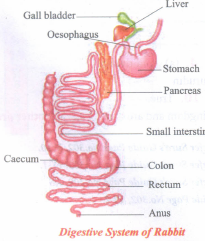
Explain the Digestive System of Rabbit.
12.
List out the parasitic adaptations in leech.
13.
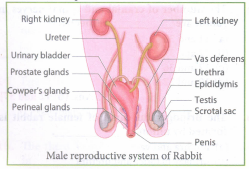
Explain the male reproductive system of rabbit with a labelled diagram.
14.
15.
How is the digestive system of rabbit suited for herbivorous mode of feeding?
16.
Leeches have a _________feeding habit.
17.
___________ separate nitrogenous waste from the blood in rabbit
18.
The anterior end of leech has a lobe-like structure called _____________.
19.
The posterior sucker is formed by the fusion of the ___________ segments
20.
Ovary
21.
4 channels
22.
Pharynx
23.
Jaws
24.
Triradiate
1.
(a)
epididymis
2.
(d)
excretory organs
3.
(b)
Viviparous
4.
(b)
Warm blooded
5.
(d)
6.
The Ieech makes a triradiate or 'Y' shaped incision in the skin of the host by the jaws protruded through the mouth and sucks the blood by muscular pharynx.
7.
CNS stand for Central Nervous System.
8.
Diastema is a gap between incisors and premolar formed due to absence of canine.
9.
Respiration takes place through skin.
10.
The Indian cattle leech.
11.
i) The digestive system includes the alimentary canal and the associated digestive glands.
ii) The alimentary canal consists of mouth, buccal cavity, pharynx, oesophagus, stomach, small intestine, caecum, large intestine and anus.
iii) Mouth leads to the buccal cavity.
iv) Through the pharynx it reaches oesopbagus.
v) Oesophagus opens into the stomach followed by smallintestine.
vi) Caecum ispresent in between the snnall intestine and large intestine.
vii) Caecunm contains bacteria that helps in the digestion of cellulose.
viii) Large intestine has colon and rectum.
ix) It finally opens in to the anus.
x) The digestive glands are salivary glands, gastric glands, liver, pancreas and intestinal glands. The secretion of digestive glands help in digestion of food in the alimentary canal.
12.
Leech is a parasite and sucks the blood of vertebrates and show adaptations.
(i) Suckers are present in the anterior and posterior ends of the body, by which the animal attaches itself to the body of the host.
(ii) The three jaws inside the mouth causes a triradiate or Y shaped wound in the skin of the host.
(iii) Saliva contains a protein called hirudin which prevents the blood clotting. Thus continuous supply of blood is maintained.
(iv) Blood is stored in the crop. It gives nourishment to the leech for several months. Hence, there is no digestive juices and enzyme.
13.
Male Reproductive system
(i) Male reproductive system of rabbit consists of a pair of testes which are ovoid in shape.
(ii) Testes are enclosed by scrotal sacs in the abdominal cavity
(iii) Each testis consists of numerous fine tubules called seminiferous tubules
(iv) This network of tubules lead into a coiled tubule called epididymis, which lead into the sperm duct called vas deferens.
(v) Below the urinary bladder is the urethra. Vas deferens joins the urethra.
(vi) Urethra runs backward and passes into the penis.
(vii) There are three accessory glands namely prostate gland, cowper's gland and perineal gland. Their secretions are involved in reproduction.
14.
15.
(i) Herbivores have a more specialised digestive system than that of a carnivore because it is more difficult to digest vegetarian than meat.
(ii) Plant material is difficult to digest, particularly plant cellulose.
(iii) The herbivorous animals have a longer intestine than the carnivorous animals giving more time for digestion.
(iv) The teeth is also designed to grind the grass and plant material rather than the sharp teeth of carnivores designed to tear flesh.
16.
()
sanguivorous
17.
()
Nephrons
18.
()
anterior sucker (or) oral sucker
19.
()
seven
20.
Follicle
21.
Haemocoelic fluid
22.
Pump
23.
Papillae
24.
Y shaped incision

10th Standard Syllabus & Materials
10th Standard
TN 10th English Prose - 2 - The Night the Ghost Got in Important Questions And Answers Study Material - QB365 Set A
NEW10th Standard
TN 10th English Supplementary - 1 - The Tempest Important Questions And Answers Study Material - QB365 Set A
NEW10th Standard
TN 10th English Poem - 1 - Life Important Questions And Answers Study Material - QB365 Set A
NEW10th Standard
TN 10th English Prose - 1 - His First Flight Important Questions And Answers Study Material - QB365 Set A



Tamilnadu Stateboard 10th Standard Subjects
Tamilnadu Stateboard Standards





