
 100% FREE ACCESS
10th Standard Syllabus & Materials
10th Standard
TN 10th English Prose - 4 - The Attic Important Questions And Answers Study Material - QB365 Set A
NEW10th Standard
TN 10th English Supplementary - 3 - The Story of Mulan Important Questions And Answers Study Material - QB365 Set A
NEW10th Standard
TN 10th English Poem - 3 - I am Every Woman Important Questions And Answers Study Material - QB365 Set A
NEW10th Standard
TN 10th English Prose - 3 - Empowered Women Navigating The World Important Questions And Answers Study Material - QB365 Set A
NEW10th Standard
TN 10th English Supplementary - 2 - Zigzag Important Questions And Answers Study Material - QB365 Set A
NEW10th Standard
TN 10th English Poem - 2 - The Grumble Family Important Questions And Answers Study Material - QB365 Set A

Published on: 02/09/2019
Thermal Physics
Download Tamil Nadu 10th Standard Science question papers, model tests, one-mark questions, important questions, and public exam papers in PDF format. Free study materials and answer keys for TN State Board students.
Questions + Answers key
Take MCQ Science Test1.
In the Given diagram, the possible direction of heat energy transformation is
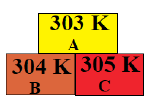
A\(\leftarrow\)B, A\(\leftarrow\)C, B\(\leftarrow\)C
A\(\rightarrow\)B, A\(\rightarrow\)C, B\(\rightarrow\)C
A\(\rightarrow\)B, A\(\leftarrow\)C, B\(\rightarrow\)C
A\(\leftarrow\)B, A\(\rightarrow\)C, B\(\leftarrow\)C
2.
The value of universal gas constant
3.81 J mol–1 K–1
8.03 J mol–1 K–1
1.38 J mol–1 K–1
8.31 J mol–1 K–1
3.
What is co-efficient of apparent expansion?
4.
What is co-efficient of real expansion?
5.
Distinguish between ideal gas and real gas.
6.
Derive the ideal gas equation.
7.
Boltzmann constant
8.
Heat transformation
9.
Cubical expansion
10.
Superficial expansion
11.
Transfer of energy between any two objects due to difference in temperature is called _____
12.
The process of heat transfer directly from molecule to molecule is called ______
13.
Hotness or coldness of an object is called _____
14.
With an illustration, explain the method of Calculation for cubical expansion of an object.
15.
With an illustration, explain the method of Calculation for linear expansion of an object.
1.
(a)
A\(\leftarrow\)B, A\(\leftarrow\)C, B\(\leftarrow\)C
2.
(d)
8.31 J mol–1 K–1
3.
(i) Co-efficient of apparent expansion is defined as the ratio of the apparent rise in the volume of the liquid per degree rise in temperature to its unit volume.
(ii) Its SI unit is K-1.
4.
(i) Co-efficient of rear-expansion is defined as the ratio of the true rise in the volume of the liquid per degree rise in temperature to its unit volume.
(ii) Its SI unit is K-1
5.
| S. No |
Ideal gas |
Real gas |
|---|---|---|
| (i) | If the atoms or molecules of a gas do not interact with each other, then the gas is said to be an ideal gas or a perfect gas. | If the molecules or atoms of a gas interact with each other with a definite amount of intermolecular or interatomic force of attraction, then the gases are said to be a real gases. |
6.
(i) The ideal gas equation is an equation, which relates to all the properties of an ideal gas.
(ii) An ideal gas obeys Boyle's law and Charles's law and Avogadro's law.
(iii) According to Boyle's law,
PV = constant ... (1)
(iv) According to Charles's law,
V/T = constant ... (2)
(v) According to Avogadro's law,
V/n = constant ... (3)
(vi) After combining equations (1), (2), and (3), we can get the following equation.
PV/nT = constant ... (4)
The above relation is called the combined gas law
(vii) If you consider a gas which contains μ moles of the gas, the number of atoms contained will be equal to μ times the Avogadro number, NA. i.e.,
\(n=\mu N_A\) ...... (5)
(viii) Using equation (5), equation (4) can be written as
\(PV/\mu N_AT\) = constant
(ix) The value of constant in the above equation is taken to be kB, which is called as Boltzmann's constant. Its value is (1.381 x10⁻²³JK-1). Hence, we have the following equation:
\(PV/\mu N_AT=K_B\)
\(PV=\mu N_AK_BT\)
(xi) Here, \(\mu N_AK_B=R\), which is termed as universal gas constant whose value is 8.31 J mol-1 K-1.
PV = RT ...... (6)
Ideal gas equation is also called as equation of state because it gives the relation between the state variables and it is used to describe the state of any gas.
7.
1.381 x 10⁻²³ JK-1
8.
hot body to cold body
9.
change in volume
10.
change in area
11.
()
Thermal (or) heat energy
12.
()
conduction
13.
()
Temperature
14.
Cubical expansion:
(i) If there is an increase in the volume of a solid body due to heating, then the expansion is called cubical or volumetric expansion.
(ii) As in the cases of linear and areal expansion, cubical expansion is also expressed in terms of coefficient of cubical expansion. The ratio of increase in volume of the body per degree rise in temperature to its unit volume is called coefficient of cubical expansion. This is also measured in K-1.
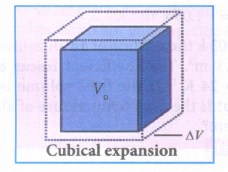
(iii) The equation relating to the change in volume to the change in temperature is given below:
\(\frac { \triangle V }{ { V }_{ 0 } } \) = αv ΔT
ΔV - Change in volume
V0 - Original volume
ΔT - Change in temperature
αv - Coefficient of cubical expansion.
15.
Linear expansion:
(i) When a body is heated or cooled, the length of the body changes due to change in its temperature. This expansion is said to be a linear or longitudinal expansion.
(ii) The ration of increase in length of a body per degree celsius rise in temperature to its unit length is called the coefficient of linear expansion. Its SI unit is per Kelvin. The value of coefficient of linear expansion is different for different materials.
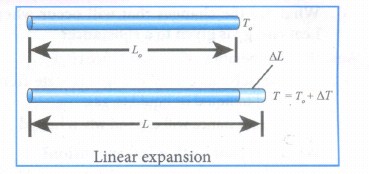
(iii) The equation relating the change in length to the change in temperature of a body is given below:
\(\frac { \triangle L }{ { L }_{ 0 } } \) =αL ΔT
ΔL - Change in length
L0 - Original length
ΔT - Change in temperature
αL - Coefficient of linear expansion.

10th Standard Syllabus & Materials
10th Standard
TN 10th English Prose - 2 - The Night the Ghost Got in Important Questions And Answers Study Material - QB365 Set A
NEW10th Standard
TN 10th English Supplementary - 1 - The Tempest Important Questions And Answers Study Material - QB365 Set A
NEW10th Standard
TN 10th English Poem - 1 - Life Important Questions And Answers Study Material - QB365 Set A
NEW10th Standard
TN 10th English Prose - 1 - His First Flight Important Questions And Answers Study Material - QB365 Set A



Tamilnadu Stateboard 10th Standard Subjects
Tamilnadu Stateboard Standards





