
 100% FREE ACCESS
10th Standard Syllabus & Materials
10th Standard
TN 10th English Prose - 4 - The Attic Important Questions And Answers Study Material - QB365 Set A
NEW10th Standard
TN 10th English Supplementary - 3 - The Story of Mulan Important Questions And Answers Study Material - QB365 Set A
NEW10th Standard
TN 10th English Poem - 3 - I am Every Woman Important Questions And Answers Study Material - QB365 Set A
NEW10th Standard
TN 10th English Prose - 3 - Empowered Women Navigating The World Important Questions And Answers Study Material - QB365 Set A
NEW10th Standard
TN 10th English Supplementary - 2 - Zigzag Important Questions And Answers Study Material - QB365 Set A
NEW10th Standard
TN 10th English Poem - 2 - The Grumble Family Important Questions And Answers Study Material - QB365 Set A

Published on: 08/02/2020
10th Standard Social Science All Chapter Creative Questions-II-2019-2020
Download Tamil Nadu 10th Standard Social Science question papers, model tests, one-mark questions, important questions, and public exam papers in PDF format. Free study materials and answer keys for TN State Board students.
Questions + Answers key
Take MCQ Social Science Test
1.
Write about population in India
2.
Write a note on GAIL.
3.
What are the main problems of the Indian soils?
4.
Write about Modern Globalization
5.
What is Net National Product?
6.
How does the state cabinet work?
7.
Write any four qualifications to become a member of the Rajya Sabha
8.
Name the three types of emergencies envisaged in the constitution.
9.
Define Wildlife.
10.
Write the longitudinal and latitudinal extent of India.
11.
What was the attitude of Muslims towards Western Education after the revolt of 1857 and state its impact.
12.
Name the eleven republic which announced secession from the Soviet Union in 1991.
13.
Why was Germany army unable to resist the Soviet force completely?
14.
Name the countries that were accorded Dominion Status prior to 1939.
15.
What heightened the tension between Germany and Britain?
16.
Write the sector wise Indian GDP composition in 2017.
17.
The __________ railway accounts for the longest length route.
Northern
Southern
Western
Eastern
18.
The first nuclear power station was setup at _________ near Mumbai in 1969
Kalpakkam
Kaiga
Rawatbhata
Tarapur
19.
The term________ invented by prof. Theodore Levitt.
Privatization
Liberalization
Globalization
None
20.
Per capita Income =__________
National Income + Population
National Income x Population
National Income - Population
National Income ÷ Population
21.
Generally, the _______ does not belong to the state where he is appointed.
Cheif Minister
Governor
Election Commission
Chief Justice
22.
All Indian Citizens above________years of age are eligible to vote in elections
19
18
21
25
23.
The first language committee was appointed in_________
1947
1950
1955
1952
24.
The capacity of hydro power generation of Bhakra Nangal project is ______________ Megawatts.
1500
1200
1000
1700
25.
Isobar is a line joining places having equal _____________
temperature
pressure
cloud cover
Sunshine
26.
The fresh water lake found in the deltaic region of Godavari is _________________
Kolleru
Chelak
Pulicat
Vembanad
27.
The Theosophical Society founded in the USA, shifted to India at _______________ , Chennai.
Santhome
Nungambakkam
Mylapore
Adyar
28.
Gorbachev was held under house arrest in ______________,
Kazan
Sochi
Volgograd
Moscow
29.
In 1937, Japan invaded _____________ and seized Beijing.
Turkey
Russia
Germany
China
30.
Between 1871 and 1914,________ had risen to dizzy heights of economic, political and cultural accomplishments.
India
Germany
Italy
Britain
31.
In 1931 Japan attacked ______________
China
Manchuria
France
Russia
32.
GATT was signed by_______ countries in 1947
33.
GNH stands for________
34.
The maximum strength of the Assembly must not exceed_______and its minimum strength should not be below__________
35.
The Vice-President can act as the president for a maximum period of________ months.
36.
42nd amendment of the Constitution is known as the_________
37.
The cry of Swami Dayanand Saraswati was ______________
38.
With the fall of the ___________ followed by the collapse of the Soviet Union in 1991, the Cold War era came to an end.
39.
When Italy invaded Ethiopia, Emperor ______________ of Ethiopia, appealed to the League of Nations.
40.
In 1935, Mussolini invaded _______________
41.
By 1900, practically the whole of_________ was colonised.
42.
East Coast Railway
43.
Pink revolution
44.
Copper
45.
First French Factory in India
46.
National Income Population
47.
Kamaraj
48.
Mohammad Hidayatullah
49.
Chief Justice of India
50.
World Water Day
51.
Guru shikar
52.
R. C. Bhandarkar
53.
Fidel Castro
54.
Blitz
55.
Von Hindenburg
56.
Lloyd George
57.
Tank irrigation is popular in Peninsular India.
58.
Explain the importance of mass communications systems in India.
59.
Write the goals of World Trade Organisation
60.
Draw the pie chart for sector wise Contribution of GDP Growth in India for the year 2018 - 2019
61.
Give a detailed account of the classification of the Council of Ministers based on ranks.
62.
Explain in detail about the Acquisition of Citizenship in our country.
63.
Explain about any two factors affecting the climate of India.
64.
Write the importance of Himalayas.
65.
Give an account of Narayana Guru's life and teachings.
66.
Given an account of the communist Victory over China.
67.
What were the causes for the failure of the League of Nations?
68.
Give an account of Boer Wars.
69.
What was the outcome of the Russian Revolution?
70.
(i) By the end of Second World War, Viet Minh controlled the northern half of Vietnam.
(ii) In March 1946, the French and Viet Minh's government reached an agreement by which North Vietnam was to be a free state.
(iii) The problem of Indo-China soon became involved in the cold war.
(iv) The French were receiving considerable financial aid from Russia, the Viet Minh were helped by the new Chinese government.
(a) (i) and (ii) are correct
(b) (ii), (iii) and (iv) are correct
(c) (i), (ii) and (iii) are correct
(d) (ii) and (iv) are correct
71.
Major ports and Minor ports
72.
Open wells and Tube wells
73.
Iron & Steel and Software industries.
74.
Coastal forests and Tidal forests.
75.
River Ganga and Brahmaputra.
1.
India is the second most populous country in the world next only to china. India covers only 2.4 percent of the land area of the world, but is the home of about 17.5 percent of the world's population.
2.
(i) The Gas Authority of India Ltd [GAIL] is doing pioneer work in the field of natural gas exploration.
(ii) Discovery of gas made rapid strides in the 1985. Oil strikes at Cauvery offshore, at Nanda in Cambay basin and Tarot in Jaisalmer basin in Rajasthan were major discoveries during 1988-89.
(Iii) Recently, it has been found that Krishna- Godavari delta has reserves of Natural gas.
3.
The main problems of the Indian soils are
(i) Soil erosion
(ii) Degradation of Soil
(iii) Water-logging
(iv) Saline and Alkaline, and
(v) Salt Flats, types of soils have different erosion.
4.
(i) The 19th Century witnessed the advent of globalization approaching its modern form.
(ii) There are significant differences in globalization between 19th and 20th century.
(iii) There are two main points one is the global trade and the capital investment.
5.
(i) Net National Product (NNP) is arrived by making some adjustment with regard to depreciation.
(ii) Net National Product (NNP) is arrived by deducting the value of depreciation from Gross National Product.
(iii) NNP = GNP - Depreciation
6.
The cabinet works through various committees called cabinet committees. They are of two types standing and ad hoc. The former are of a permanent nature while the latter are of a temporary nature
7.
(f) He should be a citizen of India.
(ii) He should not be less than 30 years of age.
(iii) He should not hold any office of profit under any Government.
(iv) He should be a person with sound mind and monetarily solvent
8.
National Emergency, State Emergency, Financial Emergency
9.
(i) The term 'Wildlife' includes animals of any habitat in nature.
(ii) Wild animals are non-domesticated animals and include both vertebrates (Fish, Amphibians, Reptiles, Birds, and Mammals) and invertebrates(Bees, Butterflies, Moths, etc.).
(iii) India has a rich and diversified wildlife.
10.
India extends from 8° 04' N to 37° 06' N latitudes and between 68° 07' E to 97° 25' E longitudes.
11.
(i) After the suppression of great revolt of 1857 Indian Muslims looked to Western culture with suspicion.
(ii) The community feared that Western education, Western culture, and Western ideas would endanger their religion.
(iii) Therefore only a small section of Muslims accepted the new avenues for modern education.
(iv) Consequently, Indian Muslims as a community lagged behind in comparison to the Hindu elite of various parts of India.
12.
In November 1991, eleven republics (Ukraine, Georgia, Belarus, Armenia, Azerbaijan, Kazakhstan, Kyrgyzstan, Moldova, Turkmenistan, Tajikistan, and Uzbekistan) announced secession from the Soviet Union.
13.
(i) The German strategy of lightning strikes was initially successful and the army penetrated 1000 miles into Russian territory very soon.
(ii) The German army then marched on Moscow. But ultimately, the resistance by the Soviet army and the fierce Russian winter defeated the German army.
14.
Canada, New Zealand, the Union of South Africa and Ireland.
15.
(i) Kaiser proclaimed that Germany would be the leader of the world. The German navy was expanded.
(ii) Germany's aggressive diplomacy and rapid building of naval bases convinced Britain that a German navy could be directed only against her. Therefore, Britain embarked on a naval race, which heightened the tension between the two powers.
16.
\(\begin{array}{|c|c|c|c|} \hline \text { Year } & \text { Agriculture (%) } & \text { Industry (%) } & \text { Service (%) } \\ \hline 2017 & 17.09 & 29.03 & 52.08 \\ \hline 2018 & 17.01 & 29.01 & 53.09 \\ \hline \end{array}\)
17.
(a)
Northern
18.
(d)
Tarapur
19.
(c)
Globalization
20.
(d)
National Income ÷ Population
21.
(b)
Governor
22.
(b)
18
23.
(c)
1955
24.
(a)
1500
25.
(b)
pressure
26.
(a)
Kolleru
27.
(d)
Adyar
28.
(d)
Moscow
29.
(d)
China
30.
(b)
Germany
31.
(b)
Manchuria
32.
()
23 countries
33.
()
Gross National Happiness
34.
()
500,60
35.
()
6 months
36.
()
mini Constitution
37.
()
Go back to Vedas
38.
()
Berlin Wall
39.
()
Haile Selassie
40.
()
Ethiopia
41.
()
Africa
42.
Bhuvaneswar
43.
Onion production
44.
Rajasthan
45.
1668
46.
Per capita Income
47.
1954-1963
48.
Chief Justice and Vice President
49.
M.M. Punchchi
50.
22nd March
51.
Aravalli
52.
Prarthana Samaj
53.
Cuba
54.
Battle of Britain
55.
German President
56.
England
57.
A tank is a natural or man-made hollow on the surface developed by constructing a small bund around it across a stream. It is used to collect and store water for irrigation and other purposes. Irrigation by tanks is a very old system in India. It also includes irrigation from lakes and ponds. The tank irrigation is popular in the peninsular India due to the following reasons:
(i) The undulating relief and hard rocks make difficult to dig canals and wells.
(ii) Natural depressions serve as reservoirs.
(iii) Absence of perennial rivers.
(iv) Impermeable rock structure which do not permit percolation.
(v) The scattered nature of population and agricultural fields
58.
Electronic Media:
(i) Mass Communication enables millions of people to get the information at the same time.
(ii) It is a great way to provide education as well as entertainment.
(iii) It helps in creating awareness among the people regarding various national policies and programmes.
(iv) The Mass Communication Systems can provide the information to people in two methods.
Electronic Media:
(i) Radio broadcasting in India was started in 1923 by the Radio club of Bombay.
(ii) It was named as All India Radio (AIR) in 1936 and again it was renamed as Akashwani in 1957.
(iii) It broadcasts a variety of programs related to information, education and entertainment.
Print Media:
(i) Newspapers are the most common but powerful means of communication come under print media.
(ii) India has many newspapers which carry information on local, national and international events to the people
59.
Goals of WTO:
(i) Raising and stabilizing the incomes of small scale farmers, farm workers and artisans.
(ii) More equitably distributing the economic gains, opportunities and risks associated with the production and sale of these goods.
(iii) Increasing the organisational and commercial capacities of producer groups.
(iv) Promoting labour rights and the right workers to organize.
(v) Promoting safe and sustainable farming methods and working conditions
60.
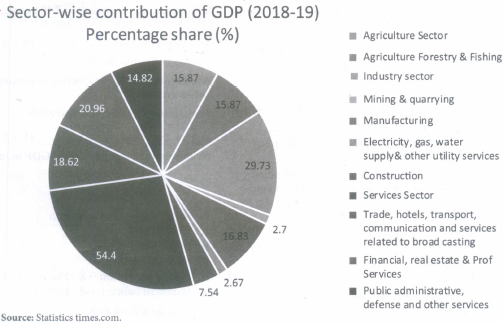
61.
Categories of the Ministers The ministers are classified under three ranks
(I) Cabinet Minister
(II) Ministers of State
(III) Deputy Ministers.
Cabinet Ministers
(i) The Cabinet is an informal body of senior ministers who form the nucleus of administration.
(ii) Important decisions of the government are taken by the Cabinet, such as defence, finance, external affairs and home.
(iii) The Cabinet recommends to the President to promulgate an ordinance.
(iv) It is instrumental in moving Amendments to the Constitution.
Ministers of State
(i) These ministers belong to the second category of ministers in the council.
(ii) They are also in charge of ministries or departments but they do not participate in the meetings of the cabinet unless invited to do so.
Deputy Ministers
They are the lowest ranked ministers in the cabinet. They assist either the Ministers of Cabinet or state in the performance of the duties entrusted to them
62.
The Citizenship Act of 1955 prescribes five ways of acquiring citizenship, viz, birth, descent, registration, naturalisation and incorporation of territory:
According to the Citizenship Act, 1955, the citizenship could be acquired through any of the following methods.
(i) By Birth : All persons born in India on or after January 26, 1950 are treated as citizens by birth.
(ii) By Descent: A person born outside India on or after January 26, 1950 shall be a citizen of India by descent, if his father is a citizen of India at the time of his birth.
(iii) By Registration : A person can acquire citizenship of India by registration with appropriate authority.
(iv) By Naturalisation : A foreigners can' acquire Indian citizenship, on application for naturalization to the Government of India.
(v) By Incorporation of Territory : In the event of a certain territory being added to the territory of India, the Government of India shall specify the persons of that territory who shall be citizen of India.
63.
Climate of India is affected by the factors of latitude, distance from the seas, monsoon wind, relief features, and jet stream.
(i) Latitude:
(a) Latitudinally, India lies between 8°4'N and 37°6'N latitudes.
(b) The Tropic of Cancer divides the country into two equal halves.
(c) The area located to the south of Tropic of cancer experiences high temperature and no severe cold season throughout the year whereas, the areas to the north of this parallel enjoys sub-tropical climate.
(d) Here, summer temperature may rise above 40°C and it is close to freezing point during winter.
(ii) Altitude:
(a) When the altitude increases, The temperatures decreases.
(b) Temperature decreases at the rate of 6SC for every 1000 meters of ascent. It is called normal lapse rate.
(c) Hence, places in the mountains are cooler than the places on the plains.
(d) That is why the places located at higher altitudes even in south India have a cool climate.
(e) Ooty and several other hill stations of south India and of the Himalayan ranges like Mussoorie, Shimla, etc., are much cooler than the places located on the Great Plains.
64.
(i) Himalayas blocks southwest monsoon winds and causes heavy rainfall to north India.
(ii) It forms a natural barrier to the subcontinent.
(iii) It is the source for many perennial rivers like Indus, Ganges, Brahmaputra, etc.
(iv) The Northern Mountains are described as the paradise of tourists due to its natural beauty.
(v) Many hill stations and pilgrim centers like Amarnath, Kedarnath, Badrinath, and Vaishnavi Devi temples are situated here.
(vi) It provides raw material for many forest based industries.
(vii) It prevents the cold winds blowing from the central Asia and protects India from severe cold.
(viii) Himalayas are renowned for the rich biodiversity.
65.
(i) Born to poor parents in Kerala, Narayana Guru (1854-1928) evolved into a poet and scholar in Malayalam, Tamil, and Sanskrit.
(ii) In his days the people of depressed classes had no access to temples, streets, public tanks and wells, and educational institutions.
(iii) Men and women belonging to lower castes were not allowed to wear the upper garments.
(iv) Disturbed by the terrible caste tyranny, that the lower caste people suffered, he dedicated his whole life for the betterment of the oppressed.
(v) He set up the Sri Narayana Dharma Paripalana Yogam, an organization to work for the uplift of the "depressed classes'.
(vi) He established a grand temple at Aruvipuram and dedicated it to all.
(vii) His movement inspired a radical transformation of Kerala society, especially among the Ezhavas.
(viii) Thinkers and writers such as Kumaran Asan and Dr. Palpu were influenced by his ideas and carried forward the movement.
66.
Communist Victory:
(i) With the surrender of the Japanese (1945), both the Kuomintang and the communists sought to occupy the Japanese areas.
(ii) In this race the Kuomintang was successful. The cities and railways soon fell into their hands.
(iii) Even the area around Peking was soon controlled by Chiang Kai-shek's forces, largely because of the military aid given by the USA.
(iv) With the massive support provided by the USA, Kuomintang government controlled the administration, ports and communication system.
(v) But the soldiers, mainly drawn from the peasants, were disillusioned and discontented.
(vi) Mao was keen on obtaining the support of the middle class.
(vii) Mao continued the use of guerrilla tactics but also ordered large-scale military movements.
(viii) Cities fell one by one and Chiang Kai-shek's army began to disintegrate quickly.
(ix) In the summer of 1948, Communist control had been established over most parts of China.
67.
(i) The Treaty also set up the League of Nations, on the initiative of President Woodrow Wilson of the United States.
(ii) The League was expected to mediate between countries and take action against countries which indulged in military aggression.
(iii) However, the United States was not interested in playing a global role or any role in European politics.
(iv) The popular mood favoured the traditional isolationist approach, and therefore the United States did not become a member of the League.
(v) The other Allied nations were also determined to maintain a noninterventionist attitude and, in consequence, the League remained an ineffectual international body.
68.
(i) The relations between the two British colonies of Natal and Cape Colony and the two independent Boer states of Transvaal and the Orange Free State had long been unfriendly.
(ii) The discovery of gold in Transvaal, in 1886, led to large numbers of British miners settling in and around Johannesburg.
(iii) The Boers hated these people whom they referred to as Uitlanders (foreigners). The Boers taxed them heavily and denied political rights to them.
(iv) So the question was whether the British or the Boers were to be supreme in South Africa.
(v) Fearing attacks from the British, the Boers armed themselves and decided to attack.
(vi) The Boer War lasted for three years, from 1899 to 1902. Initially, the Boers were successful.
(vii) But by the first half of 1900, the Boer army was defeated. Pretoria was occupied.
(viii) In retaliation, the British destroyed farms and crops. They set up internment camps for Boer women and children.
(ix) Shortage of food, medical and sanitary facilities caused the death of 26,000 people.
(x) The British annexed the two Boer states. Boers were however promised self-government in due course.
(xi) In 1907 full responsible government was given to the Transvaal and the Orange Free State.
(xii) The four states formed into a union and the South Africa Act passed by the British parliament in 1909 provided for a Union Parliament at Cape Town.
(xiii) In May 1910 the Union of South Africa came into being.
69.
(i) The Russian Communist Party could eliminate illiteracy and poverty in Russia within a record time.
(ii) Russian industry and agriculture had developed remarkably.
(iii) Women were given equal rights, including rights to vote.
(iv) Industries and banks were nationalized. Land was announced as social property.
(v) Land was distributed to poor peasants.
(vi) Lenin thought the most important factor for the fall of Provisional government was its failure to withdraw from World War.
(vii) So Lenin immediately appealed for peace.
(viii) Unmindful of the harsh terms dictated by the Central Powers, Lenin opted for withdrawing from the War to concentrate on the formation of new government.
(ix) In March 1918 the Treaty of Brest-Litovsk was signed.
70.
(c) (i), (ii) and (iii) are correct
71.
| S.No |
Major ports |
Minor ports |
|---|---|---|
| 1. | There are about 13 Major ports | There are about 200 minor or intermediate ports. |
| 2. | These ports are managed by the Port trust under Central Government. | These ports are managed by the Government. |
| 3. | Eg. Mumbai, Kolkata Tuticorin, Kochi Chennai, etc. | Eg. Cuddalore Nagapattinam,Kollam etc. |
72.
| S.No | Open wells | Tube wells |
|---|---|---|
| 1. | This type of irrigation is widely practiced in the areas where groundwater is sufficiently available. | Tube wells are developed in the areas of low water table, sufficient power supplies, and soft subsurface geological units. |
| 2. | The areas are in Ganga plains, the deltaic region of Mahanadi, Godavari, Krishna, Cauvery, and parts of Narmada and Tapti valleys. | Tube wells are predominant in the states of Gujarat, Maharashtra, Punjab, Madhya Pradesh and Tamil Nadu. |
73.
| S.No |
Iron and Steel |
Software |
|---|---|---|
| (1) | Mineral-based | Human-based |
| (2) | Iron and steel industries of India are concentrated in the Chota Nagpur plateau region | TCS, Infosys Accenture, Wipro are important software companies. |
| (3) | Ex: Durgapur Bokaro, Rourkela, Jamshedpur. | The IT parks are located in Chennai, Mumbai Pune, Bengaluru, Hyderabad, Mysore, Thiruvananthapuram, etc. |
74.
| S.No |
Coastal forests |
Tidal forests |
|---|---|---|
| 1. | The coastal areas have this kind of forests | Tidal forests occur in and around deltas, estuaries, and creeks prone to tidal influences. |
| 2. | These are littoral forests | They are also known as mangrove forests |
| 3. | Both eastern and western coasts have these type of forests | The Ganga, Brahmaputra delta has the largest tidal forest |
| 4. | Ex: Kerala and Goa | The deltas of Mahanadi, Godavari and Krishna rivers are also known for Tidal forests. |
75.
| S.No |
Ganga |
Brahmaputra |
|---|---|---|
| 1. | River Ganga originates from the Gangotri glacier. | River Brahmaputra originates from Lake Manasarovar. |
| 2. | The important tributaries are Ghagra, Gandak, Gomti, Son, etc. | The important tributaries are Raidak, Sankosh, Dibond, Lohit, etc. |
| 3. | The states that benefitted are Uttar Pradesh, Bihar, and West Bengal. | The North-Eastern states of Arunachal Pradesh, Assam are benefited. |

10th Standard Syllabus & Materials
10th Standard
TN 10th English Prose - 2 - The Night the Ghost Got in Important Questions And Answers Study Material - QB365 Set A
NEW10th Standard
TN 10th English Supplementary - 1 - The Tempest Important Questions And Answers Study Material - QB365 Set A
NEW10th Standard
TN 10th English Poem - 1 - Life Important Questions And Answers Study Material - QB365 Set A
NEW10th Standard
TN 10th English Prose - 1 - His First Flight Important Questions And Answers Study Material - QB365 Set A



Tamilnadu Stateboard 10th Standard Subjects
Tamilnadu Stateboard Standards




