
 100% FREE ACCESS
10th Standard Syllabus & Materials
10th Standard
TN 10th English Prose - 4 - The Attic Important Questions And Answers Study Material - QB365 Set A
NEW10th Standard
TN 10th English Supplementary - 3 - The Story of Mulan Important Questions And Answers Study Material - QB365 Set A
NEW10th Standard
TN 10th English Poem - 3 - I am Every Woman Important Questions And Answers Study Material - QB365 Set A
NEW10th Standard
TN 10th English Prose - 3 - Empowered Women Navigating The World Important Questions And Answers Study Material - QB365 Set A
NEW10th Standard
TN 10th English Supplementary - 2 - Zigzag Important Questions And Answers Study Material - QB365 Set A
NEW10th Standard
TN 10th English Poem - 2 - The Grumble Family Important Questions And Answers Study Material - QB365 Set A

Published on: 08/02/2020
10th Standard Social Science All Chapter Important Creative Questions-I- 2019-2020
Download Tamil Nadu 10th Standard Social Science question papers, model tests, one-mark questions, important questions, and public exam papers in PDF format. Free study materials and answer keys for TN State Board students.
Questions + Answers key
Take MCQ Social Science Test
1.
What is population census?
2.
Write a note on saline and Alkaline soils.
3.
What are the Mica producing states in India?
4.
Write about European traders in South India
5.
What is Gross National Product?
6.
Name the writs that can be issued by the High Court.
7.
What is the role of the President with regard to appointment of officials in the Government?
8.
Why is the Supreme Court called the 'Guardian of the Constitution'?
9.
Define Wildlife.
10.
Write the longitudinal and latitudinal extent of India.
11.
Who were Parsis?
12.
What is Perestroika?
13.
What do you mean by 'Lend Lease' Explain.
14.
What is Gold standard?
15.
What were the objectives of the League of Nations?
16.
What is meant by Gross domestic product?
17.
The Konkan Railways connects Roha in____________to Mangaluru__________.
Goa, Karnataka
Maharashtra, Kerala
Maharashtra, Goa
Maharashtra, Karnataka
18.
__________stands first in the reserves of bauxite in India.
Bihar
Gujarat
Odisha
Rajasthan
19.
Dutch captured Pondicherry in
1498
1693
1995
1947
20.
CSO Stands for
Central Statistical Organisation
Circle Statistical Organisation
Central Sampling Organisation
None
21.
Article ________vests the executive power of the State in the Governor
154
157
158
36
22.
The Lok Sabha enjoys a term of________years from the date of its first session
3
6
5
4
23.
The preamble to the Indian Constitution is based on the________ drafted by Jawaharlal Nehru
Rights
Duties
Objective Resolution
Articles
24.
The removal of soil along drainage lines by surface water run off forming large gullies is called ___________
Gully erosion
Rill erosion
Sheet erosion
Ravine erosion
25.
The Indian Board for Wildlife (IBWL) was constituted in ________ to suggest means of protection, conservation and management of wildlife to the government.
1950
1954
1952
1951
26.
Kayals ad Teris are found in _______ coast.
Konkan
Malabar
Coromandel
Northern Circars
27.
Aligarh Mohammedan Anglo-Oriental college was raised to the status of a university in _______________
1915
1920
1930
1925
28.
Gorbachev was held under house arrest in ______________,
Kazan
Sochi
Volgograd
Moscow
29.
In 1939, Hitler invaded ____________
Austria
France
India
Czechoslovakia
30.
Ho Chi Minh was inspired by
Mao-Tse-Tung
Lenin
Mortague
Hitler
31.
In 1902, Japan entered into an alliance with England and demanded that Russia should withdraw its troops from _______________
France
Spain
Manchuria
India
32.
Globalization is the integration of country with the________
33.
PPP is _______
34.
___________represents special interests like teachers, graduates and local Governments
35.
The Vice-President can act as the president for a maximum period of________ months.
36.
_________was the calligrapher of the Indian Constitution.
37.
Inspired by Sree Narayana Guru, Ayyankali founded the _________.
38.
The _______________ emerged in the watch of decolonization on that followed World War II.
39.
All the countries in ___________ are now welfare states.
40.
The __________ had barred European interference in the affairs of the American continent.
41.
_________and____________ declared war on the central powers in 1916 and 1917 respectively.
42.
NH 1
43.
Pink revolution
44.
Gypsum
45.
G7 Countries
46.
Consumer Price Index
47.
Hight court
48.
Mohammad Hidayatullah
49.
Inter - state concil
50.
World Earth Day
51.
Pamir knot
52.
Fatwa
53.
Negev
54.
Royal Air Force
55.
Social Democratic party
56.
River Somme
57.
Major issues faced by farmers in India.
58.
Explain the importance of mass communications systems in India.
59.
Write the negative impact of Globalization
60.
Draw the pie chart for sector wise Contribution of GDP Growth in India for the year 2018 - 2019
61.
Give a detailed account of the classification of the Council of Ministers based on ranks.
62.
Explain in detail about the Acquisition of Citizenship in our country.
63.
Explain about any two factors affecting the climate of India.
64.
Write the importance of Himalayas.
65.
Give an account of Narayana Guru's life and teachings.
66.
Explain in detail about the Vietnam War.
67.
What were the causes for the failure of the League of Nations?
68.
Give an account of Boer Wars.
69.
Explain the structure and composition of the League of Nations
70.
(i) West Berlin's economy became prosperous due to the support received from the west under the Marshall plan.
(ii) People in East Berlin suffered from back of democracy and freedom.
(iii) East German began to construct a wall in 1965 to cut if off from West Berlin.
(iv) On 9 November 1999 mass of people began to demolish the wall.
(a) (i) and (ii) are correct
(b) (ii), (iii) and (iv) are correct
(c) (i), (iii) and (iv) are correct
(d) (ii) and (iii) are correct
71.
Village Roads and District Roads.
72.
Sheet erosion and Rill erosion
73.
Automobile and Electronic Industry
74.
Coastal forests and Tidal forests.
75.
Distinguish between : GMT and IST
1.
(i) Population census is the total process of collecting, compiling, analysing or other wise disseminating demographic, economic and social data pertaining, at a specific time, of all persons in a country or a well-defined part of a country.
(ii) The data collected through the census are used for administration, planning, policy making as well as management and evaluation of various programmes by the government.
2.
Saline and Alkaline Soils
(i) These are formed due to ill drainage which causes water logging. Area covered by these soils is 68,000 sq.km and constitute 2.8 % of soil in India.
(ii) These soils contain many salts like sodium, magnesium, and calcium, which make them infertile and unfit for agriculture.
(iii) These types of soil are found in Andhra Pradesh, Karnataka, and in the drier parts of Bihar, Uttar Pradesh, Haryana, Punjab, Rajasthan, and Maharashtra.
3.
(i) Andhra Pradesh
(ii) Rajasthan
(iii) Odisha
(iv) Jharkhand
4.
(i) European companies which came to trade with India.
(ii) The discovery of a new all-sea route from Europe to India via cape of Good Hope by Vasco da Gama.
(Iii) Vasco da Gama had far-reaching repercussions on the civilized world.
5.
(i) Gross National Product is the total value of (goods and services) produced and income received in a year by domestic residents of a country.
(ii) It includes profit earned from capital invested abroad.
(iii) GNP = C + I + G + (X - M) + NFIA
6.
Habeas Corpus, Mandamus, Prohibition, Quo Warranto, Certiorari
7.
(i) He is responsible for making a wide variety of appointments.
(ii) These include the appointment of Governors of States, the Chief Justice and other Judges of the Supreme Court and high Courts, the Attorney General, the Comptroller and Auditor General, the Chief Election Commissioner and other Election Commissioners the Chairman and other Members of the Union Public Service Commission Ambassadors and High Commissioners to other countries
8.
Both the Supreme Court and the High Courts are empowered to issue five kinds of writs of habeas corpus, mandamus, prohibition, quo warranto and certiorari. That is why the Supreme Court is called the "Guardian of the Constitution".
9.
(i) The term 'Wildlife' includes animals of any habitat in nature.
(ii) Wild animals are non-domesticated animals and include both vertebrates (Fish, Amphibians, Reptiles, Birds, and Mammals) and invertebrates(Bees, Butterflies, Moths, etc.).
(iii) India has a rich and diversified wildlife.
10.
India extends from 8° 04' N to 37° 06' N latitudes and between 68° 07' E to 97° 25' E longitudes.
11.
The Zoroastrians who had fled from Iran in the tenth century in the face of religious persecution.
12.
Perestroika ('restructuring') refers to the programme introduced by Mikhail Gorbachev in the late 1980s to restructure Soviet economic and political system.
13.
(i) President Roosevelt realized that the United States had to change its policy of isolation, but could not intervene directly in the War in Europe, because it was not politically feasible.
(ii) So he started a program of "Lend Lease" in March 1941. Arms, food, military equipment, and other supplies were sent to Britain, disguised as a "loan", which would be returned after use.
14.
Gold Standard is a monetary system where a country's currency or paper money carried a value directly linked to gold.
15.
The two-fold objective of the League of Nations was to avoid war and maintain peace in the world and to promote international cooperation in economic and social affairs. The League intended to act as conciliator and arbitrator and thereby resolve a dispute in its early stages. If wars should break out despite arbitration, the members should apply sanctions to the aggressor-first economic and then military.
16.
Gross Domestic Product (GDP) is the total value of output of goods and services produced by the factors of production within the geographical boundaries of the country.
17.
(d)
Maharashtra, Karnataka
18.
(c)
Odisha
19.
(b)
1693
20.
(a)
Central Statistical Organisation
21.
(a)
154
22.
(c)
5
23.
(a)
Rights
24.
(a)
Gully erosion
25.
(c)
1952
26.
(b)
Malabar
27.
(b)
1920
28.
(d)
Moscow
29.
(d)
Czechoslovakia
30.
(a)
Mao-Tse-Tung
31.
(c)
Manchuria
32.
()
World economy
33.
()
Purchasing Power Parity
34.
()
Legislative Council
35.
()
6 months
36.
()
Prem Behari Narain Raizada
37.
()
Sadhu Jana Paripalana Sangam
38.
()
The Non-Alignment movement
39.
()
Western Europe
40.
()
Monroe Doctrine
41.
()
Romania and Greece
42.
Delhi to Amritsar
43.
Onion production
44.
Rajasthan
45.
United States
46.
CPI
47.
1862
48.
Chief Justice and Vice President
49.
1990
50.
22nd April
51.
Roof of the world
52.
Religious decree
53.
Southern Israel
54.
Spitfires & Hurricanes
55.
Leipzig
56.
Four month Battle
57.
Indian agriculture and Indian farmers are plagued by several problems; some of them are natural and some others are manmade.
(i) Small and fragmented land-holdings: The problem of small and fragmented holdings is more serious in densely populated and intensively cultivated states in India.
(ii) High Costs of Inputs: Seed is a critical and basic input for attaining higher crop yields and sustained growth in agricultural production.
(iii) Infertile Soil: Indian soils have been used for growing crops over thousands of years without caring much for replenishing. This has led to depletion and exhaustion of soils resulting low productivity.
(iv) Lack of Irrigation: Only one- third of the cropped area falls under irrigated area. To make agriculture reliable, irrigation facility has to be developed.
(v) Soil erosion: Large tracts of fertile land suffer from soil erosion by wind and water. Such kind of areas must be properly treated and restored to its original fertility.
(vi) Agricultural marketing: In rural India, agricultural marketing continues in bad shape. Due to the absence of sound marketing facility, the farmers have to depend on local traders and middlemen for the disposal of their farm products which is sold at a low price.
(vii) Inadequate storage facilities: Storage facilities in the rural areas are either totally absent or grossly inadequate. Under such conditions, the farmers are compelled to sell their products immediately after the harvest irrespective of the condition of market.
58.
Electronic Media:
(i) Mass Communication enables millions of people to get the information at the same time.
(ii) It is a great way to provide education as well as entertainment.
(iii) It helps in creating awareness among the people regarding various national policies and programmes.
(iv) The Mass Communication Systems can provide the information to people in two methods.
Electronic Media:
(i) Radio broadcasting in India was started in 1923 by the Radio club of Bombay.
(ii) It was named as All India Radio (AIR) in 1936 and again it was renamed as Akashwani in 1957.
(iii) It broadcasts a variety of programs related to information, education and entertainment.
Print Media:
(i) Newspapers are the most common but powerful means of communication come under print media.
(ii) India has many newspapers which carry information on local, national and international events to the people
59.
(i) Too much flow of capital amongst countries, Introduces unfair and immoral distributors of Income
(ii) Another fear is losing national integrity Because of too much exchange of trade, independent domestic policies are lost.
(iii) Rapid growth of the economy has required a major infrastructure and resource extraction. This increase negative ecological and Social costs.
(iv) Rapid increases in exploitation of natural resources to earn foreign exchange.
(v) Environmental standards and regulations have been relaxed.
60.
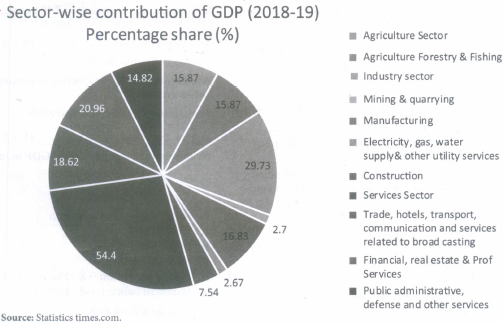
61.
Categories of the Ministers The ministers are classified under three ranks
(I) Cabinet Minister
(II) Ministers of State
(III) Deputy Ministers.
Cabinet Ministers
(i) The Cabinet is an informal body of senior ministers who form the nucleus of administration.
(ii) Important decisions of the government are taken by the Cabinet, such as defence, finance, external affairs and home.
(iii) The Cabinet recommends to the President to promulgate an ordinance.
(iv) It is instrumental in moving Amendments to the Constitution.
Ministers of State
(i) These ministers belong to the second category of ministers in the council.
(ii) They are also in charge of ministries or departments but they do not participate in the meetings of the cabinet unless invited to do so.
Deputy Ministers
They are the lowest ranked ministers in the cabinet. They assist either the Ministers of Cabinet or state in the performance of the duties entrusted to them
62.
The Citizenship Act of 1955 prescribes five ways of acquiring citizenship, viz, birth, descent, registration, naturalisation and incorporation of territory:
According to the Citizenship Act, 1955, the citizenship could be acquired through any of the following methods.
(i) By Birth : All persons born in India on or after January 26, 1950 are treated as citizens by birth.
(ii) By Descent: A person born outside India on or after January 26, 1950 shall be a citizen of India by descent, if his father is a citizen of India at the time of his birth.
(iii) By Registration : A person can acquire citizenship of India by registration with appropriate authority.
(iv) By Naturalisation : A foreigners can' acquire Indian citizenship, on application for naturalization to the Government of India.
(v) By Incorporation of Territory : In the event of a certain territory being added to the territory of India, the Government of India shall specify the persons of that territory who shall be citizen of India.
63.
Climate of India is affected by the factors of latitude, distance from the seas, monsoon wind, relief features, and jet stream.
(i) Latitude:
(a) Latitudinally, India lies between 8°4'N and 37°6'N latitudes.
(b) The Tropic of Cancer divides the country into two equal halves.
(c) The area located to the south of Tropic of cancer experiences high temperature and no severe cold season throughout the year whereas, the areas to the north of this parallel enjoys sub-tropical climate.
(d) Here, summer temperature may rise above 40°C and it is close to freezing point during winter.
(ii) Altitude:
(a) When the altitude increases, The temperatures decreases.
(b) Temperature decreases at the rate of 6SC for every 1000 meters of ascent. It is called normal lapse rate.
(c) Hence, places in the mountains are cooler than the places on the plains.
(d) That is why the places located at higher altitudes even in south India have a cool climate.
(e) Ooty and several other hill stations of south India and of the Himalayan ranges like Mussoorie, Shimla, etc., are much cooler than the places located on the Great Plains.
64.
(i) Himalayas blocks southwest monsoon winds and causes heavy rainfall to north India.
(ii) It forms a natural barrier to the subcontinent.
(iii) It is the source for many perennial rivers like Indus, Ganges, Brahmaputra, etc.
(iv) The Northern Mountains are described as the paradise of tourists due to its natural beauty.
(v) Many hill stations and pilgrim centers like Amarnath, Kedarnath, Badrinath, and Vaishnavi Devi temples are situated here.
(vi) It provides raw material for many forest based industries.
(vii) It prevents the cold winds blowing from the central Asia and protects India from severe cold.
(viii) Himalayas are renowned for the rich biodiversity.
65.
(i) Born to poor parents in Kerala, Narayana Guru (1854-1928) evolved into a poet and scholar in Malayalam, Tamil, and Sanskrit.
(ii) In his days the people of depressed classes had no access to temples, streets, public tanks and wells, and educational institutions.
(iii) Men and women belonging to lower castes were not allowed to wear the upper garments.
(iv) Disturbed by the terrible caste tyranny, that the lower caste people suffered, he dedicated his whole life for the betterment of the oppressed.
(v) He set up the Sri Narayana Dharma Paripalana Yogam, an organization to work for the uplift of the "depressed classes'.
(vi) He established a grand temple at Aruvipuram and dedicated it to all.
(vii) His movement inspired a radical transformation of Kerala society, especially among the Ezhavas.
(viii) Thinkers and writers such as Kumaran Asan and Dr. Palpu were influenced by his ideas and carried forward the movement.
66.
(i) By the end of Second World War Viet Minh controlled the northern half of Vietnam. Viet Minh formed a government led by Ho Chi Minh in Hanoi.
(ii) This Viet Minh government quickly occupied the southern half of Vietnam. However, the Allied Powers decided at Potsdam that the British in the south and the Chinese in the north should defend Indo-China from the Japanese.
(iii) In March the two governments (French and Viet Minh) reached an agreement by which North Vietnam was to be a free state, within an Indo-Chinese Federation. But the new French constitution included all overseas colonies in a French Union.
(iv) In 1949 the French attempted to secure the support of the population by declaring Vietnam, Laos, and Cambodia independent within the French Union, retaining only foreign affairs and defense under French control. However, the problem of Indo- China soon became involved in the Cold War.
(v) While the French were receiving considerable financial aid from America, the Viet Minh were helped by the new Chinese communist government. The French troops were eventually defeated.
(vi) South Vietnam, approximately of the same size and population, was ruled by Ngo Dinh Diem.
(vii) Diem refused to hold the elections to decide on a united Vietnam.
(viii) However, by 1962, it was clear that Diem was incapable of controlling the situation. This led to the posting of more US armed forces in the area.
(ix) The US bombed both North and South in the hope that it could force the liberation forces to abandon the struggle.
(x) The fighters of North Vietnam, trained in guerilla warfare, had grown out of spontaneous struggles against a repressive regime.
(xi) The American troops also used bacteriological weapons.
(xii) Incendiary bombs such as napalm and Agent Orange (to defoliate the forest cover) were used.
(xiii) Escalation of the total military outlay caused the US big business to protest. The youths rebelled against the conscription and the horrors of war.
(xiv) Anti-Vietnam War protests rocked universities and colleges across the US and in Europe and became part of the 1960s counterculture.
(xv) No other single issue united millions of people all over the world as the war of Vietnam.
67.
(i) The Treaty also set up the League of Nations, on the initiative of President Woodrow Wilson of the United States.
(ii) The League was expected to mediate between countries and take action against countries which indulged in military aggression.
(iii) However, the United States was not interested in playing a global role or any role in European politics.
(iv) The popular mood favoured the traditional isolationist approach, and therefore the United States did not become a member of the League.
(v) The other Allied nations were also determined to maintain a noninterventionist attitude and, in consequence, the League remained an ineffectual international body.
68.
(i) The relations between the two British colonies of Natal and Cape Colony and the two independent Boer states of Transvaal and the Orange Free State had long been unfriendly.
(ii) The discovery of gold in Transvaal, in 1886, led to large numbers of British miners settling in and around Johannesburg.
(iii) The Boers hated these people whom they referred to as Uitlanders (foreigners). The Boers taxed them heavily and denied political rights to them.
(iv) So the question was whether the British or the Boers were to be supreme in South Africa.
(v) Fearing attacks from the British, the Boers armed themselves and decided to attack.
(vi) The Boer War lasted for three years, from 1899 to 1902. Initially, the Boers were successful.
(vii) But by the first half of 1900, the Boer army was defeated. Pretoria was occupied.
(viii) In retaliation, the British destroyed farms and crops. They set up internment camps for Boer women and children.
(ix) Shortage of food, medical and sanitary facilities caused the death of 26,000 people.
(x) The British annexed the two Boer states. Boers were however promised self-government in due course.
(xi) In 1907 full responsible government was given to the Transvaal and the Orange Free State.
(xii) The four states formed into a union and the South Africa Act passed by the British parliament in 1909 provided for a Union Parliament at Cape Town.
(xiii) In May 1910 the Union of South Africa came into being.
69.
(i) The Covenant of the League was worked out at the Paris Peace Conference and included in each of the treaties that were signed after the First World War.
(ii) It was largely due to the pressure from I President Wilson that this task was: accomplished.
(iii) In drawing up the constitution of this organization, the ideas of Britain and America prevailed.
(iv) The League consisted office bodies the Assembly, the Council, the Secretariat, the Permanent Court of Justice, and the International Labour Organisation.
(v) Each member-country was represented in the Assembly.
(vi) It discussed general policy and any decision taken in the Assembly had to be unanimous.
(vii) The Council was the executive of the League. Britain, France, Italy, Japan, and the United States were originally declared permanent members of the Council.
(viii) Each member had one vote and since all decisions had to be unanimous, even the small nations possessed the right of veto.
70.
(a) (i) and (ii) are correct
71.
| S.No |
Village Roads |
District Road |
|---|---|---|
| 1. | Village roads link the different villages with their neighbouring towns | District roads link district and taluk headquarters with the State highways and National highways. |
| 2. | These roads are maintained by Village Panchayats. | These roads are constructed and maintained by State Public Works Department. |
72.
| S.No | Sheet erosion | Rill erosion |
|---|---|---|
| 1. | Removal of the top layer of the soil is known as sheet erosion. | Rill is the second stage of erosion which form small holes on the earth's surface. |
| 2. | It is common on relatively steeper slopes of heavy rainfall regions in the Himalayas. Foothills, over the northeastern parts of the Peninsula, Assam. | Rill erosion is active over wide areas in Bihar, Uttar Pradesh, Madhya Pradesh, and in semi area parts of the Peninsula in Maharastra, Karnataka, Andra Pradesh, and TamilNadu. |
73.
| S.No | Automobile industry | Electronic industry |
|---|---|---|
| (1) | It is one of the most dynamic industrial groups in India | Electronic industry was started in India with radio manufacturing in 1850. |
| (2) | India is a major producer of two-wheelers commercial vehicles, motorcycles, jeeps, mopeds, three-wheelers, passenger cars, etc | The setting up of the Indian telephone industry in 1950 at Bangalore gave a boost to the industry |
| (3) | The growth of the automobile industry in India is only after independence. The first automobile industry was started at Kurla in Mumbai in 1947 and in Uttarpara (Kolkata) in 1948. | The industry now meets the needs of posts and telegraph, defense, railways electricity boards etc. |
| (4) | Chennai is known as Detroit of Asia | Bengaluru is known as the Electronic Capital of India. |
74.
| S.No |
Coastal forests |
Tidal forests |
|---|---|---|
| 1. | The coastal areas have this kind of forests | Tidal forests occur in and around deltas, estuaries, and creeks prone to tidal influences. |
| 2. | These are littoral forests | They are also known as mangrove forests |
| 3. | Both eastern and western coasts have these type of forests | The Ganga, Brahmaputra delta has the largest tidal forest |
| 4. | Ex: Kerala and Goa | The deltas of Mahanadi, Godavari and Krishna rivers are also known for Tidal forests. |
75.
| S.No | GMT | IST |
|---|---|---|
| 1. | GMT - denotes Greenwich Mean Time. | IST - stands for Indian Standard Time. |
| 2. | It is based on 0° longitude. | It is based on 82° 30'E longitude. |
| 3. | This meridian passes through Greenwich in London. | Meridian of IST passes through Mirzapur. |
| 4. | It is 5 1/2 hours behind of Indian standard time. | It is 5 1/2 hours ahead of Greenwich Mean Time. |
| 5. | It is the world standard time. | It is the time for whole India. |

10th Standard Syllabus & Materials
10th Standard
TN 10th English Prose - 2 - The Night the Ghost Got in Important Questions And Answers Study Material - QB365 Set A
NEW10th Standard
TN 10th English Supplementary - 1 - The Tempest Important Questions And Answers Study Material - QB365 Set A
NEW10th Standard
TN 10th English Poem - 1 - Life Important Questions And Answers Study Material - QB365 Set A
NEW10th Standard
TN 10th English Prose - 1 - His First Flight Important Questions And Answers Study Material - QB365 Set A



Tamilnadu Stateboard 10th Standard Subjects
Tamilnadu Stateboard Standards




