
 100% FREE ACCESS
10th Standard Syllabus & Materials
10th Standard
TN 10th English Prose - 4 - The Attic Important Questions And Answers Study Material - QB365 Set A
NEW10th Standard
TN 10th English Supplementary - 3 - The Story of Mulan Important Questions And Answers Study Material - QB365 Set A
NEW10th Standard
TN 10th English Poem - 3 - I am Every Woman Important Questions And Answers Study Material - QB365 Set A
NEW10th Standard
TN 10th English Prose - 3 - Empowered Women Navigating The World Important Questions And Answers Study Material - QB365 Set A
NEW10th Standard
TN 10th English Supplementary - 2 - Zigzag Important Questions And Answers Study Material - QB365 Set A
NEW10th Standard
TN 10th English Poem - 2 - The Grumble Family Important Questions And Answers Study Material - QB365 Set A

Published on: 06/02/2020
10th Standard Social Science Book Back and Creative All Chapter Questions-II- 2020
Download Tamil Nadu 10th Standard Social Science question papers, model tests, one-mark questions, important questions, and public exam papers in PDF format. Free study materials and answer keys for TN State Board students.
Questions + Answers key
Take MCQ Social Science Test
1.
East-west corridor connects______in Assam to_________in Gujarat.
Guwahati, Baroda
Silchar, Porbandar
Dispur, Ahemadabad
Digboi, Surat
2.
Golden Quadrilateral is a__________ km long road and the project was launched in_______
5846, 1999
5845, 1998
5844, 1997
5843, 1996
3.
The first cotton textile mill was established at Gloster, near_________in 1818.
Mumbai
Madras
Delhi
Kolkata
4.
The largest coal producing state in the country is______
Bihar
Jharkhand
Odisha
Madhya Pradesh
5.
An early form of globalized economics and culture, known as______ globalization.
Archaic
Proto
Modern
None
6.
FIP Stands for
Foreign Investment Policy
Foreign Institute Product
Former Institute Programme
None
7.
In India,___________ has the second rank in GDP among the states.
Kerala
Tamil Nadu
Maharashtra
Andhra Pradesh
8.
DPI=__________
GNP - Depreciation
GDP - Depreciation
PI - Direct taxes
National Income / Population
9.
_______is the sixth largest economy of the world.
U.S.A
Japan
India
Pakistan
10.
Article ___________ deals with the creation or abolition of Legislative council in a state.
169
171
164
177
11.
The lower house, _______ represents the people of the state in the state legislature
Legislative Council
Lok Sabha
Legislative Assembly
Rajya Sabha
12.
The Governor of a state shall be appointed by the_________
Prime Minister
cheif Minister
High Court Judge
President
13.
All Indian Citizens above________years of age are eligible to vote in elections
19
18
21
25
14.
The__________ is the Ex-officio Chairman of the Rajya Sabha
President
Vice- President
Speaker·
Deputy Speaker
15.
The National Commission to review the working of the constitution was headed by_______
Sarkaria
M.N. Venkatachaliah
Rajamannar
B.R.Ambedkar
16.
The drafted constitution came into force on_______
26th January 1947
15th August 1947
30th January 1950
26th January 1950
17.
The removal of soil along drainage lines by surface water run off forming large gullies is called ___________
Gully erosion
Rill erosion
Sheet erosion
Ravine erosion
18.
The fresh water lake found in the deltaic region of Godavari is _________________
Kolleru
Chelak
Pulicat
Vembanad
19.
Kayals ad Teris are found in _______ coast.
Konkan
Malabar
Coromandel
Northern Circars
20.
Earth rotates from ___________ to ___________
South to north
East to west
West to east
North to south
21.
_____________ , socio-political activist was also a siddha medicine practitioner.
Vaikunda Swami
Iyothee Thassar
Ramalinga Adigal
John Rathinam
22.
____________ organised in campaign for legislation against the practice of child marriage in Mumbai.
Behramji Malabari
Furdunji Naoroji
Pherozeshah Mehta
Dinshaw Wacha
23.
______________ was a revivalist movement organised by the orthodox Muslim Ulama.
Aligarh movement
Satyashodhak Samaj
Arya Samaj
Deoband movement
24.
_______________ is an umbrella political organization representing the World's Palestinians.
PLO
UAE
Negev
Arab League
25.
_______________ had no joint commands with standing forces.
NATO
SEATO
WARSAW Pact
CENTO
26.
NATO had _______________ members in 2017.
29
28
27
25
27.
The Chinese army, under __________ retreated to the west to the hilly country from where they continued to fight the Japanese.
Su Yu
Chiang Kai-shek
Chen Yi
Lin Biao
28.
In 1939, Hitler invaded ____________
Austria
France
India
Czechoslovakia
29.
_________ was not interested in playing global role or any role in European Politics.
Britain
The United States
France
Spain
30.
At the dawn of the 20th Century__________ had occupied Cuba and Puerto Rico
The United Kingdom
The United States
Germany
Italy
31.
_________ became the first Caribbean country to throw off slavery and French colonial control
Cuba
Jamaica
Guyana
Haiti
32.
After the I World war, the situation was made worse by the political complication caused by the ________
Treaty of Brest-Litovsk
Treaty of Bucharest
Treaty of Versailles
Treaty of London
33.
In December 1939 Russia was expelled from the League of Nations for her attack on ___________
Germany
Italy
Austria
Finland
34.
In March 1918, the Treaty of__________ was signed.
Versailles
Sevres
Brest - Litovsk
London
35.
In the eastern front, Russian troops repeatedly defeated the _____________
French
Indians
Austrians
Germans
36.
Foreign Investment policy (FIP) announced in
June 1991
July 1991
July -Aug -1991
Aug 1991
37.
GNP equals
NNP adjusted for inflation
GDP adjusted for inflation
GDP plus net property income from abroad
NNP plus net property income or abroad
38.
39.
If you are elected as the President of India, which of the following decision can you take on your own?
Nominate the leaders of your choice to the council of minister
Ask for reconsideration of a bill passed by both the Houses
Select the person you like as Prime Minister
Dismiss a Prime Minister who has a majority in the Lok Sabha
40.
The procedure for the amendment of the Indian Constitution is given in
Article 352
Article 356
Article 360
Article 368
41.
Which one of the following rights was described by Dr. B.R. Ambedkar as the heart and soul of the Constitution?
Right to freedom of religion
Right to equality
Right to Constitutional remedies
Right to property
42.
The National Remote sensing Centre(NRSC) is located at___________.
Bengaluru
Chennai
Delhi
Hyderabad
43.
The first Jute mill of India was established at ____________.
Kolkata
Mumbai
Ahmedabad
Baroda
44.
Which crop is called as “Golden Fiber” in India?
Cotton
Wheat
Jute
Tobacco
45.
The monsoon forests are otherwise called as _______________.
Tropical evergreen forest
Deciduous forest
Mangrove forest
Mountain forest
46.
Pulicat Lake is located between the states of
West Bengal and Odisha
Karnataka and Kerala
Odisha and Andhra Pradesh
Tamil Nadu and Andhra Pradesh
47.
Who was the founder of Namdhari Movement?
Baba Dayal Das
Baba Ram Singh
Guru Nanak
Jyotiba Phule
48.
Where was the Japanese Navy defeated by the US Navy?
Battle of Guadalcanal
Battle of Midway
Battle of Leningrad
Battle of El Alamein
49.
With whose conquest did the Mexican civilization collapse?
Hernan Cortes
Francisco Pizarro
Toussaint Louverture
Pedro I
50.
Which country was expelled from the League of Nations for attacking Finland?
Germany
Russia
Italy
France
51.
What is population dynamics?
52.
What is meant by Dependency ratio?
53.
What are the major pulse growing areas in India?
54.
Write a note on bauxite
55.
Write a Short note on Proto Globalization?
56.
Write a short note on Personal Income (PI).
57.
Write any three important economic policies
58.
Name the writs that can be issued by the High Court.
59.
Write a short note on the High Court of Madras.
60.
Give an account of the term of the Chief Minister
61.
Prepare a flow chart to show the Central Governments Administrative set up
62.
Can a person who is not a member of the Parliament be appointed as in Minister?
63.
Write a short note on Administrative-relations
64.
Why did Dr. B.R. Ambedkar describe Directive ' principles as 'novel features' of the Indian Constitution?
65.
Who is a Citizen?
66.
List the factors affecting climate of India.
67.
Write a note on Delta plains.
68.
Brief Ramalinga Adigal's views on hunger and poverty.
69.
Write a note on Suddhi.
70.
What led to the partition of the Palestine by the UN?
71.
What is Diaspora?
72.
Name the Satellite states of the United States.
73.
Why was Germany army unable to resist the Soviet force completely?
74.
Give an account of the inspirational speech by Winston Churchill in June 1940.
75.
How was President Theodore Roosevelt's attitude to Latin American countries summed up?
76.
What is Gold standard?
77.
Why did America enter the first World war?
78.
Why is 20th century called 'the long twentieth century' by historians?
79.
Write any two positive impact of Globalization.
80.
Write the name of economic policies in India.
81.
What do you understand by the “Appellate Jurisdiction” of the High Court?
82.
How does the state of Jammu and Kashmir differ from the other states of India?
83.
How is President of India elected?
84.
What is national emergency?
85.
List out the three heads of the relations between the centre and the states.
86.
What is communication? What are its types?
87.
Name the states that lead in the production of Iron ore in India.
88.
State the places of mangrove forests in India.
89.
State the west following rivers of India.
90.
Highlight the work done by Jyotiba Phule for the welfare of the poor and the marginalized.
91.
Mention the important clauses of the Treaty of Versailles relating to Germany.
92.
How did Great Depression impact on Indian agriculture?
93.
What was the role of Mustafa Kemal Pasha?
94.
Can you give solutions for the prevailing water disputes in South India?
95.
Major issues faced by farmers in India.
96.
Explain the importance of mass communications systems in India.
97.
Write the goals of World Trade Organisation
98.
Explain the limitations of GDP
99.
Explain in detail about the Vietnam War.
100.
What were the causes for the failure of the League of Nations?
101.
Give an account of Boer Wars.
102.
Give an account of popular uprisings in Russia.
103.
List out the functions of the Lok Sabha and the Rajya Sabha.
104.
Iron & Steel and Software industries.
105.
Mark the following countries on the world map.
1. Italy
2. Morocco
3. Turkey
4. Serbia
5. Bosnia
6. Greece
7. Austria-Hungary
8. Bulgaria
9. Rumania
106.
Mark the following incidents 1920 - 1940
1.
(b)
Silchar, Porbandar
2.
(a)
5846, 1999
3.
(d)
Kolkata
4.
(b)
Jharkhand
5.
(a)
Archaic
6.
(a)
Foreign Investment Policy
7.
(b)
Tamil Nadu
8.
(c)
PI - Direct taxes
9.
(c)
India
10.
(a)
169
11.
(c)
Legislative Assembly
12.
(d)
President
13.
(b)
18
14.
(b)
Vice- President
15.
(b)
M.N. Venkatachaliah
16.
(d)
26th January 1950
17.
(a)
Gully erosion
18.
(a)
Kolleru
19.
(b)
Malabar
20.
(c)
West to east
21.
(b)
Iyothee Thassar
22.
(a)
Behramji Malabari
23.
(d)
Deoband movement
24.
(a)
PLO
25.
(b)
SEATO
26.
(a)
29
27.
(b)
Chiang Kai-shek
28.
(d)
Czechoslovakia
29.
(b)
The United States
30.
(b)
The United States
31.
(d)
Haiti
32.
(c)
Treaty of Versailles
33.
(d)
Finland
34.
(c)
Brest - Litovsk
35.
(d)
Germans
36.
(c)
July -Aug -1991
37.
(c)
GDP plus net property income from abroad
38.
(c)
39.
(b)
Ask for reconsideration of a bill passed by both the Houses
40.
(d)
Article 368
41.
(c)
Right to Constitutional remedies
42.
(d)
Hyderabad
43.
(a)
Kolkata
44.
(c)
Jute
45.
(b)
Deciduous forest
46.
(d)
Tamil Nadu and Andhra Pradesh
47.
(b)
Baba Ram Singh
48.
(b)
Battle of Midway
49.
(a)
Hernan Cortes
50.
(b)
Russia
51.
(i) Human population dynamics is a field that tracks factors related to changes in the size of population and its characteristics
(ii) Predicting population changes is an important aspect of population studies
(iii) The demographic trend affects the economic, social, and environmental systems..
(iv) The size of Population and characteristics undergoes changes constantly
52.
The ratio between the economically active and economically inactive of population is termed as dependency ratio.
53.
The major pulse growing areas are Madhya Pradesh, Uttar Pradesh, Rajasthan, Maharashtra and Andhra Pradesh
54.
(i) Bauxite is an important ore from which aluminium is extracted.
(ii) It is found in the rock consisting mainly of hydrated aluminium oxides
(iii) Bauxite is widely distributed as surface deposits in the areas of laterite soil.
(iv) Being light in weight and tough, aluminium is used in the manufacture of aircrafts and automobile engines. Bauxite is also used in the manufacture of cement and chemicals.
55.
(i) Globalization was characterized by the rise of maritime European empires, in the 16th and 17th centuries.
(ii) In 17th century, globalization became private business phenomenon like British East India Company described as the first multinational company.
56.
(i) Personal Income is the total money income received by individuals and households of a country from all possible sources before direct taxes.
(ii) Personal Income can be expressed as
PI = NI Corporate Income Taxes - Undistributed corporate profits - Social security contribution + Transfer payment.
57.
(i) Agricultural Policy
(ii) Industrial Policy
(iii) New Economic Policy
58.
Habeas Corpus, Mandamus, Prohibition, Quo Warranto, Certiorari
59.
The High Court of Madras is the one of the three High Courts in India established in the three Presidency Towns of Bombay, Calcutta and Madras by letters patent granted by Queen Victoria, bearing date 26 June 1862. The High Court building is the second largest judicial complex in the world after London.
60.
(i) The term of the Chief Minister is not fixed.
(ii) He may remain as the Chief Minister as long as he enjoys the support of the majority of the members of the Legislative Assembly.
(iii) He has to resign when he loses confidence of the majority in the assembly.
(iv) It is understood that normally he completes 5 years term like other members in the Legislative Assembly.
61.
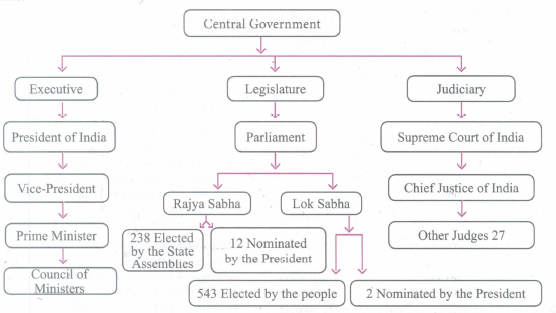
62.
A person who is not a member of the Parliament can be appointed as a minister but he has to get himself elected to the Parliament within six months
63.
The Administrative power of a State extends only to its own territory and with respect to which it has legislative competence, whereas the Union has exclusive executive power over:
(a) The matters with respect to which Parliament has exclusive power to make laws and
(b) The exercise of its powers conferred by any treaty or agreement
64.
(i) Directive Principles are not enforceable by the courts. But they are fundamental for the governance of the country.
(ii) The Government is duty-bound to apply these principles while making laws.
(iii) They aim at promoting the Social Welfare of the people.
(iv) Dr. B.R. Ambedkar described these principles as 'novel features' of the Indian Constitution.
65.
The word 'Citizen' is derived from the Latin term 'Civis' It means resident of a City State.
66.
Factors like latitude, distance from the sea, monsoon wind, relied on features and jet stream affect the climate of India.
67.
(i) The deltaic plain is an extension of the Khadar land. It covers about 1.9 lakh sq.km in the lower reaches of the Ganga River.
(ii) It is an area of deposition as the river flows in this tract sluggishly.
(iii) The deltaic plain consists mainly of old mud, new mud, and marsh.
(iv) In the delta region, the uplands are called 'Chars' while the marshy areas are called 'Bils'.
68.
(i) Ramalinga bore witness to hunger and poverty in the country: "I saw poor people, emaciated with hunger and terribly weary, going to every house, yet their hunger was not removed, and my heart suffered intensely.
(ii) Those who suffer with relentless disease, I saw them in front of me and my heart trembled.
(iii) I saw those people, poor and of unmatched honor, their hearts weary, and I grew weak:'
69.
(i) Arya Samaj attempted to check the incidence of religious conversion in British India.
(ii) One of its main objectives was counter conversion, prescribing a purificatory ceremony called suddhi, directed at Hindus who had converted to Islam and Christianity.
70.
(i) At the end of October 1945, the Jewish underground organizations like Irgun Zvai Leumi (Zionist Para-military Organization) and the Stern Gang (Zionist Terrorist Organization) began to launch terror attacks on a large scale.
(ii) Railways, bridges, airfields and government offices were blown up. The British government presented the dispute to the UN for a decision.
(iii) Succumbing to the pressure of great powers, the UN resolved to partition. Palestine into a Jewish state and an Arab state (29 November 1947).
71.
In Palestine, the ancient home of Jews, only a few thousand Jews were living in 1900. Some 15 million were scattered around Europe and North America. This is referred to as the Diaspora.
72.
The United States had its satellite states in Central America (Honduras, El Salvador, Nicaragua, Panama, and Guatemala), the Caribbean (Cuba, the Dominion Republic, and Haiti) and East Asia (the Philippines, South Korea, South Vietnam, and Thailand).
73.
(i) The German strategy of lightning strikes was initially successful and the army penetrated 1000 miles into Russian territory very soon.
(ii) The German army then marched on Moscow. But ultimately, the resistance by the Soviet army and the fierce Russian winter defeated the German army.
74.
(i) "We shall defend our island, whatever the cost may be. We shall fight on the beaches. We shall fight in the fields and in the streets. We shall never surrender."
(ii) This inspirational speech by Winston Churchill in June 1940 boosted the morale of the British people when there were real fears of an invasion by Germany.
75.
"Speak softly and carry a big stick".
76.
Gold Standard is a monetary system where a country's currency or paper money carried a value directly linked to gold.
77.
i) In January 1917 the Germans proclaimed that they would sink even neutral ships in certain waters.
ii) Lusitania, an American ship was torpedoed by a German submarine.
iii) There was lot of resentment in the USA and President Wilson declared war against Germany.
78.
(i) 1914 is a turning point in world history.
(ii) The political and social processes that began in 1789 culminated in the First World War that broke out in that year and decisively shaped the course of the twentieth century.
(iii) Historians therefore call this as 'the long twentieth century'.
79.
i) A better economy introduces rapid development of the capital market.
ii) Standard of living has increased.
iii) Globalization rapidly increases better trade so that more people are employed.
iv) Introduced new technologies and new scientific research patterns
v) Globalization increases the GDP of a country.
80.
Economic policies in India:
i) Agricultural policy
ii) Industrial policy
iii) New Economic policy
81.
a) As Courts of appeal, all High Courts entertain appeals in civil and criminal cases from their subordinate Courts as well as on their own.
b) They have, however no jurisdiction over tribunals established under the laws relating to the Armed Forces of the Country.
82.
(i) The Constitution of India grants special status to Jammu and Kashmir among Indian states, and it is the only state in India to have a separate constitution.
(ii) The Constitution of Jammu and Kashmir was adopted on the 17 November, 1957 and came into force on 26 January, 1957.
(iii) The Directive Principles of the State Policy and fundamental duties of the constitution are not applicable to the state of Jammu and Kashmir.
(iv) Right to Property, is still guaranteed as a fundamental right in Jammu and Kashmir.
83.
i) The President is elected by an electoral college in accordance with the system of proportional representation by means of single transferable vote.
ii) The Electoral college consists of the elected members of both houses of Parliament and the elected members of the states and elected members of National Capital Territory of Delhi and Puducherry.
iii) The President is elected for a term of five years and can be re-elected.
84.
i) Under Article 352, the President can declare emergency if he is satisfied that India's security is threatened due to war, external aggression or armed rebellion or if there is an imminent danger or threat.
ii) When a national emergency is declared on the ground of war or external aggression it is known as external emergency.
iii) When it is declared on the ground of armed rebellion it is known as internal emergency.
85.
i) The centre-state relations can be studied under three heads
ii) They are,
a) Legislative relations
b) Administrative relations
c) Financial relations.
86.
Communication is a process that involves exchange of information, thoughts and ideas.
Communication is categorized into
(1) Personal communication and
(2) Mass communication
87.
Jharkhand, Odisha, Chhattisgarh, Karnataka, Andhra Pradesh and Tamil Nadu.
88.
The delta of the Ganga - Brahmaputra
The deltas of Mahanadi, Godavari and Krishna rivers.
89.
Narmada, Tapti, Mahi and Sabarmathi are the west following rivers of India.
90.
i) Jyotiba Phule opened first school for "untouchables" in 1852 Poona.
ii) He launched the Satyashodak Samaj in 1870 to stir the non -Brahmin masses to self-respect and ambition.
iii) Phule opposed child marriage and supported widow remarriage.
iv) He and his wife devoted their lives for the upliftment of depressed classes and women.
v) Jyotiba opened orphanages and homes for widows.
91.
There are many clauses but the three main clauses are:
i) Germany was forced to give up territories to the west, north and east of the German border.
ii) Germany had to disarm and was allowed to retain only a very restricted armed force
iii) As reparations for the war, Germany was expected to pay for the military and civilian cost of the war to the Allied nations.
92.
a) The 'Great Depression' dealt a death blow to Indian agriculture and the indigenous manufacturing sector.
b) The value of farm produce, declined by half. But the land rent to be paid by the peasant remained unchanged. In terms of prices of agricultural commodities, the obligation of the farmers to the state doubled.
c) The great fall in prices prompted Indian nationalists to demand protection for the internal economy.
93.
i) Mustafa Kemal Pasha did a remarkable role for Turkey's rebirth as a nation.
ii) Kemal Pasha modernised Turkey and changed it out of all recognition.
94.
a) Construction of dams
b) Raising of dams/ cleaning of tanks
1. Considering the ineffectiveness of tribunals, there is a need to look for community based approaches to resolve such disputes effectively, amicably and sustainably.
2. Conflicts over water are preventable provided the communities involved become responsible water managers.
3. As the issue is protracted over centuries, the solution available is that new dams can be constructed to store the rainwater that wastefully mingles in oceans.
4. The state government must propel the action to allocate and identify the places where the dams can be constructed to store the water during heavy rainfall.
5. These wise actions will reduce the water dispute to a greater extent, when there are ways to save the running rain water, we need not fight with neighbouring states to spare water for irrigation.
6. The expert committees must have a thorough survey of the land forms to build dams.
7. This is absolutely an implementable solution.
95.
Indian agriculture and Indian farmers are plagued by several problems; some of them are natural and some others are manmade.
(i) Small and fragmented land-holdings: The problem of small and fragmented holdings is more serious in densely populated and intensively cultivated states in India.
(ii) High Costs of Inputs: Seed is a critical and basic input for attaining higher crop yields and sustained growth in agricultural production.
(iii) Infertile Soil: Indian soils have been used for growing crops over thousands of years without caring much for replenishing. This has led to depletion and exhaustion of soils resulting low productivity.
(iv) Lack of Irrigation: Only one- third of the cropped area falls under irrigated area. To make agriculture reliable, irrigation facility has to be developed.
(v) Soil erosion: Large tracts of fertile land suffer from soil erosion by wind and water. Such kind of areas must be properly treated and restored to its original fertility.
(vi) Agricultural marketing: In rural India, agricultural marketing continues in bad shape. Due to the absence of sound marketing facility, the farmers have to depend on local traders and middlemen for the disposal of their farm products which is sold at a low price.
(vii) Inadequate storage facilities: Storage facilities in the rural areas are either totally absent or grossly inadequate. Under such conditions, the farmers are compelled to sell their products immediately after the harvest irrespective of the condition of market.
96.
Electronic Media:
(i) Mass Communication enables millions of people to get the information at the same time.
(ii) It is a great way to provide education as well as entertainment.
(iii) It helps in creating awareness among the people regarding various national policies and programmes.
(iv) The Mass Communication Systems can provide the information to people in two methods.
Electronic Media:
(i) Radio broadcasting in India was started in 1923 by the Radio club of Bombay.
(ii) It was named as All India Radio (AIR) in 1936 and again it was renamed as Akashwani in 1957.
(iii) It broadcasts a variety of programs related to information, education and entertainment.
Print Media:
(i) Newspapers are the most common but powerful means of communication come under print media.
(ii) India has many newspapers which carry information on local, national and international events to the people
97.
Goals of WTO:
(i) Raising and stabilizing the incomes of small scale farmers, farm workers and artisans.
(ii) More equitably distributing the economic gains, opportunities and risks associated with the production and sale of these goods.
(iii) Increasing the organisational and commercial capacities of producer groups.
(iv) Promoting labour rights and the right workers to organize.
(v) Promoting safe and sustainable farming methods and working conditions
98.
a) Several important goods are services left out of the GDP:
i) The GDP includes only the goods and services sold in the market.
ii) The services provided by the parents to their children is very important but it is not included in the GDP because it is not sold in the market.
iii) Likewise clean air, which is vital for a healthy life, has no market value and is left out of the GDP.
b) GDP measures only quantity but not quality :
i) In the 1970s schools and banks did not permit the use of ballpoint pens.
ii) This is because, the ones available in India were of very poor quality.
iii) Since then, not only has there been a substantial increase in the quantity of ballpoint pens produced in India but their quality has also improved a lot.
iv) The improvement in quality of goods is very important but it is not captured by the GDP.
c) GDP does not tell us about the way income is described in the country:
The GDP of a country may be growing rapidly but income may be distributed so unequally that only a small percentage of people may be benefitting from it.
d) The GDP does not tell us about the kind of life people are living:
A high level of per capita real GDP can go hand - in - hand with very low health condition of people, an undemocratic political system, high pollution and high suicide rate.
99.
(i) By the end of Second World War Viet Minh controlled the northern half of Vietnam. Viet Minh formed a government led by Ho Chi Minh in Hanoi.
(ii) This Viet Minh government quickly occupied the southern half of Vietnam. However, the Allied Powers decided at Potsdam that the British in the south and the Chinese in the north should defend Indo-China from the Japanese.
(iii) In March the two governments (French and Viet Minh) reached an agreement by which North Vietnam was to be a free state, within an Indo-Chinese Federation. But the new French constitution included all overseas colonies in a French Union.
(iv) In 1949 the French attempted to secure the support of the population by declaring Vietnam, Laos, and Cambodia independent within the French Union, retaining only foreign affairs and defense under French control. However, the problem of Indo- China soon became involved in the Cold War.
(v) While the French were receiving considerable financial aid from America, the Viet Minh were helped by the new Chinese communist government. The French troops were eventually defeated.
(vi) South Vietnam, approximately of the same size and population, was ruled by Ngo Dinh Diem.
(vii) Diem refused to hold the elections to decide on a united Vietnam.
(viii) However, by 1962, it was clear that Diem was incapable of controlling the situation. This led to the posting of more US armed forces in the area.
(ix) The US bombed both North and South in the hope that it could force the liberation forces to abandon the struggle.
(x) The fighters of North Vietnam, trained in guerilla warfare, had grown out of spontaneous struggles against a repressive regime.
(xi) The American troops also used bacteriological weapons.
(xii) Incendiary bombs such as napalm and Agent Orange (to defoliate the forest cover) were used.
(xiii) Escalation of the total military outlay caused the US big business to protest. The youths rebelled against the conscription and the horrors of war.
(xiv) Anti-Vietnam War protests rocked universities and colleges across the US and in Europe and became part of the 1960s counterculture.
(xv) No other single issue united millions of people all over the world as the war of Vietnam.
100.
(i) The Treaty also set up the League of Nations, on the initiative of President Woodrow Wilson of the United States.
(ii) The League was expected to mediate between countries and take action against countries which indulged in military aggression.
(iii) However, the United States was not interested in playing a global role or any role in European politics.
(iv) The popular mood favoured the traditional isolationist approach, and therefore the United States did not become a member of the League.
(v) The other Allied nations were also determined to maintain a noninterventionist attitude and, in consequence, the League remained an ineffectual international body.
101.
(i) The relations between the two British colonies of Natal and Cape Colony and the two independent Boer states of Transvaal and the Orange Free State had long been unfriendly.
(ii) The discovery of gold in Transvaal, in 1886, led to large numbers of British miners settling in and around Johannesburg.
(iii) The Boers hated these people whom they referred to as Uitlanders (foreigners). The Boers taxed them heavily and denied political rights to them.
(iv) So the question was whether the British or the Boers were to be supreme in South Africa.
(v) Fearing attacks from the British, the Boers armed themselves and decided to attack.
(vi) The Boer War lasted for three years, from 1899 to 1902. Initially, the Boers were successful.
(vii) But by the first half of 1900, the Boer army was defeated. Pretoria was occupied.
(viii) In retaliation, the British destroyed farms and crops. They set up internment camps for Boer women and children.
(ix) Shortage of food, medical and sanitary facilities caused the death of 26,000 people.
(x) The British annexed the two Boer states. Boers were however promised self-government in due course.
(xi) In 1907 full responsible government was given to the Transvaal and the Orange Free State.
(xii) The four states formed into a union and the South Africa Act passed by the British parliament in 1909 provided for a Union Parliament at Cape Town.
(xiii) In May 1910 the Union of South Africa came into being.
102.
(i) Even on 23 February 1917, when the socialists celebrated International Working Women's Day on that day, the Tsar seemed unchallengeable. But he had to abdicate on the morning of 2 March.
(ii) Though none called for strikes fearing that the time was not ripe for militant action, the bread shortages among women textile workers, many with husbands in the army, forced them to go on strike anyway and march through the factory areas of Petrograd, the capital of the Russian Empire.
(iii) Masses of women workers in a militant frame of mind demanding "Bread for workers" waved their arms towards factory workers and shouted, "Come out!" "Stop work!"
(iv) The city's 400,000 workers joined the movement the next day (24 February).
103.
Functions of the Lok Sabha
(i) Any bill can be introduced and passed in the Lok Sabha (Including Money Bill).
(ii) It has the same power as Rajya Sabha to participate in case of impeachment of a president and the judges of Supreme Court.
(iii) It has equal power as Rajya Sabha in passing any bill for a constitutional amendment.
(iv) Lok Sabha members have the power to elect the president, vice president.
(v) The motion of no confidence can only be introduced in Lok Sabha. If it is passed then the prime minister and other councils of ministers need to resign from their post.
Functions of the Rajya Sabha
(i) Any bill (except the money bills) needs to be approved by Rajya Sabha to get passed. If the bill gets stuck for more than six months then President calls for a joint session of both the houses to resolve the deadlock.
(ii) It has the same power as Lok Sabha, for passing any bill for a constitutional amendment.
(iii) The members of Rajya Sabha have the electoral power for selection of President, Vice President.
(iv) It has power in the impeachment procedure of president and judges of the supreme court and high court.
(v) Rajya Sabha has the power to make a state list subject into National Importance. If two third majority of the members of Rajya Sabha passes a resolution to support it.
104.
| S.No |
Iron and Steel |
Software |
|---|---|---|
| (1) | Mineral-based | Human-based |
| (2) | Iron and steel industries of India are concentrated in the Chota Nagpur plateau region | TCS, Infosys Accenture, Wipro are important software companies. |
| (3) | Ex: Durgapur Bokaro, Rourkela, Jamshedpur. | The IT parks are located in Chennai, Mumbai Pune, Bengaluru, Hyderabad, Mysore, Thiruvananthapuram, etc. |
105.
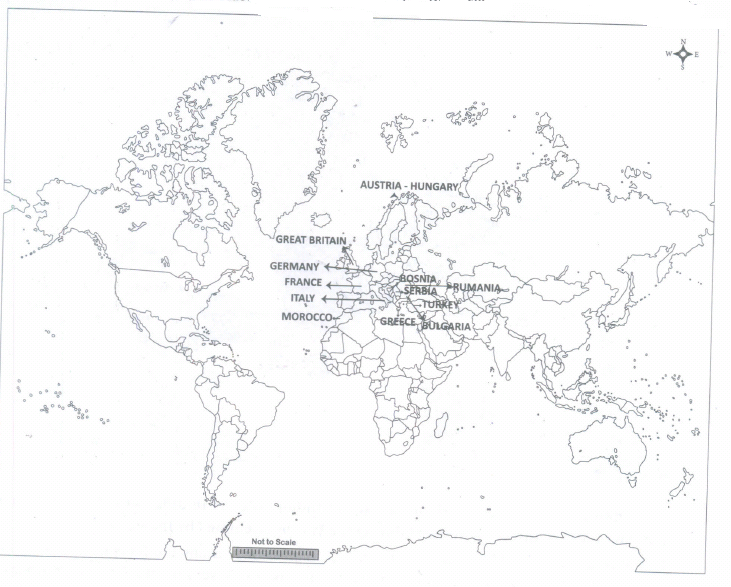
106.
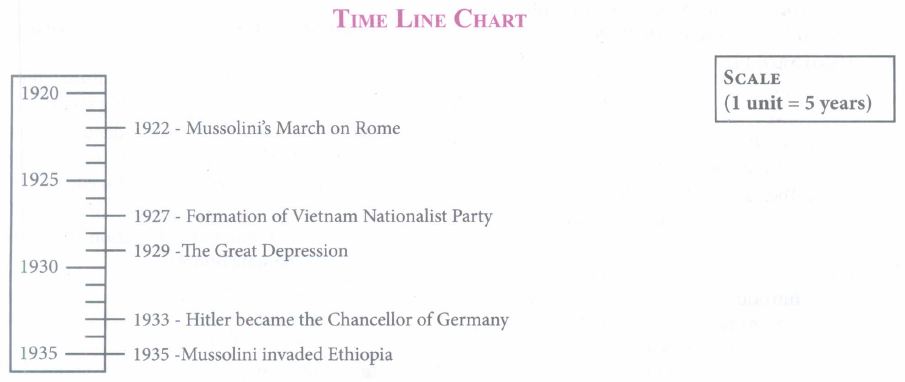

10th Standard Syllabus & Materials
10th Standard
TN 10th English Prose - 2 - The Night the Ghost Got in Important Questions And Answers Study Material - QB365 Set A
NEW10th Standard
TN 10th English Supplementary - 1 - The Tempest Important Questions And Answers Study Material - QB365 Set A
NEW10th Standard
TN 10th English Poem - 1 - Life Important Questions And Answers Study Material - QB365 Set A
NEW10th Standard
TN 10th English Prose - 1 - His First Flight Important Questions And Answers Study Material - QB365 Set A



Tamilnadu Stateboard 10th Standard Subjects
Tamilnadu Stateboard Standards




