
 100% FREE ACCESS
10th Standard Syllabus & Materials
10th Standard
TN 10th English Prose - 4 - The Attic Important Questions And Answers Study Material - QB365 Set A
NEW10th Standard
TN 10th English Supplementary - 3 - The Story of Mulan Important Questions And Answers Study Material - QB365 Set A
NEW10th Standard
TN 10th English Poem - 3 - I am Every Woman Important Questions And Answers Study Material - QB365 Set A
NEW10th Standard
TN 10th English Prose - 3 - Empowered Women Navigating The World Important Questions And Answers Study Material - QB365 Set A
NEW10th Standard
TN 10th English Supplementary - 2 - Zigzag Important Questions And Answers Study Material - QB365 Set A
NEW10th Standard
TN 10th English Poem - 2 - The Grumble Family Important Questions And Answers Study Material - QB365 Set A

Published on: 01/08/2019
Download Tamil Nadu 10th Standard Social Science question papers, model tests, one-mark questions, important questions, and public exam papers in PDF format. Free study materials and answer keys for TN State Board students.
Questions + Answers key
Take MCQ Social Science Test
1.
___________was the official newspaper of the communist party of the Soviet Union from 1918 - 1991.
Pravda
Moscow times
Trud
Vedomosti
2.
Dispute between States of India comes to the Supreme Court under:
Appellate Jurisdiction
Original Jurisdiction
Advisory Jurisdiction
None of these
3.
Meteorology is the science of _________.
Weather
Social
Political
Human
4.
Name the President who made amendment to Munro Doctrine to justify American intervention in the affairs of Latin America.
Theodore Roosevelt
Truman
Eisenhower
Woodrow Wilson
5.
What were the three major empires shattered by the end of First World War?
Germany, Austria Hungary, and the Ottomans
Germany, Austria-Hungary, and Russia
Spain, Portugal and Italy
Germany, Austria-Hungary, Italy
6.
Write a note on Riverine forest.
7.
What is a Writ?
8.
Write a short note on ‘Monsoon wind’.
9.
Name the neighbouring countries of India.
10.
What do you know of the White Terror in Indo-China?
11.
Mark the following on the outline map of India.
1. Direction of South West Monsoon wind.
2. Direction of North East Monsoon wind.
3. Areas of heavy rainfall.
4. Mountain forests.
5. Panna biosphere reserve
6. Agasthiyamalai biosphere reserve
12.
Write the classification of different sectors contribution in GDP.
13.
Give a detailed account of the classification of the Council of Ministers based on ranks.
14.
Explain about Retreating or North East Monsoon.
15.
Describe peninsular plateau.
16.
List out a few criticisms of the peace settlement.
17.
18.
Describe the Executive and Judicial powers of the President of India.
1.
(a)
Pravda
2.
(b)
Original Jurisdiction
3.
(a)
Weather
4.
(a)
Theodore Roosevelt
5.
(a)
Germany, Austria Hungary, and the Ottomans
6.
(i) These forests are found along the rivers on Khadar areas.
(ii) These are known for Tamarisk and Tamarind trees.
(iii) The rivers of Great Plains are more prominent for this type of natural vegetation.
7.
i) A writ is an order or command issued by a court in writing under its seal.
ii) It is in the nature of a command or prohibition from performing certain acts that are specified in the orders of the court.
iii) Both the Supreme Court and the High Courts are empowered to issue five kinds of writs.
iv) They are Habeas Corpus, Mandamus, Prohibition, Certiorari and Quo Warranto.
8.
a) The most dominant factors which affects the climate of India is the monsoon winds.
b) These are seasonal reversal winds and India remains in the influence of these winds for a considerable part of a year.
c) The onset of southwest monsoon brings down the temperature of the entire India and causes moderate to heavy rainfall in many parts of the country.
d) Similarly, the climate of southeast India is also influenced by northeast monsoon.
9.
The neighbouring countries of India are Pakistan and Afghanistan in the North-West, China, Nepal and Bhutan in the North and Bangladesh and Myanmar in the East.
10.
a) In 1929 the Vietnamese soldiers mutinied, and there was a failed attempt to assassinate the French Governor-General.
b) This was followed by a large scale peasant revolt led by the Communists.
c) The revolt was crushed and thousands of rebels were killed. This incident is known as the 'White Terror'.
11.
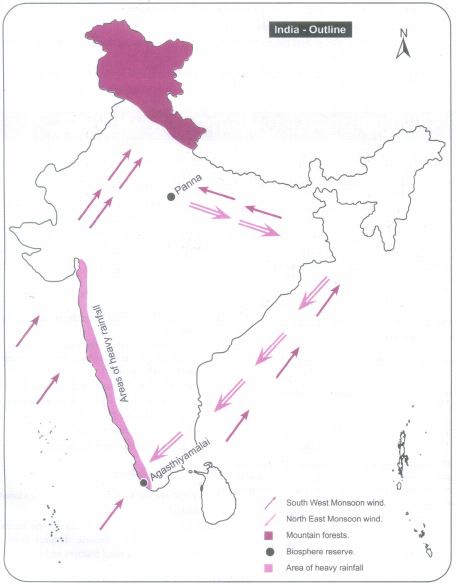
12.
Contribution of different sectors GD P in India:
i) Gross Value Added (GVA) at current prices for services sector is estimated at 92.6 lakh crore in 2018 - 19.
ii) Services sector accounts for 54.40% of total India's (GVA) of 169.61 lakh crore Indian Rupees.
iii) With GVA of Rs. 50.43 lakh crore, Industry sector contributes 29.73%.
iv) Agriculture and allied sector shares 15.87%.
v) At 2011-12 prices, composition of Agriculture &allied, Industry and services sectors are 14.39%, 31.46% and 54.15% respectively.
vi) The share of primary like agriculture, forestry, fishing and mining and quarrying.
vii) Secondary (Industry) like, manufacturing, electricity, gas, water supply, utility services and construction, tertiary (services) like, trade, hotels, transport, communication etc. have been estimated as 18.57%, 27.03%, 54.40%.
viii) According to sector wise India GDP composition in 2017 are Agriculture (15.4%), Industry (23%) and services (61.5%).
ix) India is 2nd largest producer of agriculture product.
x) India accounts for 7.39% of total global agricultural output.
xi) In Industry sector, India world rank is 6.
xii) In service sector, India world rank is 8.
xiii) Contribution of Agriculture sector in Indian economy is much higher than world's average 6.4%.
xiv) Contribution of Industry and services sector is lower than world's average 30% for Industry sector and 63% for services sector.
xv) At previous methodology, composition of Agriculture & allied, Industry and services sector was 51.81%, 14.16% and 33.25% respectively at current prices in 1950-51.
(xvi) Share of Agriculture & allied sector has declined at 18.20% in 2013 - 14.
xvii) Share of services sector has improved to 57.03%.
xviii) Share of Industry sector has also increased to 24.77%.
13.
Categories of the Ministers The ministers are classified under three ranks
(I) Cabinet Minister
(II) Ministers of State
(III) Deputy Ministers.
Cabinet Ministers
(i) The Cabinet is an informal body of senior ministers who form the nucleus of administration.
(ii) Important decisions of the government are taken by the Cabinet, such as defence, finance, external affairs and home.
(iii) The Cabinet recommends to the President to promulgate an ordinance.
(iv) It is instrumental in moving Amendments to the Constitution.
Ministers of State
(i) These ministers belong to the second category of ministers in the council.
(ii) They are also in charge of ministries or departments but they do not participate in the meetings of the cabinet unless invited to do so.
Deputy Ministers
They are the lowest ranked ministers in the cabinet. They assist either the Ministers of Cabinet or state in the performance of the duties entrusted to them
14.
(i) The southwest monsoon begins to retreat from north India by the end of September due to the southward shifting pressure belts.
(ii) The southwest monsoon wind returns from Indian landmass and blows towards Bay of Bengal.
(iii) The Coriolis force deflects this wind and makes it to blow from northeast. Hence, it is known as Northeast monsoon or Postmonsoon season.
(iv) The season is associated with the establishment of the north -easterly wind system over the Indian subcontinent.
(v) Many parts of Tamil Nadu and some parts of Andhra Pradesh and Karnataka receive rainfall during this season due to the storms forming in the Bay of Bengal.
(vi) Large scale losses to life and property occur due to heavy rainfall, strong winds and storm surge in the coastal regions.
(vii) The day time temperatures start falling sharply all over the country.
(viii) The mean temperature over north-western parts of the country shows a decline from about 38°C in October to 28°C in November.
15.
(i) The plateau region lies to the south of the Great Northern Plains. This is the largest physiographic division of our country.
(ii) It covers an area of about 16 lakh sq.km (about half of the total area of the country). It is an old rocky plateau region.
(iii) Aravalli hills mark the north-western boundary of the plateau region.
(iv) Its northern and north-eastern boundaries are marked by the Bundelkhand upland, Kaimur and Rajmahal hills.
(v) The Western Ghats and the Eastern Ghats mark the western and eastern boundaries respectively.
(vi) The peak of Anaimudi is the highest point in the plateau. Its height is 2,695 m and is located in Anaimalai.
(vii) River Narmada divides the plateau region of India broadly into 2 parts.
(viii) The region lying to the north of the Narmada is called the Central Highlands and the region lying to the south of Narmada is called the Deccan Plateau.
(ix) All the major rivers (Mahanadi, Godavari, Krishna, Kaveri, etc.) lying to the south of the Vindhyas flow eastwards and fall into the Bay of Bengal.
(x) Narmada and Tapti are the two rivers situated to the south of the Vindhyas flow westward.
(xi) Their movement towards west is due to the presence of a rift valley in the region.
16.
(i) The defeated powers were absent from negotiations. The peace settlement, a dictated one, was based on the principle, to the victor belongs the spoils and the allies are the victors.
(ii) Self-determination was the principle, which was one of the fourteen points of Woodrow Wilson for restoring peace, applied to all the peoples except the German.
(iii) Austria was not allowed to unite with Germany, because the combination would be too powerful. Germany was thus left with a sense of injustice.
(iv) The reparation of 6,600 million pounds was well beyond Germany's capacity to pay.
(v) Germany was weakened, politically and economically. But instead of having the large Russian and Austro- Hungarian empires on her eastern frontier, she was now bordered by small weak and new states.
17.
18.
Executive Powers:
i) Article 77 requires that every executive action of the Union shall be taken in the name of the President.
ii) He appoints the Prime Minister and the other members of the Council of Ministers, distributing portfolios to them on the advice of the Prime Minister.
iii) He is responsible for making a wide variety of appointments.
iv) These include the appointment of Governors of States, the Chief Justice and other Judges of the Supreme Court and high Courts, the Attorney General, the Comptroller and Auditor General, the Chief Election Commissioner and other Election Commissioners the Chairman and other Members of the Union Public Service Commission, Ambassadors and High Commissioners to other countries.
Judicial Powers:
Article 72 confers on the President power to grant pardons, reprieves, respites or remissions of punishment, or to commute the sentence of any person convicted of an offence.

10th Standard Syllabus & Materials
10th Standard
TN 10th English Prose - 2 - The Night the Ghost Got in Important Questions And Answers Study Material - QB365 Set A
NEW10th Standard
TN 10th English Supplementary - 1 - The Tempest Important Questions And Answers Study Material - QB365 Set A
NEW10th Standard
TN 10th English Poem - 1 - Life Important Questions And Answers Study Material - QB365 Set A
NEW10th Standard
TN 10th English Prose - 1 - His First Flight Important Questions And Answers Study Material - QB365 Set A



Tamilnadu Stateboard 10th Standard Subjects
Tamilnadu Stateboard Standards




