
 100% FREE ACCESS
10th Standard Syllabus & Materials
10th Standard
TN 10th English Prose - 4 - The Attic Important Questions And Answers Study Material - QB365 Set A
NEW10th Standard
TN 10th English Supplementary - 3 - The Story of Mulan Important Questions And Answers Study Material - QB365 Set A
NEW10th Standard
TN 10th English Poem - 3 - I am Every Woman Important Questions And Answers Study Material - QB365 Set A
NEW10th Standard
TN 10th English Prose - 3 - Empowered Women Navigating The World Important Questions And Answers Study Material - QB365 Set A
NEW10th Standard
TN 10th English Supplementary - 2 - Zigzag Important Questions And Answers Study Material - QB365 Set A
NEW10th Standard
TN 10th English Poem - 2 - The Grumble Family Important Questions And Answers Study Material - QB365 Set A

Published on: 12/10/2019
GEO - Climate and Natural Vegetation of India
Download Tamil Nadu 10th Standard Social Science question papers, model tests, one-mark questions, important questions, and public exam papers in PDF format. Free study materials and answer keys for TN State Board students.
Questions + Answers key
Take MCQ Social Science Test
1.
Isobar is a line joining places having equal _____________
temperature
pressure
cloud cover
Sunshine
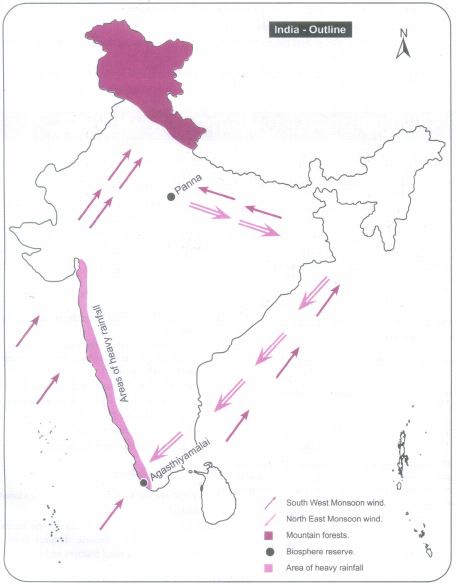
2.
There are ____________ National parks and ___________ wildlife sanctuaries created across India
102,515
104,520
103,520
104,520
3.
_________ is not a part of the world network biosphere reserves of UNESCO.
Nilgiri
Agasthiyamalai
Great Nicobar
Kachchh
4.
The monsoon forests are otherwise called as _______________.
Tropical evergreen forest
Deciduous forest
Mangrove forest
Mountain forest
5.
______________ is a line joining the places of equal rainfall.
Isohyets
Isobar
Isotherm
Latitudes
6.
Meteorology is the science of _________.
Weather
Social
Political
Human
7.
World Forest Day
8.
World Earth Day
9.
North east monsoon
10.
Biodiversity hotspot
11.
Sundarbans
12.
What is ‘Project Tiger’?
13.
Name the trees of tropical evergreen forest.
14.
Name the areas which receive heavy rainfall.
15.
What is ‘burst of monsoon’?
16.
What are ‘jet streams’?
17.
Define ‘Meteorology’.
18.
19.
Weather and Climate.
20.
Mountains are cooler than the plains.
21.
India has a tropical monsoon climate.
22.
Western Coastal plain is narrow.
23.
Explain about any two factors affecting the climate of India.
24.
Describe the forests of India.
25.
Mark the following on the outline map of India.
1. Direction of South West Monsoon wind.
2. Direction of North East Monsoon wind.
3. Areas of heavy rainfall.
4. Mountain forests.
5. Panna biosphere reserve
6. Agasthiyamalai biosphere reserve
1.
(b)
pressure
2.
(a)
102,515
3.
(d)
Kachchh
4.
(b)
Deciduous forest
5.
(a)
Isohyets
6.
(a)
Weather
7.
21st March
8.
22nd April
9.
October-December
10.
The Himalayas
11.
West Beangal
12.
Project Tiger was launched in April 1973 with the aim to conserve tiger population in specifically constituted "Tiger Reserves" in India.
13.
The most important trees are Rubber, Mahogany, Ebony, Rosewood, Coconut, Bamboo, Cinchona, Candes, Palm, Iron wood and Cedar.
14.
The western coast, Assam, South Meghalaya, Tripura, Nagaland and Arunachal Pradesh are the heavy rainfall areas.
15.
The sudden approach of monsoon wind over south India with lighting and thunder is termed as the 'break' or 'burst of monsoon'.
16.
a) Jet streams are the fast moving winds blowing in a narrow zone in the upper atmosphere.
b) According to the jet stream theory, the onset of southwest monsoon is driven by the shift of the subtropical westerly jet from the plains of India towards the Tibetan plateau.
c) The easterly jet streams cause tropical depressions both during south-west monsoon and retreating monsoon.
17.
Meteorology is the science of weather. It is essentially an inter-disciplinary science because the atmosphere, land and ocean constitute an integrated system.
18.
19.
| S.No. |
Weather |
Climate |
|---|---|---|
| 1. | Weather refers to the state of atmosphere of a place at a given point of time. | Climate is the accumulation of daily and seasonal weather event of a given location over a period of 30 - 35 years. |
| 2. | Weather of a place may change daily. | Climate of a place remains constant over a long period. |
20.
When the altitude increases the temperature decreases. Temperature decreases at the rate of 6.5°C for every 1000 metres of ascent. Hence mountains are cooler than the plains.
21.
India has a tropical monsoon climate because most of India lies in the tropical belt and her climate is influenced by the monsoon winds which mainly blow in the tropics i.e; 20°N and 20°S.
22.
The Western Coastal plain is narrow because the river flowing through this plain do not form any delta.
23.
Climate of India is affected by the factors of latitude, distance from the seas, monsoon wind, relief features, and jet stream.
(i) Latitude:
(a) Latitudinally, India lies between 8°4'N and 37°6'N latitudes.
(b) The Tropic of Cancer divides the country into two equal halves.
(c) The area located to the south of Tropic of cancer experiences high temperature and no severe cold season throughout the year whereas, the areas to the north of this parallel enjoys sub-tropical climate.
(d) Here, summer temperature may rise above 40°C and it is close to freezing point during winter.
(ii) Altitude:
(a) When the altitude increases, The temperatures decreases.
(b) Temperature decreases at the rate of 6SC for every 1000 meters of ascent. It is called normal lapse rate.
(c) Hence, places in the mountains are cooler than the places on the plains.
(d) That is why the places located at higher altitudes even in south India have a cool climate.
(e) Ooty and several other hill stations of south India and of the Himalayan ranges like Mussoorie, Shimla, etc., are much cooler than the places located on the Great Plains.
24.
On the basis of climate, soil and land form characteristics the natural vegetation of India can be divided into the following types.
Tropical Evergreen Forest:
i) These forest are found in areas with 200 cm or more annual rainfall.
ii) Western Ghats in Maharashtra, Karnataka, Kerala, Andaman Nicobar Islands, Assam, West Bengal, Nagaland, Tripura, Mizoram, Manipur and Meghalaya states have this type of forests.
iii) The most important trees are rubber, mahogany, ebony, rosewood, coconut, bamboo, cinchona, candes, palm, iron wood and cedar.
Tropical Deciduous Forest:
i) These forests are found in the areas with 100 to 200 cm annual rainfall.
ii) These are called 'Monsoon Forests'.
iii) The trees of these forests drop their leaves during the spring and early summer.
iv) These forests are found in Punjab, Haryana, Uttar Pradesh, Bihar, West Bengal, Jharkhand, Madhya Pradesh, Chhattisgarh, Maharashtra, Telangana, Andhra Pradesh and Tamil Nadu.
v) Teak and Sal are the most important trees. Sandal wood, rose wood, Kusum, Mahua, Palas haldu, amla, padank, bamboo and tendu are the other trees of economic importance.
vi) These forests also provide fragrant oil, varnish, sandal oil and perfumes.
Tropical Dry Forest:
i) These forests are found in the areas with 50 to 100 cm annual rainfall.
ii) They represent a transitional type of forests.
iii) These are found in east Rajasthan, Haryana, Punjab, Western Uttar Pradesh, Madhya Pradesh, Eastern Maharashtra, Telangana, West Karnataka and East Tamil Nadu.
iv) The important species are mahua, banyan, amaltas, palas, haldu, kikar, bamboo, babool, khair, etc.
Tropical Thorn Forest:
i) These are found in the areas having annual rainfall of less than 50 cm.
ii) They have low humidity and high temperature.
iii) These forests are found in north - west India, which includes west Rajasthan, South west
iv) Haryana, North Gujarat, South - west Punjab, parts of the Deccan plateau in Karnataka, Andhra Pradesh and Maharashtra.
v) Babul, Kikar and Wild palms are common trees found here.
Mountain or Montane Forest:
On the basis of altitude and amount of rainfall, these forests are classified into two.
i) Eastern Himalayan Forest,
ii) Western Himalayan Forest.
Alpine Forest:
i) It occurs all along the Himalayas with above 2400 m altitude.
ii) These are purely having coniferous trees.
iii) Oak, silver fir, pine and juniper are the main trees of these forests.
iv) The eastern parts of Himalayas have large extent of these forests.
Mangrove Forest:
i) These forests occur in and around the deltas, estuaries, creeks, prone to tidal influences and as such are also known as delta or swamp forests.
ii) The delta of the Ganga, Brahmaputra has the largest tidal forest.
iii) These are also known as Sundarbans forest.
iv) The deltas of Mahanadi, Godavari and Krishna rivers are also known for tidal forests.
v) These are also known as tidal forests.
25.

10th Standard Syllabus & Materials
10th Standard
TN 10th English Prose - 2 - The Night the Ghost Got in Important Questions And Answers Study Material - QB365 Set A
NEW10th Standard
TN 10th English Supplementary - 1 - The Tempest Important Questions And Answers Study Material - QB365 Set A
NEW10th Standard
TN 10th English Poem - 1 - Life Important Questions And Answers Study Material - QB365 Set A
NEW10th Standard
TN 10th English Prose - 1 - His First Flight Important Questions And Answers Study Material - QB365 Set A



Tamilnadu Stateboard 10th Standard Subjects
Tamilnadu Stateboard Standards




