
 100% FREE ACCESS
10th Standard Syllabus & Materials
10th Standard
TN 10th English Prose - 4 - The Attic Important Questions And Answers Study Material - QB365 Set A
NEW10th Standard
TN 10th English Supplementary - 3 - The Story of Mulan Important Questions And Answers Study Material - QB365 Set A
NEW10th Standard
TN 10th English Poem - 3 - I am Every Woman Important Questions And Answers Study Material - QB365 Set A
NEW10th Standard
TN 10th English Prose - 3 - Empowered Women Navigating The World Important Questions And Answers Study Material - QB365 Set A
NEW10th Standard
TN 10th English Supplementary - 2 - Zigzag Important Questions And Answers Study Material - QB365 Set A
NEW10th Standard
TN 10th English Poem - 2 - The Grumble Family Important Questions And Answers Study Material - QB365 Set A

Published on: 12/10/2019
GEO - Components of Agriculture
Download Tamil Nadu 10th Standard Social Science question papers, model tests, one-mark questions, important questions, and public exam papers in PDF format. Free study materials and answer keys for TN State Board students.
Questions + Answers key
Take MCQ Social Science Test
1.
The capacity of hydro power generation of Bhakra Nangal project is ______________ Megawatts.
1500
1200
1000
1700
2.
The state which leads in the production of coffee is ______________.
West Bengal
Karnataka
Odisha
Punjab
3.
The leading producer of rice in India is ________.
Punjab
Maharashtra
Uttar Pradesh
West Bengal
4.
Black soils are also called as:
Arid soils
Saline soils
Regur soils
Mountain soils
5.
The soil which is rich in iron oxides is _______________.
Alluvial
Black
Red
Alkaline
6.
Horticulture
7.
Hirakud
8.
Tehri
9.
Coffee
10.
Sugar bowl of India
11.
Write a brief note on the categories of fisheries in India?
12.
What do you mean by livestock?
13.
Name the seasons of agriculture in India.
14.
Define Agriculture.
15.
State any two characteristics of black cotton soil.
16.
Define soil.
17.
Tea and Coffee
18.
Marine fishing and Inland fishing.
19.
Rabi and Kharif crop seasons.
20.
Bring out the characteristics of Intensive and Plantation farming.
21.
22.
Can you give solutions for the prevailing water disputes in South India?
23.
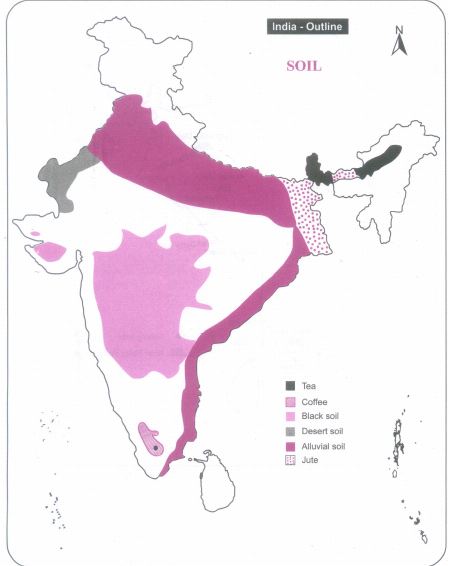
1. Demarcate the major tracts of alluvial soils.
2. Delineate the main regions of black soil.
3. Shade the regions of jute cultivation.
4. Mark any three tea and coffee growing areas.
5. Demarcate the regions of desert soil.
1.
(a)
1500
2.
(b)
Karnataka
3.
(d)
West Bengal
4.
(c)
Regur soils
5.
(c)
Red
6.
Golden revolution
7.
Mahanadi
8.
Highest dam in the India
9.
Karnataka
10.
Uttar Pradesh and Bihar
11.
Fisheries in India are a very important economic activity and a flourishing sector with varied resources and potentials.
There are 2 types of fishing categories. They are:
1) Marine or Sea Fisheries
2) Inland or Fresh Water Fisheries
12.
Livestock is an integral component of the farming system in India. The livestock sector is socially and economically very significant due to its multi-functional outputs and contribution to socio-cultural security. Livestock includes domesticated animals such as goats, buffaloes, sheep, pigs etc.
13.
1. Kharif season - June to September
2. Rabi season - October to March
3. Zaid season - April to June
14.
Agriculture is the process of producing food for people, fodder for cattle, fiber and many other desired products by the cultivation of certain plants and the raising of domesticated animals livestock.
15.
It consists of calcium and magnesium carbonates, high quantities of iron, aluminium, lime and magnesia. It is rich in potash lime, aluminium, calcium and magnesium.
16.
Soil is the uppermost layer of the land surface, usually composed of minerals, organic matter, living organisms, air and water.
17.
| S.No | Tea | Coffee |
|---|---|---|
| 1. | Tea is a beverage crop | Coffee is a beverage crop |
| 2. | Tea is an evergreen plant that mainly grows in tropical and subtropical climates. | Coffee is grown in shade and it grows effectively in the altitudes between 1,000 and 1,500m above mean sea level. |
| 3. | India is the second largest producer of tea | India is the 7th largest producer of coffee globally. |
| 4. | Assam is the larger producer of tea in India. | Karnataka is the leading producer of coffee in India. |
18.
| S.No. |
Marine or Sea fishing |
Inland or Fresh Water fishing |
|---|---|---|
| 1. | Marine or Sea fishing includes coastal, off- shore and deep sea fisheries mainly on the continental shelf upto a depth of 200 m. | Rivers, lakes, canals, reservoirs, ponds, tanks, etc. are the sources of freshwater and provide freshwater fisheries. |
| 2. | Kerala leads in the marine fish production in India. | Andhra Pradesh leads in the inland fish production in India. |
| 3. | Examples of the marine fishery are: Catfish Mackerels, Tunas, etc. | Examples of the inland fishery are: Rohus,Callas, etc. |
19.
| S.No |
Rabi crop season |
Kharif crop season |
|---|---|---|
| 1. | The season is from October to March. | The season is from June to September. |
| 2. | Wheat, gram, Rapeseeds, Mustard and Barley are grown in the northern states. | Rice, Cotton, Bajra, Maize, Jowar and Tur are grown in northern states. |
| 3. | Rice, Maize, Ragi, Groundnut and Jowar are grown in southern states. | Rice, Maize, Ragi, Groundnut and Jowar are grown in southern states. |
| 4. | Crops grow in warm weather. | Crops grow in hot weather. |
20.
Intensive farming:
i) Intensive farming is an agricultural intensification and mechanization system. It aims to maximise yields from available land through various means, such as heavy use of pesticides and chemical fertilizers.
ii) Plantation forming is practices in West Bengal, Kerala, Tamilnadu and Karnataka.
Plantation farming:
i) Plantation crops are cultivated for the purpose of exports. These are cultivated in large estates on hilly slopes. Tea, coffee, rubber and spices are the major plantation crops of India.
21.
22.
a) Construction of dams
b) Raising of dams/ cleaning of tanks
1. Considering the ineffectiveness of tribunals, there is a need to look for community based approaches to resolve such disputes effectively, amicably and sustainably.
2. Conflicts over water are preventable provided the communities involved become responsible water managers.
3. As the issue is protracted over centuries, the solution available is that new dams can be constructed to store the rainwater that wastefully mingles in oceans.
4. The state government must propel the action to allocate and identify the places where the dams can be constructed to store the water during heavy rainfall.
5. These wise actions will reduce the water dispute to a greater extent, when there are ways to save the running rain water, we need not fight with neighbouring states to spare water for irrigation.
6. The expert committees must have a thorough survey of the land forms to build dams.
7. This is absolutely an implementable solution.
23.

10th Standard Syllabus & Materials
10th Standard
TN 10th English Prose - 2 - The Night the Ghost Got in Important Questions And Answers Study Material - QB365 Set A
NEW10th Standard
TN 10th English Supplementary - 1 - The Tempest Important Questions And Answers Study Material - QB365 Set A
NEW10th Standard
TN 10th English Poem - 1 - Life Important Questions And Answers Study Material - QB365 Set A
NEW10th Standard
TN 10th English Prose - 1 - His First Flight Important Questions And Answers Study Material - QB365 Set A



Tamilnadu Stateboard 10th Standard Subjects
Tamilnadu Stateboard Standards




