
 100% FREE ACCESS
10th Standard Syllabus & Materials
10th Standard
TN 10th English Prose - 4 - The Attic Important Questions And Answers Study Material - QB365 Set A
NEW10th Standard
TN 10th English Supplementary - 3 - The Story of Mulan Important Questions And Answers Study Material - QB365 Set A
NEW10th Standard
TN 10th English Poem - 3 - I am Every Woman Important Questions And Answers Study Material - QB365 Set A
NEW10th Standard
TN 10th English Prose - 3 - Empowered Women Navigating The World Important Questions And Answers Study Material - QB365 Set A
NEW10th Standard
TN 10th English Supplementary - 2 - Zigzag Important Questions And Answers Study Material - QB365 Set A
NEW10th Standard
TN 10th English Poem - 2 - The Grumble Family Important Questions And Answers Study Material - QB365 Set A

Published on: 01/11/2019
GEO - India - Population, Transport, Communication and Trade
Download Tamil Nadu 10th Standard Social Science question papers, model tests, one-mark questions, important questions, and public exam papers in PDF format. Free study materials and answer keys for TN State Board students.
Questions + Answers key
Take MCQ Social Science Test
1.
The major import item of India is
Cement
Jewells
Tea
Petroleum
2.
Which of the following is associated with helicopter service?
Air India
Indian Airlines
Vayudoot
Pavan Hans
3.
The transport useful in the inaccessible areas is
Roadways
Railways
Airways
Waterways
4.
The National Remote sensing Centre(NRSC) is located at___________.
Bengaluru
Chennai
Delhi
Hyderabad
5.
______________ transport provides door to door services.
Railways
Roadways
Airways
Waterways
6.
The state with highest literacy rate as per 2011 census is _________.
Tamil nadu
Karnataka
Kerala
Uttarpradesh
7.
NHAI
8.
Urban sprawl
9.
Mazagaon Dock
10.
INSAT
11.
Border Road Organisation
12.
State the merits of Roadways.
13.
Define “International trade”.
14.
State the major Inland waterways of India.
15.
Write any four advantages of railways.
16.
What is Human Development?
17.
Internal trade and International trade.
18.
Roadways and Railways.
19.
Explain the importance of mass communications systems in India.
20.
Explain the process of measuring Human Development.
21.
What is urbanization? Explain its problem.
22.
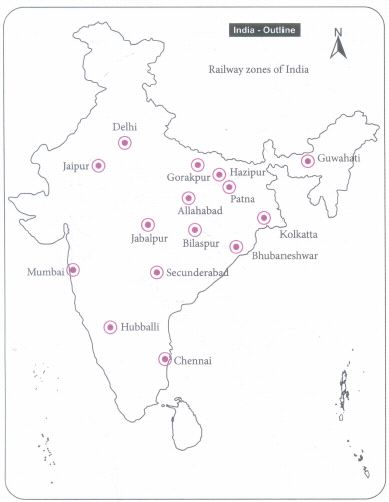
Railways zones of India.
1.
(d)
Petroleum
2.
(d)
Pavan Hans
3.
(c)
Airways
4.
(d)
Hyderabad
5.
(b)
Roadways
6.
(c)
Kerala
7.
1955
8.
Impact of Urbanization
9.
Mumbai
10.
Satellite communication
11.
1960
12.
1. Roads play an important role in carrying goods and passengers for short, medium and long distances.
2. It is highly suitable for short distance services.
3. It is comparatively easy and cheap to construct and maintain roads.
4. Road transport system can establish easy contact between farms, fields, factories and markets and can provide door to door transport services.
5. They are the most universal mode of transport. Indian roads are cost efficient and used by all sections of people in the society.
13.
Trade carried on between two or more countries is called international trade. It is also called as external trade or foreign trade.
14.
National Waterway 1: Ganga - Bhagirathi - Hooghly river system
National Waterway 2: Brahmaputra river between Dhubri - Sadiya
National Waterway 3: Kollam - Kottapuram in the state of Kerala.
15.
1. Railways promotes national integration by bringing people together.
2. It also promotes trade, tourism, education, etc.
3. Railways help in the commercialization of the agriculture sector by facilitating the quick movement of perishable goods.
4. Its role in transporting raw materials to industries and finished goods to markets is invaluable
16.
Dr. Mahabub-ul-haq defined as "It is a process of enlarging the range of people's choice, increasing their opportunities for education, health care, income, and empowerment. It covers the full range of human choices from a sound physical environment to economic, social and political freedom".
17.
| S.No |
Internal trade |
International trade |
|---|---|---|
| 1. | The trade carried on within the domestic territory of a country is internal trade. | International trade refers to trade carried on between two or more countries. |
| 2. | It is also called as Domestic trade or Local trade. | It is also called as External trade or Foreign trade. |
| 3. | Land transport (roadways and railways) plays a major role in this trade. | Waterways and Airways plays a vital role in this type of trade. |
| 4. | Local currency is used in this trade. | Foreign currency is involved in this trade. |
18.
| S.No |
Roadways |
Railways |
|---|---|---|
| 1. | Roadways are the cost efficient and most universal mode of transport | Indian railway system is the main artery of the country's inland transport |
| 2. | Construction and maintenance of roads is cheap | Construction and maintenance of railroad is costlier |
| 3. | Bulky goods cannot be transported easily. | Bulky goods can be transported easily. |
| 4. | It is highly suitable for short distance service. |
It is highly suitable for both short and long distance service. |
| 5. | Door to door service is possible. | Door to door service is not possible. |
19.
Electronic Media:
(i) Mass Communication enables millions of people to get the information at the same time.
(ii) It is a great way to provide education as well as entertainment.
(iii) It helps in creating awareness among the people regarding various national policies and programmes.
(iv) The Mass Communication Systems can provide the information to people in two methods.
Electronic Media:
(i) Radio broadcasting in India was started in 1923 by the Radio club of Bombay.
(ii) It was named as All India Radio (AIR) in 1936 and again it was renamed as Akashwani in 1957.
(iii) It broadcasts a variety of programs related to information, education and entertainment.
Print Media:
(i) Newspapers are the most common but powerful means of communication come under print media.
(ii) India has many newspapers which carry information on local, national and international events to the people
20.
Human Development:
Dr. Mahabub-ul-haq defined as "it is a process of enlarging the range of people's choice, increasing their opportunities for education, health care, income, and empowerment. It covers the full range of human choices from a sound physical environment to economic, social and political freedom".
Human Development Indicators:
Population trends, health outcomes, education achievements, national income and composition of resources, work and employment, human security, human and capital mobility, supplementary indicators: perceptions of well being and status of fundamental rights treaties are the human development indicators.
Measuring of Human Development:
Human Development Index (HDI) is a composite index focusing on three basic dimensions of human development:
(i) Health - Life expectancy at birth.
(ii) Education - Expected years of schooling for school age children and average years of schooling for the adult population.
(iii) Income - Measured by gross national income and per capita income.
Human Development Classification:
(i) HDI classifications are based on HDI fixed cut off points, which are derived from the quartiles of distributions of the component indicators.
(ii) The HDI of less than 0.550 is used for low human development, 0.550 - 0.699 stands for medium human development, 0.700 - 0.799 for high human development and 0.8 or greater for very high human development.
21.
The process of society's transformation from rural to urban is known as urbanization.
Urbanization in India:
i) The level of urbanization is measured in terms of percentage of urban population.
ii) Goa is the most urbanized state.
iii) Himachal Pradesh is the least urbanized state.
iv) Among the Union territories, Delhi is the most urbanized region followed by Chandigarh.
v) Among the major states, Tamil Nadu continues to be the second most urbanized state with 48.4% percent of urban population followed by Kerala and Maharashtra.
Impact of Urbanization:
i) Urbanization and population concentration go hand-in-hand and are closely related to each other.
ii) Rural to urban migration leads to population explosion in urban areas.
iii) Metropolitan cities like Mumbai, Kolkata and Delhi have more population than that can accommodate
iv) The following are the major problems of urbanization in India.
1. It creates urban sprawl.
2. It makes overcrowding urban centres.
3. It leads to shortage of houses in urban areas.
4. It leads to the formation of slums. (eg Chennai, Mumbai)
5. It increases traffic congestion in cities.
6. It creates water scarcity in cities,
7. It creates drainage problem.
8. It poses the problem of solid waste management.
9 It increases the rate of crime.
22.

10th Standard Syllabus & Materials
10th Standard
TN 10th English Prose - 2 - The Night the Ghost Got in Important Questions And Answers Study Material - QB365 Set A
NEW10th Standard
TN 10th English Supplementary - 1 - The Tempest Important Questions And Answers Study Material - QB365 Set A
NEW10th Standard
TN 10th English Poem - 1 - Life Important Questions And Answers Study Material - QB365 Set A
NEW10th Standard
TN 10th English Prose - 1 - His First Flight Important Questions And Answers Study Material - QB365 Set A



Tamilnadu Stateboard 10th Standard Subjects
Tamilnadu Stateboard Standards




