
 100% FREE ACCESS
10th Standard Syllabus & Materials
10th Standard
TN 10th English Prose - 4 - The Attic Important Questions And Answers Study Material - QB365 Set A
NEW10th Standard
TN 10th English Supplementary - 3 - The Story of Mulan Important Questions And Answers Study Material - QB365 Set A
NEW10th Standard
TN 10th English Poem - 3 - I am Every Woman Important Questions And Answers Study Material - QB365 Set A
NEW10th Standard
TN 10th English Prose - 3 - Empowered Women Navigating The World Important Questions And Answers Study Material - QB365 Set A
NEW10th Standard
TN 10th English Supplementary - 2 - Zigzag Important Questions And Answers Study Material - QB365 Set A
NEW10th Standard
TN 10th English Poem - 2 - The Grumble Family Important Questions And Answers Study Material - QB365 Set A

Published on: 06/02/2020
10th Standard Social Science Important Question All Chapters-I- 2019-2020
Download Tamil Nadu 10th Standard Social Science question papers, model tests, one-mark questions, important questions, and public exam papers in PDF format. Free study materials and answer keys for TN State Board students.
Questions + Answers key
Take MCQ Social Science Test
1.
For operations and management Indian Railways is organized into __________ zones.
16
14
12
10
2.
The_________ express is the fastest operational train in India.
Shatabdi
Rajdhani
Gatimaan
Charminar
3.
The first hydro electric power station in India was established at_______in 1897.
Darjeeling
Shillong
Mettur
Periyar
4.
The first nuclear power station was setup at _________ near Mumbai in 1969
Kalpakkam
Kaiga
Rawatbhata
Tarapur
5.
Foreign Exchange Regulation Act promulgated in __________
1970
1973
1972
1980
6.
Indian Government was introduced New Economic Policy in________
1956
1948
1991
1986
7.
Per capita Income =__________
National Income + Population
National Income x Population
National Income - Population
National Income ÷ Population
8.
Industrial sector is_______ sector.
Primary sector
Secondary sector
Tertiary sector
None
9.
__________Sector is largest sector.
Agriculture
Service
Industry
None.
10.
Article ___________ deals with the creation or abolition of Legislative council in a state.
169
171
164
177
11.
The size of the legislative council cannot be more than _________the membership of the Legislative Assembly.
One-fourth
One-fifth
One-sixth
One-third
12.
The State of________ has a separate constitution for its Government
Kerala
Goa
Jammu & Kashmir
punjab
13.
The________ is the legislative organ of the cabinet.
Parliament
High Court
Supreme Court
Election Commission
14.
The post of Prime Minister of India has adopted the _______model of constitutional democracy
Russian
U.S
England
Chinese
15.
The first language committee was appointed in_________
1947
1950
1955
1952
16.
The drafted constitution came into force on_______
26th January 1947
15th August 1947
30th January 1950
26th January 1950
17.
The Indian Council of Agriculture Research was set up in India in __________________
1950
1952
1953
1951
18.
Dihang is a gorge in __________
Assam
Meghalaya
Nagaland
Arunachal Pradesh
19.
The ___________ channel separates Lakshadweep islands from the Maldives islands.
ten degree
nine degree
eight degree
seven degree
20.
The total length of the coastline in India including the islands is ____________ km.
7516.6 km
7625.6 km
7526.6 km
7626.6 km
21.
___________________ a crusader for social justice in south India, hated from Samithoppu.
Narayana Guru
Ramalinga Adigal
Vaikunda Swami
Iyothee Thassar
22.
The Theosophical Society played an important role in the revival of ____________ in India.
Christianity
Buddhism
Islam
Jainism
23.
Rajaram Mohan Roy founded the _________ in 1828.
Arya Samaj
Brahmo Samaj
Prarthana Samaj
Ramakrishna Mission
24.
The ____________ refused to recognize the People's Republic of China for more than two decades.
UK
Russia
United States
Germany
25.
In the summer of 1948, _____________ control had been established over most parts of China.
Socialist
Communist
Democratic
Nazist
26.
Japanese interest in taking control over __________ led to aggression against China.
Korea
Turkey
Greece
Rome
27.
_____________ mainly functions with private enterprises in developing countries.
IDA
IBRD
IFC
ILO
28.
The Declaration of the United Nations was accepted by all the ______________ countries which fought against the Axis power.
20
22
26
25
29.
In 1938, Prime Minister Chamberlain concluded the ______________ with Germany.
Munich Pact
Tripartite Pact
German- Soviet Pact
Molotov - Ribbentrop Pact
30.
Between 1871 and 1914,________ had risen to dizzy heights of economic, political and cultural accomplishments.
India
Germany
Italy
Britain
31.
In England, the__________ party was defeated in the general elections of 1931.
Labour
Republican
Socialist
Communist
32.
The___________ powers were gravely weakened by the war, financially and politically.
British
European
African
Australian
33.
At the battle of___________ in 1914, the French succeeded in pushing back the Germans.
Tannenberg
Marne
Danzig
Balkan
34.
__________of Russia suggested to the powers that they meet together to bring about an era of universal peace.
Tsar Nicholas II
Michael
Peter the Great
Alexander I
35.
The biggest outcome of the I world war was the___________
Green Revolution
French Revolution
Russian Revolution
American Revolution
36.
GATT’s first round held in
Tokyo
Uruguay
Torquay
Geneva
37.
National Income is a measure of
Total value of money
Total value of producer goods
Total value of consumption goods
Total value of goods and services
38.
The Governor of the State is appointed by the
Prime Minister
Chief Minister
President
Chief Justice
39.
The Constitutional Head of the Union is
The President
The Chief Justice
The Prime Minister
Council of Ministers
40.
Which of the following committees/commissions made recommendations about the Centre-State Relations?
1. Sarkaria Commission
2. Rajamannar Committee
3. M.N.Venkatachaliah Commission
Select the correct answer from the codes given below
1, 2 & 3
1 & 2
1 & 3
2 & 3
41.
Find the odd one out.
Right to Equality
Right against Exploitation
Right to Property
Cultural and Educational Rights
42.
43.
One of the shore-based steel plants of India is located at ___________.
Kolkata
Tuticorin
Goa
Visakhapatnam
44.
____________ is the highest gravity dam in India.
Hirakud dam
Bhakra Nangal dam
Mettur dam
Nagarjuna Sagar Dam
45.
Meteorology is the science of _________.
Weather
Social
Political
Human
46.
_______ Plains are formed by the older alluviums.
Bhabar
Tarai
Bhangar
Khadar
47.
Who was the founder of Widow Remarriage Association?
Mahadev Govind Ranade
Devendranath Tagore
Jyotiba Phule
Ayyankali
48.
Where was the Japanese Navy defeated by the US Navy?
Battle of Guadalcanal
Battle of Midway
Battle of Leningrad
Battle of El Alamein
49.
Which part of the world disliked dollar imperialism?
Europe
Latin America
India
China
50.
Who said “imperialism is the highest stage of capitalism”?
Lenin
Marx
Sun Yat-sen
Mao Tsetung
51.
What are the premium products of postal service?
52.
Why is our Country's population uneven?
53.
What are the uses of jute?
54.
What are the Mica producing states in India?
55.
Write about European traders in South India
56.
What is Net National Product?
57.
Give three Methods of Calculating GDP
58.
How are the members to the legislative council elected?
59.
How does the state cabinet work?
60.
What does Sarkaria Commission suggest on the appointment of the Governor?
61.
Enlist the functions of the Vice - President.
62.
How is the Vice-President of India elected?
63.
Write a short note on Administrative-relations
64.
Write a short note on the 86th Amendment Act of 2002
65.
How are directive principles classified on the basis of content and direction?
66.
List the factors affecting climate of India.
67.
Write any two points of importance of Himalayas.
68.
What did Vaikunda Swamigal criticize and how?
69.
Name a few revivalist movement of India in the nineteenth century.
70.
What led to the demolition of the Berlin Wall?
71.
Give an account of the policies adopted by Fidel Castro took after he change of cuba.
72.
What were the two superpowers that emerged after the World War II?
73.
What was the movie 'Fiddler on the Roof' about?
74.
Write a note on the 'Battle of Britain'.
75.
Write a note on Nelson Mandela.
76.
Name the countries that were accorded Dominion Status prior to 1939.
77.
Write a note on
(a) Battle of Tannenberg
(b) Battle of Marne
78.
What is a Trust?
79.
What is Fair trade?
80.
What is meant by Gross domestic product?
81.
What do you understand by the “Appellate Jurisdiction” of the High Court?
82.
How does the state of Jammu and Kashmir differ from the other states of India?
83.
Write short note: Money Bill.
84.
What are the classical languages in India?
85.
What is meant by citizenship?
86.
What is migration? State its types.
87.
Name the different types of coal with their carbon content.
88.
Name the types of soil found in India.
89.
What is ‘Project Tiger’?
90.
Name the neighbouring countries of India.
91.
Write a note on reforms of Ramalinga Adigal.
92.
What are the objectives of IMF?
93.
Explain the Monroe Doctrine.
94.
95.
Major issues faced by farmers in India.
96.
Explain the importance of mass communications systems in India.
97.
Write the goals of World Trade Organisation
98.
Explain the limitations of GDP
99.
Given an account of the communist Victory over China.
100.
What were the causes for the failure of the League of Nations?
101.
Write a note on the condition of Fascists under Mussolini?
102.
What was the outcome of the Russian Revolution?
103.
Explain any three Jurisdiction of the Supreme Court of India.
104.
Solar energy and Wind energy
105.
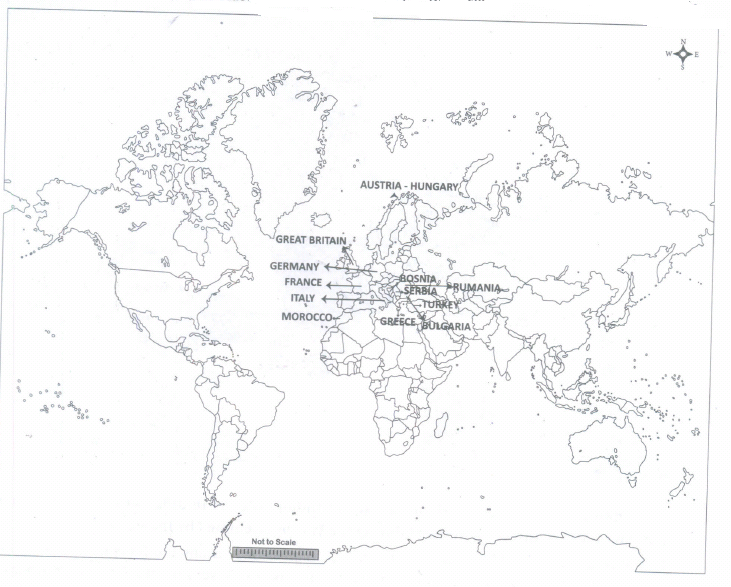
Mark the following countries on the world map.
1. Italy
2. Morocco
3. Turkey
4. Serbia
5. Bosnia
6. Greece
7. Austria-Hungary
8. Bulgaria
9. Rumania
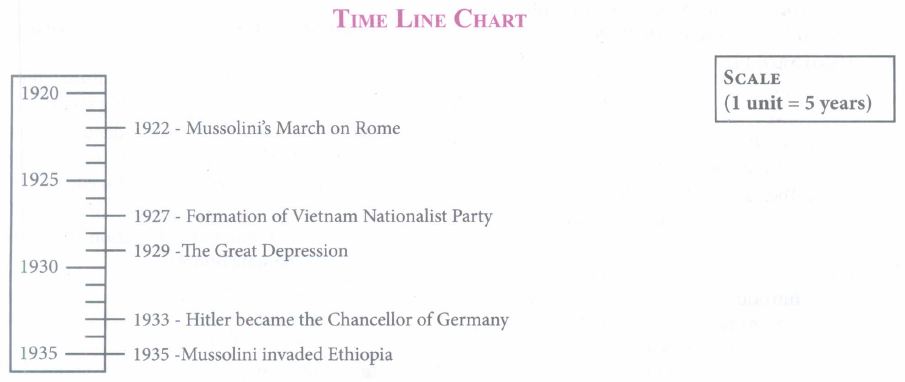
106.
Mark the following incidents 1920 - 1940
1.
(a)
16
2.
(c)
Gatimaan
3.
(a)
Darjeeling
4.
(d)
Tarapur
5.
(b)
1973
6.
(c)
1991
7.
(d)
National Income ÷ Population
8.
(b)
Secondary sector
9.
(b)
Service
10.
(a)
169
11.
(d)
One-third
12.
(c)
Jammu & Kashmir
13.
(a)
Parliament
14.
(c)
England
15.
(c)
1955
16.
(d)
26th January 1950
17.
(c)
1953
18.
(d)
Arunachal Pradesh
19.
(c)
eight degree
20.
(a)
7516.6 km
21.
(c)
Vaikunda Swami
22.
(b)
Buddhism
23.
(b)
Brahmo Samaj
24.
(c)
United States
25.
(b)
Communist
26.
(a)
Korea
27.
(c)
IFC
28.
(c)
26
29.
(a)
Munich Pact
30.
(b)
Germany
31.
(a)
Labour
32.
(a)
British
33.
(b)
Marne
34.
(a)
Tsar Nicholas II
35.
(c)
Russian Revolution
36.
(d)
Geneva
37.
(d)
Total value of goods and services
38.
(c)
President
39.
(a)
The President
40.
(b)
1 & 2
41.
(c)
Right to Property
42.
(b)
43.
(d)
Visakhapatnam
44.
(b)
Bhakra Nangal dam
45.
(a)
Weather
46.
(c)
Bhangar
47.
(a)
Mahadev Govind Ranade
48.
(b)
Battle of Midway
49.
(b)
Latin America
50.
(a)
Lenin
51.
(i) The premium products include the Money order, e-money order, Speed Post, Express Parcel Post, Business Post, Media Post, Satellite Post, Retail Post, Greeting Post, Data Post, Speed Net and Speed Passport Services.
(ii) To facilitate quick delivery of mails in large towns and cities, six mail channels have been introduced recently. They are called Rajdhani Channel, Metro Channel, Green Channel, Business Channel, Bulk Mail Channel and Periodical Channel.
52.
(i) The uneven distribution of population in the country is the result of several factors such as physical, socio-economic and historical ones.
(ii) The physical factors include relief, climate, water, natural vegetation, minerals and energy resources.
(iii) Socio-economic factors consists of the religion, culture, political issues, economy, human settlements, transport network, industrialization, urbanization, employment opportunity etc.
53.
It is used for manufacturing of gunny bags, carpets, hessian, ropes and strings rugs, clothes, tarpaulins, upholstery, etc.
54.
(i) Andhra Pradesh
(ii) Rajasthan
(iii) Odisha
(iv) Jharkhand
55.
(i) European companies which came to trade with India.
(ii) The discovery of a new all-sea route from Europe to India via cape of Good Hope by Vasco da Gama.
(Iii) Vasco da Gama had far-reaching repercussions on the civilized world.
56.
(i) Net National Product (NNP) is arrived by making some adjustment with regard to depreciation.
(ii) Net National Product (NNP) is arrived by deducting the value of depreciation from Gross National Product.
(iii) NNP = GNP - Depreciation
57.
There are three Methods of Calculating GDP. They are,
(i) Expenditure approach
(ii) The Income approach
(iii) Value added approach
58.
(i) 1/3 of the members are elected by local bodies.
(ii) 1/112 of the members are elected by Graduates of the universities in the State.
(iii) 1/12 of the members are elected by Graduate teachers
(iv) 1/3 of the members are elected by the members of the Legislative Assembly
(v) 1/6 is nominated by the Governor who is eminent in the field of literary excellence art, social services or Co-operation.
59.
The cabinet works through various committees called cabinet committees. They are of two types standing and ad hoc. The former are of a permanent nature while the latter are of a temporary nature
60.
Sarkaria Commission on Centre, State relations suggested that the appointment of the Governor should be made
(i) From a panel to be prepared by the State Legislature or
(ii) From a panel to be prepared by the State Government (in effect the Chief Minister) or invariably with the concurrence of the State Chief Minister; or
(iii Invariably in consultation with the State Chief Minister.
61.
(i) He regulates the proceeding of the House
(ii) He decides the order of the House
(iii) He decides the admissibility of a resolution or questions
(iv) He suspends or adjourns the House in case of a grave disorder
(v) He issues directions to various committees on matters relating to their functions
62.
The Vice- President is elected by the members of an electoral college consisting of the member of both Houses of Parliament
63.
The Administrative power of a State extends only to its own territory and with respect to which it has legislative competence, whereas the Union has exclusive executive power over:
(a) The matters with respect to which Parliament has exclusive power to make laws and
(b) The exercise of its powers conferred by any treaty or agreement
64.
(i) The 86th Amendment Act of 2002 changed the subject -matter of Article 45 and made elementary education a fundamental right under Article 21 A.
(ii) The amended directive requires the State to provide early childhood care and education for all children until they complete the age of six years.
65.
On the basis of their content and direction, directive principles they can be classified into three broad categories, viz, socialistic, Gandhian and liberal-intellectual.
66.
Factors like latitude, distance from the sea, monsoon wind, relied on features and jet stream affect the climate of India.
67.
(i) It is the source for many perennial rivers like Indus, Ganges, Brahmaputra, etc.
(ii) The Northern Mountains are described as the paradise of tourists due to its natural beauty.
68.
Vaikunda Swamigal criticized the rule of the British and the rule of the Rajah of Travancore as the rule of the white devils and black devils respectively.
69.
The Arya Samaj, the Ramakrishna Mission and the Deoband Movement.
70.
(i) The East European communist states, under the Soviet umbrella, were also in a deep economic and social crisis.
(ii) Gorbachev's decision to loosen the Soviet control on the countries of Eastern Europe created an independent, democratic momentum.
(iii) A series of workers' strikes undermined the communist regimes first in Poland and then in Hungary.
(iv) A wave of demonstrations that swept East Germany led to demolition of the Berlin Wall in 1989.
71.
(i) After Castro took power, the US-owned oil refineries on the island refused to process Russian oil. Castro nationalized them.
(ii) The US retaliated by ending the arrangement by which it bought the bulk of Cuba's sugar.
(iii) Castro nationalized the US-owned sugar companies. And ended the US monopolies in electricity and telephones.
(iv) All these gravely threatened American economic interests.
72.
The US and the USSR.
73.
The movie, Fiddler on the Roof, is about the anti- Jewish pogrom in nineteenth century Russia when an entire village of Jews is forced to move out by an order of the Tsar.
74.
(i) Battle of Britain- By July 1940, it was feared that the Germans were planning to invade Britain.
(ii) Hitler wanted to force Britain to accept his proposals for peace by a prolonged airborne bombing campaign.
(iii) The German air force began to attack specific targets, especially the ports, airfields, and industrial installations.
(iv) In September 1940, London was bombed mercilessly, an action known as The Blitz.
(v) By October 1940, night bombing raids on London and other industrial cities began.
75.
(i) The African National Congress founded in 1912 fought the practice of racism.
(ii) Repression was let loose against the leader of the Congress.
(iii) The ANC was banned and its leader Nelson Mandela was put behind bars. Mounting pressure at the global level helped to end the racist regime in South Africa.
(iv) In 1990 the ban on ANC was lifted and Mandela was freed after 27 years.
(v) In the elections held subsequently, the Africans were allowed to vote and ANC won the election and Mandela became the first black president of South Africa.
76.
Canada, New Zealand, the Union of South Africa and Ireland.
77.
(a) Battle of Tannenberg
(i) In 1914 Russian forces invaded East Prussia. Germany defeated them decisively. In the battle of Tannenberg Russia suffered heavy losses.
(ii) This caused distraction and helped to relieve the pressure on the western front. The French army made all efforts to drive away the invading Germans.
(b) Battle of Marne
(i) At the Battle of the Marne (early September 1914), the French succeeded in pushing back the Germans.
(ii) Paris was thus saved.
(iii) The battle of Marne is a memorable one for trench warfare.
78.
A trust is an industrial organization engaged in the production or distribution of any commodity. The trust would possess adequate control over the supply and price of that commodity to its own advantage.
79.
Fair trade is the way of doing business that ultimately aims to keep small farmers an active part of the world market place. It aims to empower consumer to make purchases that support their values.
80.
Gross Domestic Product (GDP) is the total value of output of goods and services produced by the factors of production within the geographical boundaries of the country.
81.
a) As Courts of appeal, all High Courts entertain appeals in civil and criminal cases from their subordinate Courts as well as on their own.
b) They have, however no jurisdiction over tribunals established under the laws relating to the Armed Forces of the Country.
82.
(i) The Constitution of India grants special status to Jammu and Kashmir among Indian states, and it is the only state in India to have a separate constitution.
(ii) The Constitution of Jammu and Kashmir was adopted on the 17 November, 1957 and came into force on 26 January, 1957.
(iii) The Directive Principles of the State Policy and fundamental duties of the constitution are not applicable to the state of Jammu and Kashmir.
(iv) Right to Property, is still guaranteed as a fundamental right in Jammu and Kashmir.
83.
a) A bill which covers income and expenditure of the government is called Money Bill.
b) Bills connected with tax policy of the government is also called Money Bill.
c) Lok Sabha can only introduce Money bill and once it is approved by the Lok Sabha, it is passed to Rajya Sabha for its approval.
84.
i) Six languages are granted the classical language status.
ii) They are Tamil, Sanskrit, Telugu, Kannada, Malayalam and Odia.
85.
i) The word 'citizen' is derived from the Latin terms 'civis'.
ii) It means resident of a City State.
iii) The Constitution of India provides for a single and uniform citizenship for the whole of India.
iv) Articles 5 to 11 under part II of the Constitution deals with the citizenship.
86.
Migration is the movement of people across regions and territories.
The types of migration are:
(1) Internal migration (within a country)
(2) International migration (between the countries).
87.
Based on carbon content, it is classified into the following types.
(i) Anthracite: contains 80 to 90% carbon
(ii) Bituminous: contains 60 to 80% carbon
(iii) Lignite: contains 40 to 60% carbon
(iv) Peat: contains less than 40% carbon
88.
1. Alluvial soil.
2. Black soils.
3. Red soils.
4. Laterite soils.
5. Forest and mountain soil.
6. Arid and desert soils.
7. Saline and alkaline soils.
8. Peaty and marshy soils.
89.
Project Tiger was launched in April 1973 with the aim to conserve tiger population in specifically constituted "Tiger Reserves" in India.
90.
The neighbouring countries of India are Pakistan and Afghanistan in the North-West, China, Nepal and Bhutan in the North and Bangladesh and Myanmar in the East.
91.
i) Ramalinga emphasised the bonds of responsibility and compassion between living beings.
ii) Ramalinga showed his compassion and mercy on all living things including plants. This he called 'Jeeva Karunya'.
iii) He established Samarasa Vedha Sanmarga Sangam.
iv) He also established a free feeding house for everyone irrespective of caste at Vadalur.
v) His songs were compiled under the title "Thiruvarutpa".
92.
i) The primary objective of IMF is to ensure financial stability and development across the world.
ii) The objectives of the IMF are "to foster global monetary cooperation, secure financial stability, facilitate international trade, promote high employment and sustainable economic growth and reduce poverty around the world".
93.
i) The Monroe Doctrine was developed in 1815, by the President of the USA, Monroe.
ii) It declared that if Europeans interfered anywhere in America, north or south, it would amount to waging a war against the United States.
iii) Due to this threat, by 1830 the whole of South America was free from European domination.
94.
95.
Indian agriculture and Indian farmers are plagued by several problems; some of them are natural and some others are manmade.
(i) Small and fragmented land-holdings: The problem of small and fragmented holdings is more serious in densely populated and intensively cultivated states in India.
(ii) High Costs of Inputs: Seed is a critical and basic input for attaining higher crop yields and sustained growth in agricultural production.
(iii) Infertile Soil: Indian soils have been used for growing crops over thousands of years without caring much for replenishing. This has led to depletion and exhaustion of soils resulting low productivity.
(iv) Lack of Irrigation: Only one- third of the cropped area falls under irrigated area. To make agriculture reliable, irrigation facility has to be developed.
(v) Soil erosion: Large tracts of fertile land suffer from soil erosion by wind and water. Such kind of areas must be properly treated and restored to its original fertility.
(vi) Agricultural marketing: In rural India, agricultural marketing continues in bad shape. Due to the absence of sound marketing facility, the farmers have to depend on local traders and middlemen for the disposal of their farm products which is sold at a low price.
(vii) Inadequate storage facilities: Storage facilities in the rural areas are either totally absent or grossly inadequate. Under such conditions, the farmers are compelled to sell their products immediately after the harvest irrespective of the condition of market.
96.
Electronic Media:
(i) Mass Communication enables millions of people to get the information at the same time.
(ii) It is a great way to provide education as well as entertainment.
(iii) It helps in creating awareness among the people regarding various national policies and programmes.
(iv) The Mass Communication Systems can provide the information to people in two methods.
Electronic Media:
(i) Radio broadcasting in India was started in 1923 by the Radio club of Bombay.
(ii) It was named as All India Radio (AIR) in 1936 and again it was renamed as Akashwani in 1957.
(iii) It broadcasts a variety of programs related to information, education and entertainment.
Print Media:
(i) Newspapers are the most common but powerful means of communication come under print media.
(ii) India has many newspapers which carry information on local, national and international events to the people
97.
Goals of WTO:
(i) Raising and stabilizing the incomes of small scale farmers, farm workers and artisans.
(ii) More equitably distributing the economic gains, opportunities and risks associated with the production and sale of these goods.
(iii) Increasing the organisational and commercial capacities of producer groups.
(iv) Promoting labour rights and the right workers to organize.
(v) Promoting safe and sustainable farming methods and working conditions
98.
a) Several important goods are services left out of the GDP:
i) The GDP includes only the goods and services sold in the market.
ii) The services provided by the parents to their children is very important but it is not included in the GDP because it is not sold in the market.
iii) Likewise clean air, which is vital for a healthy life, has no market value and is left out of the GDP.
b) GDP measures only quantity but not quality :
i) In the 1970s schools and banks did not permit the use of ballpoint pens.
ii) This is because, the ones available in India were of very poor quality.
iii) Since then, not only has there been a substantial increase in the quantity of ballpoint pens produced in India but their quality has also improved a lot.
iv) The improvement in quality of goods is very important but it is not captured by the GDP.
c) GDP does not tell us about the way income is described in the country:
The GDP of a country may be growing rapidly but income may be distributed so unequally that only a small percentage of people may be benefitting from it.
d) The GDP does not tell us about the kind of life people are living:
A high level of per capita real GDP can go hand - in - hand with very low health condition of people, an undemocratic political system, high pollution and high suicide rate.
99.
Communist Victory:
(i) With the surrender of the Japanese (1945), both the Kuomintang and the communists sought to occupy the Japanese areas.
(ii) In this race the Kuomintang was successful. The cities and railways soon fell into their hands.
(iii) Even the area around Peking was soon controlled by Chiang Kai-shek's forces, largely because of the military aid given by the USA.
(iv) With the massive support provided by the USA, Kuomintang government controlled the administration, ports and communication system.
(v) But the soldiers, mainly drawn from the peasants, were disillusioned and discontented.
(vi) Mao was keen on obtaining the support of the middle class.
(vii) Mao continued the use of guerrilla tactics but also ordered large-scale military movements.
(viii) Cities fell one by one and Chiang Kai-shek's army began to disintegrate quickly.
(ix) In the summer of 1948, Communist control had been established over most parts of China.
100.
(i) The Treaty also set up the League of Nations, on the initiative of President Woodrow Wilson of the United States.
(ii) The League was expected to mediate between countries and take action against countries which indulged in military aggression.
(iii) However, the United States was not interested in playing a global role or any role in European politics.
(iv) The popular mood favoured the traditional isolationist approach, and therefore the United States did not become a member of the League.
(v) The other Allied nations were also determined to maintain a noninterventionist attitude and, in consequence, the League remained an ineffectual international body.
101.
(i) In the 1924 elections, after intimidation of the electors, 65 percent of the votes were cast for the Fascists.
(ii) Matteotti, a socialist leader, who questioned fairness of the elections, was murdered.
(iii) The opposition parties boycotted the Parliament in protest.
(iv) Mussolini reacted by banning opposition parties and censoring the Press. Opposition leaders were killed or imprisoned.
(v) Assuming the title of II Duce (the leader), in 1926 he became a dictator with power to legislate.
(vi) He passed a law forbidding strikes and lockouts. Unions and employers were organized into corporations which would settle wages and working conditions.
(vii) In 1938 Parliament was abolished and was replaced by a body representing the Fascist Party and the corporations.
(viii) This new arrangement bolstered Mussolini's dictatorial control of the economy, as well as enabling him to wield enormous power as head of the administration and the armed forces.
102.
(i) The Russian Communist Party could eliminate illiteracy and poverty in Russia within a record time.
(ii) Russian industry and agriculture had developed remarkably.
(iii) Women were given equal rights, including rights to vote.
(iv) Industries and banks were nationalized. Land was announced as social property.
(v) Land was distributed to poor peasants.
(vi) Lenin thought the most important factor for the fall of Provisional government was its failure to withdraw from World War.
(vii) So Lenin immediately appealed for peace.
(viii) Unmindful of the harsh terms dictated by the Central Powers, Lenin opted for withdrawing from the War to concentrate on the formation of new government.
(ix) In March 1918 the Treaty of Brest-Litovsk was signed.
103.
Original Jurisdiction:
The cases which are brought directly in-the first instance to the Supreme Court come original under jurisdiction.
These may be
(i) dispute between the Government of India and one or more states
(ii) Dispute between two or more states
(iii) The writs are issued by the Supreme Court for the enforcement of the fundamental rights.
Appellate jurisdiction:
i) The Supreme Court is the final appellate court in the country.
ii) The Supreme Court hears appeals against the decision of High Courts.
iii) Such a case can be brought before the Supreme Court only if the High Court certifies that the case invites a substantial of law as to the interpretation of the Constitution.
Advisory Jurisdiction:
The Constitution confers on the President the power to refer to the Supreme Court any question of law or fact which in his opinion is of public importance.
Miscellaneous jurisdiction:
i) The law declared by Supreme Court is binding on all courts within the territory of India.
ii) The Supreme Court is authorized to make rules for regulating, generally the practice and procedure of the court with the approval of the President.
Judicial Review:
a) The power of the Judiciary to declare a law as unconstitutional is known as Judicial Review'.
b) The Supreme Court of India has Individual Review Power with regard to:
i) Dispute between the Centre and State.
ii) Protecting the Fundamental Rights.
104.
| S.No |
Solar energy |
Wind energy |
|---|---|---|
| (1) | Solar power is the conversion of sunlight into electricity | Wind energy is extracted from air flow using wind turbines. |
| (2) | It is a non-conventional source of energy Resources are available continuously. | It is a cheap and pollution-free source of energy. |
105.
106.

10th Standard Syllabus & Materials
10th Standard
TN 10th English Prose - 2 - The Night the Ghost Got in Important Questions And Answers Study Material - QB365 Set A
NEW10th Standard
TN 10th English Supplementary - 1 - The Tempest Important Questions And Answers Study Material - QB365 Set A
NEW10th Standard
TN 10th English Poem - 1 - Life Important Questions And Answers Study Material - QB365 Set A
NEW10th Standard
TN 10th English Prose - 1 - His First Flight Important Questions And Answers Study Material - QB365 Set A



Tamilnadu Stateboard 10th Standard Subjects
Tamilnadu Stateboard Standards




