
 100% FREE ACCESS
10th Standard Syllabus & Materials
10th Standard
TN 10th English Prose - 4 - The Attic Important Questions And Answers Study Material - QB365 Set A
NEW10th Standard
TN 10th English Supplementary - 3 - The Story of Mulan Important Questions And Answers Study Material - QB365 Set A
NEW10th Standard
TN 10th English Poem - 3 - I am Every Woman Important Questions And Answers Study Material - QB365 Set A
NEW10th Standard
TN 10th English Prose - 3 - Empowered Women Navigating The World Important Questions And Answers Study Material - QB365 Set A
NEW10th Standard
TN 10th English Supplementary - 2 - Zigzag Important Questions And Answers Study Material - QB365 Set A
NEW10th Standard
TN 10th English Poem - 2 - The Grumble Family Important Questions And Answers Study Material - QB365 Set A

Published on: 04/10/2019
GEO - India - Location, Relief and Drainage
Download Tamil Nadu 10th Standard Social Science question papers, model tests, one-mark questions, important questions, and public exam papers in PDF format. Free study materials and answer keys for TN State Board students.
Questions + Answers key
Take MCQ Social Science Test
1.
The ____________ river divides the plateau region of India broadly into two parts.
Kaveri
Narmada
Tapti
Mahanadi
2.
Pulicat Lake is located between the states of
West Bengal and Odisha
Karnataka and Kerala
Odisha and Andhra Pradesh
Tamil Nadu and Andhra Pradesh
3.
_______ Plains are formed by the older alluviums.
Bhabar
Tarai
Bhangar
Khadar
4.
A landmass bounded by sea on three sides is referred to as _________.
Coast
Island
Peninsula
Strait
5.
The north-south extent of India is
2,500 km
2,933 km
3,214 km
2,814 km
6.
Abode of snow
7.
Indira point
8.
Coromandel Coast
9.
New alluvium
10.
Tsangpo
11.
Write a note on Delta plains.
12.
Write any two points of importance of Himalayas.
13.
State the west following rivers of India.
14.
15.
Give the importance of IST.
16.
Name the neighbouring countries of India.
17.
Write the importance of Himalayas.
18.
19.
The river Godavari is often referred to as Vridha Ganga.
20.
The Eastern states are called seven sisters.
21.
The great Indian desert is called Marusthali.
22.
North Indian Rivers are perennial.
23.
Himadri and Himachal.
24.
Himalayan rivers and Peninsular rivers.
25.
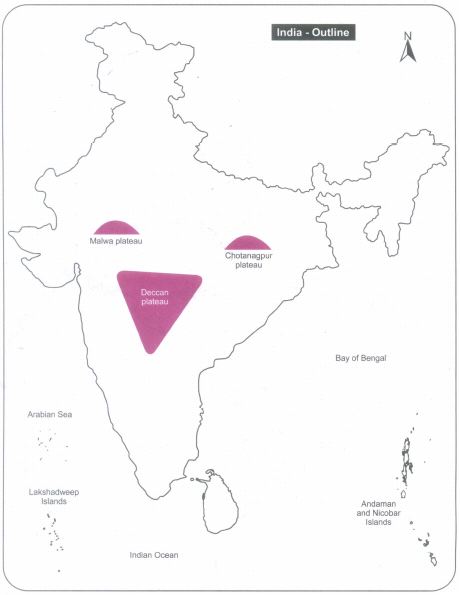
Mark the following in the outline map of India
Major plateaus – Malwa, Chotanagpur, Deccan.
1.
(b)
Narmada
2.
(d)
Tamil Nadu and Andhra Pradesh
3.
(c)
Bhangar
4.
(c)
Peninsula
5.
(c)
3,214 km
6.
Himalaya
7.
Nicobar Island
8.
Southern part of East Coastal Plain
9.
Khadar
10.
River Brahmaputra in Tibet
11.
(i) The deltaic plain is an extension of the Khadar land. It covers about 1.9 lakh sq.km in the lower reaches of the Ganga River.
(ii) It is an area of deposition as the river flows in this tract sluggishly.
(iii) The deltaic plain consists mainly of old mud, new mud, and marsh.
(iv) In the delta region, the uplands are called 'Chars' while the marshy areas are called 'Bils'.
12.
(i) It is the source for many perennial rivers like Indus, Ganges, Brahmaputra, etc.
(ii) The Northern Mountains are described as the paradise of tourists due to its natural beauty.
13.
Narmada, Tapti, Mahi and Sabarmathi are the west following rivers of India.
14.
15.
The longitudinal difference between Gujarat in the west and Arunachal Pradesh in the east is about 30°. Since Arunachal Pradesh is towards east. it will have sunrise about two hours earlier than the sunrise at Gujarat which is in the west. In order to avoid these differences, Indian Standard Time is calculated. The IST is 5.30 hrs ahead of Greenwich Mean Time (GMT).
16.
The neighbouring countries of India are Pakistan and Afghanistan in the North-West, China, Nepal and Bhutan in the North and Bangladesh and Myanmar in the East.
17.
(i) Himalayas blocks southwest monsoon winds and causes heavy rainfall to north India.
(ii) It forms a natural barrier to the subcontinent.
(iii) It is the source for many perennial rivers like Indus, Ganges, Brahmaputra, etc.
(iv) The Northern Mountains are described as the paradise of tourists due to its natural beauty.
(v) Many hill stations and pilgrim centers like Amarnath, Kedarnath, Badrinath, and Vaishnavi Devi temples are situated here.
(vi) It provides raw material for many forest based industries.
(vii) It prevents the cold winds blowing from the central Asia and protects India from severe cold.
(viii) Himalayas are renowned for the rich biodiversity.
18.
19.
The river Godavari is referred as Vridha Ganga because of its large size and extent among peninsular rivers
20.
The Eastern states are called seven sisters because of the similarity between the states in terms of geographical features and interdependence among them in political, social and economic spheres
21.
Marusthali is a Sanskrit name given to the great Indian desert, Marusthali means Land of dead sand' dune which covers the eastern portion of the desert. It extends over 24,000 square miles
22.
The North Indian rivers originate from the snow covered mountains of Himalayas. They get water from the melting of snow from the peaks and also from monsoons.
23.
| S. No |
Himadri |
Himachal |
|---|---|---|
| 1. | The Greater Himalayas is known as Himadri. | The lesser Himalayas is known as Himachal. |
| 2. | It is the northen most range of the Himalayas | It is the middle range of the Himalayas. |
| 3. | Its height is about 6000 mts | Its height varies from 3700 mts to 45000 mts. |
| 4. | It is about 25 km wide. | It is about 80 km wide. |
| 5. | It receives lesser rainfall than Himachal. | It receives higher rainfall. |
| 6. | Important peaks such as Everest and Kanchen junga are located here. | Important hill stations like Shimla, Mussoorie, Nainital, Almora and Darjeeling are located here. |
24.
| S. No |
Himalayan Rivers |
Peninsular Rivers |
|---|---|---|
| 1. | Originate from Himalayas | Originate from Western ghats. |
| 2. | Long and wide. | Short and narrow. |
| 3. | Perennial in nature. | Non-perennial in nature. |
| 4. | Unsuitable for hydro power generation. | Suitable for hydro power generation. |
| 5. | Middle and lower courses are navigable. | Not useful for navigation |
25.

10th Standard Syllabus & Materials
10th Standard
TN 10th English Prose - 2 - The Night the Ghost Got in Important Questions And Answers Study Material - QB365 Set A
NEW10th Standard
TN 10th English Supplementary - 1 - The Tempest Important Questions And Answers Study Material - QB365 Set A
NEW10th Standard
TN 10th English Poem - 1 - Life Important Questions And Answers Study Material - QB365 Set A
NEW10th Standard
TN 10th English Prose - 1 - His First Flight Important Questions And Answers Study Material - QB365 Set A



Tamilnadu Stateboard 10th Standard Subjects
Tamilnadu Stateboard Standards




