
 100% FREE ACCESS
12th Standard Syllabus & Materials
12th Standard
TN 12th Computer Applications மின்னணு தரவு பரிமாற்றம் Sample Question Papers Study Material - QB365 Set A
NEW12th Standard
TN 12th Computer Applications மின் - வணிக பாதுகாப்பு அமைப்புகள் Sample Question Papers Study Material - QB365 Set A
NEW12th Standard
TN 12th Computer Applications மின்னணு செலுத்தல் முறைகள் Sample Question Papers Study Material - QB365 Set A
NEW12th Standard
TN 12th Computer Applications மின் - வணிகம் Sample Question Papers Study Material - QB365 Set A
NEW12th Standard
TN 12th Computer Applications திறந்த மூல கருத்துருக்கள் Sample Question Papers Study Material - QB365 Set A
NEW12th Standard
TN 12th Computer Applications வலையமைப்பு வடமிடல் Sample Question Papers Study Material - QB365 Set A

Published on: 19/08/2019
Chromosomal Basis of Inheritance
Download Tamil Nadu 12th Standard Biology question papers, model tests, one-mark questions, important questions, and public exam papers in PDF format. Free study materials and answer keys for TN State Board students.
Questions + Answers key
Take MCQ Biology Test1.
Observe the gene sequence and identify the types of aberration ABC BCD E F?
Tandem duplication
Simple duplication
Reverse tandem duplication
Displaced tandem duplication
2.
Assertion (A): Self-sterility is observed in Nicotiana species.
Reason (R): Because the genes are located on chromosome.
A is true R is false
Both A and R are false
A is true, R is not correct explanation for A
R explains A
3.
Statement 1: Self-sterility in Nicotiana is controlled by multiple alleles.
Statement 2: Multiple alleles are always responsible for the same character.
Statement 1 is correct and Statement 2 is incorrect
Statement 1 is incorrect and Statement 2 is correct
Both the statements are correct
Both the statements are incorrect
4.
Which one of the following ploidy is irrelevant to others?
Monosomy
Trisomy
Tetrasomy
Pentasomy
5.
In a population of 250 progenies produced, only 120 resemble the parental forms. Calculate the recombinant frequency.
66%
52%
59%
49%
6.
Identify the syntenic gene from the given genes sequence of a chromosome G-H-I-J-K-L-M-A-B
G and H
J, K and L
G and B
A and B
7.
The following sequence represents the location of genes in a chromosome. A - B - C - M - R - S - y -Z. Which of the gene pairs will have least chance of getting inherited together?
A and M
Sand Y
M and Z
A and Y
8.
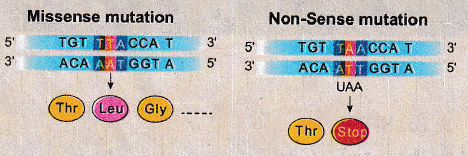
Changing the codon AGC to AGA represents _______.
missense mutation
nonsense mutation
frameshift mutation
deletion mutation
9.
Due to incomplete linkage in maize, the ratio of parental and recombinants are ______.
50:50
7:1:1:7
96.4: 3.6
1:7:7:1
10.
The A and B genes are 10 cm apart on a chromosome. If an AB/ab heterozygote is testcrossed to ab/ab, how many of each progeny class would you expect out of 100 total progeny?
25 AB, 25 ab, 25 Ab, 25 aB
10 AB, 10 ab
45 AB, 45 ab
45 AB, 45 ab, 5 Ab, 5aB
11.
What is translocation? Write about its types.
12.
13.
If you cross dominant genotype PV/PV male Drosophila with double recessive female and obtain F1 hybrid. Now you cross F1 male with double recessive female.
i) What type of linkage is seen?
ii) Draw the cross with correct genotype.
iii) What is the possible genotype in F2 generation?
14.
Mention the major stages involved in crossing over.
15.
Who coined the term crossing over? When does the crossing over occurs in a cell?
16.
What does the condition synteny refers to?
17.
18.
Why crossing over is important?
19.
Give a short note on incomplete linkage.
20.
State Coupling and Repulsion theory.
21.
Compare Mendelian factors with chromosome.
22.
What are the salient features of the chromosomal theory of inheritance ?
23.
1.
(a)
Tandem duplication
2.
(c)
A is true, R is not correct explanation for A
3.
(c)
Both the statements are correct
4.
(a)
Monosomy
5.
(b)
52%
6.
(c)
G and B
7.
(d)
A and Y
8.
(a)
missense mutation
9.
(b)
7:1:1:7
10.
(d)
45 AB, 45 ab, 5 Ab, 5aB
11.
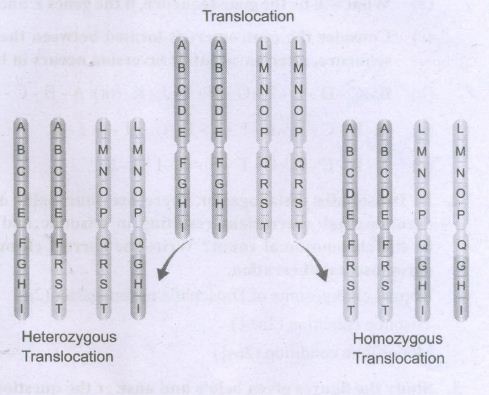
Translocation
The transfer of a segment of chromosome to a nonhomologous chromosome is called translocation. Translocation should not be confused with crossing over, in which an exchange of genetic material between homologous chromosome takes place. Translocation occurs as a result of interchange of chromosome segments in non-homologous chromosomes. There are three types:
i. Simple translocation
ii. Shift translocation
iii. Reciprocal translocation
i. Simple translocation
A single break is made in only one chromosome. The broken segment gets attached to one end of a non-homologous chromosome. It occurs very rarely in nature.
ii. Shift translocation
Broken segment of one chromosome gets inserted interstitially in a non-homologous chromosome.
iii. Reciprocal translocations
It involves mutual exchange of chromosomal segments between two non homologous chromosomes. It is also called illegitimate crossing over. It is further divided into two types.
a. Homozygous translocation: Both the chromosomes of two pairs are involved in translocation. Two homologous of each translocated chromosomes are identical.
b. Heterozygous translocation: Only one of the chromosome from each pair of two homologous are involved in translocation, while the remaining chromosome is normal.
Translocations playa major role in the formation of species.
12.
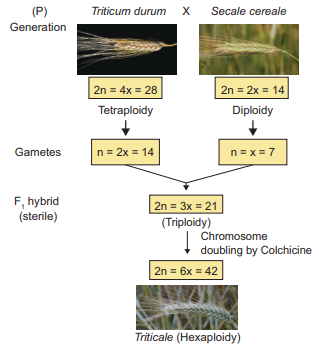
13.
(i) Incomplete linkage
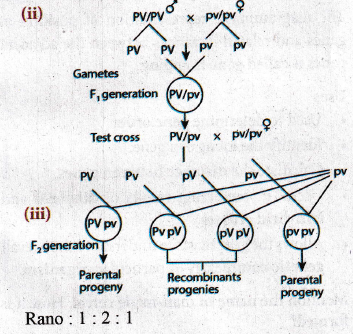
Rano : 1:2:1
14.
Crossing over is a precise process that includes stages like synapsis, tetrad formation, cross over and terminalization.
15.
The term 'crossing over' was coined by Morgan (1912). It takes place during pachytene stage of prophase I of meiosis.
16.
The two genes that are sufficiently far apart on the same chromosome are called unlinked genes or syntenic genes. Such condition is known as synteny.
17.
18.
1. Exchange of segments leads to new gene combinations which plays an important role in evolution.
2. Studies of crossing over reveal that genes are arranged linearly on the chromosomes.
3. Genetic maps are made based on the frequency of crossing over.
4. Crossing over helps to understand the nature and mechanism of gene action.
5. If a useful new combination is formed it can be used in plant breeding.
19.
If two linked genes are sufficiently apart, the chances of their separation are possible. As a result, parental and non-parental combinations are observed. The linked genes exhibit some crossing over. This phenomenon is called incomplete linkage. This was observed in maize. It was reported by Hutchinson.
20.
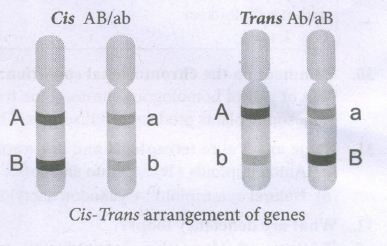
The two dominant alleles or recessive alleles occur in the same homologous chromosomes, tend to inherit together into same gamete are called coupling or cis configuration. If dominant or recessive alleles are present on two different, but homologous chromosomes they inherit apart into different gamete are called repulsion or trans configuration.
21.
| S. No. | Mendelian factors | Chromosomes behaviour |
| 1. | Alleles of a factor occur in pair. | Chromosomes occur in pairs |
| 2. | Similar or dissimilar alleles of a factor separate during the gamete formation. | The homologous chromosomes separate during meiosis. |
| 3. | Mendelian factors can assort independently. | The paired chromosomes can separate independently during meiosis but the linked genes in the same chromosome normally do not assort independently. |
22.
(i) Somatic cells of organisms are derived from the zygote by repeated cell division (mitosis). these consist of two identical sets of chromosomes. One set is received from female parent (maternal) and the other from male parent (paternal). These two chromosomes constitute the homologous pair.
(ii) Chromosomes retain their structural uniqueness and individuality throughout the life cycle of an organism.
(iii) Each chromosome carries specific determiners or Mendelian factors which are now termed as genes.
(iv) The behaviour of chromosomes during the gamete formation (meiosis) provides evidence to the fact that genes or factors are located on chromosomes.
23.

12th Standard Syllabus & Materials
12th Standard
TN 12th Computer Applications களப்பெயர் முறைமை (DNS) Sample Question Papers Study Material - QB365 Set A
NEW12th Standard
TN 12th Computer Applications வலையமைப்பு எடுத்துக்காட்டுகள் மற்றும் நெறிமுறைகள் Sample Question Papers Study Material - QB365 Set A
NEW12th Standard
TN 12th Computer Applications கணினி வலையமைப்பு ஓர் அறிமுகம் Sample Question Papers Study Material - QB365 Set A
NEW12th Standard
TN 12th Computer Applications PHP-உடன் MySQL-ஐ இணைத்தல் Sample Question Papers Study Material - QB365 Set A



Tamilnadu Stateboard 12th Standard Subjects

Maths

Chemistry

Physics
Biology

Computer Science

Business Maths and Statistics

Economics

Commerce

Accountancy

History

Computer Applications
Biology
Computer Technology
Computer Applications
Computer Science
Business Maths and Statistics
Commerce
Economics
Maths
Chemistry
Physics
Computer Technology
History
Accountancy

Tamil

English

French
Tamilnadu Stateboard Standards

