
 100% FREE ACCESS
12th Standard Syllabus & Materials
12th Standard
TN 12th Maths Applications of Matrices and Determinants Sample Question Papers Study Material - QB365 Set A
NEW12th Standard
TN 12th Computer Applications மின்னணு தரவு பரிமாற்றம் Sample Question Papers Study Material - QB365 Set A
NEW12th Standard
TN 12th Computer Applications மின் - வணிக பாதுகாப்பு அமைப்புகள் Sample Question Papers Study Material - QB365 Set A
NEW12th Standard
TN 12th Computer Applications மின்னணு செலுத்தல் முறைகள் Sample Question Papers Study Material - QB365 Set A
NEW12th Standard
TN 12th Computer Applications மின் - வணிகம் Sample Question Papers Study Material - QB365 Set A
NEW12th Standard
TN 12th Computer Applications திறந்த மூல கருத்துருக்கள் Sample Question Papers Study Material - QB365 Set A

Published on: 06/01/2020
Monetary Economics
Download Tamil Nadu 12th Standard Economics question papers, model tests, one-mark questions, important questions, and public exam papers in PDF format. Free study materials and answer keys for TN State Board students.
Questions + Answers key
Take MCQ Economics Test
1.
Barter system was introduced by________
Mesopetamia tribes
Babylonian's
Both 'a' and 'b'
None of the above
2.
'Inflation is taxation without legislation' was said by______
Rudi Dorbush
Adam smith
Milton Friedman
Alfred Marshall
3.
The study of alternating fluctuations in business activity is referred to in Economics as
Boom
Recession
Recovery
Trade cycle
4.
___________inflation occurs when general prices of commodities increases due to increase in production costs such as wages and raw materials.
Cost-push
demand pull
running
galloping
5.
__________inflation results in a serious depreciation of the value of money.
Creeping
Walking
running
Hyper
6.
How does Money facilitate the distribution of National Income?
7.
What are the function of Money?
8.
What is Stagflation?
9.
What is gold standard?
10.
What is commodity money?
11.
Explain Effects on Production of Inflation.
12.
Explain any three main causes of inflation in India.
13.
Explain “The Keynes Equation” Keynes equation is expressed as:
14.
15.
Write the types of inflation
16.
Explain the evolution of money.
17.
Compare and contrast inflation and deflation.
18.
What are the causes and effects of inflation on the economy?
19.
Illustrate Fisher’s Quantity theory of money.
1.
(a)
Mesopetamia tribes
2.
(c)
Milton Friedman
3.
(d)
Trade cycle
4.
(a)
Cost-push
5.
(d)
Hyper
6.
Money facilitates the distribution of income asrent, wage, interest and profit.
7.
(i) Medium of exchange
(ii) Store of value
(iii) Measure of value
(iv) Standard of deferred payment
8.
Stagflation is a combination of stagnant economic growth, high unemployment and high inflation.
9.
(i) The value of the monetary unit is directly linked with a certain weight of gold.
(ii) The purchasing power of a unit of money is maintained equal to the value of a fixed weight of gold.
10.
(i) Surplus goods were exchanged for money which in turn was exchanged for other needed goods.
(ii) Goods like furs, skins, salt, rice, wheat, utensils, weapons were used as money
11.
When the inflation is very moderate, it acts as an incentive to traders and producers. The profit due to rising prices encourages and induces business class to increase their investments in production, leading to generation of employment and income.
(i) However, hyper-inflation results in a serious depreciation of the value of money and it discourages savings.
(ii) When the value of money undergoes considerable depreciation, this may even drain out the foreign capital.
(iii) With reduced capital accumulation, the investment will suffer a serious set-back which may have an adverse effect on the volume of production.
12.
(i) Increase in Money Supply: Inflation is caused by an increase in the supply of money which leads to increase in aggregate demand.
(ii) Increase in Disposable Income: When the disposable income of the people increases, it raises their demand for goods and services.
(iii) Increase in Public Expenditure: Government activities have been expanding due to developmental activities and social welfare programmes.
13.
n = pk (or) p = n / k
Where
n is the total supply of money
p is the general price level of consumption goods
k is the total quantity of consumption units the people decide to keep in the form of cash.
because it is measured in terms of consumer goods.
According to Keynes, peoples desire to hold money is unaltered by monetary authority. So, price level and value of money can be stabilized through regulating quantity of money (n) by the monetary authority.
Later, Keynes extended his equation in the following form:
n = p (k + rk') or p = n/(k + rk')
Where,
n = total money supply
p = price level of consumer goods
k = peoples' desire to hold money in hand (in terms of consumer goods) in the total income of them
r = cash reserve ratio
k' = community’s total money deposit in banks, in terms of consumers goods.
14.
15.
(i) On the basis of speed there are four types of inflation - Creeping inflation, Walking Inflation, Running inflation, Galloping inflation.
(ii) Demand-Pull inflation, Cost-Push inflation.
(iii) On the basis of inducement - currency inflation, credit inflation, deficit induced inflation, profit induced inflation, scarcity induced inflation, tax induced inflation.
16.
BARTER SYSTEM
(i) Exchange of goods for goods was known as “Barter Exchange” or “Barter System”.
(ii) In a barter system, the commodities and services were directly exchanged for other commodities and services.
(iii) Goods like furs, skins, salt, rice, wheat, utensils, weapons, etc. were commonly used as money.
METALLIC MONEY
(i) Under metallic standard, some kind of metal either gold or silver is used to determine the standard value of the money and currency.
(ii) Standard coins made out of the metal are the principal coins used under the metallic standard.
(iii) These standard coins are full bodied or full weighted legal tender. Their face value is equal to their intrinsic metal value.
GOLD STANDARD
(i) Gold Standard is a system in which the value of the monetary unit or the standard currency is directly linked with gold.
(ii) The monetary unit is defined in terms of a certain weight of gold.
SILVER STANDARD
(i) The silver standard is a monetary system in which the standard economic unit of account is a fixed weight of silver.
(ii) The silver standard is a monetary arrangement in which a country’s Government allows conversion of its currency into fixed amount of silver.
PAPER CURRENCY
The paper currency standard refers to the monetary system in which the paper currency notes issued by the Treasury or the Central Bank or both circulate as unlimited legal tender.
PLASTIC MONEY
(i) The latest type of money is plastic money.
(ii) Plastic money is a term that is used predominantly in reference to the hard plastic cards used every day in place of actual bank notes.
(iii) Plastic money can come in many different forms such as Cash cards, Credit cards, Debit cards, Pre-paid Cash cards, Store cards, Forex cards and Smart cards.
CRYPTO CURRENCIES
Decentralised crypto currencies such as Bitcoin now provide an outlet for Personal Wealth that is beyond restriction and confiscation.
17.
| BASIS FOR COMPARISON | INFLATION | DEFLATION |
| Meaning | When the value of money decreases in the international market, then this situation is termed as inflation. | Deflation is a situation, when the value of money increases in the international market. |
| Effects | Increase in the general price level | Decrease in the general price level |
| National income | Does not declines | Declines |
| Gold price | Falls | Rises |
| Classification | Demand pull inflation, cost push inflation and stagflation. |
Debt deflation, money supply side deflation, credit deflation. |
| Good for | Producers | Consumers |
| Consequences | Unequal distribution of income. |
Rise in the level of unemployment. |
| Which is Good | A little bit of inflation is a symbol of economic growth of the country. | Deflation is not good for an economy. |
18.
Causes:
Increase in Money Supply:
1. Increase in money supply leads to increase in aggregate demand.
2. The higher the growth rate of nominal money supply, the higher is the rate of inflation.
Increase in Disposable Income:
1. When disposable income increases, it raises their demand for goods and services.
2. Disposable income may increase with the rise in national income or reduction in taxes or saving of the people.
Increase in Public Expenditure:
1. Government activities have been expanding due to developmental activities and social welfare programmes.
2. This is also a cause for price rise.
Increase in Consumer Spending:
1. The demand for goods and services increases when they are given credit to buy goods on hire-purchase and instalment basis.
Cheap Monetary Policy:
1. Cheap monetary policy leads to increase in the money supply which raises demand for goods and services.
Deficit Financing:
1. To meet the expenses, government resorts to deficit financing by borrowing from the public and even by printing more notes.
2. This raises aggregate demand leading to inflation.
Black Assets, Activities and Money:
1. It leads to corruption, tax evasion.
2. People spend black money lavishly.
3. Black marketing and hoarding reduces the supply of goods and increases.
Repayment of Public Debt:
1. Whenever government repays its past internal debt to the public, money supply increases.
Increase in Exports:
1. When exports are encouraged, domestic supply of goods decline, prices rise.
Effects:
On Production:
1. When inflation is very moderate it is an incentive to traders and producers.
2. When profit increases the business men increase their investments in production leading to more employment and income.
3. Hyper inflation leads to depreciation of the value of money and discourages savings.
4. It may even drain out the foreign capital already invested in the country.
5. The reduced capital accumulation, discourage entrepreneurs and business men from taking business risk.
6. Inflation also leads to hoarding of essential goods by traders and consumers leading to still higher inflation rate.
7. Encourages investment in speculative activities rather than productive purposes.
On Distribution:
Debtors and Creditors:
1. During inflation debtors are the gainers.
2. Debtors had borrowed when the purchasing power of money was high and now repay the loans when the purchasing power of money is low due to rising prices.
Fixed-income Groups:
1. They are worst hit because their incomes being fixed has no relationship with the rising cost of living.
Entrepreneurs:
1. Inflation is a boon to manufacturers, traders, merchants, businessmen, because it serves as a tonic for business enterprise.
2. They get windfall gains as the prices of their stocks suddenly go up.
Investors:
1. Those who invest in fixed interest yielding bonds and securities lose during inflation.
2. Those who invest in shares stand to gain by rich dividends and appreciation in value of shares.
19.
Introduction:
(i) It was first propounded in 1588 by an Italian economist Davanzatti. It was popularised by an Americill economist, Irving Fisher is his book, "The Purchasing Power of Money" in 1911. He gave it a quantitative form in terms of "Equation of Exchange".
Equations:
MV = PT
(i) The Supply of Money = Demand for Money
M = Money Supply
V = Velocity of Money
P = Price level
T = Volume of Transaction.
(ii) The total quantity of money will be equal to the total value of all goods and services bought and sold.
\(P=\frac{M V}{T}\)
(iii) The quantity of money determines the price level and the price level varies directly with the quantity of money provided 'V' and 'T' remain constant.
(iv) Later Fisher extended his exchange to include bank deposits M1 and its velocity V1.
\(P T =M V+M^{\prime} V^{\prime} \)
\(P =\frac{M V+M^{\prime} V^{\prime}}{T}\)
- The price level is determined by
(a) quantity of money in circulation M
(b) velocity of circulation of money V
(c) volume of bank credit money M1
(d) velocity of circulation of credit money V1
(c) Volume of trade ('T')
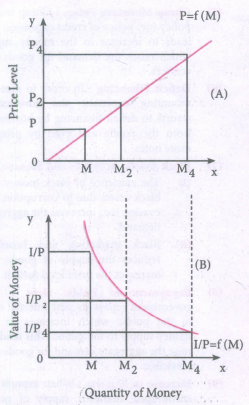
(i) It show's the effect of changes in the quantity of money on the price level.
(ii) When quantity of money is OM1, the price level is OP1.
(iii) When the quantity of money is doubled to OM2, the price level is also doubled to OP2.
(iv) When quantity of money is increased four-fold to OM4, the price level also increases by 4 times to OP4 his relationship is shown by the curve OP = f(M) from the origin at 45o.
Quantity of money
(i) Fig B shows the inverse relation between the quantity of money and the value of money.
(ii) Value of money is taken on the vertical axis.
(iii) When the quantity of money is OM1, the value of money is OI / P1.
(iv) When quantity of money is doubled to OM2, the value of money becomes one half of what it was before (OI / P2)
(v) When quantity of money increases by the four fold to OM4, the value of among is reduced by OI / P4
(vi) This inverse relationship between the quantity of money and the value of money is shown by downward sloping curve 1 / OP= f(M).

12th Standard Syllabus & Materials
12th Standard
TN 12th Computer Applications வலையமைப்பு வடமிடல் Sample Question Papers Study Material - QB365 Set A
NEW12th Standard
TN 12th Computer Applications களப்பெயர் முறைமை (DNS) Sample Question Papers Study Material - QB365 Set A
NEW12th Standard
TN 12th Computer Applications வலையமைப்பு எடுத்துக்காட்டுகள் மற்றும் நெறிமுறைகள் Sample Question Papers Study Material - QB365 Set A
NEW12th Standard
TN 12th Computer Applications கணினி வலையமைப்பு ஓர் அறிமுகம் Sample Question Papers Study Material - QB365 Set A



Tamilnadu Stateboard 12th Standard Subjects

Maths

Chemistry

Physics

Biology

Computer Science

Business Maths and Statistics
Economics

Commerce

Accountancy

History

Computer Applications
Biology
Computer Technology
Computer Applications
Computer Science
Business Maths and Statistics
Commerce
Economics
Maths
Chemistry
Physics
Computer Technology
History
Accountancy

Tamil

English

French
Tamilnadu Stateboard Standards
